欢迎访问作物学报,今天是
作物学报 ›› 2026, Vol. 52 ›› Issue (2): 539-551.doi: 10.3724/SP.J.1006.2026.55052
娄洪祥( ), 幸仁鹏(), 汪波, 王晶, 徐正华, 赵杰, 蒯婕(), 周广生
Lou Hong-Xiang(), Xing Ren-Peng(), Wang Bo, Wang Jing, Xu Zheng-Hua, Zhao Jie, Kuai Jie(), Zhou Guang-Sheng
摘要:
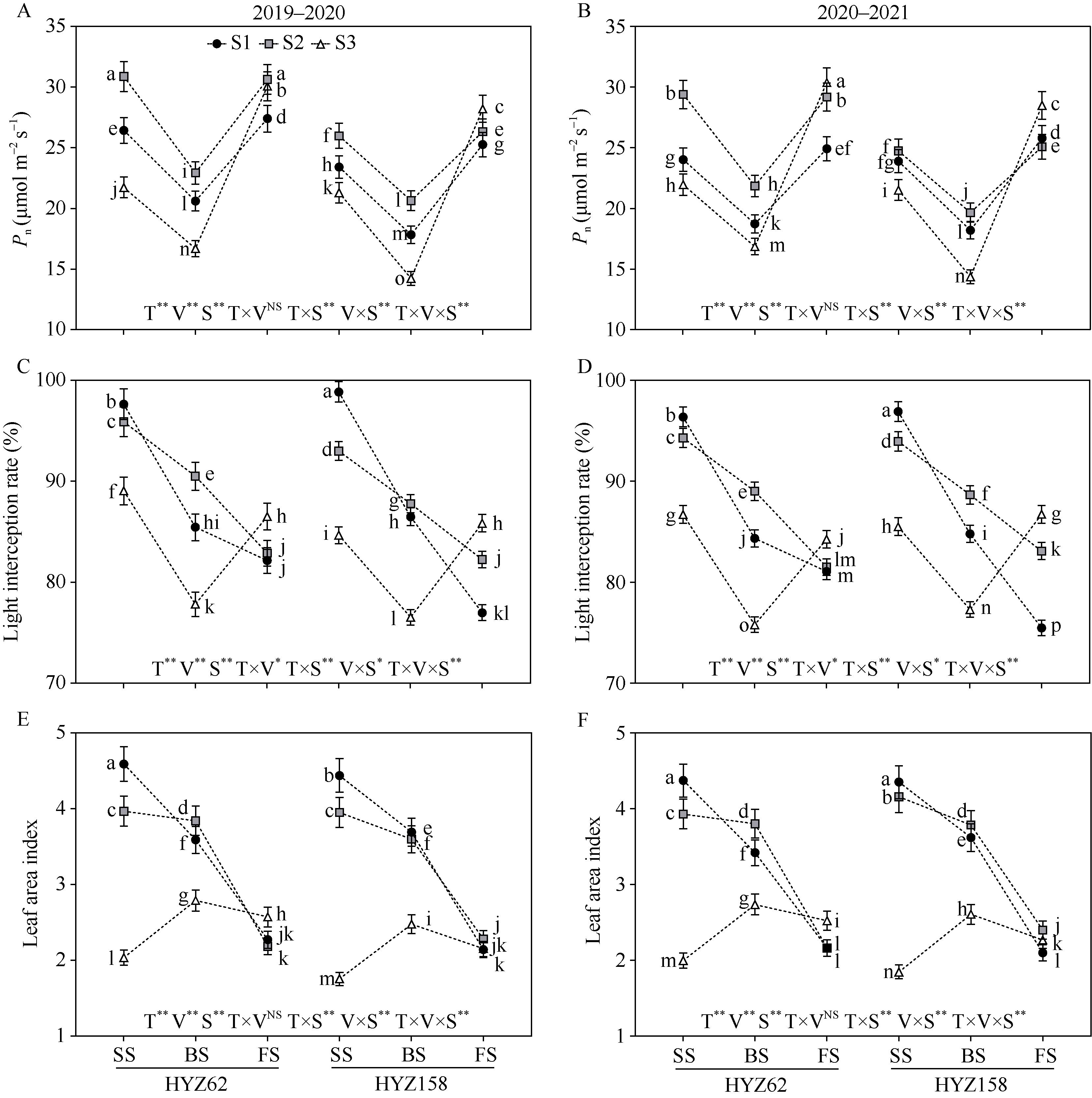
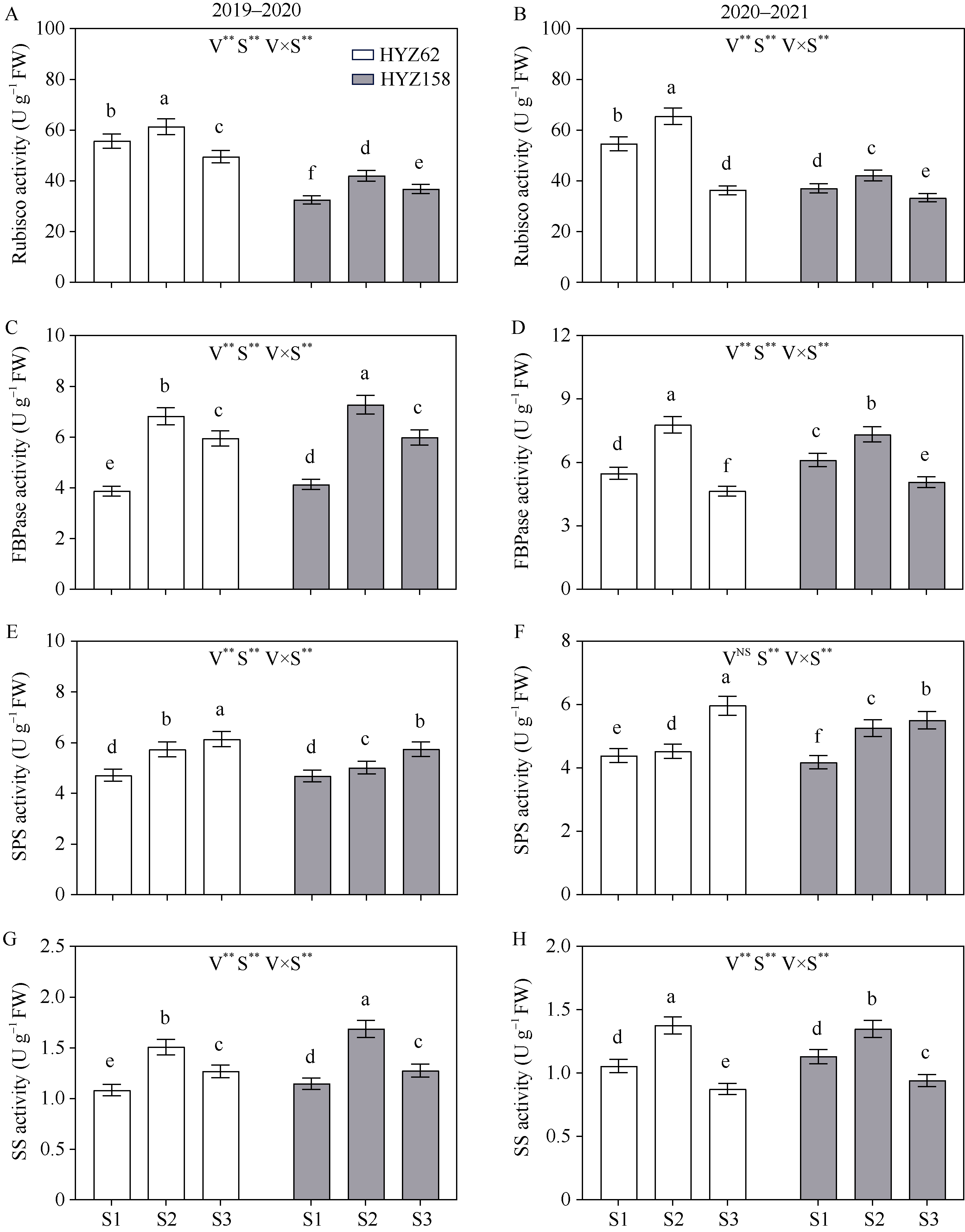
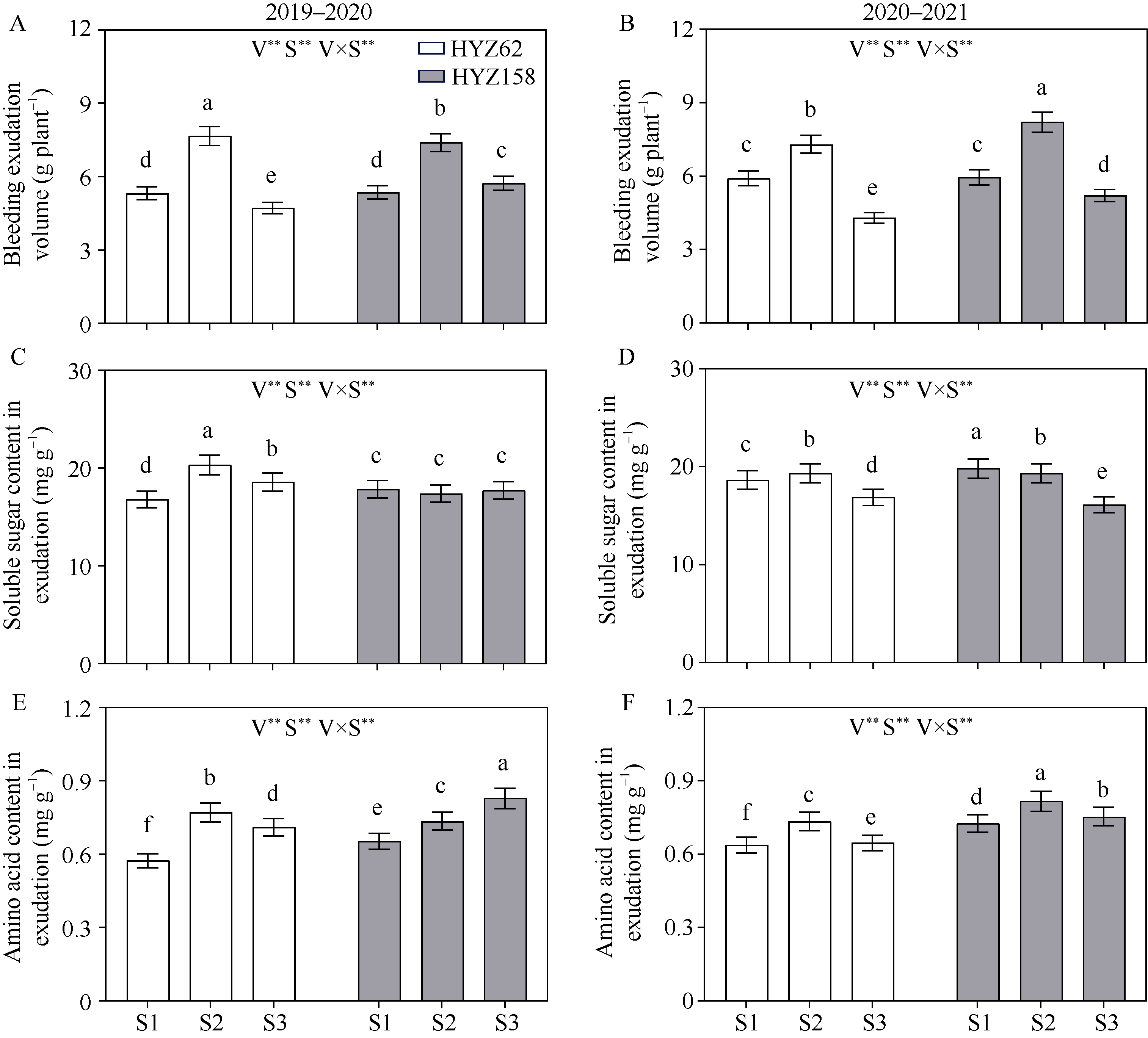
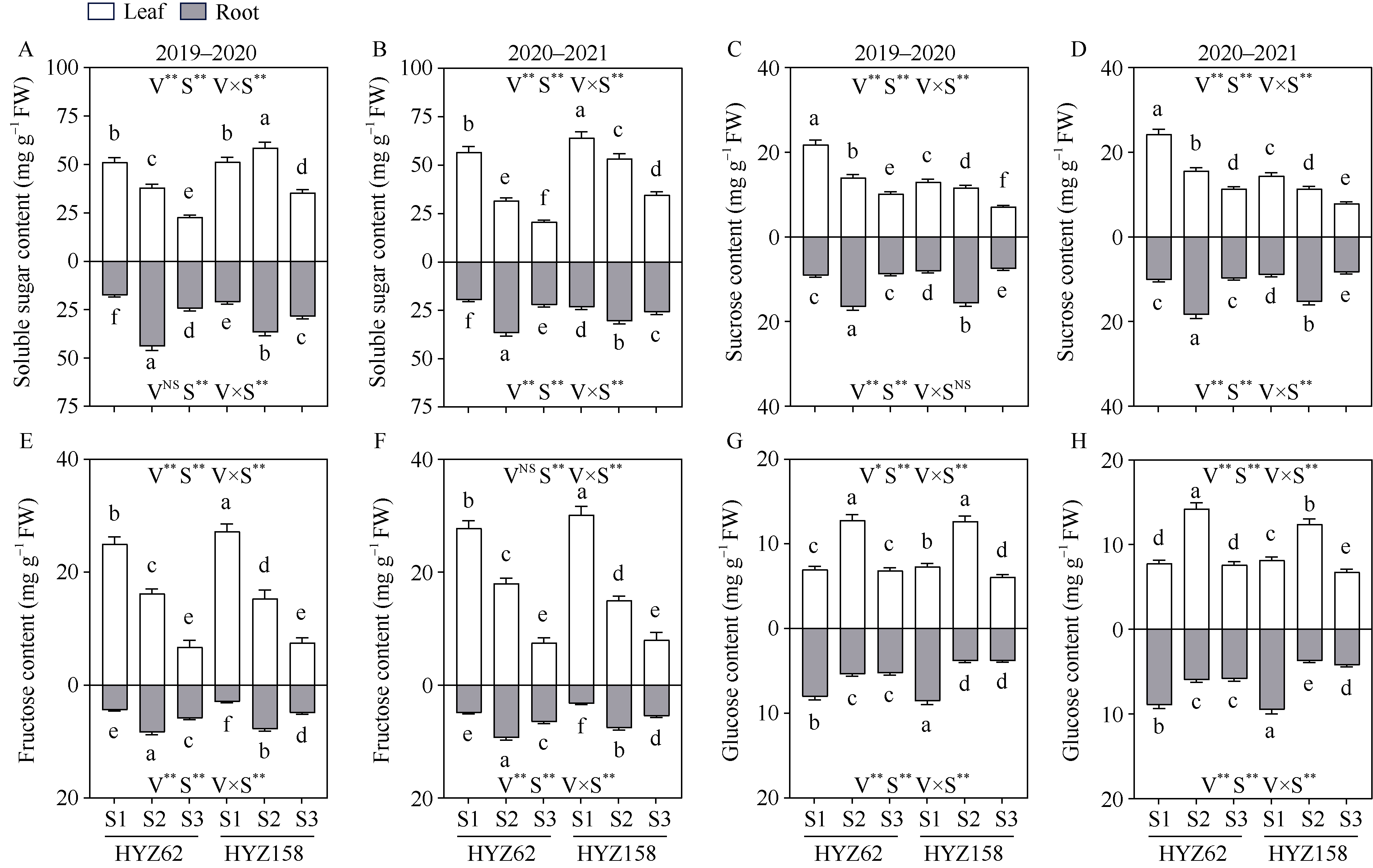
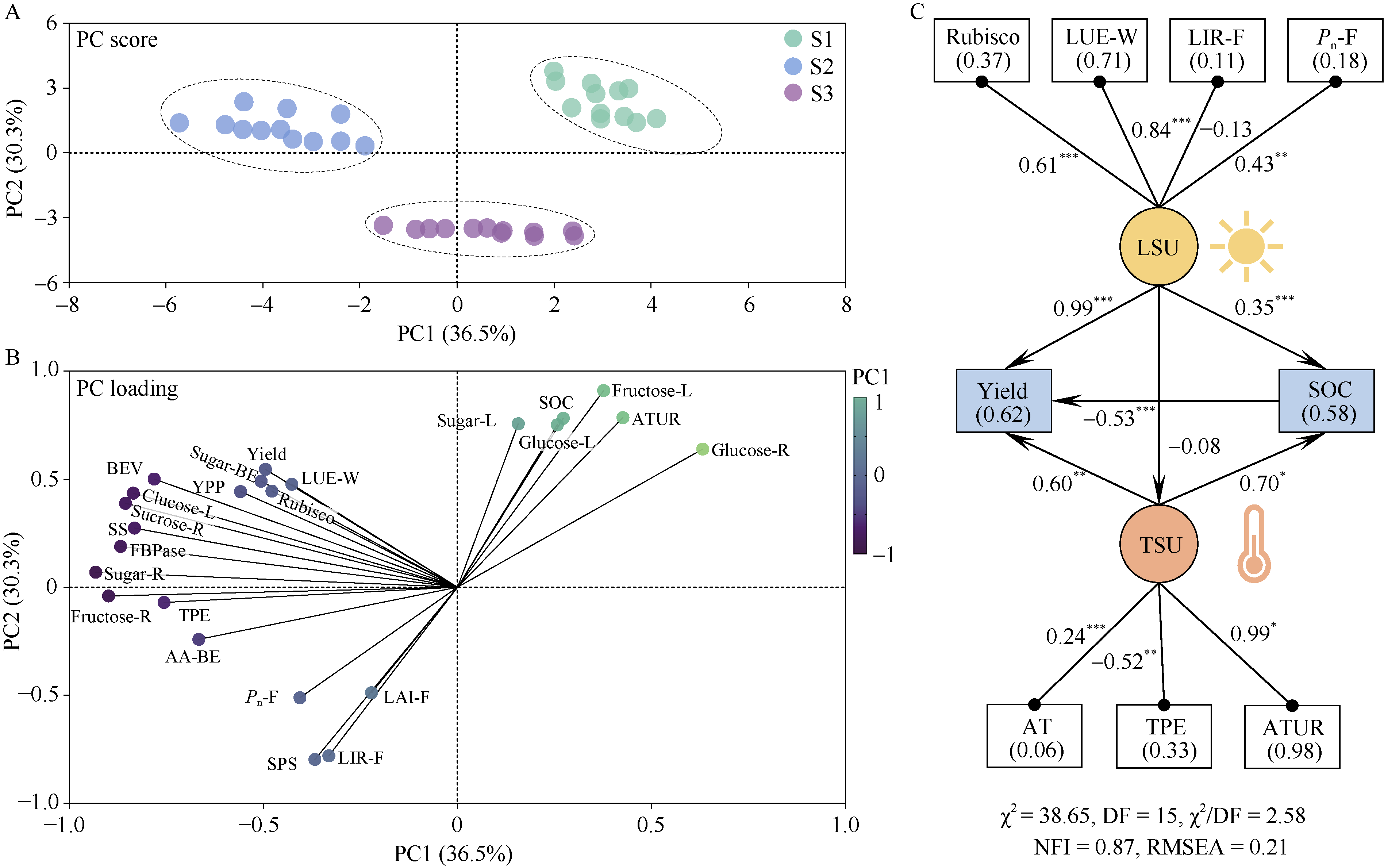
推迟冬油菜播种期可缓解长江中游地区稻油茬口矛盾, 但迟播会使产量显著降低。为解析迟播和早播减产机制并探索增产途径, 本研究以华油杂62和华油杂158为试验材料, 于2018—2021年开展3年播种期田间试验(早播S1: 9月20日; 适播S2: 10月1日; 迟播S3: 10月10日), 系统分析产量、光温资源利用效率及碳代谢生理响应。研究结果表明: (1) S2提高了光温资源利用效率并实现了产量和产油量的显著提升。(2) 与S1相比, S2的生育期缩短, 有效积温下降, 但光温资源利用率显著提高; 与S1和S3相比, S2叶片碳代谢酶(Rubisco、果糖1,6-二磷酸酶和蔗糖合成酶)活性上升, 碳代谢水平的提高促进了叶片可溶性糖积累。(3) S2的花期冠层截光率和单叶光合能力均高于S1和S3, 伤流液可溶性糖与氨基酸含量显著上升, 促进光合产物向角果高效转运。因此, 适播油菜充分利用光温资源, 提高了积温生产效率和光能利用率, 协同提高产量和品质。光温资源利用不足是迟播产量的重要限制因素, 这对迟播油菜品种选育和栽培调控具有理论和指导意义。
| [1] |
Li L F, Olsen K M. To have and to hold: selection for seed and fruit retention during crop domestication. Curr Top Dev Biol, 2016, 119: 63-109.
doi: 10.1016/bs.ctdb.2016.02.002 pmid: 27282024 |
| [2] |
Li X Y, Zuo Q S, Chang H B, et al. Higher density planting benefits mechanical harvesting of rapeseed in the Yangtze River Basin of China. Field Crops Res, 2018, 218: 97-105.
doi: 10.1016/j.fcr.2018.01.013 |
| [3] |
Zhang Y F, Wu H, Yao M Y, et al. Estimation of nitrogen runoff loss from croplands in the Yangtze River Basin: a meta-analysis. Environ Pollut, 2021, 272: 116001.
doi: 10.1016/j.envpol.2020.116001 |
| [4] |
Deng N Y, Grassini P, Yang H S, et al. Closing yield gaps for rice self-sufficiency in China. Nat Commun, 2019, 10: 1725.
doi: 10.1038/s41467-019-09447-9 pmid: 30979872 |
| [5] |
Yu X, Xu L, Yuan S, et al. Resource use efficiencies, environmental footprints and net ecosystem economic benefit of direct-seeded double-season rice in central China. J Clean Prod, 2023, 393: 136249.
doi: 10.1016/j.jclepro.2023.136249 |
| [6] | Rizzo G, Monzon J P, Tenorio F A, et al. Climate and agronomy, not genetics, underpin recent maize yield gains in favorable environments. Proc Natl Acad Sci USA, 2022, 119: e2113629119. |
| [7] | 张树杰, 张春雷. 气候变化对我国油菜生产的影响. 农业环境科学学报, 2011, 30: 1749-1754. |
| Zhang S J, Zhang C L. Influences of climate changes on oilseed rape production in China. J Agro-Environ Sci, 2011, 30: 1749-1754 (in Chinese with English abstract). | |
| [8] |
MacDuff J H, Hopper M J, Wild A. The effect of root temperature on growth and uptake of ammonium and nitrate by Brassica napus L. in flowing solution culture: I.GROWTH. J Exp Bot, 1987, 38: 42-52.
doi: 10.1093/jxb/38.1.42 |
| [9] |
Farooq M, Basra S M A, Rehman H, et al. Seed priming enhances the performance of late sown wheat (Triticum aestivum L.) by improving chilling tolerance. J Agron Crop Sci, 2008, 194: 55-60.
doi: 10.1111/jac.2008.194.issue-1 |
| [10] |
Caviglia O P, Melchiori R J M, Sadras V O. Nitrogen utilization efficiency in maize as affected by hybrid and N rate in late-sown crops. Field Crops Res, 2014, 168: 27-37.
doi: 10.1016/j.fcr.2014.08.005 |
| [11] | 李强, 陈跃华, 林萍, 等. 播期对冬油菜干物质积累及经济性状的影响. 西南农业学报, 2010, 23(1): 51-55. |
| Li Q, Chen Y H, Lin P, et al. Effects of sowing date on dry matter accumulation and economic characteristics of winter rapeseed. Southwest China J Agric Sci, 2010, 23(1): 51-55 (in Chinese with English abstract). | |
| [12] |
Siddik M A, Zhang J, Chen J, et al. Responses of indica rice yield and quality to extreme high and low temperatures during the reproductive period. Eur J Agron, 2019, 106: 30-38.
doi: 10.1016/j.eja.2019.03.004 |
| [13] | 马霓, 张春雷, 李俊, 等. 播期和密度对免耕直播油菜生长及产量的影响. 湖北农业科学, 2010, 49: 1580-1583. |
| Ma N, Zhang C L, Li J, et al. Effects of sowing date and plant density on growth and yield of direct seeding rapeseed (Brassica napus L.) under no tillage cultivation condition. Hubei Agric Sci, 2010, 49: 1580-1583 (in Chinese with English abstract). | |
| [14] | 陆志峰, 鲁剑巍, 任涛, 等. 播期对‘中双11号’油菜干物质和养分积累的影响. 中国农学通报, 2014, 30(6): 140-147. |
|
Lu Z F, Lu J W, Ren T, et al. Effects of sowing date on dry matter and nutrient accumulation of ‘Zhongshuang11’. Chin Agric Sci Bull, 2014, 30(6): 140-147 (in Chinese with English abstract).
doi: 10.11924/j.issn.1000-6850.2013-1442 |
|
| [15] |
Scott R K, Ogunremi E A, Ivins J D, et al. The effect of sowing date and season on growth and yield of oilseed rape (Brassica napus). J Agric Sci, 1973, 81: 277-285.
doi: 10.1017/S0021859600058937 |
| [16] |
Ozer H. Sowing date and nitrogen rate effects on growth, yield and yield components of two summer rapeseed cultivars. Eur J Agron, 2003, 19: 453-463.
doi: 10.1016/S1161-0301(02)00136-3 |
| [17] |
Sturm D J, Kunz C, Peteinatos G, et al. Do cover crop sowing date and fertilization affect field weed suppression? Plant Soil Environ, 2017, 63: 82-88.
doi: 10.17221/1/2017-PSE |
| [18] | 巩若琳, 宋波, 杨志叶, 等. 迟播和密度对不同油菜品种抗倒伏及产量的影响. 作物学报, 2023, 49: 2777-2792. |
|
Gong R L, Song B, Yang Z Y, et al. Effects of sowing date and density on lodging resistance and yield of different rapeseed cultivars. Acta Agron Sin, 2023, 49: 2777-2792 (in Chinese with English abstract).
doi: 10.3724/SP.J.1006.2023.24248 |
|
| [19] |
Luo T, Zhang J, Khan M N, et al. Temperature variation caused by sowing dates significantly affects floral initiation and floral bud differentiation processes in rapeseed (Brassica napus L.). Plant Sci, 2018, 271: 40-51.
doi: 10.1016/j.plantsci.2018.03.004 |
| [20] | Dogiwal G, Pannu R K, Satishkumar, et al. Effect of sowing dates on allocation of current photosynthates to different plant parts at various growth stages of wheat varieties. Ann Biol, 2005, 21: 23-27. |
| [21] |
Huang M, Fang S L, Cao F B, et al. Early sowing increases grain yield of machine-transplanted late-season rice under single-seed sowing. Field Crops Res, 2020, 253: 107832.
doi: 10.1016/j.fcr.2020.107832 |
| [22] |
Hafeez A, Ali S, Ma X L, et al. Potassium to nitrogen ratio favors photosynthesis in late-planted cotton at high planting density. Ind Crops Prod, 2018, 124: 369-381.
doi: 10.1016/j.indcrop.2018.08.006 |
| [23] |
Waalen W, Øvergaard S I, Åssveen M, et al. Winter survival of winter rapeseed and winter turnip rapeseed in field trials, as explained by PPLS regression. Eur J Agron, 2013, 51: 81-90.
doi: 10.1016/j.eja.2013.06.004 |
| [24] |
Kamh M, Wiesler F, Ulas A, et al. Root growth and N-uptake activity of oilseed rape (Brassica napus L.) cultivars differing in nitrogen efficiency. J Plant Nutr Soil Sci, 2005, 168: 130-137.
doi: 10.1002/jpln.v168:1 |
| [25] |
Wang G L, Ding G D, Li L, et al. Identification and characterization of improved nitrogen efficiency in interspecific hybridized new-type Brassica napus. Ann Bot, 2014, 114: 549-559.
doi: 10.1093/aob/mcu135 |
| [26] |
徐冉, 陈松, 徐春梅, 等. 施氮量对籼粳杂交稻甬优1540产量和氮肥利用效率的影响及其机制. 作物学报, 2023, 49: 1630-1642.
doi: 10.3724/SP.J.1006.2023.22040 |
|
Xu R, Chen S, Xu C M, et al. Effects of nitrogen fertilizer rates on grain yield and nitrogen use efficiency of Japonica-indica hybrid rice cultivar Yongyou 1540 and its physiological bases. Acta Agron Sin, 2023, 49: 1630-1642 (in Chinese with English abstract).
doi: 10.3724/SP.J.1006.2023.22040 |
|
| [27] | 廖桂平, 官春云. 甘蓝型冬油菜(Brassica napus)干物质积累、分配与转移的特性研究. 作物学报, 2002, 28: 52-58. |
| Liao G P, Guan C Y. Study on characteristics of dry matter accumulation, distribution and transfer of winter rapeseed (Brassica napus). Acta Agron Sin, 2002, 28: 52-58 (in Chinese with English abstract). | |
| [28] |
Schubert S, Mengel K. Effect of light intensity on proton extrusion by roots of intact maize plants. Physiol Plant, 1986, 67: 614-619.
doi: 10.1111/ppl.1986.67.issue-4 |
| [29] |
Tang M, Cheng W X, Zeng H, et al. Light intensity controls rhizosphere respiration rate and rhizosphere priming effect of soybean and sunflower. Rhizosphere, 2019, 9: 97-105.
doi: 10.1016/j.rhisph.2018.12.002 |
| [30] |
娄洪祥, 黄肖玉, 江萌, 等. 长江流域迟播甘蓝型油菜播种期和播种量优化配置研究. 作物学报, 2024, 50: 2091-2105.
doi: 10.3724/SP.J.1006.2024.34166 |
|
Lou H X, Huang X Y, Jiang M, et al. Optimal allocation of sowing date and sowing rate of late-sowing rapeseed in the Yangtze River Basin. Acta Agron Sin, 2024, 50: 2091-2105 (in Chinese with English abstract).
doi: 10.3724/SP.J.1006.2024.34166 |
|
| [31] |
谌洁, 吕腾飞, 王志强, 等. 青菜/油菜茬口下水稻栽植方式对温光资源利用和产量的影响. 应用生态学报, 2022, 33: 405-414.
doi: 10.13287/j.1001-9332.202201.024 |
| Shen J, Lyu T F, Wang Z Q, et al. Effects of planting methods on the utilization of temperature and sunshine resources and yield of rice under cabbage/rape-paddy cropping system. Chin J Appl Ecol, 2022, 33: 405-414 (in Chinese with English abstract). | |
| [32] |
Lou H X, Zhao B W, Peng Y, et al. Auxin plays a key role in nitrogen and plant density-modulated root growth and yield in different plant types of rapeseed. Field Crops Res, 2023, 302: 109066.
doi: 10.1016/j.fcr.2023.109066 |
| [33] |
聂晓玉, 李真, 王天尧, 等. 种植密度对角果期弱光胁迫油菜籽粒油脂积累的影响. 作物学报, 2024, 50: 493-505.
doi: 10.3724/SP.J.1006.2024.24273 |
|
Nie X Y, Li Z, Wang T Y, et al. Effect of planting density and weak light stress at pod-filling stage on seed oil accumulation in rapeseed. Acta Agron Sin, 2024, 50: 493-505 (in Chinese with English abstract).
doi: 10.3724/SP.J.1006.2024.24273 |
|
| [34] | Chaudhary A, Sewhag M, Hooda V S, et al. Effect of different dates of sowing on yield attributes, yield and quality of Barley (Hordeum vulgare L.) cultivars. J Appl Nat Sci, 2017, 9: 129-132. |
| [35] |
Mendham N J, Shipway P A, Scott R K. The effects of delayed sowing and weather on growth, development and yield of winter oil-seed rape (Brassica napus). J Agric Sci, 1981, 96: 389-416.
doi: 10.1017/S002185960006617X |
| [36] |
Al Hoda Asghari B, Heravan E M, Alizadeh B, et al. Oil content, seed yield and morphological changes of canola cultivars in response to different sowing dates. Crop Res, 2018, 53: 38.
doi: 10.5958/2454-1761.2018.00006.2 |
| [37] |
张亚杰, 李京, 彭红坤, 等. 油菜生育期动态模拟模型的构建. 作物学报, 2015, 41: 766-777.
doi: 10.3724/SP.J.1006.2015.00766 |
|
Zhang Y J, Li J, Peng H K, et al. Dynamic simulation model for growth duration of rapeseed (Brassica napus). Acta Agron Sin, 2015, 41: 766-777 (in Chinese with English abstract).
doi: 10.3724/SP.J.1006.2015.00766 |
|
| [38] |
Gao J, Zhao B, Dong S T, et al. Response of summer maize photosynthate accumulation and distribution to shading stress assessed by using 13CO2 stable isotope tracer in the field. Front Plant Sci, 2017, 8: 1821.
doi: 10.3389/fpls.2017.01821 |
| [39] |
Sharwood R E, Sonawane B V, Ghannoum O. Photosynthetic flexibility in maize exposed to salinity and shade. J Exp Bot, 2014, 65: 3715-3724.
doi: 10.1093/jxb/eru130 pmid: 24692650 |
| [40] | 张吉旺, 董树亭, 王空军, 等. 大田遮荫对夏玉米光合特性的影响. 作物学报, 2007, 33: 216-222. |
| Zhang J W, Dong S T, Wang K J, et al. Effects of shading in field on photosynthetic characteristics in summer corn. Acta Agron Sin, 2007, 33: 216-222 (in Chinese with English abstract). | |
| [41] |
Hiyane R, Hiyane S, Tang A C, et al. Sucrose feeding reverses shade-induced kernel losses in maize. Ann Bot, 2010, 106: 395-403.
doi: 10.1093/aob/mcq132 |
| [42] |
Hu J, Ren B Z, Dong S T, et al. Poor development of spike differentiation triggered by lower photosynthesis and carbon partitioning reduces summer maize yield after waterlogging. Crop J, 2022, 10: 478-489.
doi: 10.1016/j.cj.2021.08.001 |
| [43] |
张吉旺, 董树亭, 王空军, 等. 大田遮阴对夏玉米淀粉合成关键酶活性的影响. 作物学报, 2008, 34: 1470-1474.
doi: 10.3724/SP.J.1006.2008.01470 |
|
Zhang J W, Dong S T, Wang K J, et al. Effects of shading in field on key enzymes involved in starch synthesis of summer maize. Acta Agron Sin, 2008, 34: 1470-1474 (in Chinese with English abstract).
doi: 10.3724/SP.J.1006.2008.01470 |
|
| [44] |
Souza R P, Machado E C, Silva J A B, et al. Photosynthetic gas exchange, chlorophyll fluorescence and some associated metabolic changes in cowpea (Vigna unguiculata) during water stress and recovery. Environ Exp Bot, 2004, 51: 45-56.
doi: 10.1016/S0098-8472(03)00059-5 |
| [45] |
Stitt M, Zeeman S C. Starch turnover: pathways, regulation and role in growth. Curr Opin Plant Biol, 2012, 15: 282-292.
doi: 10.1016/j.pbi.2012.03.016 pmid: 22541711 |
| [46] |
Peng B, Liu X W, Dong X J, et al. Root morphological traits of winter wheat under contrasting environments. J Agron Crop Sci, 2019, 205: 571-585.
doi: 10.1111/jac.12360 |
| [47] |
Wu W, Duncan R W, Ma B L. Quantification of canola root morphological traits under heat and drought stresses with electrical measurements. Plant Soil, 2017, 415: 229-244.
doi: 10.1007/s11104-016-3155-z |
| [48] |
李小勇, 顾炽明, 刘康, 等. 施氮量对迟播油菜氮素利用和产量品质的影响. 中国农业科学, 2021, 54: 3726-3736.
doi: 10.3864/j.issn.0578-1752.2021.17.014 |
|
Li X Y, Gu C M, Liu K, et al. Effects of nitrogen application rate on nitrogen use efficiency, yield and quality of late sowing rapeseed. Sci Agric Sin, 2021, 54: 3726-3736 (in Chinese with English abstract).
doi: 10.3864/j.issn.0578-1752.2021.17.014 |
| [1] | 胡川, 赵凯男, 黄修利, 吴金芝, 任开明, 王贺正, 付国占, 黄明, 李友军. 一次灌溉下耕作方式和氮肥用量对旱地小麦产量和品质的影响[J]. 作物学报, 2026, 52(6): 1830-1846. |
| [2] | 马胜乾, 王志平, 陈浩天, 窦淑贤, 张燕, 邓艾兴, 张卫建, 原向阳, 宋振伟. 秸秆还田下耕作方式与氮肥施用量对东北玉米产量及土壤团聚体的影响[J]. 作物学报, 2026, 52(6): 1802-1816. |
| [3] | 赵佳雪, 周龙昊, 郭岂源, 尚伦霄, 王涵, 刘志涛, 陈曦, 张晓佩, 宋宪亮, 毛丽丽. 长期秸秆还田与深松通过改善土壤环境与棉花光合特性提高滨海盐碱地棉花产量[J]. 作物学报, 2026, 52(5): 1548-1560. |
| [4] | 张思思, 赵向辉, 周洋, 姚云凤, 朱荣昱, 董元杰, 胡国庆, 徐通, 刘兆新. 冬闲期翻耕和绿肥还田对连作花生田土壤理化性质和产量的影响[J]. 作物学报, 2026, 52(5): 1472-1486. |
| [5] | 任依涵, 赵曼利, 代晶, 李银水, 顾炽明, 杨璐, 杜雪竹, 胡文诗, 秦璐. 油菜叶片功能氮动态变化对光合速率及光合氮利用效率的影响[J]. 作物学报, 2026, 52(5): 1459-1471. |
| [6] | 张宁宁, 滕雨菲, 任娜娜, 魏兴卓, 闫书豪, 樊可心, 王永宏, 陈文康, 张兴华, 朱万超, 徐淑兔, 薛吉全. 201份玉米自交系抗旱表型评价及可塑性分析[J]. 作物学报, 2026, 52(5): 1309-1325. |
| [7] | 张振, 冯连杰, 石玉, 于振文, 张永丽. 节水补灌下不同穗型小麦产量形成差异研究[J]. 作物学报, 2026, 52(5): 1522-1535. |
| [8] | 闫安, 蒋昆炜, 王蓉圆, 田林, 张璐, 王韵, 徐建龙. 水稻剑叶小维管束数基因SVN7的鉴定与克隆[J]. 作物学报, 2026, 52(5): 1364-1372. |
| [9] | 刘昕萌, 任昊, 张继波, 张吉旺, 赵斌, 任佰朝, 刘鹏, 王洪章. 茉莉酸甲酯(MeJA)缓解高温影响玉米雌穗分化的生理机制[J]. 作物学报, 2026, 52(5): 1561-1572. |
| [10] | 王壮壮, 武紫君, 张永新, 张芯源, 袁丽雪, 陈如雪, 刘世举, 段剑钊, 冯伟, 王同朝, 王永华. 豫东南黏壤潮土区水氮优化协同提高冬小麦产量和氮素利用效率[J]. 作物学报, 2026, 52(5): 1501-1521. |
| [11] | 张鸿蓉, 王菲儿, 李盼, 仇海龙, 朱静, 赵连豪, 南运有, 何蔚, 樊志龙, 胡发龙, 柴强, 殷文. 减量20%灌水与25%有机肥替代化肥提高青贮玉米产量的光合特性[J]. 作物学报, 2026, 52(5): 1487-1500. |
| [12] | 王宇诚, 张露, 刘阿康, 黄见良, 彭少兵, 袁珅. 基于产量差的作物大面积单产提升策略与展望[J]. 作物学报, 2026, 52(5): 1279-1290. |
| [13] | 郭星宇, 胡丹, 林苏期, 王梦凯, 谭文峰, 黄传琴. 生物炭配施化肥提高玉米‖大豆下玉米产量和土壤生态系统多功能性[J]. 作物学报, 2026, 52(5): 1536-1547. |
| [14] | 蔡宏玮, 于爱忠, 姜科强, 王鹏飞, 王玉珑, 霍建喆, 庞小能, 尹波, 尚永盼. 干旱灌区有机肥替代部分化肥促进甜玉米产量提升的关键机制[J]. 作物学报, 2026, 52(4): 1166-1180. |
| [15] | 崔雪梅, 柳妍娣, 刘景辉, 米俊珍, 武俊英, 赵宝平. 不同基因型燕麦强弱势粒生理特性与产量关系研究[J]. 作物学报, 2026, 52(4): 1220-1235. |
|
||