欢迎访问作物学报,今天是
作物学报 ›› 2019, Vol. 45 ›› Issue (8): 1137-1145.doi: 10.3724/SP.J.1006.2019.84159
• 作物遗传育种·种质资源·分子遗传学 • 下一篇
王艳花1,2,谢玲1,2,杨博1,2,曹艳茹1,2,李加纳1,2,*( )
)
WANG Yan-Hua1,2,XIE Ling1,2,YANG Bo1,2,CAO Yan-Ru1,2,LI Jia-Na1,2,*()
摘要:
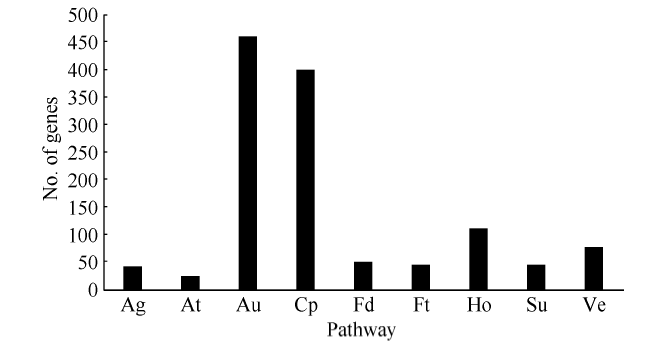
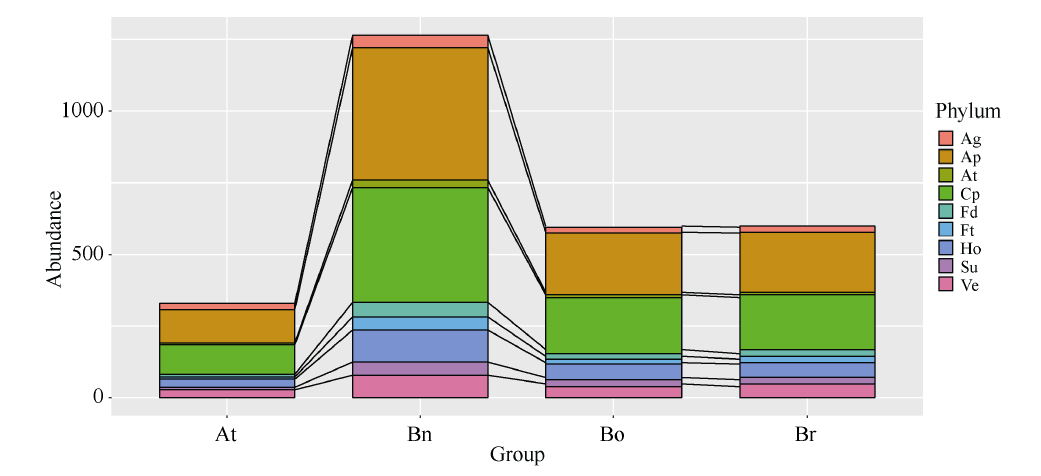
开花是开花植物繁衍后代的前提, 控制开花时间对农作物获得高产稳产具有重要影响。然而, 关于甘蓝型油菜基因组水平上开花相关基因的信息报道较少。本研究对甘蓝型油菜开花相关的基因进行了鉴定、特征分析、进化与表达模式分析。结果表明, 基因组水平上共鉴定到甘蓝型油菜1173个开花相关基因, 这些基因分为9类, 且不均匀地分布在染色体上; 与白菜(AA, 2n=20)和甘蓝(CC, 2n=18)相比, 甘蓝型油菜(AACC, 2n=38)经过自然杂交和染色体加倍后, 使开花相关基因的数目显著扩增; 选择压力分析表明, 糖代谢信号途径的基因比自发途径的开花相关基因受到的选择压力更大; 仍有一些开花相关基因在拟南芥和油菜基因组内非常保守。甘蓝型油菜基因数目的扩增和功能分化导致其开花调控机制更加复杂, 本研究为油菜开花途径提供更多的信息, 也为阐明拟南芥和油菜开花基因的进化关系指明了方向。
| [1] |
Srikanth A, Schmid M . Regulation of flowering time: all roads lead to Rome. Cell Mol Life Sci, 2011,68:2013-2037.
doi: 10.1007/s00018-011-0673-y |
| [2] |
Koornneef M, Alonso B C, Peeters A J M, Soppe W . Genetic control of flowering time in Arabidopsis. Annu Rev Plant Physiol Plant Mol Biol, 1998,49:345-370.
doi: 10.1146/annurev.arplant.49.1.345 |
| [3] | Bouche F, Lobet G, Tocquin P, Perilleux C . FLOR-ID: an interactive database of flowering-time gene networks in Arabidopsis thaliana. Nucl Acids Res, 2016,44:1167-1171. |
| [4] |
Blumel M, Dally N, Jung C . Flowering time regulation in crops-what did we learn from Arabidopsis?. Curr Opin Biotechnol, 2015,32:121-129.
doi: 10.1016/j.copbio.2014.11.023 |
| [5] |
Fornara F, de Montaigu A, Coupland G . SnapShot: control of flowering in Arabidopsis. Cell, 2010,141:550-550.
doi: 10.1016/j.cell.2010.04.024 |
| [6] | Peng F Y, Hu Z, Yang R C . Genome-wide comparative analysis of flowering-related genes in Arabidopsis, wheat, and barley. Int J Plant Genomics, 2015,15:1-17. |
| [7] |
Raman H, Raman R, Coombes N, Song J, Prangnell R, Bandaranayake C, Tahira R, Sundaramoorthi V, Killian A, Meng J, Dennis E S, Balasubramanian S . Genome-wide association analyses reveal complex genetic architecture underlying natural variation for flowering time in canola. Plant Cell Environ, 2016,39:1228-1239.
doi: 10.1111/pce.12644 |
| [8] | Xu L, Hu K, Zhang Z, Guan C, Chen S, Hua W, Li J, Wen J, Yi B, Shen J, Ma C, Tu J, Fu T . Genome-wide association study reveals the genetic architecture of flowering time in rapeseed (Brassica napus L.). DNA Res, 2016,23:43-52. |
| [9] | Wang J, Qiu Y, Cheng F, Chen X, Zhang X, Wang H, Song J, Duan M, Yang H, Li X . Genome-wide identification, characterization, and evolutionary analysis of flowering genes in radish (Raphanus sativus L.). BMC Genomics, 2017,18:981, doi: 10.1186/s12864-017-4377-z. |
| [10] |
Yang Z . PAML 4: phylogenetic analysis by maximum likelihood. Mol Biol Evol, 2007,24:1586-1591.
doi: 10.1093/molbev/msm088 |
| [11] | Liang Y, Wan N, Cheng Z, Mo Y, Liu B, Liu H, Raboanatahiry N, Yin Y, Li M . Whole-genome identification and expression pattern of the vicinal oxygen chelate family in rapeseed (Brassica napus L.). Front Plant Sci, 2017,8:745, doi: 10.3389/fpls.2017.00745. |
| [12] |
Trapnell C, Roberts A, Goff L, Pertea G, Kim D, Kelley D R, Pimentel H, Salzberg S L, Rinn J L, Pachter L . Differential gene and transcript expression analysis of RNA-seq experiments with TopHat and Cufflinks. Nat Protoc, 2012,7:562-578.
doi: 10.1038/nprot.2012.016 |
| [13] |
Kim D, Pertea G, Trapnell C, Pimentel H, Kelley R, Salzberg S L . TopHat2: accurate alignment of transcriptomes in the presence of insertions, deletions and gene fusions. Genome Biol, 2013,14:R36.
doi: 10.1186/gb-2013-14-4-r36 |
| [14] |
Song Y H, Ito S, Imaizumi T . Flowering time regulation: photoperiod- and temperature-sensing in leaves. Trends Plant Sci, 2013,18:575-583.
doi: 10.1016/j.tplants.2013.05.003 |
| [15] |
Wenkel S, Turck F, Singer K, Gissot L, Le Gourrierec J, Samach A, Coupland G . CONSTANS and the CCAAT box binding complex share a functionally important domain and interact to regulate flowering of Arabidopsis. Plant Cell, 2006,18:2971-2984.
doi: 10.1105/tpc.106.043299 |
| [16] |
Dong M A, Farre E M, Thomashow M F . Circadian clock-associated 1 and late elongated hypocotyl regulate expression of the C-repeat binding factor (CBF) pathway in Arabidopsis. Proc Natl Acad Sci USA, 2011,108:7241-7246.
doi: 10.1073/pnas.1103741108 |
| [17] | Sawa M, Kay S A . GIGANTEA directly activates flowering locus T in Arabidopsis thaliana. Proc Natl Acad Sci USA, 2011,108:11698-11703. |
| [18] |
Nagel D H, Doherty C J, Pruneda P J L, Schmitz R J, Ecker J R, Kay S A . Genome-wide identification of CCA1 targets uncovers an expanded clock network in Arabidopsis. Proc Natl Acad Sci USA, 2015,112:4802-4810.
doi: 10.1073/pnas.1513609112 |
| [19] |
Baudry A, Ito S, Song Y H, Strait A A, Kiba T, Lu S, Henriques R, Pruneda P J L, Chua N H, Tobin E M, Kay S A, Imaizumi T . F-box proteins FKF1 and LKP2 act in concert with ZEITLUPE to control Arabidopsis clock progression. Plant Cell, 2010,22:606-622.
doi: 10.1105/tpc.109.072843 |
| [20] | Lou P, Wu J, Cheng F, Cressman L G, Wang X , McClung C R. Preferential retention of circadian clock genes during diploidization following whole genome triplication in Brassica rapa. Plant Cell, 2012,24:2415-2426. |
| [21] |
Johanson U, West J, Lister C, Michaels S, Amasino R, Dean C . Molecular analysis of FRIGIDA, a major determinant of natural variation in Arabidopsis flowering time. Science, 2000,290:344-347.
doi: 10.1126/science.290.5490.344 |
| [22] |
Noh B, Lee S H, Kim H J, Yi G, Shin E A, Lee M, Jung K J, Doyle M R, Amasino R M, Noh Y S . Divergent roles of a pair of homologous jumonji/zinc-finger-class transcription factor proteins in the regulation of Arabidopsis flowering time. Plant Cell, 2004,16:2601-2613.
doi: 10.1105/tpc.104.025353 |
| [23] |
Simpson G G . The autonomous pathway: epigenetic and post- transcriptional gene regulation in the control of Arabidopsis flowering time. Curr Opin Plant Biol, 2004,7:570-574.
doi: 10.1016/j.pbi.2004.07.002 |
| [24] |
Parcy F . Flowering: a time for integration. Int J Dev Biol, 2005,49:585-593.
doi: 10.1387/ijdb.041930fp |
| [25] |
Kim S, Soltis P S, Wall K, Soltis D E . Phylogeny and domain evolution in the APETALA2-like gene family. Mol Biol Evol, 2006,23:107-120.
doi: 10.1093/molbev/msj014 |
| [26] |
Mitchum M G, Yamaguchi S, Hanada A, Kuwahara A, Yoshioka Y, Kato T, Tabata S, Kamiya Y, Sun T P . Distinct and overlapping roles of two gibberellin 3-oxidases in Arabidopsis development. Plant J, 2006,45:804-818.
doi: 10.1111/tpj.2006.45.issue-5 |
| [27] |
Ariizumi T, Murase K, Sun T P, Steber C M . Proteolysis- independent downregulation of DELLA repression in Arabidopsis by the gibberellin receptor GIBBERELLIN INSENSITIVE DWARF1. Plant Cell, 2008,20:2447-2459.
doi: 10.1105/tpc.108.058487 |
| [28] |
Achard P, Vriezen W H, Van D S D, Harberd N P . Ethylene regulates arabidopsis development via the modulation of DELLA protein growth repressor function. Plant Cell, 2003,15:2816-2825.
doi: 10.1105/tpc.015685 |
| [29] |
Samach A, Wigge P A . Ambient temperature perception in plants. Curr Opin Plant Biol, 2005,8:483-486.
doi: 10.1016/j.pbi.2005.07.011 |
| [30] |
Thines B C, Youn Y, Duarte M I, Harmon F G . The time of day effects of warm temperature on flowering time involve PIF4 and PIF5. J Exp Bot, 2014,65:1141-1151.
doi: 10.1093/jxb/ert487 |
| [31] |
Lee J H, Yoo S J, Park S H, Hwang I, Lee J S, Ahn J H . Role of SVP in the control of flowering time by ambient temperature in Arabidopsis. Genes Dev, 2007,21:397-402.
doi: 10.1101/gad.1518407 |
| [32] |
Yan Y, Shen L, Chen Y, Bao S, Thong Z, Yu H . A MYB-domain protein EFM mediates flowering responses to environmental cues in Arabidopsis. Dev Cell, 2014,30:437-448.
doi: 10.1016/j.devcel.2014.07.004 |
| [33] |
Paul M J, Primavesi L F, Jhurreea D, Zhang Y . Trehalose metabolism and signaling. Annu Rev Plant Biol, 2008,59:417-441.
doi: 10.1146/annurev.arplant.59.032607.092945 |
| [34] | Dalchau N, Baek S J, Briggs H M, Robertson F C, Dodd A N, Gardner M J, Stancombe M A, Haydon M J, Stan G B, Goncalves J M, Webb A A . The circadian oscillator gene GIGANTEA mediates a long-term response of the Arabidopsis thaliana circadian clock to sucrose. Proc Natl Acad Sci USA, 2011,108:5104-5109. |
| [35] | Wahl V, Ponnu J, Schlereth A, Arrivault S, Langenecker T, Franke A, Feil R, Lunn J E, Stitt M, Schmid M . Regulation of flowering by trehalose-6-phosphate signaling in Arabidopsis thaliana. Science, 2013,339:704-707. |
| [36] |
Seo P J, Ryu J, Kang S K, Park C M . Modulation of sugar metabolism by an INDETERMINATE DOMAIN transcription factor contributes to photoperiodic flowering in Arabidopsis. Plant J, 2011,65:418-429.
doi: 10.1111/tpj.2011.65.issue-3 |
| [37] |
Jung J H, Seo Y H, Seo P J, Reyes J L, Yun J, Chua N H, Park C M . The GIGANTEA-regulated microRNA172 mediates photoperiodic flowering independent of CONSTANS in Arabidopsis. Plant Cell, 2007,19:2736-2748.
doi: 10.1105/tpc.107.054528 |
| [38] |
Mathieu J, Yant L J, Murdter F, Kuttner F, Schmid M . Repression of flowering by the miR172 target SMZ. PLoS Biol, 2009,7:e1000148.
doi: 10.1371/journal.pbio.1000148 |
| [39] |
Wang J W, Czech B , Weigel D. miR156-regulated SPL transcription factors define an endogenous flowering pathway in Arabidopsis thaliana. Cell, 2009,138:738-749.
doi: 10.1016/j.cell.2009.06.014 |
| [40] |
Matsoukas I G, Massiah A J, Thomas B . Starch metabolism and antiflorigenic signals modulate the juvenile-to-adult phase transition in Arabidopsis. Plant Cell Environ, 2013,36:1802-1811.
doi: 10.1111/pce.2013.36.issue-10 |
| [41] | Wang X, Wang H, Wang J, Sun R, Wu J, Liu S, Bai Y, Mun J H, Bancroft I, Cheng F, Huang S, Li X, Hua W, Wang J, Wang X, Freeling M, Pires J C, Paterson A H, Chalhoub B, Wang B, Hayward A, Sharpe A G, Park B S, Weisshaar B, Liu B, Li B, Liu B, Tong C, Song C, Duran C, Peng C, Geng C, Koh C, Lin C, Edwards D, Mu D, Shen D, Soumpourou E, Li F, Fraser F, Conant G, Lassalle G, King G J, Bonnema G, Tang H, Wang H, Belcram H, Zhou H, Hirakawa H, Abe H, Guo H, Wang H, Jin H, Parkin I A, Batley J, Kim J S, Just J, Li J, Xu J, Deng J, Kim J A, Li J, Yu J, Meng J, Wang J, Min J, Poulain J, Wang J, Hatakeyama K, Wu K, Wang L, Fang L, Trick M, Links M G, Zhao M, Jin M, Ramchiary N, Drou N, Berkman P J, Cai Q, Huang Q, Li R, Tabata S, Cheng S, Zhang S, Zhang S, Huang S, Sato S, Sun S, Kwon S J, Choi S R, Lee T H, Fan W, Zhao X, Tan X, Xu X, Wang Y, Qiu Y, Yin Y, Li Y, Du Y, Liao Y, Lim Y, Narusaka Y, Wang Y, Wang Z, Li Z, Wang Z, Xiong Z, Zhang Z , Brassica rapa Genome Sequencing Project C. The genome of the mesopolyploid crop species Brassica rapa. Nat Genet, 2011,43:1035-1039. |
| [42] | Chalhoub B, Denoeud F, Liu S, Parkin I A, Tang H, Wang X, Chiquet J, Belcram H, Tong C, Samans B, Correa M, Da S C, Just J, Falentin C, Koh C S, Le C I, Bernard M, Bento P, Noel B, Labadie K, Alberti A, Charles M, Arnaud D, Guo H, Daviaud C, Alamery S, Jabbari K, Zhao M, Edger P P, Chelaifa H, Tack D, Lassalle G, Mestiri I, Schnel N, Le P M C, Fan G, Renault V, Bayer P E, Golicz A A, Manoli S, Lee T H, Thi V H, Chalabi S, Hu Q, Fan C, Tollenaere R, Lu Y, Battail C, Shen J, Sidebottom C H, Wang X, Canaguier A, Chauveau A, Berard A, Deniot G, Guan M, Liu Z, Sun F, Lim Y P, Lyons E, Town C D, Bancroft I, Wang X, Meng J, Ma J, Pires J C, King G J, Brunel D, Delourme R, Renard M, Aury J M, Adams K L, Batley J, Snowdon R J, Tost J, Edwards D, Zhou Y, Hua W, Sharpe A G, Paterson A H, Guan C, Wincker P . Early allopolyploid evolution in the post-Neolithic Brassica napus oilseed genome. Science, 2014,345:950-953. |
| [43] | Liu S, Liu Y, Yang X, Tong C, Edwards D, Parkin I A, Zhao M, Ma J, Yu J, Huang S, Wang X, Wang J, Lu K, Fang Z, Bancroft I, Yang T J, Hu Q, Wang X, Yue Z, Li H, Yang L, Wu J, Zhou Q, Wang W, King G J, Pires J C, Lu C, Wu Z, Sampath P, Wang Z, Guo H, Pan S, Yang L, Min J, Zhang D, Jin D, Li W, Belcram H, Tu J, Guan M, Qi C, Du D, Li J, Jiang L, Batley J, Sharpe A G, Park B S, Ruperao P, Cheng F, Waminal N E, Huang Y, Dong C, Wang L, Li J, Hu Z, Zhuang M, Huang Y, Huang J, Shi J, Mei D, Liu J, Lee T H, Wang J, Jin H, Li Z, Li X, Zhang J, Xiao L, Zhou Y, Liu Z, Liu X, Qin R, Tang X, Liu W, Wang Y, Zhang Y, Lee J, Kim H H, Denoeud F, Xu X, Liang X, Hua W, Wang X, Wang J, Chalhoub B, Paterson A H . The Brassica oleracea genome reveals the asymmetrical evolution of polyploid genomes. Nat Commun, 2014,5:3930, doi: 10.1038/ncomms4930. |
| [44] |
Fujiwara S, Oda A, Yoshida R, Niinuma K, Miyata K, Tomozoe Y, Tajima T, Nakagawa M, Hayashi K, Coupland G, Mizoguchi T . Circadian clock proteins LHY and CCA1 regulate SVP protein accumulation to control flowering in Arabidopsis. Plant Cell, 2008,20:2960-2971.
doi: 10.1105/tpc.108.061531 |
| [45] | Ding Z, Millar A J, Davis A M, Davis S J . TIME FOR COFFEE encodes a nuclear regulator in the Arabidopsis thaliana circadian clock. Plant Cell, 2007,19:1522-1536. |
| [46] |
Tao Z, Shen L, Liu C, Liu L, Yan Y, Yu H . Genome-wide identification of SOC1 and SVP targets during the floral transition in Arabidopsis. Plant J, 2012,70:549-561.
doi: 10.1111/tpj.2012.70.issue-4 |
| [47] |
Wigge P A, Kim M C, Jaeger K E, Busch W, Schmid M, Lohmann J U, Weigel D . Integration of spatial and temporal information during floral induction in Arabidopsis. Science, 2005,309:1056-1059.
doi: 10.1126/science.1114358 |
| [48] |
Lee H, Suh S S, Park E, Cho E, Ahn J H, Kim S G, Lee J S, Kwon Y M, Lee I . The AGAMOUS-LIKE 20 MADS domain protein integrates floral inductive pathways in Arabidopsis. Genes Dev, 2000,14:2366-2376.
doi: 10.1101/gad.813600 |
| [49] |
Liu C, Xi W, Shen L, Tan C, Yu H . Regulation of floral patterning by flowering time genes. Dev Cell, 2009,16:711-722.
doi: 10.1016/j.devcel.2009.03.011 |
| [1] | 左同鸿, 张贺翠, 曾静, 朱利泉. 甘蓝自交不亲和相关基因BoPUB3L的克隆与表达分析[J]. 作物学报, 2026, 52(6): 1698-1710. |
| [2] | 胡赵, 钱润, 谢丰璞, 应素平. 水稻SPX基因家族鉴定及响应磷处理的表达分析[J]. 作物学报, 2026, 52(6): 1902-1912. |
| [3] | 田立涛, 丁宁, 王树林, 齐恩芳, 张荣, 王蕊蕊, 马利雯, 李建武, 杨江伟. 马铃薯Argonaute基因家族鉴定及晚疫病诱导表达分析[J]. 作物学报, 2026, 52(4): 1116-1126. |
| [4] | 杨宗桃, 杨婷, 王禹童, 艾静, 李燕烨, 刘家勇, 邓军, 赵勇, 张跃彬. 甘蔗CLC基因家族鉴定与表达分析[J]. 作物学报, 2026, 52(3): 722-734. |
| [5] | 孟成, 王哲. 玉米ZmPFK基因家族全基因组鉴定及响应胁迫表达分析[J]. 作物学报, 2026, 52(3): 764-779. |
| [6] | 马毅娜, 吴晓明玉, 李藕琪, 王圆, 陈丽, 张盈川, 赵伦, 文静, 傅廷栋, 沈金雄. Bna-miR1040-EIF3A模块调控油菜开花时间的功能研究[J]. 作物学报, 2026, 52(2): 349-362. |
| [7] | 张力岚, 杨军, 王让剑. 基于WGCNA发掘茶树糖苷类香气前体含量性状相关的候选基因[J]. 作物学报, 2026, 52(2): 494-513. |
| [8] | 景秀清, 蔡永朵, 邓宁, 赵晓东, 翟飞红, 曾群. 藜麦RopGEF家族基因的鉴定及表达模式分析[J]. 作物学报, 2026, 52(1): 28-43. |
| [9] | 王彬, 蒙姜宇, 邱浩良, 贺亚军, 钱伟. 甘蓝型油菜BnaDUF579基因家族的鉴定与表达模式分析[J]. 作物学报, 2025, 51(8): 2100-2110. |
| [10] | 郭腾达, 崔梦杰, 陈琳杰, 韩锁义, 郭敬坤, 吴晨迪, 付留洋, 黄冰艳, 董文召, 张新友. 花生磷脂酰肌醇转运蛋白基因AhSFH的克隆及其响应黄曲霉菌侵染的表达特征分析[J]. 作物学报, 2025, 51(6): 1489-1500. |
| [11] | 夏琦, 郭滢, 王坤美, 王思忆, 巨建业, 彭雅雯, 刘忠松, 夏石头. 甘蓝型油菜种子和种皮中水杨酸含量与原花色素积累的关系研究[J]. 作物学报, 2025, 51(5): 1189-1197. |
| [12] | 周恩强, 缪亚梅, 周瑶, 姚梦楠, 赵娜, 王永强, 朱宇翔, 薛冬, 李宗迪, 石宇欣, 李波, 汪凯华, 顾春燕, 王学军, 魏利斌. 基于种子发育转录组的豌豆bZIP基因家族分析及种子发育候选基因的鉴定[J]. 作物学报, 2025, 51(4): 914-931. |
| [13] | 潘炬忠, 韦萍, 朱德平, 邵胜雪, 陈珊珊, 韦雅倩, 高维维. 水稻转录因子OsERF104的克隆和功能研究[J]. 作物学报, 2025, 51(4): 900-913. |
| [14] | 王晓琳, 刘忠松, 康雷, 杨柳. 甘蓝型油菜角果长度和每角粒数基因定位以及角果皮转录组动态分析[J]. 作物学报, 2025, 51(4): 888-899. |
| [15] | 张琴, 戴成, 马朝芝. 生长素响应报告基因转化甘蓝型油菜及各组织GUS动态信号分析[J]. 作物学报, 2025, 51(3): 667-675. |
|
||