Welcome to Acta Agronomica Sinica,

Acta Agronomica Sinica ›› 2026, Vol. 52 ›› Issue (10): 3037-3053.doi: 10.3724/SP.J.1006.2026.63016

• TILLAGE & CULTIVATION·PHYSIOLOGY & BIOCHEMISTRY • Previous Articles     Next Articles

Responses of root-shoot coordination and grain-filling characteristics to increased planting density in maize cultivars with varying density tolerance

Li Si-Yuan1(), Li Si-Jia1, Zhang Sen-Yan1, Qiao Po1, Cui Xin-Fei1, Yang Meng-Tao1, Wang Yi-Bo4, Zeng Bo2, Liu Gui-Zhen3, Li Hong-Ping1,*(), Liu Tian-Xue1, Tang Ji-Hua1,*()   

  1. 1 College of Agronomy, Henan Agricultural University / Key Laboratory of Crop Growth and Development Regulation, Ministry of Education, Zhengzhou 450046, Henan, China
    2 National Agro-Tech Extension and Service Center, Beijing 100125, China
    3 Henan Provincial Seed Industry Development Center, Zhengzhou 450046, Henan, China
    4 Beijing Lantron Seed Co., Ltd., Beijing 100081, China
  • Received:2026-01-30 Accepted:2026-07-15 Online:2026-10-12 Published:2026-07-23
  • Contact: Li Hong-Ping, E-mail: hongpingli2019@163.com; Tang Ji-Hua, E-mail: tangjihua@henau.edu.cn
  • Supported by:
    Henan Province Key Research and Development Special Project(241111114300);2025 Henan Province Science and Technology Research Project(252102111076)

Abstract:

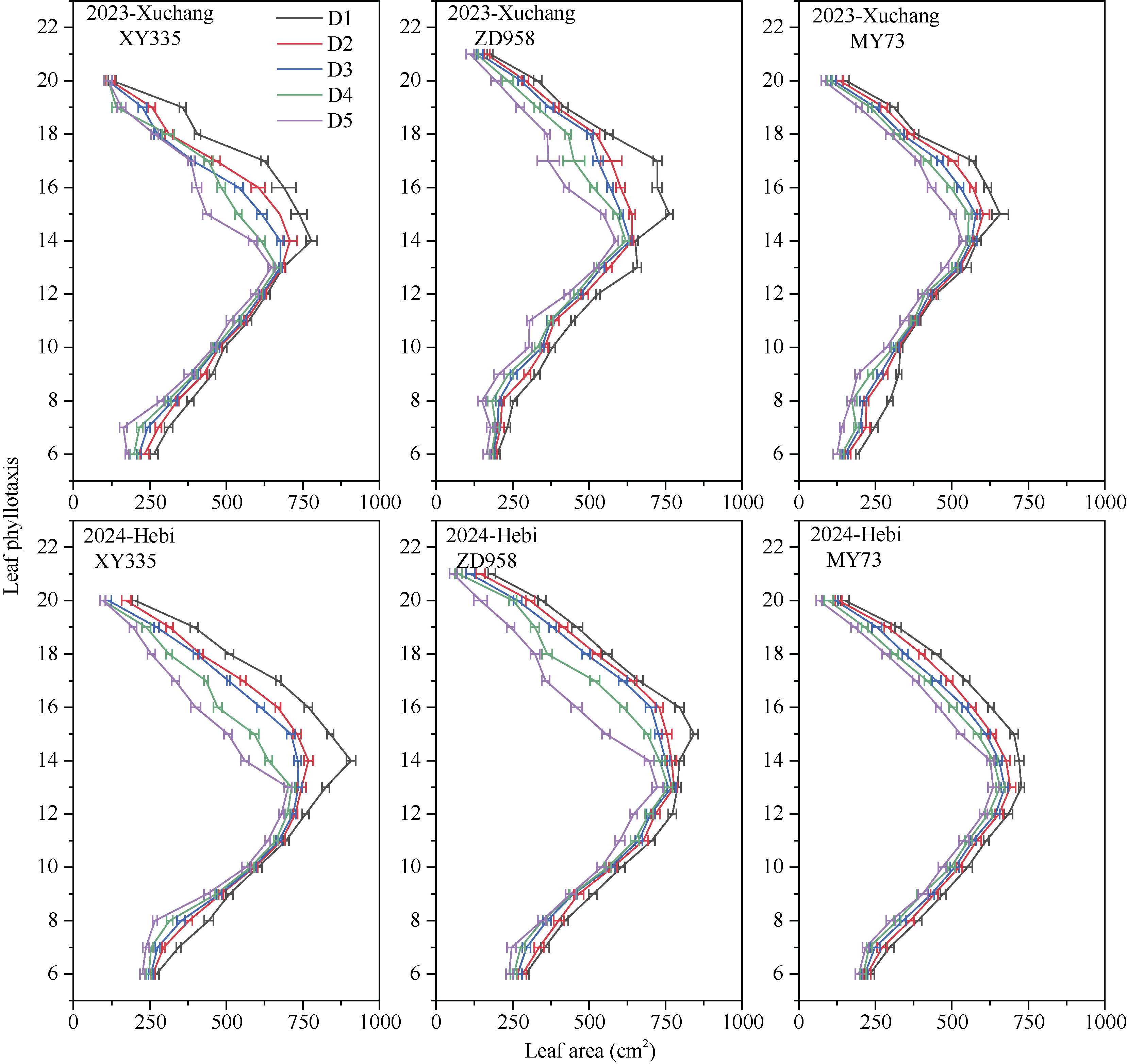
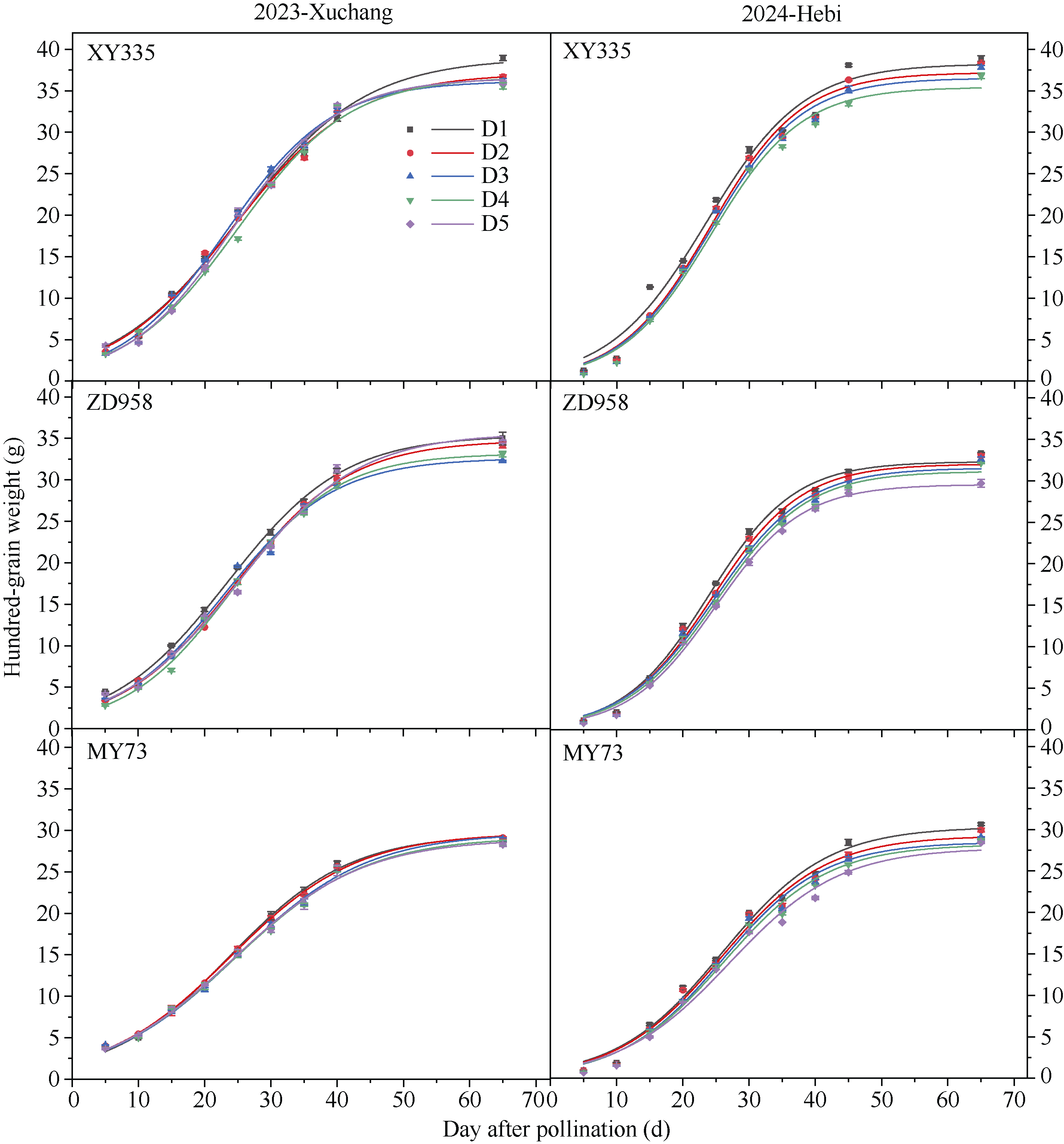
This study investigated the responses of root and leaf architecture, canopy light utilization, and grain-filling characteristics to increased planting density in maize cultivars with varying density tolerance. A two-factor field experiment was conducted during the 2023 and 2024 maize growing seasons using three maize cultivars differing in density tolerance: Xianyu 335 (XY335), Zhengdan 958 (ZD958), and MY73. Five planting density treatments were established: 60,000 (D1), 75,000 (D2), 90,000 (D3), 105,000 (D4), and 120,000 plants hm-2 (D5). Traits related to root-leaf architecture, canopy light distribution, leaf photosynthetic parameters, leaf area, photosynthetically active radiation use efficiency, and grain filling were measured. The results showed that XY335, ZD958, and MY73 achieved high yields at D1-D2, D2-D3, and D3-D4, respectively, with their optimum density ranges centered around D1, D2, and D3. Across all density treatments in the two-year experiment, the density-tolerant cultivar MY73 had significantly greater root angle, root projected area, root number, root-shoot ratio, leaf orientation value, light transmittance in each canopy layer, and net photosynthetic rate under high density than ZD958 and XY335, whereas its leaf area and dry matter radiation use efficiency were significantly lower. At low densities, XY335 had significantly higher yield and grain radiation use efficiency than ZD958 and MY73, whereas under high-density conditions, MY73 significantly outperformed XY335 and ZD958. With increasing density, root biomass, root-shoot ratio, root architecture, leaf angle, light transmittance in each canopy layer, and leaf area at different leaf positions decreased significantly across cultivars, while leaf orientation value and dry matter radiation use efficiency increased significantly. Potential grain weight and the maximum grain-filling rate showed decreasing trends, whereas the time to reach the maximum grain-filling rate and the active grain-filling period increased. Cultivars with different density tolerance exhibited different magnitudes of trait variation in response to increased density. Among the three cultivars, the density-tolerant MY73 showed the smallest reductions in root projected area and root weight, with two-year mean reductions that were 3.9% and 16.1% lower than those of ZD958 and 4.4% and 0.6% lower than those of XY335, respectively. MY73 also showed a smaller reduction in leaf angle in the ear-leaf layer and a greater increase in leaf orientation value; the mean reduction in leaf angle was 3.0%-47.9% lower than that of ZD958, while the mean increase in leaf orientation value was 14.0%-357.5% greater. MY73 exhibited the smallest reduction in light transmittance in each canopy layer; its two-year mean reduction was 37.0% and 46.9% lower than that of ZD958 and XY335, respectively, at the midpoint between the canopy top and ear position, and 32.4% and 49.6% lower at the ear position. The leaf area in the upper canopy was the most sensitive to increased density across cultivars, and the two-year mean reduction in MY73 was 22.1% and 32.3% lower than that in ZD958 and XY335, respectively. In conclusion, the density-tolerant cultivar MY73 showed less deterioration in root traits, stronger regulation of leaf orientation, more favorable canopy light transmittance, higher leaf net photosynthetic rate under high density, and a smaller reduction in individual plant leaf area as density increased. It also maintained a shorter time to reach the maximum grain-filling rate, a longer active grain-filling period, and higher grain radiation use efficiency under high-density conditions. These characteristics may represent the population quality regulation mechanism underlying the high yield of MY73 under dense planting.

Key words: maize cultivar, density tolerance, planting density, root and leaf architecture, canopy light utilization, grain filling characteristics

Table 1

Variation in root architecture, biomass, and root-shoot ratio of maize cultivars differing in density tolerance under different planting density treatments"

年地组合
Year-site combination
品种
Cultivar
种植
密度
Density
根开角
Root opening angle (°)
根系投影面积
Root projected area (cm2)
最大根系宽度
Maximal width (cm)
总结构投影长度Total projected structure length (cm) 根条数
Number of root
根干重
Root dry weight (g)
根冠比Root-shoot ratio (%)
2023-
Xuchang
XY335 D1 114.5±1.0 aA 111.0±3.1 aA 15.1±0.2 aA 2022.8±71.4 aA 62.0±1.7 aB 20.3±0.1 aA 5.4±0.1 aB
D2 96.5±1.9 bA 81.3±7.6 bB 14.0±0.6 bA 1682.8±62.3 bA 53.0±1.0 bB 15.0±0.8 bA 4.1±0.2 bB
D3 84.2±1.9 cB 74.7±6.0 bB 11.8±0.6 cA 1417.4±71.0 cA 49.3±0.6 cB 10.4±0.4 cA 3.1±0.1 cB
D4 66.1±1.3 dB 63.8±4.1 cB 10.6±0.5 dA 1181.4±9.6 dA 48.0±2.0 cA 8.8±0.4 dA 3.1±0.1 cB
D5 56.5±1.9 eB 48.6±2.9 dB 9.5±0.5 eA 950.7±55.8 eA 44.3±0.6 dA 5.4±0.3 eB 2.1±0.0 dB
ZD958 D1 70.0±2.5 aB 84.1±4.1 aC 11.3±0.3 aB 1699.9±69.2 aB 55.7±0.6 aC 15.9±0.3 aC 5.6±0.1 aB
D2 68.9±0.9 aB 69.7±0.9 bC 10.9±0.4 aB 1375.1±32.2 bB 42.7±0.6 bC 10.5±0.4 bB 4.0±0.1 bB
D3 64.4±1.0 bC 63.6±4.1 cC 9.4±0.7 bB 1138.2±27.7 cB 40.7±0.6 cC 7.4±0.2 cC 2.9±0.1 cC
D4 60.4±2.3 cC 48.5±1.2 dC 8.7±0.2 bB 1009.1±49.0 dB 39.3±0.6 dB 6.4±0.5 dC 2.6±0.1 dC
D5 54.8±2.5 dB 45.9±2.1 dB 7.8±0.5 cB 845.9±50.5 eB 36.7±0.6 eB 4.9±0.4 eB 2.1±0.2 eB
MY73 D1 115.0±2.3 aA 104.9±0.9 aB 15.3±0.3 aA 2019.5±20.2 aA 66.0±1.7 aA 19.0±0.9 aB 7.2±0.3 aA
D2 96.5±1.9 bA 94.7±1.4 bA 13.6±0.1 bA 1815.1±93.9 bA 56.7±2.5 bA 15.0±0.6 bA 6.2±0.1 bA
D3 88.3±2.3 cA 87.7±2.4 cA 12.4±0.5 cA 1457.2±33.4 cA 53.0±0.0 cA 9.5±0.6 cB 4.1±0.1 cA
D4 83.6±0.3 dA 72.3±1.7 dA 11.2±0.3 dA 1257.4±45.7 dA 49.7±0.6 dA 7.3±0.5 dB 3.7±0.0 dA
D5 77.2±1.2 eA 63.6±1.6 eA 10.3±0.9 dA 1026.6±37.7 eA 45.3±3.1 eA 6.6±0.3 eA 3.3±0.1 eA
2024-
Hebi
XY335 D1 104.8±3.3 aB 129.9±1.6 aB 15.8±0.6 aA 2218.8±95.6 aB 61.0±0.9 aB 22.3±1.4 aA 5.8±0.3 aB
D2 100.4±2.7 bA 103.5±3.4 bB 14.2±0.8 bA 1829.6±35.3 bA 49.3±0.4 cB 15.0±0.9 bA 4.5±0.1 bB
D3 90.4±1.4 cA 92.7±3.0 cA 13.5±0.6 bA 1598.5±77.0 cA 48.3±0.2 dB 11.4±0.2 cA 3.5±0.0 cB
D4 78.9±1.7 dB 74.0±5.5 dB 12.0±0.7 cA 1233.2±104.3 dA 53.3±0.4 bA 9.9±1.5 dA 3.2±0.1 dB
D5 67.0±1.9 eB 60.2±1.5 eB 10.8±0.8 dA 952.7±91.2 eA 53.3±0.6 bA 5.9±0.8 eB 4.3±0.1 bA
ZD958 D1 70.0±1.8 aC 94.5±4.0 aC 10.3±0.7 aB 1793.1±88.8 aC 57.3±0.1 aC 16.3±0.2 aB 4.8±0.1 aC
D2 63.7±1.0 bB 78.3±3.5 bC 8.8±0.1 bB 1454.6±20.4 bB 41.7±1.2 bC 10.5±3.4 bB 3.9±0.1 bC
D3 54.3±1.5 cB 64.9±1.3 cC 8.8±0.7 bB 1199.2±61.0 cC 42.7±0.8 bC 7.7±0.1 bcC 3.1±0.1 cC
D4 49.1±1.2 dC 54.6±1.7 dC 8.6±0.6 bB 1076.5±65.1 dB 39.3±1.2 cC 6.8±0.5 cB 2.8±0.1 dC
D5 47.6±3.1 dC 51.1±1.3 dC 7.6±0.6 cB 769.1±9.1 eB 38.0±0.3 cB 4.8±1.0 dB 2.4±0.2 eB
MY73 D1 110.8±0.3 aA 141.8±6.5 aA 16.5±0.3 aA 2466.3±126.1 aA 77.3±0.5 aA 21.0±1.4 aA 7.6±0.1 aA
D2 99.5±1.5 bA 112.0±1.2 bA 14.5±0.1 bA 1857.3±70.7 bA 56.3±1.0 bA 15.1±0.6 bA 6.0±0.1 bA
D3 88.4±2.1 cA 86.0±2.9 cB 12.6±0.9 cA 1475.4±37.8 cB 54.7±1.0 cA 8.7±0.1 cB 4.3±0.0 cA
D4 91.3±1.9 cA 79.0±4.1 cdA 11.4±0.2 dA 1343.2±29.4 dA 44.3±0.5 dB 7.6±0.3 cdB 4.2±0.1 cA
D5 73.2±1.9 dA 65.0±2.8 dA 11.0±0.4 dA 1043.0±8.1 eA 53.3±1.0 cA 7.1±0.1 dA 4.1±0.0 dA
变异来源
Source of variation
年地组合
Year-site
combination (Y)
ns * ns ns ns ns ns
密度Density (D) *** ** *** *** *** *** **
品种Cultivar (C) ** ** * ** ** ** **
Y×D ns ns ns ns ns ns ns
Y×C ns ns ** ns ns ns ns
D×C * ns * ns *** *** **
Y×D×C *** *** ns ** *** ns ***

Fig. 1

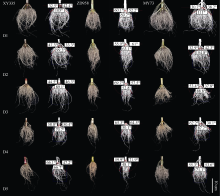
Changes in root morphology of maize cultivars differing in density tolerance under different planting density treatments Abbreviations and treatments are the same as those given in Table 1. For each cultivar, the left image shows the original root photograph, and the right image shows the scanned analytical image. The values marked on the scanned images indicate the left root angle, root opening angle, and right root angle from left to right, respectively. Scale bar = 10 cm."

Table 2

Variation in leaf angle and leaf orientation value of the ear leaf and the two leaves above it in maize cultivars differing in density tolerance under different planting density treatments"

年地组合
Year-site combination
品种
Cultivar
密度
Density
叶夹角 Leaf angle (°) 叶向值 Leaf orientation value
穗位叶
Ear-leaf
穗上1叶
1st leaf upper ear
穗上2叶
2nd leaf upper ear
穗位叶
Ear leaf
穗上1叶
1st leaf upper ear
穗上2叶
2nd leaf upper ear
2023-
Xuchang
XY335 D1 35.2±1.1 aB 28.6±0.6 aA 27.9±3.3 aA 40.1±0.9 eC 48.1±0.4 eC 56.2±0.3 bB
D2 32.7±0.4 abA 26.6±1.0 bA 24.5±0.4 abA 43.7±0.8 dB 50.2±0.6 dC 56.3±0.6 bB
D3 32.0±1.2 bA 23.8±0.3 cA 22.8±0.3 bcA 46.8±0.8 cC 52.4±0.4 cC 56.2±0.7 bC
D4 23.9±2.0 cA 20.2±1.3 dA 19.8±2.6 cA 48.7±0.6 bC 54.3±0.3 bC 56.3±0.6 bC
D5 22.7±1.9 cA 20.9±1.2 dA 19.4±1.3 cA 51.3±0.6 aC 56.3±1.3 aB 58.6±0.3 aC
ZD958 D1 38.8±1.0 aA 26.5±0.6 aB 20.3±0.5 aB 43.2±0.2 eB 50.8±1.9 cB 56.8±0.4 dA
D2 31.2±1.7 bA 19.1±1.0 bC 18.0±0.5 bB 45.5±1.2 dB 55.0±0.7 bB 57.6±0.4 cdA
D3 28.4±0.6 cB 17.6±0.6 cC 17.7±0.8 bB 49.5±0.7 cB 56.8±0.7 abB 57.8±0.5 cB
D4 25.6±0.5 dA 16.6±0.4 cB 15.6±1.2 cB 53.5±0.5 bB 56.7±0.5 abB 59.1±0.4 bB
D5 19.1±0.9 eB 14.5±1.1 dC 12.7±0.4 dC 56.7±1.1 aB 58.0±0.6 aB 60.6±0.5 aB
MY73 D1 33.6±1.0 aB 24.6±1.3 aC 21.3±1.2 aB 56.4±1.0 cA 54.8±0.7 dA 57.0±0.3 eA
D2 32.1±1.1 aA 22.5±0.7 bB 18.5±0.5 bB 57.9±1.1 cA 59.3±1.0 cA 58.7±0.8 dA
D3 26.4±0.8 bC 21.8±0.9 bB 16.8±0.5 cB 61.9±0.6 bA 60.1±1.6 cA 62.7±0.2 cA
D4 20.2±1.1 cB 19.0±0.7 cA 15.5±0.6 cdB 69.8±1.1 aA 69.1±0.7 bA 69.0±1.1 bA
D5 19.1±0.9 cB 18.5±0.7 cB 15.2±0.7 dB 70.9±0.9 aA 70.9±0.6 aA 70.6±0.7 aA
2024-
Hebi
XY335 D1 38.7±0.4 aB 28.4±0.8 aA 28.2±1.2 aA 39.0±1.9 cB 48.4±0.5 cC 59.2±1.0 aA
D2 33.3±0.2 bA 26.9±0.3 bA 25.9±1.5 bA 42.8±1.9 bB 53.4±1.0 bC 59.7±0.7 aA
D3 31.2±1.1 cA 24.3±0.3 cA 23.2±1.0 cA 44.6±2.0 bB 54.8±2.1 abB 55.5±0.3 cB
D4 24.3±1.4 dA 23.2±0.8 cA 23.1±0.4 cA 49.8±2.1 aB 55.6±0.4 aC 55.0±0.3 cC
D5 21.6±1.4 eA 21.0±0.9 dA 18.6±1.6 dA 51.5±1.4 aB 56.1±0.6 aB 57.7±0.6 bC
ZD958 D1 40.8±0.8 aA 24.0±1.1 aB 21.6±1.6 aB 37.5±2.6 dB 52.8±1.2 cB 56.7±0.6 bB
D2 32.0±0.5 bA 19.6±0.4 bC 18.8±0.4 bB 40.2±2.7 cB 55.2±1.1 bB 55.5±0.6 cC
D3 28.7±1.2 cA 18.3±0.5 bcC 17.5±1.2 bB 45.0±2.3 bB 55.1±1.9 bB 55.5±0.5 cB
D4 26.3±0.7 dA 16.9±0.6 cC 15.2±0.3 cC 48.6±3.7 aB 57.6±1.0 aB 60.2±0.5 aB
D5 19.9±2.3 eA 13.5±1.0 dB 12.4±0.2 dB 50.8±4.3 aB 57.5±0.6 aB 60.8±0.5 aB
MY73 D1 33.4±2.6 aC 26.0±1.6 aAB 21.8±1.2 aB 45.2±1.5 eA 55.1±0.4 dA 56.6±0.4 cB
D2 33.0±2.2 aA 23.6±0.4 bB 19.5±0.3 bB 50.8±1.0 dA 58.4±0.7 cA 57.5±0.9 cB
D3 24.3±2.1 bB 22.3±0.4 bcB 17.3±1.0 cB 56.4±2.1 cA 59.7±1.4 cA 63.8±0.6 bA
D4 21.1±1.6 bcB 21.1±0.4 cB 16.0±0.4 cB 62.7±0.9 bA 67.0±0.8 bA 64.6±0.4 bA
D5 19.9±2.0 cA 19.4±0.9 dA 14.1±1.0 dB 69.1±3.6 aA 70.1±1.4 aA 67.5±0.2 aA
变异来源
Source of variation
年地组合
Year-site combination (Y)
ns ns ns ns ns ns
密度Density (D) ** *** *** *** *** ***
品种Cultivar (C) ** ** ** ** * **
Y×D ns ** ns ns ns ns
Y×C ns ** ns ns * ns
D×C ** *** ** * * ***
Y×D×C *** ns ns ns ns *

Fig. 2

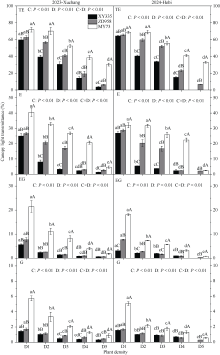
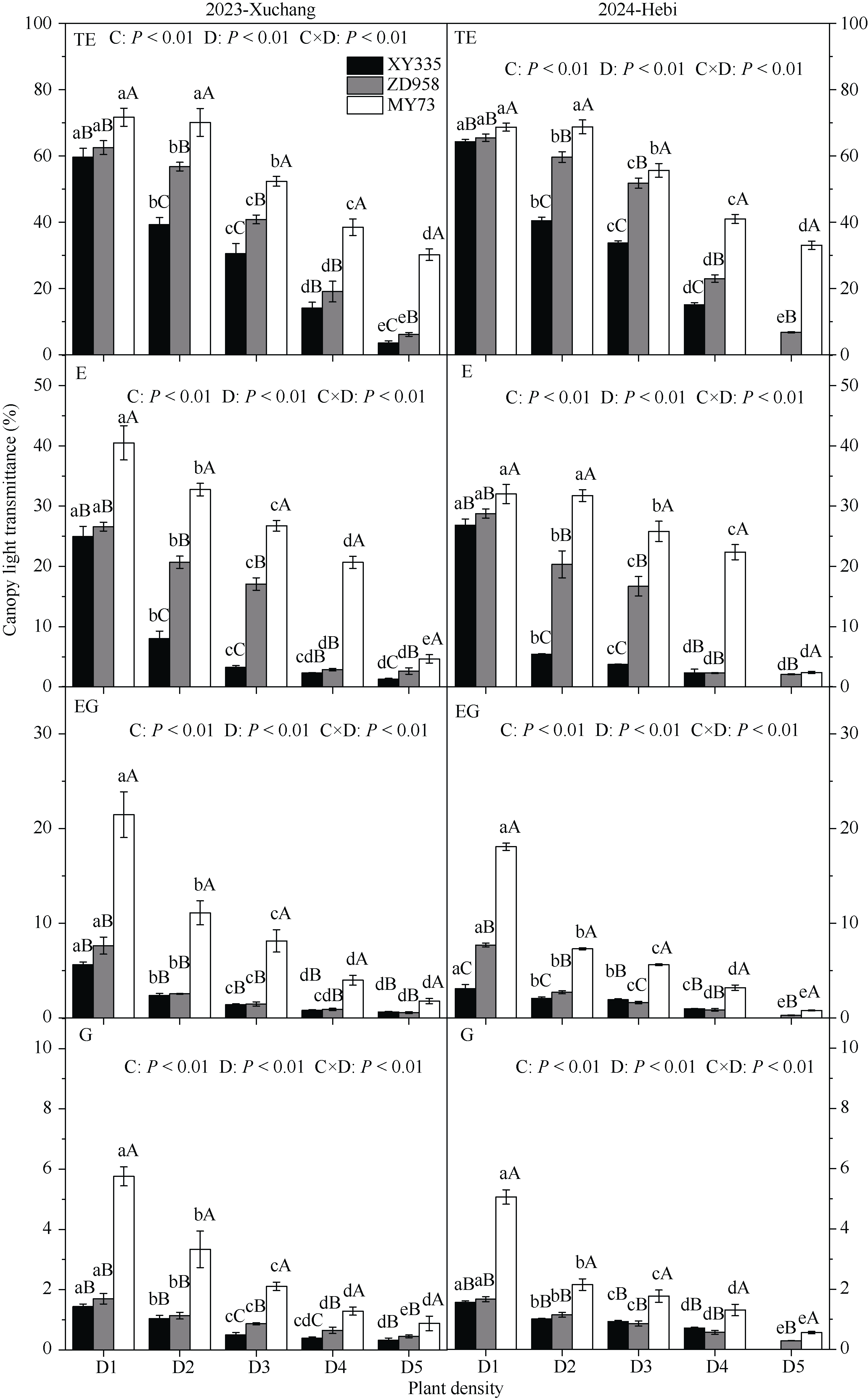
Variation in light transmittance across canopy layers of maize cultivars differing in density tolerance under different planting density treatments Abbreviations and treatments are the same as those given in Table 1. TE: midpoint between the canopy top and the ear position; E: ear position; EG: midpoint between the ear position and the ground; G: 20 cm above the ground. Different lowercase letters indicate significant differences among planting densities within the same cultivar at the 0.05 probability level. Different uppercase letters indicate significant differences among cultivars under the same planting density at the 0.05 probability level."

Table 3

Variation in photosynthetic characteristics of the ear leaf in maize cultivars differing in density tolerance under different planting density treatments"

年地组合
Year-site combination
品种
Cultivar
密度
Density
净光合速率
Pn
(μmol m-2 s-1)
气孔导度
Gs
(mol m-2 s-1)
胞间二氧化碳浓度
Ci
(μmol m-2 s-1)
蒸腾速率
Tr
(mmol m-2 s-1)
2023-Xuchang XY335 D1 32.8±0.8 aA 0.40±0.03 aA 285.2±4.5 aA 7.85±0.50 aA
D2 27.5±0.8 bC 0.32±0.02 bA 259.1±6.3 bAB 6.38±0.80 bA
D3 24.1±0.6 cB 0.24±0.00 cB 226.2±2.2 cB 4.71±0.15 cB
D4 21.8±0.8 dB 0.20±0.00 dB 203.5±4.8 dB 3.98±0.03 dAB
D5 16.3±0.5 eA 0.16±0.01 eA 171.4±3.3 eB 3.28±0.23 eAB
ZD958 D1 33.8±1.3 aA 0.41±0.02 aA 276.0±7.9 aA 7.56±0.44 aA
D2 28.3±0.9 bB 0.31±0.04 bA 241.0±6.5 bB 5.67±0.33 bB
D3 24.7±0.8 cB 0.26±0.02 cA 233.8±2.9 bA 5.07±0.21 cAB
D4 23.0±0.7 dA 0.21±0.00 dA 201.7±2.0 cB 4.07±0.08 dA
D5 15.5±0.6 eB 0.16±0.00 eA 179.5±2.4 dA 3.32±0.03 eA
MY73 D1 32.9±0.5 aA 0.42±0.03 aA 277.0±7.7 aA 8.25±0.41 aA
D2 29.1±0.3 bA 0.35±0.03 bA 265.3±13.0 aA 6.48±0.17 bA
D3 26.7±0.8 cA 0.26±0.02 cA 237.6±4.2 bA 5.39±0.26 cA
D4 23.1±0.7 dA 0.20±0.01 dB 210.6±2.1 cA 3.88±0.01 dB
D5 13.9±1.0 eC 0.14±0.00 eB 169.5±2.3 dB 3.02±0.04 eB
2024-Hebi XY335 D1 27.1±0.3 aB 0.34±0.03 aA 253.6±4.5 aA 6.75±0.50 aA
D2 24.7±0.4 bA 0.26±0.02 bB 229.1±6.3 bA 5.66±0.80 bA
D3 23.2±0.9 bcA 0.23±0.00 cA 211.4±2.2 cB 5.06±0.15 cA
D4 21.3±1.3 cA 0.21±0.00 dA 200.7±4.8 dA 4.28±0.03 dA
D5 15.8±1.3 dA 0.13±0.01 eA 159.9±3.3 eB 3.71±0.23 eA
ZD958 D1 29.7±1.7 aA 0.34±0.02 aA 234.2±7.9 aB 6.44±0.44 aA
D2 24.7±0.9 bA 0.23±0.04 bB 209.5±6.5 bB 4.91±0.33 bB
D3 22.7±0.7 bcAB 0.19±0.02 cB 207.5±2.9 bB 4.33±0.21 cB
D4 21.0±0.6 cA 0.18±0.00 cB 176.3±2.0 cB 4.16±0.08 cAB
D5 16.3±0.4 dA 0.12±0.00 dA 178.8±2.4 cA 3.13±0.03 dB
MY73 D1 28.2±0.6 aAB 0.39±0.03 aA 257.5±7.7 aA 6.77±0.41 aA
D2 25.9±0.3 bA 0.29±0.03 bA 231.6±13.0 bA 5.78±0.17 bA
D3 22.4±1.1 cB 0.23±0.02 cA 221.3±4.2 bA 4.90±0.26 cA
D4 20.1±1.0 dA 0.15±0.01 dC 181.3±2.1 cB 3.91±0.01 dB
D5 12.2±1.0 eB 0.09±0.00 eB 177.6±2.3 cA 2.71±0.04 eC
变异来源
Source of variation
年地组合
Year-site combination (Y)
ns * ** *
密度Density (D) ** *** *** ***
品种Cultivar (C) * ns * **
Y×D ns * ns *
Y×C * ns ns ns
D×C ** * * **
Y×D×C *** * ns ns

Fig. 3

Variation in leaf area at different leaf ranks of maize cultivars differing in density tolerance under different planting density treatments Abbreviations and treatments are the same as those given in Table 1."

Table 4

Variation in radiation use efficiency and yield of maize cultivars differing in density tolerance under different planting density treatments"

年地组合
Year-site
combination
品种
Cultivar
密度
Density
籽粒产量辐射利用率
Radiation utilization of grain yield (g MJ-1)
地上生物量辐射利用率
Radiation utilization of aboveground
dry matter (g MJ-1)
产量
Yield
(t hm-2)
2023年许昌
2023-Xuchang
XY335 D1 1.28±0.02 aA 2.29±0.04 dA 12,680±183 aA
D2 1.30±0.06 aA 2.73±0.06 cA 12,923±588 aA
D3 1.25±0.01 aA 3.00±0.04 bA 12,393±140 bA
D4 1.04±0.03 bB 3.01±0.02 bA 10,290±255 cC
D5 0.81±0.03 cB 3.17±0.15 aA 8012±325 dB
ZD958 D1 1.01±0.01 bB 1.73±0.04 eB 10,060±139 bB
D2 1.10±0.06 abB 2.00±0.02 dB 10,975±563 abB
D3 1.15±0.08 aB 2.35±0.06 cB 11,457±816 aB
D4 1.08±0.05 abB 2.55±0.00 bB 10,745±516 abB
D5 0.75±0.02 cB 2.79±0.08 aB 7460±173 cC
MY73 D1 0.93±0.04 cC 1.60±0.04 dC 9260±367 dC
D2 1.10±0.09 bB 1.84±0.07 cC 10,950±909 cB
D3 1.24±0.08 aA 2.11±0.02 bC 12,300±749 abA
D4 1.33±0.05 aA 2.22±0.03 bC 13,248±459 aA
D5 1.34±0.03 aA 2.41±0.15 aC 13,280±346 aA
2024年鹤壁
2024-Hebi
XY335 D1 1.16±0.04 aA 2.39±0.01 dA 11,190±391 aA
D2 1.18±0.03 aA 2.68±0.06 cA 11,370±265 aB
D3 1.02±0.04 bC 3.00±0.01 bA 9855±345 bC
D4 0.76±0.01 cC 3.24±0.01 aA 7335±64 cC
D5 0.26±0.02 dC 1.76±0.09 eC 2490±164 dC
ZD958 D1 1.05±0.01 bB 2.08±0.01 cB 10,142±54 bB
D2 1.19±0.04 aA 2.12±0.01 cB 11,476±424 aB
D3 1.19±0.05 aB 2.34±0.07 bB 11,444±485 aB
D4 1.07±0.04 bB 2.76±0.04 aB 10,307±359 bB
D5 0.84±0.10 cB 2.30±0.04 bA 8067±940 cB
MY73 D1 1.05±0.01 dB 1.71±0.10 bC 10,157±75 dB
D2 1.23±0.01 bA 1.98±0.04 aC 11,915±136 bA
D3 1.32±0.04 aA 2.10±0.04 aC 12,702±365 aA
D4 1.27±0.02 bA 1.98±0.07 aC 12,279±181 bA
D5 1.17±0.02 cA 2.07±0.08 aB 11,316±216 cA
变异来源
Source of variation
年地组合
Year-site combination (Y)
ns ns ns
密度Density (D) *** ** **
品种Cultivar (C) ** ** ***
Y×D ns ns *
Y×C ** ** ns
D×C *** *** **
Y×D×C * *** ***

Table 5

Yield potential index and density sensitivity index of maize cultivars differing in density tolerance"

品种
Cultivar
2023年许昌2023-Xuchang 2024年鹤壁2024-Hebi
丰产性指数
YPI (t hm-2)
密度敏感性指数
DSI (%)
最适密度
OSD
丰产性指数
YPI (t hm-2)
密度敏感性指数
DSI (%)
最适密度
OSD
XY335 12,923 2.99 D2 11,370 7.45 D2
ZD958 11,457 5.21 D3 11,476 5.95 D2
MY73 13,248 3.70 D4 12,702 4.76 D3

Fig. 4

Variation in grain-filling curves of maize cultivars differing in density tolerance under different planting density treatments Abbreviations and treatments are the same as those given in Table 1."

Table 6

Variation in grain-filling characteristics of maize cultivars differing in density tolerance under different planting density treatments"

年地组合Year-site combination 品种Cultivar 密度Density 决定系数
R2
潜在粒重
A
参数B
Parameter B
参数K
Parameter K
达最大灌浆速率的天数
Tmax (d)
最大灌浆速率
Gmax
(g d-1)
活跃灌浆期
Active grain filling period (d)
2023-
Xuchang
XY335 D1 0.9950 38.97 13.98 0.1051 25.10 1.02 57.09
D2 0.9945 37.11 16.05 0.1035 26.82 0.96 57.97
D3 0.9971 36.19 18.29 0.1030 28.22 0.93 58.25
D4 0.9943 36.70 19.30 0.1087 27.23 1.00 55.20
D5 0.9948 36.54 18.45 0.1074 27.14 0.98 55.87
ZD958 D1 0.9980 35.37 14.51 0.1139 23.48 1.01 52.68
D2 0.9989 34.80 16.09 0.1122 24.76 0.98 53.48
D3 0.9946 32.62 16.14 0.1105 25.17 0.90 54.30
D4 0.9980 33.19 16.47 0.1154 24.28 0.96 51.99
D5 0.9940 35.65 16.45 0.1140 24.56 1.02 52.63
MY73 D1 0.9978 29.54 11.88 0.1101 22.48 0.81 54.50
D2 0.9988 29.71 11.97 0.1069 23.22 0.79 56.13
D3 0.9972 29.72 12.43 0.1056 23.86 0.78 56.82
D4 0.9952 29.26 12.52 0.1029 24.56 0.75 58.31
D5 0.9967 28.99 13.60 0.1020 25.59 0.74 58.82
2024-Hebi XY335 D1 0.9911 38.26 24.70 0.1461 21.95 1.40 41.07
D2 0.9917 37.21 33.79 0.1459 24.13 1.36 41.12
D3 0.9926 36.55 34.01 0.1457 24.20 1.33 41.18
D4 0.9936 35.43 35.26 0.1410 25.27 1.25 42.55
ZD958 D1 0.9948 32.30 40.12 0.1546 23.88 1.25 38.81
D2 0.9941 32.03 38.89 0.1494 24.50 1.20 40.16
D3 0.9946 31.55 36.80 0.1455 24.78 1.15 41.24
D4 0.9977 31.14 39.78 0.1439 25.60 1.12 41.70
D5 0.9949 29.56 44.56 0.1426 26.63 1.05 42.08
MY73 D1 0.9900 30.32 25.99 0.1256 25.94 0.95 47.77
D2 0.9901 29.26 26.46 0.1268 25.83 0.93 47.32
D3 0.9910 28.48 29.79 0.1271 26.70 0.90 47.21
D4 0.9908 28.21 28.29 0.1273 26.26 0.90 47.13
D5 0.9903 27.80 25.89 0.1205 27.00 0.84 49.79

Fig. 5

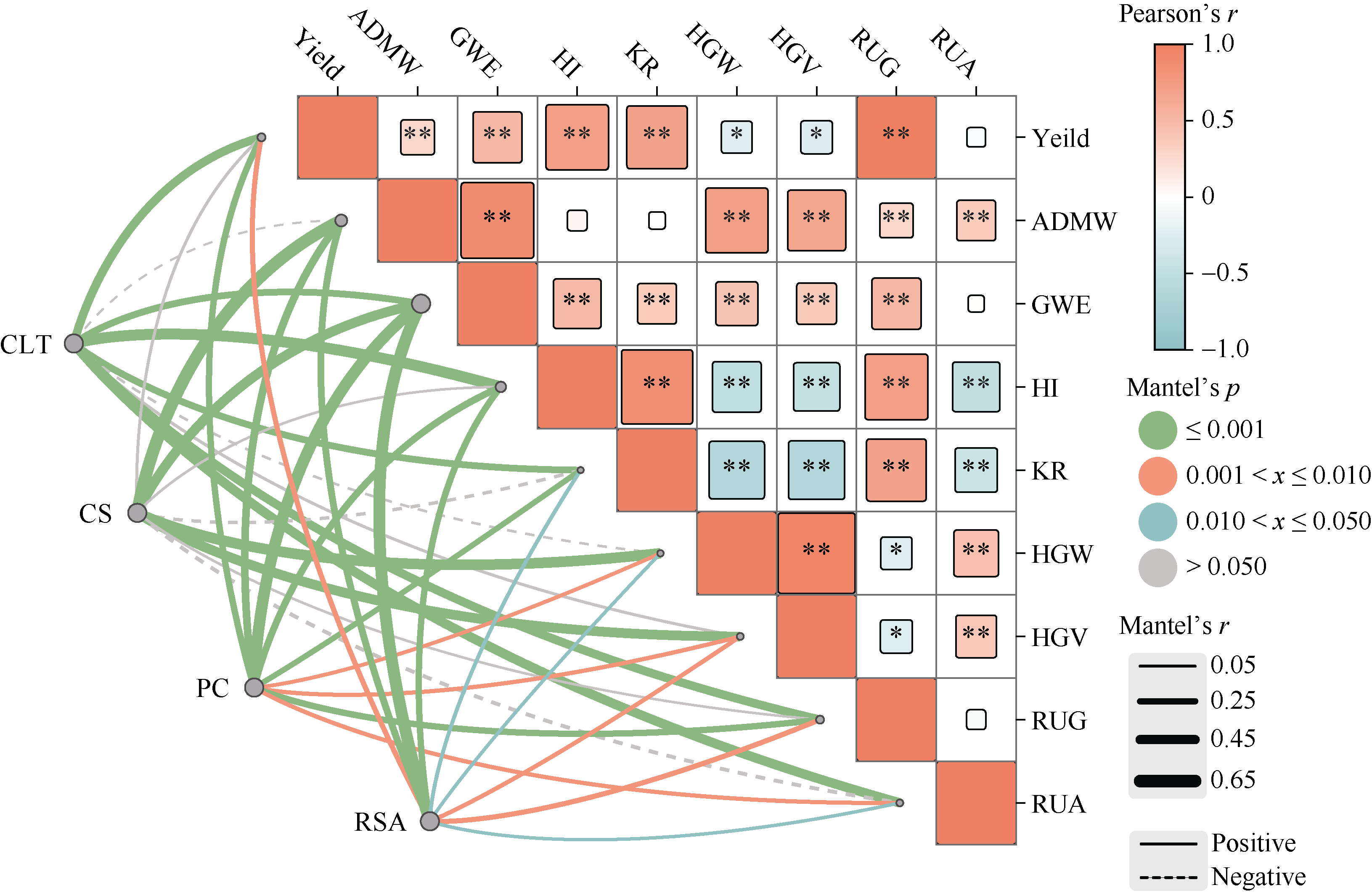
Mantel test correlation analysis based on maize biomass, canopy light transmittance, photosynthetic characteristics, and yield traits CLT: canopy light transmittance; CS: canopy structure; PC: photosynthetic characteristics; RSA: root system architecture; ADMW: aboveground dry matter weight per plant; GWE: grain weight per ear; HI: harvest index; KR: kernel ratio; HGW: hundred grain weight; HGV: hundred grain volume; RUG: radiation utilization of grain yield; RUA: radiation utilization of aboveground dry matter. ** and * indicate significant correlations at P < 0.01 and P < 0.05 levels, respectively."

[1] Tilman D, Balzer C, Hill J, et al. Global food demand and the sustainable intensification of agriculture. Proc Natl Acad Sci USA, 2011, 108: 20260-20264.
doi: 10.1073/pnas.1116437108 pmid: 22106295
[2] Luo N, Meng Q F, Feng P Y, et al. China can be self-sufficient in maize production by 2030 with optimal crop management. Nat Commun, 2023, 14: 2637.
doi: 10.1038/s41467-023-38355-2
[3] Liu B H, Chen X P, Meng Q F, et al. Estimating maize yield potential and yield gap with agro-climatic zones in China: distinguish irrigated and rainfed conditions. Agric For Meteor, 2017, 239: 108-117.
doi: 10.1016/j.agrformet.2017.02.035
[4] Tokatlidis I S, Koutroubas S D. A review of maize hybrids’ dependence on high plant populations and its implications for crop yield stability. Field Crops Res, 2004, 88: 103-114.
doi: 10.1016/j.fcr.2003.11.013
[5] Hou P, Liu Y E, Liu W M, et al. How to increase maize production without extra nitrogen input. Resour Conserv Recycl, 2020, 160: 104913.
doi: 10.1016/j.resconrec.2020.104913
[6] Mansfield B D, Mumm R H. Survey of plant density tolerance in U.S. maize germplasm. Crop Sci, 2014, 54: 157-173.
doi: 10.2135/cropsci2013.04.0252
[7] 吴希, 王家瑞, 郝淼艺, 等. 种植密度对不同生育期玉米品种光温资源利用率和产量的影响. 作物学报, 2023, 49: 1065-1078.
doi: 10.3724/SP.J.1006.2023.23032
Wu X, Wang J R, Hao M Y, et al. Effects of planting density on solar and heat resource utilization and yield of maize varieties at different growth stages. Acta Agron Sin, 2023, 49: 1065-1078 (in Chinese with English abstract).
doi: 10.3724/SP.J.1006.2023.23032
[8] Amelong A, Hernández F, Novoa A D, et al. Maize stand density yield response of parental inbred lines and derived hybrids. Crop Sci, 2017, 57: 32-39.
doi: 10.2135/cropsci2016.02.0083
[9] Hashemi A M, Herbert S J, Putnam D H. Yield response of corn to crowding stress. Agron J, 2005, 97: 839-846.
doi: 10.2134/agronj2003.0241
[10] Ottaviano E, Camussi A. Phenotypic and genetic relationships between yield components in maize. Euphytica, 1981, 30: 601-609.
doi: 10.1007/BF00038787
[11] Li J, Xie R Z, Wang K R, et al. Variations in maize dry matter, harvest index, and grain yield with plant density. Agron J, 2015, 107: 829-834.
doi: 10.2134/agronj14.0522
[12] Troyer A F, Wellin E J. Heterosis decreasing in hybrids: yield test inbreds. Crop Sci, 2009, 49: 1969-1976.
doi: 10.2135/cropsci2009.04.0170
[13] Russell W A. Genetic improvement of maize yields. In: Advances in Agronomy Volume 46. Amsterdam: Elsevier, 1991. pp 245-298.
[14] Hammer G L, Dong Z S, McLean G, et al. Can changes in canopy and/or root system architecture explain historical maize yield trends in the U.S. corn belt? Crop Sci, 2009, 49: 299-312.
doi: 10.2135/cropsci2008.03.0152
[15] Sangoi L, Gracietti M A, Rampazzo C, et al. Response of Brazilian maize hybrids from different eras to changes in plant density. Field Crops Res, 2002, 79: 39-51.
doi: 10.1016/S0378-4290(02)00124-7
[16] Shao H, Xia T T, Wu D L, et al. Root growth and root system architecture of field-grown maize in response to high planting density. Plant Soil, 2018, 430: 395-411.
doi: 10.1007/s11104-018-3720-8
[17] Shao H, Shi D F, Shi W J, et al. Genotypic difference in the plasticity of root system architecture of field-grown maize in response to plant density. Plant Soil, 2019, 439: 201-217.
doi: 10.1007/s11104-019-03964-8
[18] 杨吉顺, 高辉远, 刘鹏, 等. 种植密度和行距配置对超高产夏玉米群体光合特性的影响. 作物学报, 2010, 36: 1226-1233.
doi: 10.3724/SP.J.1006.2010.01226
Yang J S, Gao H Y, Liu P, et al. Effects of planting density and row spacing on canopy apparent photosynthesis of high-yield summer corn. Acta Agron Sin, 2010, 36: 1226-1233 (in Chinese with English abstract).
doi: 10.3724/SP.J.1006.2010.01226
[19] Piao L, Qi H, Li C F, et al. Optimized tillage practices and row spacing to improve grain yield and matter transport efficiency in intensive spring maize. Field Crops Res, 2016, 198: 258-268.
doi: 10.1016/j.fcr.2016.08.012
[20] 孙磊康, 李孝永, 郭航兆, 等. 施氮量和种植密度对玉米冠层光截获、籽粒灌浆和产量的影响. 农业工程学报, 2025, 41(22): 101-113.
Sun L K, Li X Y, Guo H Z, et al. Effects of nitrogen application rate and planting density on light interception in different maize canopy layers, grain filling, and yield. Trans CSAE, 2025, 41(22): 101-113 (in Chinese with English abstract).
[21] 贾倩民. 半干旱区集雨补灌与种植密度对玉米生长及光合生理特性的影响. 西北农林科技大学博士学位论文, 陕西杨凌, 2018.
Jia Q M. Effects of Rainwater-harvesting Planting with Supplemental Irrigation and Planting Densities on the Growth and Photosynthetic Physiology of Maize in the Semi-arid Regions. PhD Dissertation of Northwest A&F University, Yangling, Shaanxi, China, 2018 (in Chinese with English abstract).
[22] 张明, 宋振伟, 陈涛, 等. 不同春玉米品种干物质生产和籽粒灌浆对种植密度的响应. 玉米科学, 2015, 23(3): 57-65.
Zhang M, Song Z W, Chen T, et al. Differences in responses of biomass production and grain-filling to planting density between spring maize cultivars. J Maize Sci, 2015, 23(3): 57-65 (in Chinese with English abstract).
[23] 张倩, 张明才, 刘明, 等. 氮肥-生长调节剂对寒地春玉米植株形态及产量的互作效应研究. 中国农业大学学报, 2014, 19(5): 29-37.
Zhang Q, Zhang M C, Liu M, et al. Interaction of nitrogen fertilizer and plant growth regular on plant morphology and yield in spring maize of cold region. J China Agric Univ, 2014, 19(5): 29-37 (in Chinese with English abstract).
[24] 宋利, 刘广周, 张华, 等. 西南地区密植栽培下水肥一体化显著提升玉米产量、水肥利用效率和经济效益. 植物营养与肥料学报, 2025, 31: 2472-2482.
Song L, Liu G Z, Zhang H, et al. Integrated water and fertilizer management under high-density cultivation significantly improves maize yield, water and fertilizer utilization efficiency, and economic benefits in Southwest China. J Plant Nutr Fert, 2025, 31: 2472-2482 (in Chinese with English abstract).
[25] 杨锦忠, 赵延明, 宋希云. 玉米产量对密度的敏感性研究. 生物数学学报, 2015, 30(2): 243-252.
Yang J Z, Zhao Y M, Song X Y. Sensitivity of crop yield to plant density with an example in maize. J Biomath, 2015, 30(2): 243-252 (in Chinese with English abstract).
[26] 关雅静, 张茜, 孔德杰, 等. 种植方式和密度对宁夏中部干旱带玉米叶片特征和产量的影响. 北方农业学报, 2025, 53(4): 11-26.
doi: 10.12190/j.issn.2096-1197.2025.04.02
Guan Y J, Zhang Q, Kong D J, et al. Effects of planting patterns and densities on leaf characteristics and yield of maize in the arid zone of central Ningxia. J North Agric, 2025, 53(4): 11-26 (in Chinese with English abstract).
[27] 黄紫岳, 王园园, 马守田, 等. 种植品种与密度互作对玉米根系形态的影响. 生态学杂志, 2025, 44: 3613-3619.
Huang Z Y, Wang Y Y, Ma S T, et al. Interactive effects of cultivar and planting density on root morphology of summer maize. Chin J Ecol, 2025, 44: 3613-3619 (in Chinese with English abstract).
doi: 10.13292/j.1000-4890.202511.017
[28] Legendre P, Legendre L. Numerical Ecology, 3rd edn. Amsterdam: Elsevier, 2012. pp 515-568.
[29] Rogers E D, Benfey P N. Regulation of plant root system architecture: implications for crop advancement. Curr Opin Biotechnol, 2015, 32: 93-98.
doi: 10.1016/j.copbio.2014.11.015
[30] Wiesler F, Horst W J. Root growth and nitrate utilization of maize cultivars under field conditions. Plant Soil, 1994, 163: 267-277.
doi: 10.1007/BF00007976
[31] Zhang P, Wang Y Y, Sheng D C, et al. Optimizing root system architecture to improve root anchorage strength and nitrogen absorption capacity under high plant density in maize. Field Crops Res, 2023, 303: 109109.
doi: 10.1016/j.fcr.2023.109109
[32] Anderson E L. Tillage and N fertilization effects on maize root growth and root: shoot ratio. Plant Soil, 1988, 108: 245-251.
doi: 10.1007/BF02375655
[33] Hébert Y, Guingo E, Loudet O. The response of root/shoot partitioning and root morphology to light reduction in maize genotypes. Crop Sci, 2001, 41: 363-371.
doi: 10.2135/cropsci2001.412363x
[34] 陈延玲, 吴秋平, 陈晓超, 等. 不同耐密性玉米品种的根系生长及其对种植密度的响应. 植物营养与肥料学报, 2012, 18: 52-59.
Chen Y L, Wu Q P, Chen X C, et al. Root growth and its response to increasing planting density in different maize hybrids. J Plant Nutr Fert, 2012, 18: 52-59 (in Chinese with English abstract).
[35] Liu F, Zhou F, Wang X L, et al. Optimizing nitrogen management enhances stalk lodging resistance and grain yield in dense planting maize by improving canopy light distribution. Eur J Agron, 2023, 148: 126871.
doi: 10.1016/j.eja.2023.126871
[36] Li R F, Zhang G Q, Liu G Z, et al. Improving the yield potential in maize by constructing the ideal plant type and optimizing the maize canopy structure. Food Energy Secur, 2021, 10: e312.
[37] Jaikumar N S, Stutz S S, Fernandes S B, et al. Can improved canopy light transmission ameliorate loss of photosynthetic efficiency in the shade? An investigation of natural variation in Sorghum bicolor. J Exp Bot, 2021, 72: 4965-4980.
doi: 10.1093/jxb/erab176 pmid: 33914063
[38] Wei S S, Wang X Y, Li G H, et al. Plant density and nitrogen supply affect the grain-filling parameters of maize kernels located in different ear positions. Front Plant Sci, 2019, 10: 180.
doi: 10.3389/fpls.2019.00180 pmid: 30881365
[39] Liu Z, Hao Z H, Sha Y, et al. High responsiveness of maize grain yield to nitrogen supply is explained by high ear growth rate and efficient ear nitrogen allocation. Field Crops Res, 2022, 286: 108610.
doi: 10.1016/j.fcr.2022.108610
[1] Ma Hai-Hui, Zhang Guo-Ping, Yang Si-Cun, Wang Hong-Li. Effects of nitrogen application at different densities on carbon and nitrogen accumulation and translocation characteristics in forage maize in semi-arid regions [J]. Acta Agronomica Sinica, 2026, 52(4): 1193-1207.
[2] CUI Dong, WANG Tong-Chao, YANG Song-Lin, REN Bai-Zhao, GAO Ying-Bo, YU Ning-Ning, ZHANG Ji-Wang. Optimization of irrigation methods and planting density synergistically increases yield and water use efficiency in summer maize [J]. Acta Agronomica Sinica, 2025, 51(11): 3026-3037.
[3] ZHANG Qi-Qi, CHEN Jie-Chang, KUAI Jie, WANG Bo, WANG Jing, XU Zheng-Hua, ZHAO Jie, ZHAO Si-Ming, JIA Cai-Hua, ZHOU Guang-Sheng. Effect of high density planting on the quality of cold pressed rapeseed oil [J]. Acta Agronomica Sinica, 2024, 50(9): 2358-2370.
[4] PENG Jie, XIE Xiao-Qi, ZHANG Zhao, YAO Xiao-Fen, QIU Shen, CHEN Dan-Dan, GU Xiao-Na, WANG Yu-Jie, WANG Chen-Chen, YANG Guo-Zheng. Relationship between cotton yield and canopy microenvironment under summer direct seeding [J]. Acta Agronomica Sinica, 2024, 50(9): 2371-2382.
[5] XU Ze, WU Xin-Ling, LIU Zhen-Yu, LI Han-Jia, LENG Xin-Hua, WU Tian-Fan, CHEN Yuan, ZHANG Xiang, CHEN De-Hua. Effects of planting density with nitrogen rate on regulation of nitrogen utilization in summer direct seeded cotton [J]. Acta Agronomica Sinica, 2024, 50(6): 1584-1596.
[6] NIE Xiao-Yu, LI Zhen, WANG Tian-Yao, ZHOU Yuan-Wei, XU Zheng-Hua, WANG Jing, WANG Bo, KUAI Jie, ZHOU Guang-Sheng. Effect of planting density and weak light stress at pod-filling stage on seed oil accumulation in rapeseed [J]. Acta Agronomica Sinica, 2024, 50(2): 493-505.
[7] LIU Yu-Hang, ZHAO Shu-Hong, ZHU Ting-Ting, LIANG Zhen-Yu, HE Da-Hai, CHEN Jia-Bo, REN Yong, HUANG Lin, FAN Gao-Qiong, WU Bi-Hua. Effects of 16,17-dihydro gibberellin A5 on canopy radiation interception and yield of Shumai 133 under different planting density [J]. Acta Agronomica Sinica, 2024, 50(11): 2787-2800.
[8] LU Jian-Xiang, GAO Qian-Wen, GAO Zhi-Qiang, YANG Hui-Bing, WEN Shuang-Ya, SHI Nan, HU Wen-Rui, JIN Yu-Hao, CHEN Long, LIU Yun, CAO Zheng-Deng-Yuan. Effect of high-density planting and fertilizer reduction on yield and growth and development of indica hybrid rice [J]. Acta Agronomica Sinica, 2024, 50(10): 2586-2598.
[9] WEI Jin-Gui, GUO Yao, CHAI Qiang, YIN Wen, FAN Zhi-Long, HU Fa-Long. Yield and yield components of maize response to high plant density under reduced water and nitrogen supply [J]. Acta Agronomica Sinica, 2023, 49(7): 1919-1929.
[10] WU Xi, WANG Jia-Rui, HAO Miao-Yi, ZHANG Hong-Jun, ZHANG Ren-He. Effects of planting density on solar and heat resource utilization and yield of maize varieties at different growth stages [J]. Acta Agronomica Sinica, 2023, 49(4): 1065-1078.
[11] GONG Ruo-Lin, SONG Bo, YANG Zhi-Ye, LU Li-Jing, DONG Jun-Gang. Effects of sowing date and density on lodging resistance and yield of different rapeseed cultivars [J]. Acta Agronomica Sinica, 2023, 49(10): 2777-2792.
[12] ZHANG Zhen-Bo, QU Xin-Yue, YU Ning-Ning, REN Bai-Zhao, LIU Peng, ZHAO Bin, ZHANG Ji-Wang. Effects of nitrogen application rate on grain filling characteristics and endogenous hormones in summer maize [J]. Acta Agronomica Sinica, 2022, 48(9): 2366-2376.
[13] LI Rui-Dong, YIN Yang-Yang, SONG Wen-Wen, WU Ting-Ting, SUN Shi, HAN Tian-Fu, XU Cai-Long, WU Cun-Xiang, HU Shui-Xiu. Effects of close planting densities on assimilate accumulation and yield of soybean with different plant branching types [J]. Acta Agronomica Sinica, 2022, 48(4): 942-951.
[14] WANG Li-Qing, YU Xiao-Fang, GAO Ju-Lin, MA Da-Ling, HU Shu-Ping, GUO Huai-Huai, LIU Ai-Ye. Response of grain yield formation to planting density of maize varieties in different eras [J]. Acta Agronomica Sinica, 2022, 48(10): 2625-2637.
[15] LOU Hong-Xiang, JI Jian-Li, KUAI Jie, WANG Bo, XU Liang, LI Zhen, LIU Fang, HUANG Wei, LIU Shu-Yan, YIN Yu-Feng, WANG Jing, ZHOU Guang-Sheng. Effects of planting density on yield and lodging related characters of reciprocal hybrids in Brassica napus L. [J]. Acta Agronomica Sinica, 2021, 47(9): 1724-1740.
Viewed
Full text


Abstract

Cited

  Shared   
  Discussed   
No Suggested Reading articles found!