欢迎访问作物学报,今天是
作物学报 ›› 2018, Vol. 44 ›› Issue (02): 268-277.doi: 10.3724/SP.J.1006.2018.00268
谢军红1,2, 李玲玲1,2, 张仁陟1,3, 柴强1,2,*( )
)
Jun-Hong XIE1,2, Ling-Ling LI1,2, Ren-Zhi ZHANG1,3, Qiang CHAI1,2,*()
摘要:
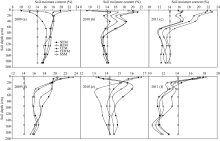
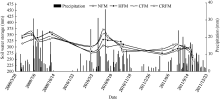
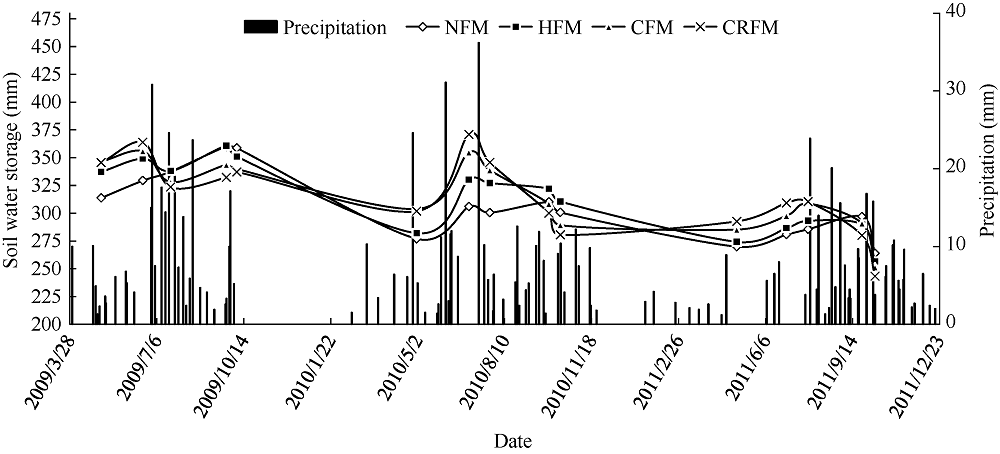
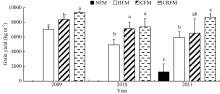
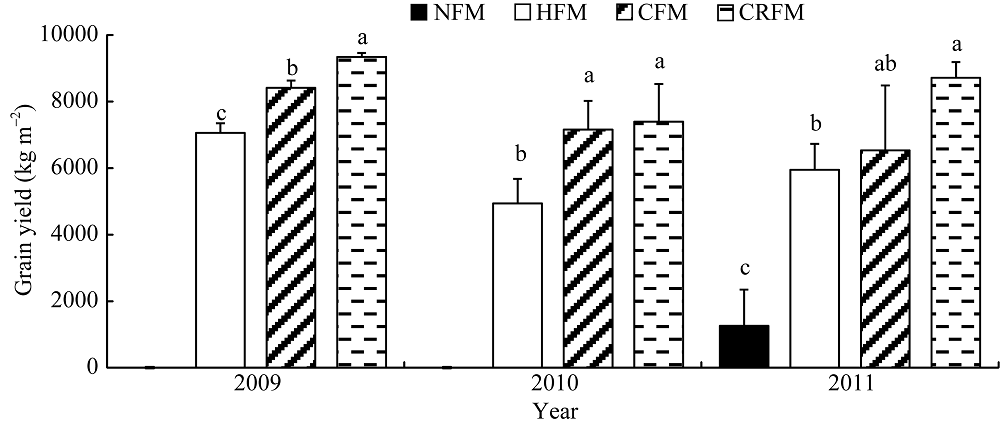
为了揭示黄土高原半干旱区玉米(Zea mays L.)种植中覆膜、沟垄作的增产作用和水分利用特征, 布设大田定位试验, 包括全覆膜沟垄作、全覆膜平作、半覆膜平作和不覆膜平作4个处理。结果发现, 连续3个平水年中, 全膜沟垄作集成了全覆膜与沟垄作的优点, 产生明显的叠加效应, 较半膜平作分别增产2282.9、2460.2和2765.5 kg hm-2, 增产率为32.3%、49.8%和46.5%。其中, 全覆膜的贡献分别为59.3%、90.3%和20.9%, 沟垄作的贡献分别为40.7%、9.7%和79.1%。叠加效应中全覆膜与沟垄作对产量的贡献呈此消彼长态势, 连作前两年, 全覆膜的作用大于沟垄作, 连作第3年, 沟垄作的作用大于全覆膜。玉米的水分利用效率, 全膜沟垄作较半膜平作的增幅为10.6%~25.2%。在同等降水条件下, 全覆膜沟垄作、全覆膜平作处理播前土壤贮水量较不覆膜平作增幅分别达6.3%~15.1%和3.5%~11.5%。收获期土壤贮水量明显低于不覆膜平作, 降幅达6.0%~12.9%和4.7%~7.5%。随着连作年限的增长, 土壤贮水量呈递减趋势, 连作第2、第3年收获期全覆膜沟垄作、全覆膜平作较连作开始土壤贮水量分别降低37.1%、44.0%和35.5%、40.9%, 连作第2年全覆膜沟垄作在50~200 cm出现干燥化现象, 第3年各处理30~200 cm土层均出现干燥化现象。综上所述, 全覆膜沟垄作具有明显的增产和提高水分利用效率的作用, 但其较高的产量以高耗水为代价, 在连续低降水条件下, 3年玉米连作会导致土壤干燥化, 存在生态安全风险。
| [1] | 李生秀. 中国旱地农业. 北京: 中国农业出版社, 2004. pp 1-2 |
| Li S X.Dryland Agriculture in China. Beijing: China Agriculture Press, 2004. pp 1-2 (in Chinese) | |
| [2] | Wang Y J, Xie Z K, Malhi S S, Vera C L, Zhang Y B, Wang J N.Effects of rainfall harvesting and mulching technologies on water use efficiency and crop yield in the semi-arid Loess Plateau China.Agric Water Manage, 2009, 96: 374-382 |
| [3] | 黄占斌. 有限供水对作物水分利用率的影响及其机理. 土壤侵蚀与水土保持学报, 1998, 4(3): 92-94 |
| Huang Z B.Effect of limited water supply on water use efficiency of crops and its mechanism. J Soil Erosion Soil Water Conserv, 1998, 4(3): 92-94 (in Chinese with English abstract) | |
| [4] | Wang X, Dai K, Zhang D C, Zhang X M, Zhao Q S, Cai D X, Hoogmoed W B, Oenema O.Dryland maize yields and water use efficiency in response to tillage/crop stubble and nutrient management practices in China.Field Crops Res, 2011, 120: 47-57 |
| [5] | Wen X X, Zhang D Q, Liao Y C, Jia Z K, Ji S Q.Effects of water-collecting and -retaining techniques on photosynthetic rates, yield, and water use efficiency of millet grown in a semiarid region. J Integr Agric, 2012, 11: 1119-1128 |
| [6] | Li X Y, Gong J D, Wei X H.In-situ rainwater harvesting and gravel mulch combination for corn production in the dry semi-arid region of China.J Arid Environ, 2000, 46: 371-382 |
| [7] | Huang G B, Zhang R Z, Li G D, Li L L, Chan K Y, Heenan D P, Chen W, Unkovich M J, Robertson M J, Cullis B R, Bellotti W D.Productivity and sustainability of a spring wheat-field pea rotation in a semi-arid environment under conventional and conservation tillage systems.Field Crops Res, 2008, 107: 43-55 |
| [8] | Zhang S L, Chen X P, Zhang F S.Water use efficiency of dryland wheat in the Loess Plateau in response to soil and crop management. Field Crops Res, 2013, 151: 9-18 |
| [9] | Yu H Y.Effects of no-tillage on soil water content and physical properties of spring corn fields in semiarid region of northern China. Chin J Appl Ecol, 2011, 22(1): 99-104 |
| [10] | 任小龙. 模拟不同雨量下沟垄集雨种植对春玉米生产力的影响. 生态学报, 2008, 28: 1006-1015 |
| Ren X L.Effects of rainwater-harvested furrow/ridge system on spring corn productivity under different simulated rainfalls.Acta Ecol Sin, 2008, 28: 1006-1015 (in Chinese with English abstract) | |
| [11] | 任小龙. 模拟降雨量条件下沟垄集雨种植对土壤养分分布及夏玉米根系生长的影响. 农业工程学报, 2007, 23(12): 94-99 |
| Ren X L.Effect of ridge and furrow planting of rainfall harvesting on soil available nutrient distribution and root growth of summer corn under simulated rainfall conditions. Trans CSAE, 2007, 23(12): 94-99 (in Chinese with English abstract) | |
| [12] | Wang H L.Effects of mulching methods on soil water dynamics and corn yield of rain-fed cropland in the semiarid area of China. Chin J Plant Ecol, 2011, 35: 825-833 |
| [13] | 黄高宝, 方彦杰, 李玲玲, 谢军红, 汪佳. 旱地全膜双垄沟播玉米高效用水机制研究. 干旱地区农业研究, 2010, 28(6): 116-121 |
| Huang G B, Fang Y J, Li L L, Xie J H, Wang J.High water use efficiency mechanism of maize planting in furrows of completely mulched alternating narrow and wide ridges systems in rainfed areas.Agric Res Arid Area, 2010, 28(6): 116-121 (in Chinese with English abstract) | |
| [14] | 李军, 邵明安, 张兴昌, 李世清. 黄土高原旱塬区高产玉米田土壤干燥化与产量波动趋势模拟研究. 中国生态农业学报, 2007, 15(02): 54-58 |
| Li J, Shao M A, Zhang X C, Li S Q.Simulation of soil desiccation and yield finctuation of high yield maize field on rain-fed highland of the Loess Plateau.Chin J Eco-agric, 2007, 15(02): 54-58 (in Chinese with English abstract) | |
| [15] | Li X Y.Incorporation of ridge and furrow method of rainfall harvesting with mulching for crop production under semiarid conditions. Agric Water Manage, 2001, 50: 173-183 |
| [16] | 李凤民, 刘小兰, 王俊. 底墒与磷肥互作对春小麦产量形成的影响. 生态学报, 2001, 21: 1941-1946 |
| Li F M, Liu X L, Wang J.Effects of pre-sowing irrigation and P fertilization on spring wheat yield information. Acta Ecol Sin, 2001, 21: 1941-1946 (in Chinese with English abstract) | |
| [17] | 李锋瑞, 赵松岭, 李凤民, 高崇岳. 陇东黄土旱塬作物组合系统农田耗水规律研究. 生态学报, 1995, 15: 420-425 |
| Li F R, Zhao S L, Li F M, Gao C Y.Study on the water consumption law of complex crop system in the tablelands of the eastern Gansu loess plateua.Acta Ecol Sin, 1995, 15: 420-425 (in Chinese with English abstract) | |
| [18] | 李玲玲. 黄高宝, 张仁陟, 晋小军, Kwong Y C.不同保护性耕作措施对旱作农田土壤水分的影响. 生态学报, 2005, 25: 2326-2332 |
| Li L L. Huang G B, Zhang R Z, Jin X J, Kwong Y C.Effects of conservation tillage on soil water regimes in rainfed areas.Acta Ecol Sin, 2005, 25: 2326-2332 (in Chinese with English abstract) | |
| [19] | 张雷, 牛芬菊, 李小燕, 豆国兰, 李德仁. 旱地全膜双垄沟播秋覆膜对玉米产量和水分利用率的影响. 中国农学通报, 2010, 26(22): 142-145 |
| Zhang L, Niu F J, Li X Y, Dou G L, Li D R.Effects of planting in furrow and whole plastic-film mulching on double ridges in autumn on yield index of corn production and water use efficiency in dry lands.Chin Agric Sci Bull, 2010, 26(22): 142-145 (in Chinese with English abstract) | |
| [20] | 王琦. 半干旱地区沟垄微型集雨种植马铃薯最优沟垄比的确定. 农业工程学报, 2005, 25: 39-41 |
| Wang Q.Optimum ratio of ridge to furrow for planting potato in micro-water harvesting system in semiarid areas.Trans CSAE, 2005, 25: 39-41(in Chinese with English abstract) | |
| [21] | 王晓凌, 陈明灿, 易现峰. 付国占. 垄沟覆膜集雨系统垄宽和密度效应对玉米产量的影响. 农业工程学报, 2009, 25(8): 40-47 |
| Wang X L, Chen M C, Yi X F, Fu G Z.Effects of ridge width and planting density on corn yields in rainwater-harvesting system with plastic film mulching on ridge.Trans CSAE, 2009, 25(8): 40-47 (in Chinese with English abstract) | |
| [22] | 韩清芳. 微集水种植技术的农田水分调控效果模拟研究. 农业工程学报, 2004, 20(02): 78-82 |
| Han Q F.Simulated study on soil moisture of the field under water micro-collecting farming conductions.Trans CSAE, 2004, 20(02): 78-82(in Chinese with English abstract) | |
| [23] | Zhou L M, Li F M, Jin S L.How two ridges and the furrow mulched with plastic film affects soil water temperature and yield of maize on the semiarid Loess Plateau of China. Field Crops Res, 2009, 113: 41-47 |
| [24] | 廖允成, 温晓霞, 韩思明. 黄土高原旱地小麦覆盖保水技术效果研究. 中国农业科学, 2003, 36: 548-552 |
| Liao Y C, Wen X X, Han S M.Effect of mulching of water conservation for dry land winter wheat in the loess tableland.Sci Agric Sin, 2003, 36: 548-552(in Chinese with English abstract) | |
| [25] | Li X Y.Incorporation of ridges and furrow method of rainfall harvesting with mulching for crop production under semiarid conditions. Agric Water Manage, 2001, 50: 173-183 |
| [26] | 任小龙, 贾志宽, 丁瑞霞, 韩清芳. 我国旱区作物根域微集水种植技术研究进展及展望. 干旱地区农业研究, 2010, 28(3): 83-89 |
| Ren X L, Jia Z K, Ding R X, Han Q F.Progress and prospect of research on root-zone water micro-collecting farming for crop in arid region of China.Agric Res Arid Areas, 2010, 28(3): 83-89 (in Chinese with English abstract) | |
| [27] | Richards R A, Rebetzke G J, Condon A G.Breeding opportunities for increasing the efficiency of water use and crop yield in temperate cereals.Crop Sci, 2002, 42: 111-121 |
| [28] | Li F M, Guo A H, Wei H.Effects of clear plastic film mulch on yield of spring wheat. Field Crops Res, 1999, 63: 79-86 |
| [29] | 李军, 蒋斌, 胡伟, 次仁央金, 赵玉娟, 李晓芳, 陈兵. 黄土高原不同类型旱区旱作粮田深层土壤干燥化特征. 自然资源学报, 2009, 24: 2124-2134 |
| Li J, Jiang B, Hu W, Ciren Y J, Zhao Y J, Li X F, Chen B.Characteristics of deep soil desiccation on rainfed grain croplands in different rainfall areas of the Loess Plateau of China.J Nat Resour, 2009, 24: 2124-2134 (in Chinese with English abstract) | |
| [30] | 刘沛松, 贾志宽, 李军, 任小龙, 李永平, 刘世新. 宁南山区紫花苜蓿(Medicago sativa)土壤干层水分动态及草粮轮作恢复效应. 生态学报, 2008, 28: 183-191 |
| Liu P S, Jia Z K, Li J, Ren X L, Li Y P, Liu S X.Moisture dynamics of soil dry layer and water-restoring effects of alfalfa (Medicago sativa)- grain crop rotation on soil dry layer in alfalfa farmlands in mountainous region of southern Ningxia. Acta Ecol Sin, 2008, 28: 183-191 (in Chinese with English abstract) | |
| [31] | 王红丽, 张绪成, 宋尚有, 马一凡, 于显枫. 西北黄土高原旱地全膜双垄沟播种植对玉米季节性耗水和产量的调节机制. 中国农业科学, 2013, 46: 917-926 |
| Wang H L, Zhang X C, Song S Y, Ma Y F, Yu X F.Regulation of whole field surface plastic mulching and double ridge-furrow planting on seasonal soil water loss and maize yield in Rain-Fed Area of Northwest Loess Plateau.Sci Agric Sin, 2013, 46: 917-926 (in Chinese with English abstract) | |
| [32] | 王红丽, 张绪成, 宋尚有.半干旱区旱地不同覆盖种植方式玉米田的土壤水分和产量效应. 植物生态学报, 2011, 35: 825-833 |
| Wang H L, Zhang X C, Song S Y.Effects of mulching methods on soil water dynamics and corn yield of rain-fed cropland in thesemiarid area of China.Chin J Plant Ecol, 2011, 35: 825-833 (in Chinese with English abstract) | |
| [33] | 莫非, 周宏, 王建永, 赵鸿, 张恒嘉, 吴姗, 陈应龙, 杨通, 邓浩亮, Asfa B, 王润元, Simon N N, 李凤民, 熊友才. 田间微集雨技术研究及应用. 农业工程学报, 2013, 29(8): 1-17 |
| Mo F, Zhou H, Wang J Y, Zhao H, Zhang H J, Wu S, Chen Y L, Yang T, Deng H L, Asfa B, Wang R Y, Simon N N, Li F M, Xiong Y C.Development and application of micro-field rain-harvesting technologies.Trans CSAE, 2013, 29(8): 1-17 (in Chinese with English abstract) |
| [1] | 王丹, 周宝元, 马玮, 葛均筑, 丁在松, 李从锋, 赵明. 长江中游双季玉米种植模式周年气候资源分配与利用特征[J]. 作物学报, 2022, 48(6): 1437-1450. |
| [2] | 王旺年, 葛均筑, 杨海昌, 阴法庭, 黄太利, 蒯婕, 王晶, 汪波, 周广生, 傅廷栋. 大田作物在不同盐碱地的饲料价值评价[J]. 作物学报, 2022, 48(6): 1451-1462. |
| [3] | 颜佳倩, 顾逸彪, 薛张逸, 周天阳, 葛芊芊, 张耗, 刘立军, 王志琴, 顾骏飞, 杨建昌, 周振玲, 徐大勇. 耐盐性不同水稻品种对盐胁迫的响应差异及其机制[J]. 作物学报, 2022, 48(6): 1463-1475. |
| [4] | 杨欢, 周颖, 陈平, 杜青, 郑本川, 蒲甜, 温晶, 杨文钰, 雍太文. 玉米-豆科作物带状间套作对养分吸收利用及产量优势的影响[J]. 作物学报, 2022, 48(6): 1476-1487. |
| [5] | 陈静, 任佰朝, 赵斌, 刘鹏, 张吉旺. 叶面喷施甜菜碱对不同播期夏玉米产量形成及抗氧化能力的调控[J]. 作物学报, 2022, 48(6): 1502-1515. |
| [6] | 李祎君, 吕厚荃. 气候变化背景下农业气象灾害对东北地区春玉米产量影响[J]. 作物学报, 2022, 48(6): 1537-1545. |
| [7] | 石艳艳, 马志花, 吴春花, 周永瑾, 李荣. 垄作沟覆地膜对旱地马铃薯光合特性及产量形成的影响[J]. 作物学报, 2022, 48(5): 1288-1297. |
| [8] | 闫晓宇, 郭文君, 秦都林, 王双磊, 聂军军, 赵娜, 祁杰, 宋宪亮, 毛丽丽, 孙学振. 滨海盐碱地棉花秸秆还田和深松对棉花干物质积累、养分吸收及产量的影响[J]. 作物学报, 2022, 48(5): 1235-1247. |
| [9] | 柯健, 陈婷婷, 吴周, 朱铁忠, 孙杰, 何海兵, 尤翠翠, 朱德泉, 武立权. 沿江双季稻北缘区晚稻适宜品种类型及高产群体特征[J]. 作物学报, 2022, 48(4): 1005-1016. |
| [10] | 李瑞东, 尹阳阳, 宋雯雯, 武婷婷, 孙石, 韩天富, 徐彩龙, 吴存祥, 胡水秀. 增密对不同分枝类型大豆品种同化物积累和产量的影响[J]. 作物学报, 2022, 48(4): 942-951. |
| [11] | 王吕, 崔月贞, 吴玉红, 郝兴顺, 张春辉, 王俊义, 刘怡欣, 李小刚, 秦宇航. 绿肥稻秆协同还田下氮肥减量的增产和培肥短期效应[J]. 作物学报, 2022, 48(4): 952-961. |
| [12] | 杜浩, 程玉汉, 李泰, 侯智红, 黎永力, 南海洋, 董利东, 刘宝辉, 程群. 利用Ln位点进行分子设计提高大豆单荚粒数[J]. 作物学报, 2022, 48(3): 565-571. |
| [13] | 陈云, 李思宇, 朱安, 刘昆, 张亚军, 张耗, 顾骏飞, 张伟杨, 刘立军, 杨建昌. 播种量和穗肥施氮量对优质食味直播水稻产量和品质的影响[J]. 作物学报, 2022, 48(3): 656-666. |
| [14] | 袁嘉琦, 刘艳阳, 许轲, 李国辉, 陈天晔, 周虎毅, 郭保卫, 霍中洋, 戴其根, 张洪程. 氮密处理提高迟播栽粳稻资源利用和产量[J]. 作物学报, 2022, 48(3): 667-681. |
| [15] | 丁红, 徐扬, 张冠初, 秦斐斐, 戴良香, 张智猛. 不同生育期干旱与氮肥施用对花生氮素吸收利用的影响[J]. 作物学报, 2022, 48(3): 695-703. |
|
||