欢迎访问作物学报,今天是
作物学报 ›› 2019, Vol. 45 ›› Issue (4): 538-545.doi: 10.3724/SP.J.1006.2019.82031
王旭虹1,*,李鸣晓1,*,张群1,金峰2,马秀芳3,姜树坤4,徐正进1,*( ),陈温福1
WANG Xu-Hong1,*,LI Ming-Xiao1,*,ZHANG Qun1,JIN Feng2,MA Xiu-Fang3,JIANG Shu-Kun4,XU Zheng-Jin1,*(),CHEN Wen-Fu1
摘要:
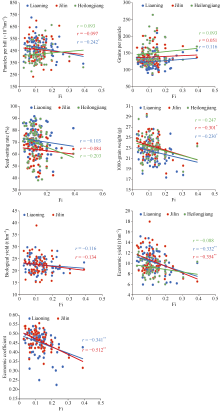
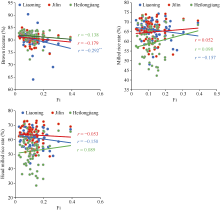
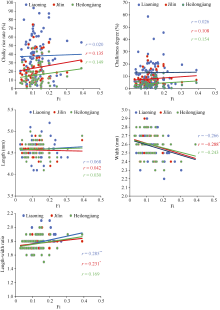
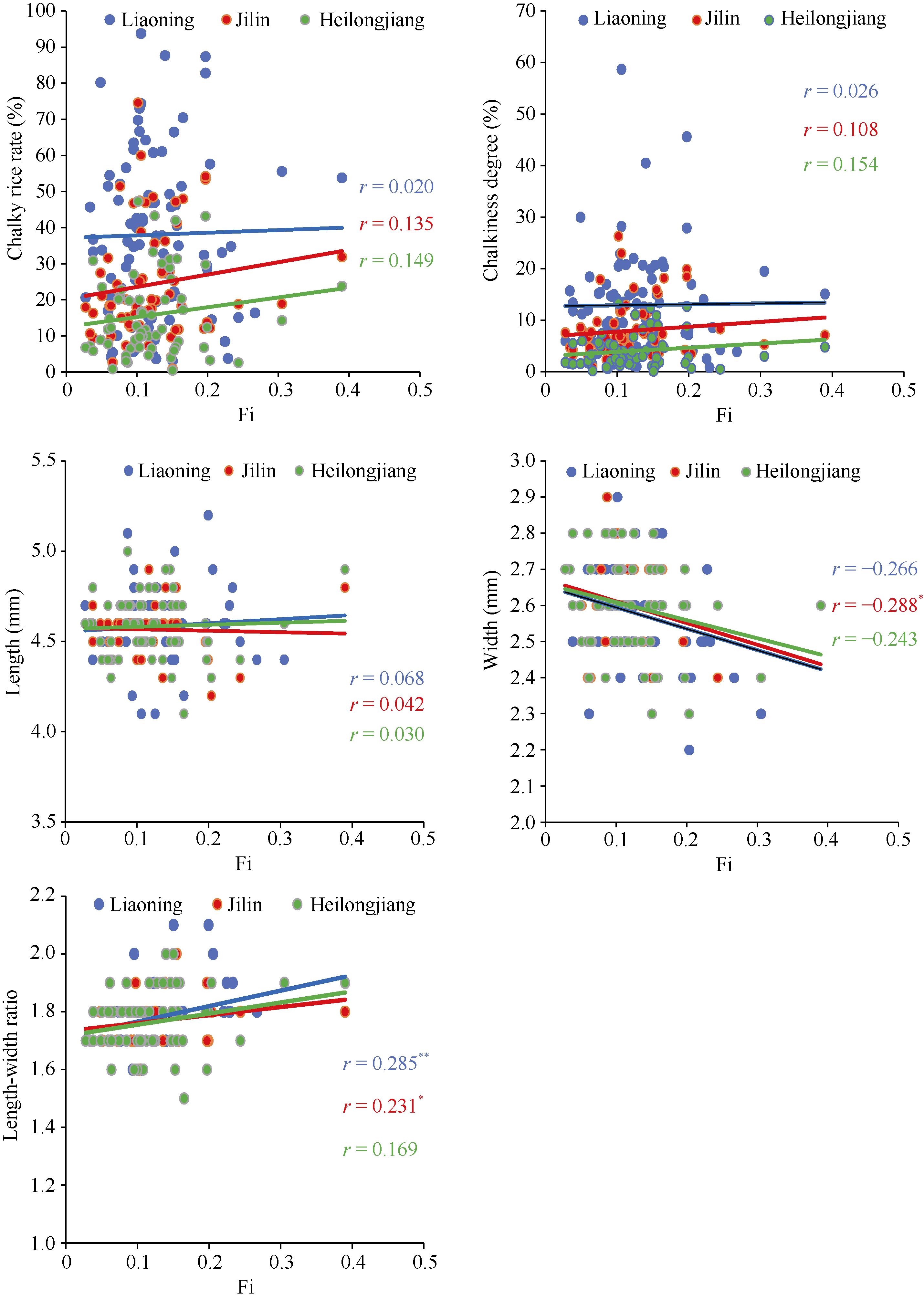
针对20世纪80年代以来特别是进入新世纪我国东北水稻大多通过籼粳稻杂交育成的实际情况, 为了明确籼型血缘对东北水稻产量和品质的影响, 以Sasanishiki(粳稻)/Habataki(籼稻)//Sasanishiki///Sasanishiki构建的回交重组自交系群体(BILs) 85个株系为试材, 分别在辽宁沈阳、吉林长春和黑龙江哈尔滨种植, 以籼型频率(Fi)即来自籼型亲本分子标记比例为指标, 分析了籼型血缘与产量和品质的关系。结果表明, BILs群体在辽宁、吉林和黑龙江能够正常成熟, 株系数和Fi平均值有自南向北逐渐降低的趋势, 三地生物产量、经济系数和经济产量差异均未达到显著水平(黑龙江生物产量和经济系数缺失); 穗数在辽宁、吉林>在黑龙江, 每穗粒数在黑龙江>在吉林>在辽宁; 糙米率在黑龙江显著高于辽宁, 而在吉林与辽宁和黑龙江差异不显著; 精米率和整精米率在辽宁、吉林>在黑龙江, 垩白粒率和垩白度在辽宁>在吉林>在黑龙江, 三地粒长、粒宽和长宽比均无显著差异。总体上Fi与千粒重、经济产量、经济系数、糙米率和粒宽呈极显著负相关, 与长宽比呈极显著正相关; 三地Fi与产量及其构成因素的相关性与总体相似, 只是在黑龙江大多没有达到显著水平; 在辽宁和吉林Fi与粒宽呈显著负相关, 而只有在辽宁Fi与长宽比的正相关达到显著水平。在本试验条件下, 控制籼型频率在10%左右可能有利于实现籼粳亚种有利基因互补, 促进东北粳稻产量和品质在更高水平上统一起来。
| [1] | Matsuo T M . Great Achievement of Rice Science. Vol.3 Genetics. Tokyo: Nousangyoson Culture Society, 1990. pp 1-3 (in Japanese). |
| [2] | 万建民 . 中国水稻遗传育种与品种系谱 . 北京: 中国农业出版社, 2010. pp 1-23. |
| Wan J M. Rice Genetic Breeding and Variety Genealogy in China. Beijing: China Agriculture Press, 2010. pp 1-23(in Chinese). | |
| [3] | 张洪程, 许轲, 张军, 李国业, 董啸波, 花劲, 周培建, 程飞虎, 黄大山, 陈忠平, 陈国梁, 方明珍, 戴其根, 霍中洋, 魏海燕, 高辉 . 双季晚粳生产力及相关生态生理特征. 作物学报, 2014,40:283-300. |
| Zhang H C, Xu K, Zhang J, Li G Y, Dong X B, Hua J, Zhou P J, Cheng F H, Huang D S, Chen Z P, Chen G L, Fang M Z, Dai Q Y, Huo Z Y, Wei H Y, Gao H . Productivity and eco-physiological characteristics of late japonica rice in double-cropping system. Acta Agron Sin, 2014,40:283-300 (in Chinese with English abstract). | |
| [4] | 钱前 . 水稻基因设计育种.北京: 科学出版社, 2007. pp 3-4. |
| Qian Q. Gene Design and Breeding of Rice. Beijing: Science Press, 2007. pp 3-4(in Chinese). | |
| [5] | 陈温福, 徐正进 . 水稻超高产育种理论与方法. 北京: 科学出版社, 2007. pp 20-25. |
| Chen W F, Xu Z J. The Theories and Methods of Rice Breeding for Maximum Yield. Beijing: Science Press, 2007. pp 20-25(in Chinese). | |
| [6] | 顾铭洪 . 水稻高产育种中一些问题的讨论. 作物学报, 2010,36:1431-1439. |
| Gu M H . Discussion on the aspects of high-yielding breeding in rice. Acta Agron Sin, 2010,36:1431-1439 (in Chinese with English abstract). | |
| [7] | 毛艇, 徐海, 郭艳华, 朱春杰, 陈凯, 王嘉宇, 姜树坤, 徐正进 . 籼粳交重组自交系的亚种属性与稻米品质性状的关系. 中国水稻科学, 2010,24:474-478. |
| Mao T, Xu H, Guo Y H, Zhu C J, Chen K, Wang J Y, Jiang S K, Xu Z J . Relationship between subspecies differentiation and rice quality traits in RILs population from indica-japonica cross. Chin J Rice Sci, 2010,24:474-478 (in Chinese with English abstract). | |
| [8] | 张佳, 程海涛, 徐海, 夏英俊, 刘春香, 徐正进 . 籼粳稻杂交后代蒸煮食味品质与亚种分化的关系. 中国水稻科学, 2015,29:167-173. |
| Zhang J, Cheng H T, Xu H, Xia Y J, Liu C X, Xu Z J . Relationship between cooking-eating quality and subspecies differentiation in RILs population from indica and japonica crossing. Chin J Rice Sci, 2015,29:167-173 (in Chinese with English abstract). | |
| [9] | 吴长明, 孙传清, 付秀林, 王象坤, 李自超, 张强 . 稻米品质性状与产量性状及籼粳分化度的相互关系研究. 作物学报, 2003,29:822-828. |
| Wu C M, Sun C Q, Fu X L, Wang X K, Li Z C, Zhang Q . Study on the relationship between quality yield characters or indica-japonica differentiation in rice(Oryza sativa L.). Acta Agron Sin, 2003,29:822-828 (in Chinese with English abstract). | |
| [10] | 高虹, 李飞飞, 吕国依, 夏英俊, 王嘉宇, 孙健, 唐亮, 徐正进 . 籼粳稻杂交对中国东北粳稻品质的影响. 作物学报, 2013,39:1806-1813. |
| Gao H, Li F F, Lyu G Y, Xia Y J, Wang J Y, Sun J, Tang L, Xu Z J . Effect of indica-japonica hybridization on grain quality of rice cultivars in northeast China. Acta Agron Sin, 2013,39:1806-1813 (in Chinese with English abstract). | |
| [11] | 徐铨, 唐亮, 徐凡, 福嶌阳, 黄瑞冬, 陈温福, 徐正进 . 粳稻食味品质改良研究现状与展望. 作物学报, 2013,39:961-968. |
| Xu Q, Tang L, Xu F, Fu D Y, Huang R D, Chen W F, Xu Z J . Research advances and prospects of eating quality improvement in japonica rice(Oryza sativa L.). Acta Agron Sin, 2013,39:961-968 (in Chinese with English abstract). | |
| [12] | 徐正进, 陈温福 . 中国北方粳型超级稻研究进展. 中国农业科学, 2016,49:239-250. |
| Xu Z J. Chen W F . Research progress and related problems on japonica super rice in Northern China. Sci Agric Sin, 2016,49:239-250 (in Chinese with English abstract). | |
| [13] |
Nagata K, Fuktuta Y, Shimzu S, Yagi T, Terao T . Quantitative trait loci for sink size and ripening traits in rice (Oryza sativa L.). Breed Sci, 2002,52:259-273.
pmid: 11912234 |
| [14] |
Fan M Y, Wang X J, Sun J, Zhang Q, Xu Z J, Xu Q . Effect of indica pedigree on eating and cooking quality in rice backcross inbred lines of indica and japonica crosses. Breed Sci, 2017,67:450-458.
doi: 10.1270/jsbbs.16191 pmid: 29398938 |
| [15] | 王海泽, 刘迪, 唐亮 . 东北地区主栽水稻品种的籼型位点频率及其与产量的关系. 沈阳农业大学学报, 2014,45:661-667. |
| Wang H Z, Liu D, Tang L . Indica genotype frequency of popular cultivars in the Northeast of China and its relationship with yield . J Shenyang Agric Univ, 2014,45:661-667 (in Chinese with English abstract). | |
| [16] | 曾研华 . 低温诱导籼粳杂交稻灌浆结实障碍特性研究. 南京农业大学博士学位论文, 江苏南京, 2015. p 22. |
| Zeng Y H . Characteristics of Low Temperature Induced Grain Filling and Grain Filling in Indica-Japonica Hybrid Rice. PhD Dissertation of Nanjing Agricultural University, Nanjing, Jiangsu,China, 2015. p 22 (in Chinese with English abstract). | |
| [17] | 李任华, 徐才国, 孙传清, 李自超, 王象坤 . 栽培稻的基因型差异程度和分类. 作物学报, 1999,25:518-526. |
| Li R H, Xu C G, Sun C Q, Li Z C, Wang X K . Genotypic divergence and classification of Asian cultivated rice (Oryza sativa L.). Acta Agron Sin, 1999,25:518-526 (in Chinese with English abstract). | |
| [18] | 程侃声, 周季维, 卢义宣, 罗军, 黄迈威, 刘光荣, 王象坤 . 云南稻种资源的综合研究与利用: II. 亚洲栽培稻分类的再认识. 作物学报, 1984,10:271-280. |
| Cheng K S, Lu Y X, Luo J, Huang M W, Lin G R, Wang X K . Studies on the indigenous rices in Yunnan and their utilization: II. A revised classification of Asian cultivated rice. Acta Agron Sin, 1984,10:271-280 (in Chinese with English abstract). | |
| [19] | 毛艇, 徐海, 郭艳华, 朱春杰, 陈凯, 王嘉宇, 徐正进 . 籼粳稻杂交后代群体形态分化与遗传分化的比较. 中国水稻科学, 2009,23:323-326. |
| Mao T, Xu H, Guo Y H, Zhu C J, Chen K, Wang J Y, Xu Z J . Comparative study on morphological differentiation and genetic differentiation in filial generation of cross between indica and japonica rice. Chin J Rice Sci, 2009,23:323-326 (in Chinese with English abstract). | |
| [20] |
Li R, Jiang T B, Xu C G, Li X H, Wang X K . Relationship between morphological and genetic differentiation in rice (Oryza sativa L.). Euphytica, 2000,114:1-8.
doi: 10.1023/A:1003664528131 |
| [1] | 田甜, 陈丽娟, 何华勤. 基于Meta-QTL和RNA-seq的整合分析挖掘水稻抗稻瘟病候选基因[J]. 作物学报, 2022, 48(6): 1372-1388. |
| [2] | 郑崇珂, 周冠华, 牛淑琳, 和亚男, 孙伟, 谢先芝. 水稻早衰突变体esl-H5的表型鉴定与基因定位[J]. 作物学报, 2022, 48(6): 1389-1400. |
| [3] | 周文期, 强晓霞, 王森, 江静雯, 卫万荣. 水稻OsLPL2/PIR基因抗旱耐盐机制研究[J]. 作物学报, 2022, 48(6): 1401-1415. |
| [4] | 郑小龙, 周菁清, 白杨, 邵雅芳, 章林平, 胡培松, 魏祥进. 粳稻不同穗部籽粒的淀粉与垩白品质差异及分子机制[J]. 作物学报, 2022, 48(6): 1425-1436. |
| [5] | 颜佳倩, 顾逸彪, 薛张逸, 周天阳, 葛芊芊, 张耗, 刘立军, 王志琴, 顾骏飞, 杨建昌, 周振玲, 徐大勇. 耐盐性不同水稻品种对盐胁迫的响应差异及其机制[J]. 作物学报, 2022, 48(6): 1463-1475. |
| [6] | 杨建昌, 李超卿, 江贻. 稻米氨基酸含量和组分及其调控[J]. 作物学报, 2022, 48(5): 1037-1050. |
| [7] | 杨德卫, 王勋, 郑星星, 项信权, 崔海涛, 李生平, 唐定中. OsSAMS1在水稻稻瘟病抗性中的功能研究[J]. 作物学报, 2022, 48(5): 1119-1128. |
| [8] | 朱峥, 王田幸子, 陈悦, 刘玉晴, 燕高伟, 徐珊, 马金姣, 窦世娟, 李莉云, 刘国振. 水稻转录因子WRKY68在Xa21介导的抗白叶枯病反应中发挥正调控作用[J]. 作物学报, 2022, 48(5): 1129-1140. |
| [9] | 王小雷, 李炜星, 欧阳林娟, 徐杰, 陈小荣, 边建民, 胡丽芳, 彭小松, 贺晓鹏, 傅军如, 周大虎, 贺浩华, 孙晓棠, 朱昌兰. 基于染色体片段置换系群体检测水稻株型性状QTL[J]. 作物学报, 2022, 48(5): 1141-1151. |
| [10] | 王泽, 周钦阳, 刘聪, 穆悦, 郭威, 丁艳锋, 二宫正士. 基于无人机和地面图像的田间水稻冠层参数估测与评价[J]. 作物学报, 2022, 48(5): 1248-1261. |
| [11] | 陈悦, 孙明哲, 贾博为, 冷月, 孙晓丽. 水稻AP2/ERF转录因子参与逆境胁迫应答的分子机制研究进展[J]. 作物学报, 2022, 48(4): 781-790. |
| [12] | 王吕, 崔月贞, 吴玉红, 郝兴顺, 张春辉, 王俊义, 刘怡欣, 李小刚, 秦宇航. 绿肥稻秆协同还田下氮肥减量的增产和培肥短期效应[J]. 作物学报, 2022, 48(4): 952-961. |
| [13] | 巫燕飞, 胡琴, 周棋, 杜雪竹, 盛锋. 水稻延伸因子复合体家族基因鉴定及非生物胁迫诱导表达模式分析[J]. 作物学报, 2022, 48(3): 644-655. |
| [14] | 陈云, 李思宇, 朱安, 刘昆, 张亚军, 张耗, 顾骏飞, 张伟杨, 刘立军, 杨建昌. 播种量和穗肥施氮量对优质食味直播水稻产量和品质的影响[J]. 作物学报, 2022, 48(3): 656-666. |
| [15] | 王琰, 陈志雄, 姜大刚, 张灿奎, 查满荣. 增强叶片氮素输出对水稻分蘖和碳代谢的影响[J]. 作物学报, 2022, 48(3): 739-746. |
|
||