欢迎访问作物学报,今天是
作物学报 ›› 2021, Vol. 47 ›› Issue (4): 691-700.doi: 10.3724/SP.J.1006.2021.02038
田昌1( ), 靳拓1,2, 周旋3, 黄思怡1, 王英姿4,*(), 徐泽5, 彭建伟1, 荣湘民1, 谢桂先1
TIAN Chang1(), JIN Tuo1,2, ZHOU Xuan3, HUANG Si-Yi1, WANG Ying-Zi4,*(), XU Ze5, PENG Jian-Wei1, RONG Xiang-Min1, XIE Gui-Xian1
摘要:
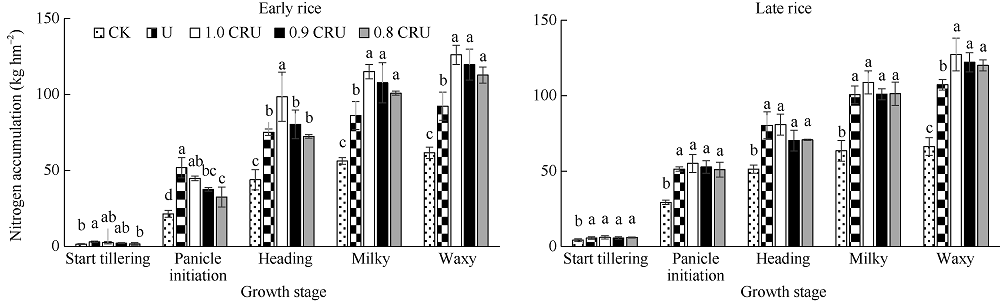
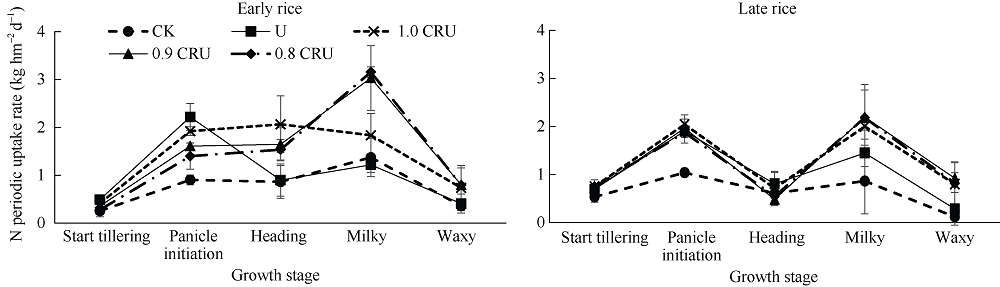
缓控释肥料应用于我国水稻生产中, 对化肥使用量零增长和农业可持续发展具有重要推动作用。本研究以连续在湖南进行6年(2013—2018年)的双季稻控释尿素施用试验为研究平台, 分析控释尿素施用下环洞庭湖区早晚稻主要生育期地上部氮素累积、氮素阶段吸收速率与氮素利用的关系, 探究控释尿素减施对水稻持续稳产增产的原因。结果表明: 早稻各施氮处理均有1次明显的氮素阶段吸收速率峰值, 控释尿素(controlled-release urea, CRU)处理氮素吸收相对延后, 氮素累积主要在幼穗分化始期至抽穗期阶段, 占生育期总量的35.31%~42.33%, 其次为始分蘖期至幼穗分化始期和抽穗期至乳熟期。晚稻于始分蘖期至幼穗分化始期和抽穗期至乳熟期出现2次明显的氮素阶段吸收速率峰值, 均以1.0 CRU (等氮量控释尿素)处理峰值最高; 始分蘖期至幼穗分化始期、抽穗期至乳熟期水稻大量吸收氮素, 累积增量分别占35.92%~40.52%和23.05%~24.58%。控释尿素还能显著提高双季稻产量, 早晚稻分别以0.9 CRU (控释尿素减氮10%)和0.8 CRU (控释尿素减氮20%)处理最佳, 控释尿素减施的晚稻增产效果优于早稻, 且显著提高早晚稻氮肥吸收利用率、农学利用率和偏生产力。CRU处理早晚稻产量与幼穗分化始期、抽穗期、乳熟期、腊熟期氮素累积量和有效穗数均呈极显著正相关, 且晚稻产量与穗长呈显著正相关; 早晚稻幼穗分化始期氮素累积量与氮肥农学利用率、生理利用率呈显著负相关, 氮肥偏生产力与早稻幼穗分化始期、抽穗期、乳熟期和腊熟期氮素累积量呈极显著或显著负相关, 与晚稻抽穗期氮素累积量呈显著负相关。因此, 控释尿素施用使水稻氮素阶段吸收速率、地上部氮素累积后延, 有利于后期生殖生长及籽粒结实, 显著提高双季稻产量及氮肥利用效率。结合双季稻吸氮特征和籽粒产量, 建议环洞庭湖区早稻采用释放期较短的控释尿素或配合速效氮肥施用, 进一步实现增产。
| [1] | 王敬国, 林杉, 李保国. 氮循环与中国农业氮管理. 中国农业科学, 2016,49:503-517. |
| Wang J G, Lin S, Li B G. Nitrogen cycling and management strategies in Chinese agriculture. Sci Agric Sin, 2016,49:503-517 (in Chinese with English abstract). | |
| [2] | 刘立军, 杨立年, 孙小淋, 王志琴, 杨建昌. 水稻实地氮肥管理的氮肥利用效率及其生理原因. 作物学报, 2009,35:1672-1680. |
| Liu L J, Yang L N, Sun X L, Wang Z Q, Yang J C. Fertilizer-nitrogen use efficiency and its physiological mechanism under site-specific nitrogen management in rice. Acta Agron Sin, 2009,35:1672-1680 (in Chinese with English abstract). | |
| [3] | 朱兆良. 农田中氮肥的损失与对策. 土壤与环境, 2000,9(1):1-6. |
| Zhu Z L. Loss of fertilizer N from plants-soil system and the strategies and techniques for its reduction. Soil Environ Sci, 2000,9(1):1-6 (in Chinese with English abstract). | |
| [4] | 彭少兵, 黄见良, 钟旭华, 杨建昌, 王光火, 邹应斌, 张福锁, 朱庆森. Roland B, Christian W. 提高中国稻田氮肥利用率的研究策略. 中国农业科学, 2002,35, 1095-1103. |
| Peng S B, Huang J L, Zhong X H, Yang J C, Wang G H, Zou Y B, Zhang F S, Zhu Q S, Roland B, Christian W. Research strategy in improving fertilizer nitrogen use efficiency of irrigated rice in China. Sci Agric Sin, 2002,35:1095-1103 (in Chinese with English abstract). | |
| [5] | 张海军, 武志杰, 梁文举, 解宏图. 包膜肥料养分控释机理研究进展. 应用生态学报, 2003,14:2337-2341. |
| Zhang H J, Wu Z J, Liang W J, Xie H T. Research advances on controlled-release mechanisms of nutrients in coated fertilizers. Chin J Appl Ecol, 2003,14:2337-2341. | |
| [6] | 李敏, 郭熙盛, 叶舒娅, 刘枫, 袁嫚嫚, 黄义德. 硫膜和树脂膜控释尿素对水稻产量、光合特性及氮肥利用率的影响. 植物营养与肥料学报, 2013,19:808-815. |
| Li M, Guo X S, Ye S Y, Liu F, Yuan M M, Huang Y D. Effects of sulfur-and polymercoated controlled release urea on yield, photosynthetic characteristics and nitrogen fertilizer efficiency of rice. Plant Nutr Fert Sci, 2013,19:808-815 (in Chinese with English abstract). | |
| [7] | 聂军, 肖剑, 戴平安, 郑圣先. 控释氮肥对水稻氮代谢关键酶活性及糙米蛋白质含量的影响. 湖南农业大学学报(自然科学版), 2003,29:318-321. |
| Nie J, Xiao J, Dai P A, Zheng S X. Effect of controlled release nitrogen fertilizer on key enzymes activities of nitrogen metabolism and protein contents in brown rice. J Hunan Agric Univ (Nat Sci Edn), 2003,29:318-321 (in Chinese with English abstract). | |
| [8] | 黄思怡, 田昌, 谢桂先, 欧震, 刘强, 彭建伟. 控释尿素减少双季稻田氨挥发的主要机理和适宜用量. 植物营养与肥料学报, 2019,25:2102-2112. |
| Huang S Y, Tian C, Xie G X, Ou Z, Liu Q, Peng J W. Mechanism and suitable application dosage of controlled-release urea effectively reducing ammonia volatilization in double-cropping paddy fields. Plant Nutr Fert Sci, 2019,25:2102-2112 (in Chinese with English abstract). | |
| [9] | 田昌, 周旋, 黄思怡, 袁浩凌, 谢桂先, 刘强, 彭建伟. 控释尿素减施对稻田CH4和N2O排放及经济效益的影响. 生态环境学报, 2019,28:2223-2230. |
| Tian C, Zhou X, Huang S Y, Yuan H L, Xie G X, Liu Q, Peng J W. Effects of controlled-release urea reduction on CH4 and N2O emissions and its economic benefits in double cropping paddy fields. Ecol Environ Sci, 2019,28:2223-2230 (in Chinese with English abstract). | |
| [10] | Wang S Q, Zhao X, Xing G X, Yang Y C, Zhang M, Chen H K. Improving grain yield and reducing N loss using polymer-coated urea in southeast China. Agron Sustain Dev, 2015,35:1103-1115. |
| [11] | 杜君, 孙克刚, 张运红, 和爱玲, 孙克振. 控释尿素对水稻生理特性、氮肥利用率及土壤硝态氮含量的影响. 农业资源与环境学报, 2016,33:134-141. |
| Du J, Sun K G, Zhang Y H, He A L, Sun K Z. Effects of controlled release urea on physiological characteristics and nitrogen use efficiency of rice and NO3--N contents in soil. J Agric Res Environ, 2016,33:134-141 (in Chinese with English abstract). | |
| [12] | 纪雄辉, 罗兰芳, 郑圣先. 控释肥料对提高水稻养分利用率和削减稻田土壤环境污染的作用. 磷肥与复肥, 2007,22(2):67-68. |
| Ji X H, Luo L F, Zheng S X. Effect of controlled release fertilizer on increasing rice nutrient use efficiency and minimizing environmental contamination of rice field. Phos Comp Fert, 2007,22(2):67-68 (in Chinese with English abstract). | |
| [13] | 蒋曦龙, 陈宝成, 张民, 李成亮, 马丽, 陈剑秋. 控释肥氮素释放与水稻氮素吸收相关性研究. 水土保持学报, 2014,28:215-220. |
| Jiang X L, Chen B C, Zhang M, Li C L, Ma L, Chen J Q. Study on the correlation between nitrogen release dynamics of controlled-release fertilizer and nitrogen uptake of the rice. J Soil Water Conserv, 2014,28:215-220 (in Chinese with English abstract). | |
| [14] | 侯红乾, 冀建华, 刘益仁, 黄永兰, 冯兆滨, 刘秀梅, 胡兆平, 韦礼和, 王子君. 缓/控释肥对双季稻产量、氮素吸收和平衡的影响. 土壤, 2018,50:43-50. |
| Hou H Q, Ji J H, Liu Y R, Huang Y L, Feng Z B, Liu X M, Hu Z P, Wei L H, Wang Z J. Effects of slow/controlled-release fertilizer on grain yield, N uptake and soil N balance in double cropping rice. Soils, 2018,50:43-50 (in Chinese with English abstract). | |
| [15] | 邓飞, 王丽, 刘利, 刘代银, 任万军, 杨文钰. 不同生态条件下栽培方式对水稻干物质生产和产量的影响. 作物学报, 2012,38:1930-1942. |
| Deng F, Wang L, Liu L, Liu D Y, Ren W J, Yang W Y. Effects of cultivation methods on dry matter production and yield of rice under different ecological conditions. Acta Agron Sin, 2012,38:1930-1942 (in Chinese with English abstract). | |
| [16] | 彭玉, 孙永健, 蒋明金, 徐徽, 秦俭, 杨志远, 马均. 不同水分条件下缓/控释氮肥对水稻干物质量和氮素吸收、运转及分配的影响. 作物学报, 2014,40:859-870. |
| Peng Y, Sun Y J, Jiang M J, Xu H, Qin J, Yang Z Y, Ma J. Effects of water management and slow/controlled release nitrogen fertilizer on biomass and nitrogen accumulation, translocation, and distribution in rice. Acta Agron Sin, 2014,40:859-870 (in Chinese with English abstract). | |
| [17] | Jiang L G, Dai T B, Jiang D, Cao W X, Gan X Q, Wei S Q. Charactering physiological N-use efficiency as influenced by nitrogen management in three rice cultivars. Field Crops Res, 2004,88:239-250. |
| [18] | 刘德林, 聂军, 肖剑. 15N标记水稻控释氮肥对提高氮素利用效率的研究. 激光生物学报, 2002,11(2):87-92. |
| Liu D L, Nie J, Xiao J. Study on 15N labeled rice controlled release fertilizer in increasing nitrogen utilization efficiency . Acta Laser Bio Sin, 2002,11(2):87-92 (in Chinese with English abstract). | |
| [19] | 郑圣先, 肖剑, 易国英. 淹水稻田土壤条件下包膜控释肥料养分释放的动力学与数学模拟. 磷肥与复肥, 2005,20(4):8-11. |
| Zheng S X, Xiao J, Yi G Y. Kinetics and mathematic simulation of nutrient release from coated controlled release fertilizer under the condition of flooded paddy soil. Phos Comp Fert, 2005,20(4):8-11 (in Chinese with English abstract). | |
| [20] | 田昌, 周旋, 刘强, 谢桂先, 荣湘民, 张玉平, 黄思怡, 彭建伟. 控释尿素减施对双季稻田氮素渗漏淋失的影响. 应用生态学报, 2018,29:3267-3274. |
| Tian C, Zhou X, Liu Q, Xie G X, Rong X M, Zhang Y P, Huang S Y, Peng J W. Effects of the reduction of controlled-release urea application on nitrogen leaching in double cropping paddy field. Chin J Appl Ecol, 2018,29:3267-3274 (in Chinese with English abstract). | |
| [21] | 张福锁, 王激清, 张卫峰, 崔振岭, 马文奇, 陈新平, 江荣风. 中国主要粮食作物肥料利用率现状与提高途径. 土壤学报, 2008,45:915-924. |
| Zhang F S, Wang J Q, Zhang W F, Cui Z L, Ma W Q, Chen X P, Jiang R F. Nutrients use efficiencies of major cereal crops in china and measures for improvement. Acta Pedol Sin, 2008,45:915-924 (in Chinese with English abstract). | |
| [22] | 鲁艳红, 聂军, 廖育林, 周兴, 王宇, 汤文光. 氮素抑制剂对双季稻产量、氮素利用效率及土壤氮平衡的影响. 植物营养与肥料学报, 2018,24:95-104. |
| Lu Y H, Nie J, Liao Y L, Zhou X, Wang Y, Tang W G. Effects of urease and nitrification inhibitor on yield, nitrogen efficiency and soil nitrogen balance under double-rice cropping system. Plant Nutr Fert Sci, 2018,24:95-104 (in Chinese with English abstract). | |
| [23] | Zhou J B, Xi J G, Chen Z J, Li S X. Leaching and transformation of nitrogen fertilizers in soil after application of N with irrigation: a soil column method. Pedosphere, 2006,16:245-252. |
| [24] | Ji X H, Zheng S X, Shi L H, Liu Z B. Systematic studies of nitrogen loss from paddy soils through leaching in the Dongting Lake area of China. Pedosphere, 2011,21:753-762. |
| [25] | 俞巧钢, 叶静, 杨梢娜, 符建荣, 马军伟, 孙万春, 姜丽娜, 王强, 汪建妹. 不同施氮量对单季稻养分吸收及氨挥发损失的影响. 中国水稻科学, 2012,26:487-494. |
| Yu Q G, Ye J, Yang S N, Fu J R, Ma J W, Sun W C, Jiang L N, Wang Q, Wang J M. Effects of different nitrogen application levels on rice nutrient uptake and ammonium volatilization. Chin J Rice Sci, 2012,26:487-494 (in Chinese with English abstract). | |
| [26] | 鲁艳红, 聂军, 廖育林, 周兴, 谢坚, 汤文光, 杨曾平. 不同控释氮肥减量施用对双季水稻产量和氮素利用的影响. 水土保持学报, 2016,30:155-161. |
| Lu Y H, Nie J, Liao Y L, Zhou X, Xie J, Tang W G, Yang Z P. Effects of application reduction of controlled release nitrogen fertilizer on yield of double cropping rice and nitrogen uptake. J Soil Water Conserv, 2016,30:155-161 (in Chinese with English abstract). | |
| [27] | Geng J B, Sun Y B, Zhang M, Li C L, Yang Y C, Liu Z G, Li S L. Long-term effects of controlled release urea application on crop yields and soil fertility under rice-oilseed rape rotation system. Field Crops Res, 2015,184:65-73. |
| [28] | 田昌, 周旋, 谢桂先, 刘强, 荣湘民, 张玉平, 谭力彰, 彭建伟. 控释尿素减施对双季稻田径流氮素变化、损失及产量的影响. 水土保持学报, 2018,32(3):21-28. |
| Tian C, Zhou X, Xie G X, Liu Q, Rong X M, Zhang Y P, Tan L Z, Peng J W. Effects of controlled-release urea application on dynamics and loss of nitrogen in runoff and yield in double-rice cropping field. J Soil Water Conserv, 2018,32(3):21-28 (in Chinese with English abstract). |
| [1] | 胡川, 赵凯男, 黄修利, 吴金芝, 任开明, 王贺正, 付国占, 黄明, 李友军. 一次灌溉下耕作方式和氮肥用量对旱地小麦产量和品质的影响[J]. 作物学报, 2026, 52(6): 1830-1846. |
| [2] | 马胜乾, 王志平, 陈浩天, 窦淑贤, 张燕, 邓艾兴, 张卫建, 原向阳, 宋振伟. 秸秆还田下耕作方式与氮肥施用量对东北玉米产量及土壤团聚体的影响[J]. 作物学报, 2026, 52(6): 1802-1816. |
| [3] | 张思思, 赵向辉, 周洋, 姚云凤, 朱荣昱, 董元杰, 胡国庆, 徐通, 刘兆新. 冬闲期翻耕和绿肥还田对连作花生田土壤理化性质和产量的影响[J]. 作物学报, 2026, 52(5): 1472-1486. |
| [4] | 张宁宁, 滕雨菲, 任娜娜, 魏兴卓, 闫书豪, 樊可心, 王永宏, 陈文康, 张兴华, 朱万超, 徐淑兔, 薛吉全. 201份玉米自交系抗旱表型评价及可塑性分析[J]. 作物学报, 2026, 52(5): 1309-1325. |
| [5] | 张振, 冯连杰, 石玉, 于振文, 张永丽. 节水补灌下不同穗型小麦产量形成差异研究[J]. 作物学报, 2026, 52(5): 1522-1535. |
| [6] | 闫安, 蒋昆炜, 王蓉圆, 田林, 张璐, 王韵, 徐建龙. 水稻剑叶小维管束数基因SVN7的鉴定与克隆[J]. 作物学报, 2026, 52(5): 1364-1372. |
| [7] | 刘昕萌, 任昊, 张继波, 张吉旺, 赵斌, 任佰朝, 刘鹏, 王洪章. 茉莉酸甲酯(MeJA)缓解高温影响玉米雌穗分化的生理机制[J]. 作物学报, 2026, 52(5): 1561-1572. |
| [8] | 王壮壮, 武紫君, 张永新, 张芯源, 袁丽雪, 陈如雪, 刘世举, 段剑钊, 冯伟, 王同朝, 王永华. 豫东南黏壤潮土区水氮优化协同提高冬小麦产量和氮素利用效率[J]. 作物学报, 2026, 52(5): 1501-1521. |
| [9] | 张鸿蓉, 王菲儿, 李盼, 仇海龙, 朱静, 赵连豪, 南运有, 何蔚, 樊志龙, 胡发龙, 柴强, 殷文. 减量20%灌水与25%有机肥替代化肥提高青贮玉米产量的光合特性[J]. 作物学报, 2026, 52(5): 1487-1500. |
| [10] | 王宇诚, 张露, 刘阿康, 黄见良, 彭少兵, 袁珅. 基于产量差的作物大面积单产提升策略与展望[J]. 作物学报, 2026, 52(5): 1279-1290. |
| [11] | 赵佳雪, 周龙昊, 郭岂源, 尚伦霄, 王涵, 刘志涛, 陈曦, 张晓佩, 宋宪亮, 毛丽丽. 长期秸秆还田与深松通过改善土壤环境与棉花光合特性提高滨海盐碱地棉花产量[J]. 作物学报, 2026, 52(5): 1548-1560. |
| [12] | 郭星宇, 胡丹, 林苏期, 王梦凯, 谭文峰, 黄传琴. 生物炭配施化肥提高玉米‖大豆下玉米产量和土壤生态系统多功能性[J]. 作物学报, 2026, 52(5): 1536-1547. |
| [13] | 蔡宏玮, 于爱忠, 姜科强, 王鹏飞, 王玉珑, 霍建喆, 庞小能, 尹波, 尚永盼. 干旱灌区有机肥替代部分化肥促进甜玉米产量提升的关键机制[J]. 作物学报, 2026, 52(4): 1166-1180. |
| [14] | 崔雪梅, 柳妍娣, 刘景辉, 米俊珍, 武俊英, 赵宝平. 不同基因型燕麦强弱势粒生理特性与产量关系研究[J]. 作物学报, 2026, 52(4): 1220-1235. |
| [15] | 杨锐, 陈敬东, 黄郢, 张学昆, 周登文, 刘清云, 徐劲松, 谢伶俐, 许本波. 长江下游冬油菜区应对气候变化的育种和栽培策略研究[J]. 作物学报, 2026, 52(4): 1153-1165. |
|
||