欢迎访问作物学报,今天是
作物学报 ›› 2022, Vol. 48 ›› Issue (3): 565-571.doi: 10.3724/SP.J.1006.2022.14011
杜浩1( ), 程玉汉2, 李泰1, 侯智红1, 黎永力1, 南海洋1, 董利东1, 刘宝辉1, 程群1,*()
DU Hao1(), CHENG Yu-Han2, LI Tai1, HOU Zhi-Hong1, LI Yong-Li1, NAN Hai-Yang1, DONG Li-Dong1, LIU Bao-Hui1, CHENG Qun1,*()
摘要:
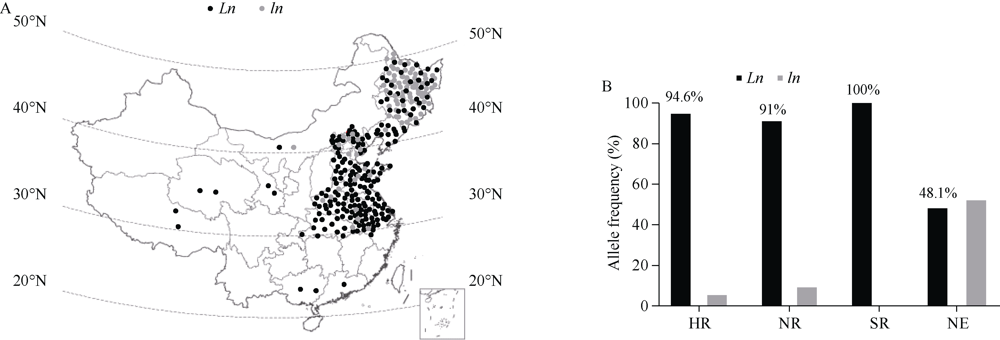
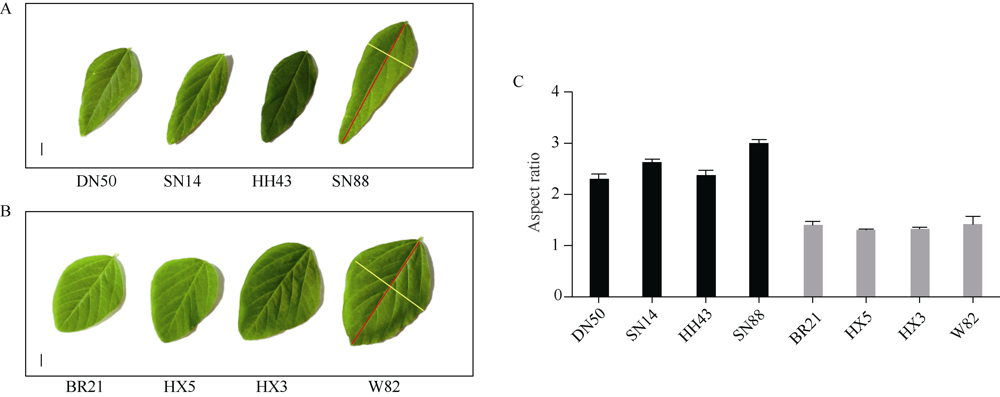
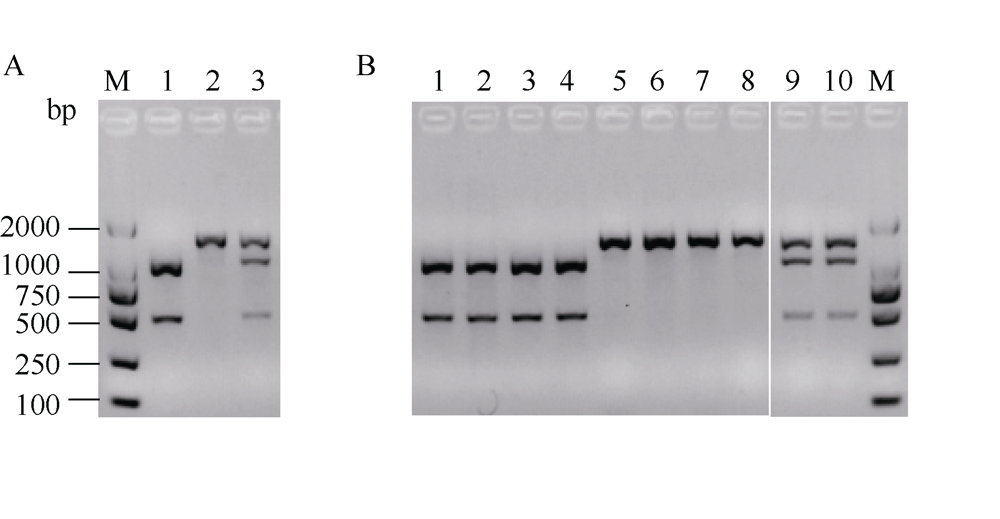
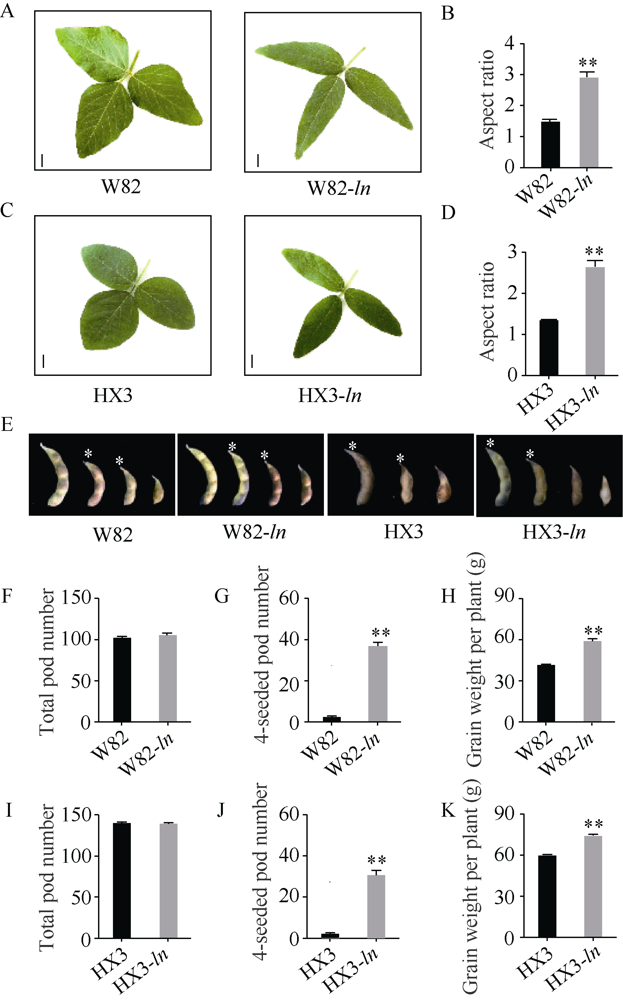
分子设计育种是将分子遗传学与传统育种相结合, 并培育成具有优良性状的新品种的重要方法之一, 尽管该方法很大程度上能够缩短育种进程, 但在实际育种过程中却应用较少。在大豆的育种过程中, 提高产量是主要的育种目标之一, 其中, 每荚粒数是决定大豆单株产量的关键性状之一。在大豆中, 每荚粒数与叶片形状呈正相关, 由一对等位基因Ln/ln控制, 宽叶的大豆品种一般为Ln, 窄叶的大豆品种一般为突变型ln, 且ln伴随着更多的四粒荚。尽管Ln对于大豆单产的提高, 具有潜在的重要作用, 但将该位点应用于分子设计育种中, 报道较少。本研究通过分析483份来自不同纬度大豆品种的Ln基因型发现, 高纬度地区大豆品种一般为ln, 而低纬度地区大豆品种一般为Ln。通过调查来自不同纬度的8个大豆品种的叶型和一粒荚至四粒荚个数发现, 低纬度大豆品种均为圆叶品种, 且几乎没有四粒荚。为将ln应用于低纬度地区大豆育种中, 成功开发了Ln的分子标记, 并通过连续回交的方法, 将ln代换到圆叶型品种Willams 82和华夏3号中, 获得了四粒荚较多的大豆新材料。本研究利用大豆分子设计育种的手段, 提高了大豆单株产量, 为加快大豆高产育种进程提供了重要的理论及实践基础。
| [1] |
Ashraf M, Foolad R. Crop breeding for salt tolerance in the era of molecular markers and marker-assisted selection. Plant Breed, 2013, 132:10-20.
doi: 10.1111/pbr.2013.132.issue-1 |
| [2] | Sharma S, Sharma A. Molecular markers based plant breeding. Adv Res, 2018, 16:2348. |
| [3] |
Hartung R C, Specht J E, Williams J H. Modification of soybean plant architecture by genes for stem growth habit and maturity. Crop Sci, 1981, 21:51-62.
doi: 10.2135/cropsci1981.0011183X002100010015x |
| [4] | 田志喜, 刘宝辉, 杨艳萍, 李明, 姚远, 任小波, 薛勇彪. 大豆分子设计育种成果与展望. 中国科学院院刊, 2018, 33:915-922. |
| Tian Z X, Liu B H, Yang Y P, Li M, Yao Y, Ren X B, Xue Y B. Update and prospect of soybean molecular module-based designer breeding in China. Bull Chin Acad Sci, 2018, 33:915-922 (in Chinese with English abstract). | |
| [5] |
Cheng Q, Dong L D, Su T, Li T Y, Gan Z R, Nan H Y, Lu S J, Fang C, Kong L P, Li H Y, Hou Z H, Kou K, Tang Y, Lin X Y, Zhao X H, Chen L Y, Liu B H, Kong F J. CRISPR/Cas9-mediated targeted mutagenesis of GmLHY genes alters plant height and internode length in soybean. BMC Plant Biol, 2019, 19:562.
doi: 10.1186/s12870-019-2145-8 pmid: 31852439 |
| [6] |
Chen L Y, Nan H Y, Kong L P, Yue L, Yang H, Zhao Q S, Fang C, Li H Y, Cheng Q, Lu S J, Kong F J, Liu B H, Dong L D. Soybean AP1 homologs control flowering time and plant height. J Integr Plant Biol, 2020, 62:1868-1879.
doi: 10.1111/jipb.v62.12 |
| [7] |
Fan C C, Xing Y Z, Mao H L, Lu T T, Han B, Xu C G, Li X H, Zhang Q F. GS3, a major QTL for grain length and weight and minor QTL for grain width and thickness in rice, encodes a putative transmembrane protein. Theor Appl Genet, 2006, 112:1164-1171.
doi: 10.1007/s00122-006-0218-1 |
| [8] |
Lu S J, Dong L D, Fang C, Liu S L, Kong L P, Cheng Q, Chen L Y, Su T, Nan H Y, Zhang D, Zhang L, Wang Z J, Yang Y Q, Yu D Y, Liu X L, Yang Q Y, Lin X Y, Tang Y, Zhao X H, Yang X Q, Tian C E, Xie Q G, Li X, Yuan X H, Tian Z X, Liu B H, Weller J L, Kong F J. Stepwise selection on homeologous PRR genes controlling flowering and maturity during soybean domestication. Nat Genet, 2020, 52:428-436.
doi: 10.1038/s41588-020-0604-7 |
| [9] |
Kong F J, Liu B H, Xia Z J, Sato S, Kim B M, Watanabe S, Yamada T, Tabata S, Kanazawa A, Harada K, Abe J. Two coordinately regulated homologs of FLOWERING LOCUS T are involved in the control of photoperiodic flowering in soybean. Plant Physiol, 2010, 154:1220-1231.
doi: 10.1104/pp.110.160796 |
| [10] |
Li Z B, Cheng Q, Gan Z R, Hou Z H, Zhang Y H, Li Y L, Li H Y, Nan H Y, Yang C, Chen L N, Lu S J, Shi W Q, Chen L Y, Wang Y P, Fang C, Kong L P, Su T, Li S C, Kou K, Wang L S, Kong F J, Liu B H, Dong L D. Multiplex CRISPR/Cas9-mediated knockout of soybean LNK2 advances flowering time. Crop J, 2021, 9:767-776.
doi: 10.1016/j.cj.2020.09.005 |
| [11] |
Li M W, Liu W, Lam H M, Gendron J M. PRR3 genes during soybean domestication PRR3 genes during soybean domestication. Plant Cell Physiol, 2019, 60:407-420.
doi: 10.1093/pcp/pcy215 |
| [12] |
Cheng Q, Gan Z R, Wang Y P, Lu S J, Hou Z H, Li H Y, Xiang H T, Liu B H, Kong F J, Dong L D. J contributes to salt stress tolerance by up-regulating salt-responsive genes J contributes to salt stress tolerance by up-regulating salt-responsive genes. Front Plant Sci, 2020, 11:272.
doi: 10.3389/fpls.2020.00272 pmid: 32256507 |
| [13] |
Hymowitz T. On the domestication of the soybean. Econ Bot, 1970, 24:408-421.
doi: 10.1007/BF02860745 |
| [14] |
Lee G A, Crawford G W, Liu L, Sasaki Y, Chen X. Archaeological soybean (Glycine max) in East Asia: does size matter? PLoS One, 2011, 6:e26720.
doi: 10.1371/journal.pone.0026720 |
| [15] |
Fang C, Li W Y, Li G Q, Wang Z, Zhou Z K, Ma Y M, Shen Y I, Li C C, Wu Y H, Zhu B G, Yang W C, Tian Z X. Ln gene through combined approach of map-based cloning and association study in soybean Ln gene through combined approach of map-based cloning and association study in soybean. J Genet Genomics, 2013, 40:93-96.
doi: 10.1016/j.jgg.2013.01.002 |
| [16] |
Jeong N, Moon J J, Kim H S, Kim C G, Jeong S C. Fine genetic mapping of the genomic region controlling leaflet shape and number of seeds per pod in the soybean. Theor Appl Genet, 2011, 122:865-874.
doi: 10.1007/s00122-010-1492-5 |
| [17] |
Jeong N, Suh S J, Kim M H, Lee S, Moon J K, Kim H S, Jeong S C. Ln is a key regulator of leaflet shape and number of seeds per pod in soybean. Plant Cell, 2012, 24:4807-4818.
doi: 10.1105/tpc.112.104968 |
| [18] |
Sayama T, Tanabata T, Saruta M, Yamada T, Anai T, Kaga A, Ishimoto M. Ln gene in induced soybean mutants Ln gene in induced soybean mutants. Breed Sci, 2017, 67:363-369.
doi: 10.1270/jsbbs.16201 |
| [19] |
Ohno C K, Reddy G V, Heisler M G, Meyerowitz E M. Arabidopsis JAGGED gene encodes a zinc finger protein that promotes leaf tissue development Arabidopsis JAGGED gene encodes a zinc finger protein that promotes leaf tissue development. Development, 2004, 131:1111-1122.
doi: 10.1242/dev.00991 |
| [20] | Neumaier N, James A T. Exploiting the long-juvenile trait to improve adaptation of soybeans to the tropics. Food Legume Newsl, 1993, 8:12-14. |
| [21] |
Spehar C R. Impact of strategic genes in soybean on agricultural development in the Brazilian tropical savannah. Field Crops Res, 1995, 41:141-146.
doi: 10.1016/0378-4290(95)00007-D |
| [22] |
Fang C, Ma Y M, Wu S W, Liu Z, Wang Z, Yang R, Hu G H, Zhou Z K, Yu H, Zhang M, Pan Y, Zhou G A, Ren H X, Du W G, Yan H R, Wang Y P, Han D Z, Shen Y T, Liu S L, Liu T F, Zhang J X, Qin H, Yuan J, Yuan X H, Kong F J, Liu B H, Li J Y, Zhang Z W, Wang G D, Zhu B G, Tian Z X. Genome-wide association studies dissect the genetic networks underlying agronomical traits in soybean. Genome Biol, 2017, 18:161-175.
doi: 10.1186/s13059-017-1289-9 |
| [23] |
Wu F Q, Kang X H, Wang M L, Haider W, Price W B, Hajek B, Hanzawa Y. GmCOL1 feed-forward loop and its roles in photoperiodic flowering of soybean GmCOL1 feed-forward loop and its roles in photoperiodic flowering of soybean. Front Plant Sci, 2019, 10:1221.
doi: 10.3389/fpls.2019.01221 |
| [24] |
Zhao X H, Cao D, Huang Z J, Wang J L, Lu S J, Xu Y, Liu B H, Kong F J, Yuan X H. Dual functions of GmTOE4a in the regulation of photoperiod-mediated flowering and plant morphology in soybean. Plant Mol Biol, 2015, 88:343-355.
doi: 10.1007/s11103-015-0322-1 |
| [1] | 胡川, 赵凯男, 黄修利, 吴金芝, 任开明, 王贺正, 付国占, 黄明, 李友军. 一次灌溉下耕作方式和氮肥用量对旱地小麦产量和品质的影响[J]. 作物学报, 2026, 52(6): 1830-1846. |
| [2] | 金昱何, 王雪菲, 徐张一娃, 缪怡宁, 蒋云杰, 伊莹, 缪德麟, 朱静仪, 钟一帆, 陈铭亨, 方芳, 刘鹏. 外源激素对低温胁迫下大豆叶片叶绿素荧光参数及抗氧化酶系统的影响[J]. 作物学报, 2026, 52(6): 1817-1829. |
| [3] | 马胜乾, 王志平, 陈浩天, 窦淑贤, 张燕, 邓艾兴, 张卫建, 原向阳, 宋振伟. 秸秆还田下耕作方式与氮肥施用量对东北玉米产量及土壤团聚体的影响[J]. 作物学报, 2026, 52(6): 1802-1816. |
| [4] | 唐宽强, 李公允, 宋美毅, 赵雪, 常春玲. 大豆株高性状全基因组关联分析及预测模型构建[J]. 作物学报, 2026, 52(6): 1743-1756. |
| [5] | 张思思, 赵向辉, 周洋, 姚云凤, 朱荣昱, 董元杰, 胡国庆, 徐通, 刘兆新. 冬闲期翻耕和绿肥还田对连作花生田土壤理化性质和产量的影响[J]. 作物学报, 2026, 52(5): 1472-1486. |
| [6] | 姚术, 郭凯悦, 翟慧慧, 姚佳慧, 邓文琪, 闫玲, 黄驰, 高阳, 俞嫣然, 赵振邦, 李英慧, 王晓波, 李佳佳. 大豆苗期耐低铁综合评价及优异种质筛选[J]. 作物学报, 2026, 52(5): 1373-1387. |
| [7] | 张宁宁, 滕雨菲, 任娜娜, 魏兴卓, 闫书豪, 樊可心, 王永宏, 陈文康, 张兴华, 朱万超, 徐淑兔, 薛吉全. 201份玉米自交系抗旱表型评价及可塑性分析[J]. 作物学报, 2026, 52(5): 1309-1325. |
| [8] | 王宇诚, 张露, 刘阿康, 黄见良, 彭少兵, 袁珅. 基于产量差的作物大面积单产提升策略与展望[J]. 作物学报, 2026, 52(5): 1279-1290. |
| [9] | 赵佳雪, 周龙昊, 郭岂源, 尚伦霄, 王涵, 刘志涛, 陈曦, 张晓佩, 宋宪亮, 毛丽丽. 长期秸秆还田与深松通过改善土壤环境与棉花光合特性提高滨海盐碱地棉花产量[J]. 作物学报, 2026, 52(5): 1548-1560. |
| [10] | 郭星宇, 胡丹, 林苏期, 王梦凯, 谭文峰, 黄传琴. 生物炭配施化肥提高玉米‖大豆下玉米产量和土壤生态系统多功能性[J]. 作物学报, 2026, 52(5): 1536-1547. |
| [11] | 张振, 冯连杰, 石玉, 于振文, 张永丽. 节水补灌下不同穗型小麦产量形成差异研究[J]. 作物学报, 2026, 52(5): 1522-1535. |
| [12] | 闫安, 蒋昆炜, 王蓉圆, 田林, 张璐, 王韵, 徐建龙. 水稻剑叶小维管束数基因SVN7的鉴定与克隆[J]. 作物学报, 2026, 52(5): 1364-1372. |
| [13] | 刘昕萌, 任昊, 张继波, 张吉旺, 赵斌, 任佰朝, 刘鹏, 王洪章. 茉莉酸甲酯(MeJA)缓解高温影响玉米雌穗分化的生理机制[J]. 作物学报, 2026, 52(5): 1561-1572. |
| [14] | 王壮壮, 武紫君, 张永新, 张芯源, 袁丽雪, 陈如雪, 刘世举, 段剑钊, 冯伟, 王同朝, 王永华. 豫东南黏壤潮土区水氮优化协同提高冬小麦产量和氮素利用效率[J]. 作物学报, 2026, 52(5): 1501-1521. |
| [15] | 张鸿蓉, 王菲儿, 李盼, 仇海龙, 朱静, 赵连豪, 南运有, 何蔚, 樊志龙, 胡发龙, 柴强, 殷文. 减量20%灌水与25%有机肥替代化肥提高青贮玉米产量的光合特性[J]. 作物学报, 2026, 52(5): 1487-1500. |
|
||