欢迎访问作物学报,今天是

作物学报 ›› 2023, Vol. 49 ›› Issue (7): 1843-1859.doi: 10.3724/SP.J.1006.2023.24173

• 作物遗传育种·种质资源·分子遗传学 • 上一篇    下一篇

茶树新梢中香叶醇樱草糖苷含量的全基因组关联分析

王让剑1,2,*(), 杨军1,2, 张力岚1,2, 高香凤1,2   

  1. 1福建省农业科学院茶叶研究所, 福建福州 355012
    2国家茶树改良中心福建分中心, 福建福州 355012
  • 收稿日期:2022-08-01 接受日期:2022-11-25 出版日期:2023-07-12 网络出版日期:2023-01-17
  • 通讯作者: *王让剑, E-mail: wangrj@faas.cn
  • 基金资助:
    本研究由国家重点研发计划项目(2019YFD1001601);福建省与中国农业科学院“5511”协同创新工程项目(XTCXGC2021004);福建省自然科学基金项目(2020J011366)

Genome-wide association analysis of geraniol primrose glycoside abundance in tender tea shoots

WANG Rang-Jian1,2,*(), YANG Jun1,2, ZHANG Li-Lan1,2, GAO Xiang-Feng1,2   

  1. 1Tea Research Institute, Fujian Academy of Agricultural Sciences, Fuzhou 355012, Fujian, China
    2Fujian Branch, National Center for Tea Improvement, Fuzhou 355012, Fujian, China
  • Received:2022-08-01 Accepted:2022-11-25 Published:2023-07-12 Published online:2023-01-17
  • Contact: *E-mail: wangrj@faas.cn
  • Supported by:
    The National Key Research and Development Program of China(2019YFD1001601);The “5511” Collaborative Innovation Project between Fujian Province and Chinese Academy of Agricultural Sciences(XTCXGC2021004);The Natural Science Foundation of Fujian Province(2020J011366)

摘要:

香叶醇是茶树中含有的一种重要的挥发性单萜醇, 在茶树与环境互作中起重要作用, 也是茶叶中关键呈香成分之一, 茶树新梢中的香叶醇主要以香叶醇樱草糖苷形式存在。发掘香叶醇樱草糖苷含量性状显著关联的SNP位点与候选基因, 对香叶醇樱草糖苷含量的遗传调控机制研究与茶树遗传改良具有重要意义。以169个茶树种质为研究对象, 连续3年对其新梢香叶醇樱草糖苷含量进行鉴定, 基于SLAF简化基因组测序技术开发SNP标记, 然后利用一般线性模型(GLM)对茶树新梢香叶醇樱草糖苷含量性状进行GWAS分析, 发掘该性状显著关联的SNP位点与候选基因, 最后对极端含量材料间的候选基因编码区碱基差异及其上游顺式作用元件进行分析。结果表明, 参试群体在3个环境下香叶醇樱草糖苷含量变异系数范围为77.6%~81.8%, 广义遗传力为62.6%。香叶醇樱草糖苷含量性状在基因型、环境间均呈现显著差异, 变异受遗传影响为主。3个环境下共检测到340个SNP与香叶醇樱草糖苷含量显著相关, 其中2个环境下重复检测到65个SNP。基于参考基因组与连锁不平衡衰减距离, 获得重复检测到的SNP两侧各100 kb范围内的基因共88个, 包含信号蛋白、激酶、磷酸酶、离子转运蛋白、转录因子、热激蛋白、激素相关蛋白、抗性蛋白、萜类代谢酶、糖基转移酶、糖苷酶, 从中初筛出10个与香叶醇樱草糖苷含量相关的候选基因。极端含量材料之间的候选基因编码区序列均存在SNP非同义突变, 多数候选基因上游2 kb区域存在不同数量的与环境胁迫和激素相关的顺式作用元件。本研究为阐明茶新梢中香叶醇樱草糖苷含量的遗传调控机制提供了新的视角, 为分子标记辅助选择茶树新品种提供了标记与基因资源。

关键词: 茶树, 香叶醇樱草糖苷, 全基因组关联分析, 单核苷酸多态性, 候选基因

Abstract:

Geraniol is an important volatile monoterpene alcohol contained in tea plant, which plays an important role in the interaction between tea plant and environment and constitutes one of key aroma components in tea. Geraniol from tea plant tender shoots mainly exists in the form of geranyl β-primeveroside. Explore SNP loci and candidate genes significantly associated with geranyl β-primeveroside content is of great significance for the the genetic regulation mechanism of geranyl β-primeveroside content and tea plant genetic improvement. Regarding 169 tea germplasms as the research materials, the geranyl β-primeveroside content of tea plant tender shoots was identified for three consecutive years (three environments), and the SNP markers were developed based on SLAF-seq technology. Then, the geranyl β-primeveroside content of tea plant tender shoots was analyzed by genome-wide association analysis (GWAS) using general linear model (GLM). The candidate genes were further screened based on the SNP loci significantly with the geranyl β-primeveroside content. Ultimately, the base differences of candidate gene coding regions and their upstream cis acting elements among the extreme geranyl β-primeveroside content were analyzed. Results showed that the variation coefficient of geranyl β-primeveroside content in three environments ranged from 77.6% to 81.8%, and the broad heritability was 62.6%. The geranyl β-primeveroside content was significant differences among the genotypes and environments, and the variation was mainly affected by heredity. A total of 340 SNP markers significantly correlated with the geranyl β-primeveroside content were detected under three environments, in which 65 SNP markers were detected repeatedly under 2 environments. Based on the tea plant reference genome and linkage disequilibrium decay distance, a total of 88 genes within 100 kb on both sides of the repeated 65 SNP markers were obtained, including signal proteins, kinases, phosphatases, ion transporters, transcription factors, heat shock proteins, hormone related proteins, resistance proteins, terpene metabolic enzymes, glycosyltransferases, and glycosidases. 10 candidate genes were preliminary screened out. SNP nonsynonymous mutations in the coding region sequences of 10 candidate genes between two extreme geranyl β-primeveroside content materials, and different numbers of cis acting elements related to environmental stress and hormones in the upstream 2 kb regions of most candidate genes were discovered. This study provides a new perspective for clarifying the genetic regulation mechanism of geranyl β-primeveroside content in tea plant tender shoots, and also provides the markers and gene resources for molecular marker assisted selection of new tea varieties.

Key words: tea (Camellia sinensis L.), geranyl β-primeveroside, genome-wide association analysis (GWAS), single nucleotide polymorphism (SNP), candidate genes

表1

香叶醇樱草糖苷含量表型变异"

环境
Environment
均值
Mean value
标准差
Standard deviation
变异系数
Coefficient of variation (%)
Ryan-Joiner检测
Ryan-Joiner test
2018 0.3585 0.2809 78.4 r=0.917, P<0.01
2019 0.2674 0.2187 81.8 r=0.914, P<0.01
2020 0.3581 0.2779 77.6 r=0.855, P<0.01

表2

香叶醇樱草糖苷含量方差分析"

方差来源
Variance
自由度
DF
平方和
SS
均方
MS
F
F-value
遗传力h2
Heritability h2 (%)
基因 Genotype 168 34.1299 0.2032 6.12** 62.6
环境 Environment 2 0.9318 0.4659 14.04**
误差 Error 336 11.3233 0.0337

表3

群体SNP标记统计"

主要类型
Main types
最大数
Maximum number
最小数
Minimum number
平均数
Average number
基因间区Intergenic 1,595,407 513,424 1,062,687
内含子Intron 53,116 21,509 41,091
基因上游(5 kb内) Upstream in 5 kb 46,686 17,538 37,335
基因下游(5 kb内) Downstream in 5 kb 42,110 16,067 32,681
同义突变Synonymous 5004 2161 3537
非同义突变Nonsynonymous 6703 2931 4911
其他Other 2899 1161 2030

图1

遗传结构及连锁不平衡分析 A: 遗传结构分析; B: 主成分分析; C: 连锁不平衡分析。"

表4

香叶醇樱草糖苷含量相关的SNP位点"

染色体
Scaffold
SNP位置
SNP location
SNP变异
SNP variation
功能区
Functional area
贡献率
Contribution rate (%)
PP-value
2018 2019 2020
Scaffold106 940,480 C/T 间区Intergenic 19.3 4.25E-09 7.89E-08
940,538 A/G 间区Intergenic 18.1 1.01E-08 1.41E-07
Scaffold1262 982,460 G/A 间区Intergenic 18.2 5.56E-09 6.45E-08
982,581 A/T 间区Intergenic 18.2 5.56E-09 6.45E-08
Scaffold1318 1,188,898 C/A 间区Intergenic 20.7 2.70E-08 9.11E-10
Scaffold1611 610,786 C/T 间区Intergenic 20.7 1.60E-07 9.52E-09
Scaffold1671 583,382 C/T 内含子Intron 18.4 4.92E-09 7.52E-08
583,566 G/A 内含子Intron 18.2 6.24E-09 8.42E-08
Scaffold209 336,614 G/A 间区Intergenic 22.6 1.88E-09 6.50E-08
Scaffold211 1,175,079 G/A 间区Intergenic 19.2 1.56E-07 8.21E-09
1,175,109 T/A 间区Intergenic 19.2 1.56E-07 8.21E-09
1,175,111 C/T 间区Intergenic 19.2 1.56E-07 8.21E-09
1,175,135 C/T 间区Intergenic 19.2 1.56E-07 8.21E-09
1,175,177 C/T 间区Intergenic 19.2 1.55E-07 8.32E-09
Scaffold2268 2,777,884 G/A 间区Intergenic 19.4 1.33E-07 1.43E-08
2,777,990 G/A 间区Intergenic 20.4 1.26E-07 4.63E-09
Scaffold2311 361,209 C/T 间区Intergenic 18.5 1.00E-07 3.44E-09
Scaffold2800 1,171,675 A/T 间区Intergenic 19.8 8.69E-08 6.93E-09
Scaffold2942 113,797 G/A 间区Intergenic 20.0 1.15E-07 1.00E-08
113,806 C/T 间区Intergenic 20.0 1.15E-07 1.00E-08
Scaffold30 1,872,412 G/T 间区Intergenic 20.2 6.24E-09 7.68E-08
Scaffold3229 195,605 C/A 间区Intergenic 17.1 1.56E-08 1.53E-07
1,193,442 C/T 间区Intergenic 20.7 2.28E-09 3.86E-09
Scaffold3317 78,232 C/A 内含子Intron 23.9 2.35E-10 7.93E-10
78,432 G/A 内含子Intron 21.8 2.12E-09 1.47E-09
Scaffold3395 141,462 C/T 间区Intergenic 20.4 8.41E-09 3.16E-10
141,471 G/A 间区Intergenic 20.4 8.41E-09 3.16E-10
141,479 G/A 间区Intergenic 20.4 8.41E-09 3.16E-10
141,537 G/A 间区Intergenic 20.4 8.41E-09 3.16E-10
Scaffold349 3,542,803 G/A 间区Intergenic 21.5 8.21E-09 4.86E-10
3,543,009 G/A 间区Intergenic 22.0 4.03E-09 3.10E-10
3,543,014 G/A 间区Intergenic 21.0 6.06E-09 9.46E-10
3,543,021 G/T 间区Intergenic 20.8 8.62E-09 1.16E-09
3,543,061 C/T 间区Intergenic 21.0 7.19E-09 9.75E-10
3,543,082 G/A 间区Intergenic 21.0 6.52E-09 9.75E-10
Scaffold3611 1,622,374 A/C 间区Intergenic 18.7 9.80E-09 8.04E-08
1,622,376 A/G 间区Intergenic 18.7 9.80E-09 8.04E-08
Scaffold4122 389,378 G/A 间区Intergenic 19.5 2.34E-09 9.22E-10
444,511 C/T 间区Intergenic 18.8 2.51E-09 7.63E-10
444,749 C/A 间区Intergenic 18.8 2.51E-09 7.63E-10
444,760 G/A 间区Intergenic 19.4 2.37E-09 7.33E-10
Scaffold4659 1,061,780 G/A 间区Intergenic 19.0 3.62E-08 2.72E-09
Scaffold4817 276,251 C/T 间区Intergenic 17.8 6.68E-08 5.92E-09
Scaffold522 69,932 T/C 内含子Intron 20.2 8.67E-08 6.37E-09
69,936 T/C 内含子Intron 20.2 8.67E-08 6.37E-09
Scaffold708 2,098,580 G/A 间区Intergenic 19.8 7.24E-09 1.21E-07
2,098,607 G/A 间区Intergenic 20.4 4.00E-09 6.13E-08
2,098,614 C/T 间区Intergenic 19.9 7.01E-09 1.20E-07
2,098,617 G/A 间区Intergenic 19.8 7.24E-09 1.21E-07
2,098,661 A/G 间区Intergenic 19.5 8.39E-10 1.67E-08
2,098,666 G/C 间区Intergenic 18.0 4.86E-09 5.84E-08
2,098,674 G/A 间区Intergenic 18.0 4.86E-09 5.84E-08
2,098,695 T/C 间区Intergenic 18.0 4.86E-09 5.84E-08
Scaffold7165 292,911 A/T 下游Downstream 22.7 9.53E-09 7.52E-10
Scaffold8160 383,511 C/T 内含子Intron 18.6 8.16E-08 5.10E-09
Scaffold8614 526,707 A/G 间区Intergenic 20.8 7.33E-08 3.20E-09
526,802 C/T 间区Intergenic 19.0 1.36E-09 5.85-08
Scaffold8631 103,446 G/A 间区Intergenic 21.9 1.29E-09 2.71E-08
103,448 T/C 间区Intergenic 21.7 1.73E-09 3.43E-08
103,743 G/A 间区Intergenic 21.9 1.29E-09 2.71E-08
Scaffold877 1,740,414 C/T 间区Intergenic 19.8 1.01E-08 1.39E-07
1,740,416 G/A 间区Intergenic 22.0 1.00E-09 2.50E-08
1,740,418 G/A 间区Intergenic 21.2 2.37E-09 2.12E-08
Scaffold89 2,029,626 A/G 内含子 Intron 19.1 7.64E-09 1.18E-07
Scaffold9179 390,469 A/T 内含子 Intron 19.4 9.31E-09 1.22E-07

表5

候选基因信息"

染色体
Scaffold
SNP位置
SNP location
距离
Distance (kb)
候选基因
Candidate gene
功能注释
Function annotation
Scaffold106 940,480-940,538 5°-37.4 TEA029079.1 MYB转录因子MYB Transcription factor
5°-65.0 TEA029081.1 丝氨酸/苏氨酸蛋白磷酸酶Serine/threonine-protein kinase
5°-76.2 TEA029085.1 脱落酸受体PYL2 Abscisic acid receptor PYL2
Scaffold1262 982,460-982,581 3°-29.7 TEA016845.1 MYB转录因子MYB Transcription factor
Scaffold1318 1,188,898 5°-73.4 TEA023905.1 PTB 调控因子PTB Regulation factor
5°-58.4 TEA023908.1 亮氨酸重复受体蛋白激酶
Leucine-rich repeat receptor-like protein kinase
5°-68.5 TEA023909.1 亮氨酸重复受体蛋白激酶
Leucine-rich repeat receptor-like protein kinase
5°-11.7 TEA023910.1 莽草酸邻羟基肉桂酰转移酶
Shikimate O-hydroxy cinnamoyl transferase
Scaffold1611 610,716-610,786 5°-17.0 TEA001327.1 丝氨酸/苏氨酸蛋白激酶Serine/threonine-protein kinase
Scaffold1671 583,382-583,566 5°-47.6 TEA026622.1 抗病蛋白Disease resistance protein
3°-87.8 TEA026619.1 乙烯反应转录因子
Ethylene-responsive transcription factor ERF
5°-53.1 TEA026637.1 抗病蛋白Disease resistance protein
Scaffold209 336,614 5°-99.2 TEA015065.1 半乳糖醛酸转移酶Galacturonosyltransferase
5°-44.9 TEA015072.1 丝氨酸/苏氨酸蛋白激酶Serine/threonine-protein kinase
Scaffold211 1,175,079-1,175,177 3°-66.4 TEA033378.1 糖基转移酶Glycosyltransferase
5°-37.2 TEA033379.1 细胞色素P450 Cytochrome P450
3°-12.1 TEA033380.1 未知蛋白Uncharacterized protein
3°-21.8 TEA033381.1 MOR1 蛋白MOR1 Protein
3°-6.6 TEA033375.1 未知蛋白Uncharacterized protein
Scaffold2268 2,777,884-2,777,990 5°-53.5 TEA021079.1 抗病蛋白Disease resistance protein
5°-59.0 TEA021105.1 亮氨酸重复受体蛋白激酶
Leucine-rich repeat receptor-like protein kinase
5°-95.5 TEA021068.1 TMV抗性蛋白TMV Resistance protein
Scaffold2311 361,209 5°-79.8 TEA030505.1 丝氨酸/苏氨酸蛋白激酶Serine/threonine-protein kinase
5°-42.6 TEA030506.1 未知蛋白Uncharacterized protein
5°-7.7 TEA030509.1 未知蛋白Uncharacterized protein
Scaffold2800 1,171,675 3°-23.5 TEA002738.1 钙转运ATP酶Calcium-transporting ATPase
5°-1.6 TEA002761.1 信号蛋白Signalling protein
5°-7.7 TEA002758.1 信号蛋白Signalling protein
5°-67.9 TEA002766.1 抗性蛋白Resistance protein
5°-19.5 TEA002755.1 丝氨酸羧肽酶Serine carboxypeptidase
Scaffold2942 113,797-113,806 5°-94.2 TEA018613.1 F-盒子调控蛋白F-box protein
Scaffold30 1,872,412 5°-32.2 TEA009798.1 淀粉合成酶Starch synthase
5°-71.1 TEA009811.1 淀粉合成酶Starch synthase
3°-74.6 TEA009793.1 叶绿素结合蛋白Chlorophyll a-b binding protein
Scaffold3229 1,195,605 3°-15.3 TEA007727.1 微管结合蛋白Microtubule binding protein
3°-84.1 TEA007735.1 微管结合蛋白Microtubule binding protein
5°-36.8 TEA007726.1 dof 转录因子dof transcription factor
Scaffold3317 78,232-78,432 5°-18.7 TEA014251.1 赤霉素氧化酶Gibberellin oxidase
5°-43.8 TEA014250.1 膜相关激酶调节器Membrane-associated kinase regulator
Scaffold3395 141,462-141,537 5°-29.2 TEA023356.1 未知蛋白Uncharacterized protein
3°-44.7 TEA023352.1 热激蛋白Heat shock 70 kD protein
Scaffold349 3,542,803-3,543,082 5°-8.6 TEA023826.1 异戊烯基二磷酸合酶/异戊烯基转移酶
Isoprenyl diphosphate synthase/prenyltransferase
5°-10.9 TEA023811.1 核糖体蛋白Ribosomal protein
5°-33.9 TEA023806.1 翻译起始因子Translation initiation factor
5°-85.8 TEA023801.1 RNA聚合酶II转录亚基
RNA Polymerase II transcription subunit
3°-89.3 TEA023809.1 RNA聚合酶II转录亚基
RNA Polymerase II transcription subunit
Scaffold3611 1,622,374-1,622,376 5°-4.5 TEA013393.1 WRKY转录因子WRKY Transcription factor
3°-14.9 TEA013410.1 UDP-糖基转移酶 92A1 UDP-glycosyltransferase 92A1
Scaffold4122 444,511-444,760 3°-56.3 TEA027152.1 F-盒子调控蛋白F-box protein
3°-69.0 TEA027153.1 F-盒子调控蛋白F-box protein
Scaffold4659 1,061,780 3°-30.6 TEA001887.1 细胞壁相关受体激酶Wall-associated receptor kinase
5°-87.4 TEA001888.1 Beta-1,3-葡聚糖酶Beta-1,3-glucanase
Scaffold4817 276,251 3°-71.7 TEA006075.1 富含亮氨酸重复序列的蛋白激酶
Leucine-rich receptor-like protein kinase
5°-86.7 TEA006076.1 抗病蛋白RPM1 Disease resistance protein RPM1
5°-30.9 TEA006078.1 线粒体蛋白Mitochondria protein
Scaffold522 69,932-69,936 3°-11.3 TEA004895.1 抗病蛋白Disease resistance protein
3°-50.6 TEA004897.1 转录因子ORG2 Transcription factor ORG2
3°-12.1 TEA004887.1 未知蛋白Uncharacterized protein
Scaffold708 2,098,580-2,098,695 3°-40.7 TEA027473.1 MLO蛋白MLO-like protein
5°-19.6 TEA027474.1 果胶酯酶/果胶酯酶抑制剂
Pectinesterase/pectinesterase inhibitor
3°-92.8 TEA027481.1 果胶酯酶抑制剂Pectinesterase inhibitor
3°-58.4 TEA027489.1 未知蛋白Uncharacterized protein
5°-54.2 TEA027491.1 肽基脯氨酰顺反异构酶
Peptidylprolyl cis/trans isomerase
5°-65.8 TEA027494.1 uncharacterized protein
3°-74.6 TEA027468.1 转录激活因子Transcriptional activator
5°-66.7 TEA027497.1 未知蛋白Uncharacterized protein
Scaffold7165 292,911 3°-4.3 TEA009868.1 钙转运ATP酶Calcium-transporting ATPase
5°-4.5 TEA009869.1 ADP核糖基化因子ADP-ribosylation factor
Scaffold8160 383,511 3°-21.1 TEA009860.1 富含脯氨酸受体样蛋白激酶
Proline-rich receptor-like protein kinase
3°-89.4 TEA009862.1 阳离子逆向转运蛋白Cation/H(+) antiporter
5°-26.1 TEA009861.1 抗病蛋白Disease resistance protein
3°-15.9 TEA009863.1 未知蛋白Uncharacterized protein
3°-12.9 TEA009864.1 核糖体蛋白Ribosomal protein
3°-14.1 TEA009865.1 亚硫酸盐输出蛋白Sulfite exporter protein
Scaffold8614 526,707-526,802 5°-49.9 TEA004103.1 钙调素结合蛋白Calmodulin-binding protein
Scaffold8631 103,446-103,743 3°-8.8 TEA006901.1 Ras相关蛋白Ras-related protein
5°-8.5 TEA006902.1 Ras相关蛋白Ras-related protein
3°-70.9 TEA006898.1 未知蛋白Uncharacterized protein
Scaffold877 1,740,414-1,740,418 3°-12.5 TEA030188.1 铜离子转运蛋白Copper transporter
3°-46.8 TEA030196.1 阳离子/钙交换剂Cation/calcium exchanger
5°-45.1 TEA030182.1 鸟嘌呤核苷酸结合蛋白Guanine nucleotide-binding protein
3°-61.6 TEA030186.1 枯草杆菌蛋白酶Subtilisin-like protease
3°-47.5 TEA030202.1 阳离子/钙交换剂Cation/calcium exchanger
5°-8.7 TEA030204.1 未知蛋白Uncharacterized protein
3°-86.2 TEA030207.1 蛋白酶体亚基Proteasome subunit
Scaffold89 2,029,626 5°-86.0 TEA018925.1 Beta-1,3-葡聚糖酶Beta-1,3-glucanase
Scaffold9179 390,469 3°-36.5 TEA027247.1 丝氨酸/苏氨酸蛋白激酶Serine/threonine-protein kinase
3°-89.2 TEA027245.1 醛酮还原酶Aldo-keto reductase

图2

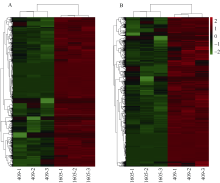
差异表达基因 A: 409 vs 1605显著上调表达; B: 409 vs 1605显著下调表达。"

图3

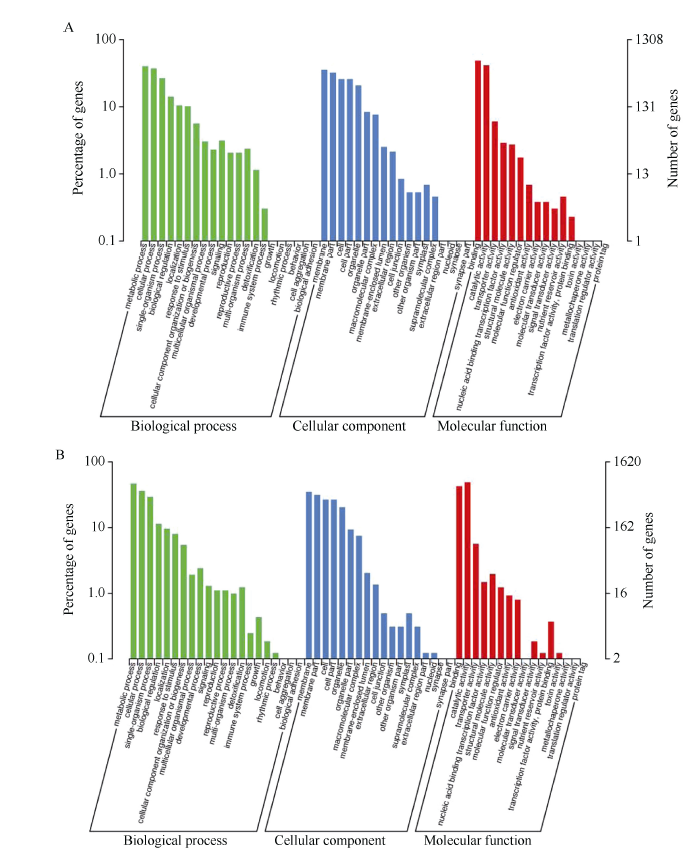
差异表达基因GO功能分析 A: 409 vs 1605显著上调表达; B: 409 vs 1605显著下调表达。"

图4

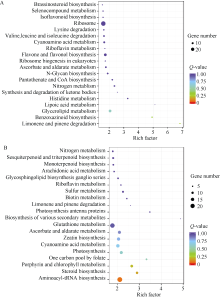
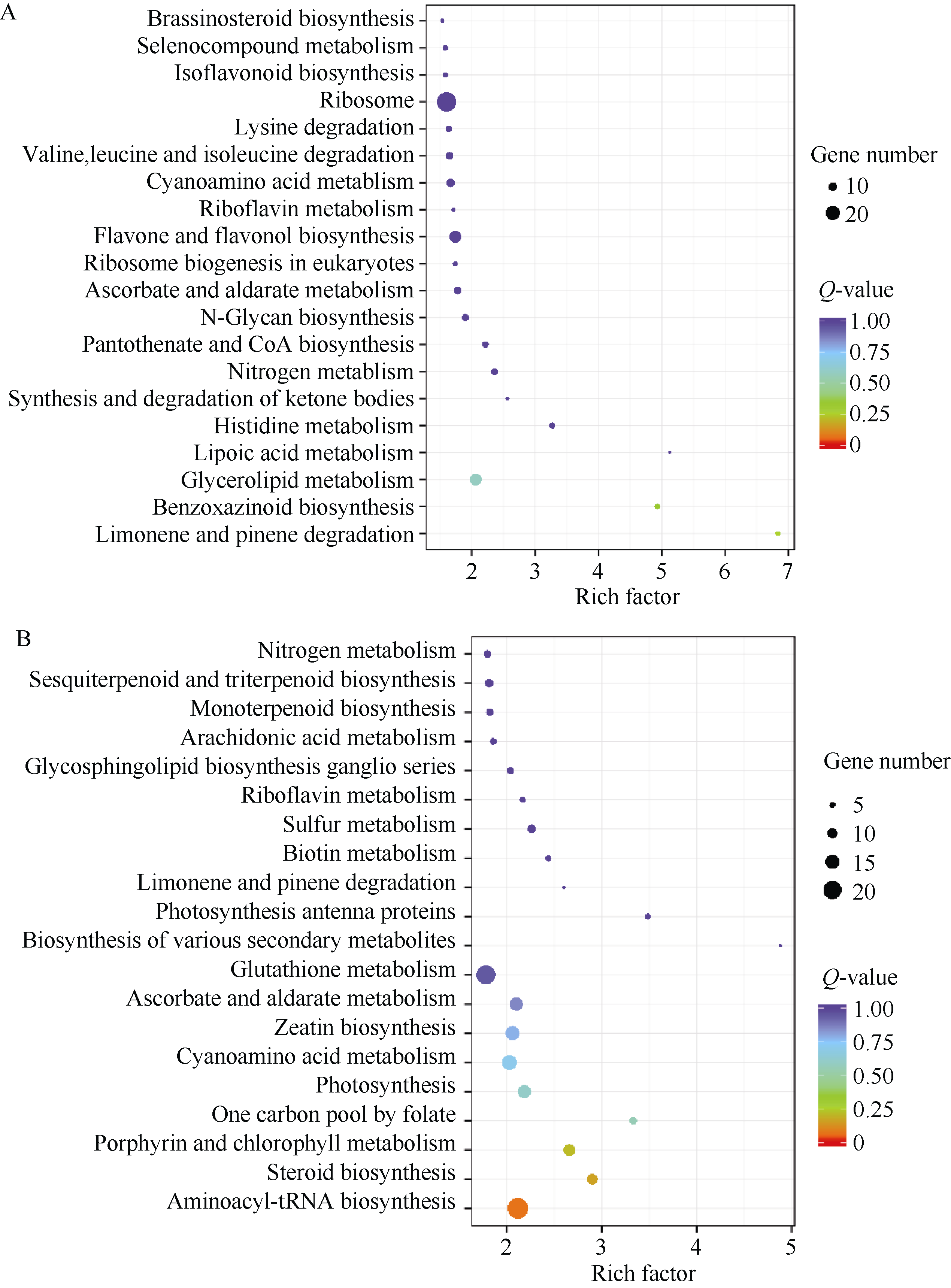
差异表达基因KEGG功能分析 A: 409 vs 1605显著上调表达; B: 409 vs 1605显著下调表达。"

表6

香叶醇樱草糖苷含量候选基因预测"

染色体
Scaffold
候选基因
Candidate gene
基因注释
Gene annotation
每百万比对数目Counts per million
409 1605 悦茗香*
Yuemingxiang*
福云6号*
Fuyun 6*
Scaffold1318 TEA023908.1 富含亮氨酸重复类受体蛋白激酶
Leucine-rich repeat receptor-like protein kinase
7.09 2.31 16.88 1.22
Scaffold4817 TEA006075.1 富含亮氨酸重复类受体蛋白激酶
Leucine-rich repea treceptor-like protein kinase
2.73 0.23 3.89 0.31
Scaffold106 TEA029081.1 丝氨酸/苏氨酸蛋白激酶
Serine/threonine-protein kinase
20.21 8.70 17.13 6.32
Scaffold9179 TEA027247.1 丝氨酸/苏氨酸蛋白激酶
Serine/threonine-protein kinase
11.93 5.26 22.37 4.63
Scaffold349 TEA023811.1 核糖体蛋白
Ribosomal protein
12.40 4.89 21.10 5.69
Scaffold8160 TEA009864.1 核糖体蛋白
Ribosomal protein
65.70 24.41 109.79 33.77
Scaffold349 TEA023801.1 RNA聚合酶II转录亚基
RNA polymerase II transcription subunit
139.33 70.50 147.46 59.41
Scaffold4659 TEA001888.1 Beta-1,3-葡聚糖酶
Beta-1,3-glucanase
7.65 1.09 8.94 1.92
Scaffold89 TEA018925.1 Beta-1,3-葡聚糖酶
Beta-1,3-glucanase
236.17 130.12 190.25 150.34
Scaffold4817 TEA006076.1 抗病蛋白RPM1
Disease resistance protein RPM1
12.33 0.85 13.07 1.31

表7

2个极端种质中差异基因编码区序列变异"

候选基因
Candidate gene
SNP位置
SNP location
409 DNA序列
409 DNA sequence
1605 DNA序列
1605 DNA sequence
409氨基酸序列
409 amino acid sequence
1605氨基酸序列
1605 amino acid sequence
TEA006075.1 348,400 T/A T Lys/Ter Lys
348,421 C/G C Glu/Gln Glu
348,436 G/C G Leu/Val Leu
348,467 G/A G Ala/Val Ala
348,488 A/G A Met/Thr Met
348,524 C/T C Gly/Glu Gly
348,764 C/T C Ser/Asn Ser
348,797 C/T C Cys/Tyr Cys
348,830 G/A G Ser/Phe Ser
349,130 G/A G Ser/Phe Ser
349,248 A/T A Tyr/Ter Tyr
349,283 G/A G Ser/Phe Ser
349,370 T/A T His/Leu His
349,421 T/C T Ter/Trp Ter
349,536 G/C G Phe/Leu Phe
349,550 A/T A Ile/Lys Ile
349,625 C/T C Trp/Ter Trp
TEA006075.1 349,633 T/G T Asn/His Asn
350,501 C/T C Trp/Ter Trp
350,647 G/A G Thr/Ile Thr
TEA023908.1 1,127,395 A G Ile Thr
1,127,410 G G/A Ala Ala/Val
1,127,793 C/G C Gln Glu
1,127,867 T/A T Ser Arg
1,127,989 C/T C Asn Ser
1,128,205 A/G A Ala Val
1,128,366 G G/C Gln Gln/Glu
1,128,407 G G/T Phe Phe/Leu
1,128,445 A A/G Ile Ile/Thr
1,128,890 T T/C Ile Ile/Met
1,129,004 G/T T His/Gln Gln
1,130,137 A A/G Ile Ile/Thr
1,130,398 A/G A Ile/Thr Ile
TEA029081.1 867,063 A/G A Leu/Ser Leu
867,147 C/T T Ser/Asn Asn
867,194 G C Pro Ala
867,221 C A Val Leu
867,354 A/G A Leu/Ser Leu
869,008 C G Arg Thr
869,038 T/A T His/Leu His
874,334 T G Lys Gln
TEA006076.1 187,415 C/A C Leu/Phe Leu
187,442 G/T G Cys/Ter Cys
189,274 C/G C Cys/Ser Cys
189,283 T/C T Gln/Arg Gln
TEA023801.1 3,449,354 G/C C Tyr/Ter Ter
3,453,357 A A/G Leu Leu/Pro
TEA023811.1 3,531,058 T T/A Lys Lys/Ter
TEA001888.1 1,154,774 T T/G Met Met/Leu
TEA009864.1 370,433 G/A A Ala/Val Val
TEA027247.1 358,366 A A/T Phe Phe/Ile
TEA018925.1 1,943,138 C A Arg Ser

表8

茶树香叶醇樱草糖苷候选基因上游与环境相关的顺式作用元件的预测"

候选基因
Candidate gene
激素响应元件 Hormone responsive elements 环境胁迫相关元件 Environmental stress-related elements
IAA GA SA ABA MeJA ASI WR LTR DSR AI DI
TEA029081.1 2 2 1 3 2
TEA023908.1 1 2 2 1 2
TEA023801.1 1 1
TEA023811.1 2 4 1
TEA001888.1 1 1 1 1 4
TEA006075.1 2 1 5 4 1 1 5
TEA006076.1 1 1 1 4 1
TEA009864.1
TEA018925.1 1 2 2 1 2 1 1
TEA027247.1 3 4 1 3 2

图5

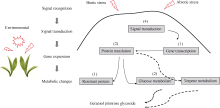
候选基因示意图 括号中的数字表示基因个数。信号转导: TEA023908.1, TEA006075.1, TEA029081.1, TEA027247.1; 基因转录: TEA023801.1; 蛋白翻译: TEA023811.1, TEA009864.1; 抗病蛋白: TEA006076.1; 糖代谢: TEA001888.1, TEA018925.1。"

[1] Inouye S, Takizawa T, Yamaguchi H. Antibacterial activity of essential oils and their major constituents against respiratory tract pathogens by gaseous contact. J Antimicrob Chemoth, 2001, 47: 565-573.
doi: 10.1093/jac/47.5.565 pmid: 11328766
[2] Wei S, Reuveny H, Bravdo B A, Shoseyov O. Hydrolysis of glycosidically bound volatiles from apple leaves (cv. Anna) by Aspergillus niger β-glucosidase affects the behavior of codling moth (Cydia pomonella L.). J Agric Food Chem, 2004, 52: 6212-6216.
doi: 10.1021/jf0495789
[3] Magnard J, Roccia A, Caissard J, Vergne P, Sun P, Hecquet R, Dubois A, Oyant L, Jullien F, Nicole F, Raymond O, Huguet S, Baltenweck R, Meyer S, Claudel P, Jeauffre J, Rohmer M, Foucher F, Hugueneyp P, Bendahmane M, Baudino S. Biosynthesis of monoterpene scent compounds in roses. Science, 2015, 349: 81-83.
doi: 10.1126/science.aab0696
[4] Zhao M Y, Wang L, Wang J M, Jin J Y, Zhang N, Lei L, Gao T, Jing T T, Zhang S R, Wu Y, Wu B, Hu Y Q, Wan X C, Schwab W, Song C K. Induction of priming by cold stress via inducible volatile cues in neighboring tea plants. J Integr Plant Biol, 2020, 62: 1461-1468.
doi: 10.1111/jipb.12937
[5] Wang D M, Yoshimura T, Kubota K, Kobayashi A. Analysis of glycosidically bound aroma precursors in tea leaves: I. Qualitative and quantitative analyses of glycosides with aglycons as aroma compounds. J Agric Food Chem, 2000, 48: 5411-5418.
doi: 10.1021/jf000443m
[6] Mizutani M, Nakanishi H, Ema J, Ma S, Noguchi E, Inohara-ochiiai M, Fukachimizutani F, Nakao M, Sakata K. Cloning of β-primeverosidase from tea leaves, a key enzyme in tea aroma formation. Plant Physiol, 2002, 130: 2164-2176.
doi: 10.1104/pp.102.011023
[7] Sarry J, Gunata Z. Plant and microbial glycoside hydrolases: volatile release from glycosidic aroma precursors. Food Chem, 2004, 87: 509-521.
doi: 10.1016/j.foodchem.2004.01.003
[8] Bock K W. The UDP-glycosyltransferase (UGT) superfamily expressed in humans, insects and plants: animal-plant arms-race and co-evolution. Biochem Pharmacol, 2015, 99: 11-17.
doi: 10.1016/j.bcp.2015.10.001
[9] Stahlbiskup E, Intert F, Holthuijzen J, Stengele M, Schulz G.Glycosidically bound volatiles-a review 1986-1991. Flavour Frag J, 1993, 8: 61-80.
doi: 10.1002/(ISSN)1099-1026
[10] Guo W, Hosoi R, Sakata K, Watanabe N, Yagi A, Ina K, Luo S. (S)-linalyl,2-phenylethyl, and benzyl disaccharide glycosides isolated as aroma precursors from oolong tea leaves. Biosci Biotechnol Biochem, 1994, 58: 1532-1534.
doi: 10.1271/bbb.58.1532
[11] Candela L, Formato M, Crescente G, Piccolella S, Pacifico S. Coumaroyl flavonol glycosides and more in marketed green teas: an intrinsic value beyond much-lauded catechins. Molecules, 2020, 25: 1765.
doi: 10.3390/molecules25081765
[12] Gu X G, Yao C C, Zhang Z Z, Wan X C, Ning J M, Shao W F. GC-ECD method for determination of glucosidically bound aroma precursors in fresh tea leaves. Chromatographia, 2011, 73: 189-193.
doi: 10.1007/s10337-010-1816-2
[13] Ogawa K, Moon J H, Guo W F, Yagi A, Watanabe N, Sakata K. A study on tea aroma formation mechanism: alcoholic aroma precursor amounts and glycosidase activity in parts of the tea plant. Zeitschrift Fur Naturforsch Sect C-J Biosci, 1995, 50: 493-498.
[14] Wang D M, Kurasawa E, Yamaguchi Y, Kubota K, Kobayashi A. Analysis of glycosidically bound aroma precursors in tea leaves: II. Changes in glycoside contents and glycosidase activities in tea leaves during the black tea manufacturing process. J Agric Food Chem, 2001, 49: 1900-1903.
doi: 10.1021/jf001077+
[15] Dai W D, Tan J F, Lu M L, Xie D C, Li P L, Lyu H P, Zhu Y, Guo L, Zhang Y, Peng Q H, Lin Z. Nontargeted modification-specific metabolomics investigation of glycosylated secondary metabolites in tea (Camellia sinensis L.) based on liquid chromatography-high resolution mass spectrometry. J Agric Food Chem, 2016, 64: 6783-6790.
doi: 10.1021/acs.jafc.6b02411
[16] Rawat R, Gulati A. Seasonal and clonal variations in some major glycosidic bound volatiles in Kangra tea (Camellia sinensis (L.) O. Kuntze). Eur Food Res Technol, 2008, 226: 1241-1249.
doi: 10.1007/s00217-007-0753-2
[17] Cui J L, Katsuno T, Totsuka K, Ohnishi T, Takemoto H, Mase N, Toda M, Narumi T, Sato K, Matsuo T, Mizutani K, Yang Z Y, Watanabe N, Tong H R. Characteristic fluctuations in glycosidically bound volatiles during tea processing and identification of their unstable derivatives. J Agric Food Chem, 2016, 64: 1151-1157.
doi: 10.1021/acs.jafc.5b05072
[18] Ohgami S, Ono E, Horikawa M, Murata J, Totsuka K, Toyonaga H, Ohba Y, Dohra H, Asai T, Matsui K, Mizutani M, Watanabe N, Ohnishi T. Volatile glycosylation in tea plants: sequential glycosylations for the biosynthesis of aroma β-primeverosides are catalyzed by two Camellia sinensis glycosyltransferases. Plant Physiol, 2015, 168: 464-477.
doi: 10.1104/pp.15.00403 pmid: 25922059
[19] Carl S R, Stephen G W. Glycosidase mechanisms. Curr Opin Plant Biol, 2000, 4: 573-580.
[20] 杨飞, 张征锋, 南波, 肖本泽. 水稻产量相关性状的全基因组关联分析及候选基因筛选. 作物学报, 2022, 48: 1813-1821.
doi: 10.3724/SP.J.1006.2022.12047
Yang F, Zhang Z F, Nan B, Xiao B Z. Genome-wide association analysis and candidate gene selection of yield related traits in rice. Acta Agron Sin, 2022, 48: 1813-1821. (in Chinese with English abstract)
doi: 10.3724/SP.J.1006.2022.12047
[21] 谢磊, 任毅, 张新忠, 王继庆, 张志辉, 石书兵, 耿洪伟. 小麦穗发芽性状的全基因组关联分析. 作物学报, 2021, 47: 1891-1902.
doi: 10.3724/SP.J.1006.2021.01078
Xie L, Ren Y, Zhang X Z, Wang J Q, Zhang Z H, Shi S B, Geng H W. Genome-wide association study of pre-harvest sprouting traits in wheat. Acta Agron Sin, 2021, 47: 1891-1902. (in Chinese with English abstract)
doi: 10.3724/SP.J.1006.2021.01078
[22] 渠建洲, 冯文豪, 张兴华, 徐淑兔, 薛吉全. 基于全基因组关联分析解析玉米籽粒大小的遗传结构. 作物学报, 2022, 48: 304-319.
doi: 10.3724/SP.J.1006.2022.13002
Qu J Z, Feng W H, Zhang X H, Xu S T, Xue J Q. Dissecting the genetic architecture of maize kernel size based on genome-wide association study. Acta Agron Sin, 2022, 48: 304-319. (in Chinese with English abstract)
doi: 10.3724/SP.J.1006.2022.13002
[23] Wang L, Yang Y M, Zhang S Y, Che Z J, Yuan W J, Yu D Y. GWAS reveals two novel loci for photosynthesis-related traits in soybean. Mol Genet Genomics, 2020, 295: 705-716.
doi: 10.1007/s00438-020-01661-1 pmid: 32166500
[24] Wang R J, Gao X F, Yang J, Kong X R. Genome-wide association study to identify favorable SNP allelic variations and candidate genes that control the timing of spring bud flush of tea (Camellia sinensis) using SLAF-seq. J Agric Food Chem, 2019, 67: 10380-10391.
doi: 10.1021/acs.jafc.9b03330
[25] Fang K X, Xia Z Q, Li H J, Jiang X H, Qin D D, Wang Q S, Wang Q, Pan C D, Li B, Wu H L. Genome-wide association analysis identified molecular markers associated with important tea flavor-related metabolites. Hortic Res, 2021, 8: 42.
doi: 10.1038/s41438-021-00477-3
[26] 王让剑, 苏德森, 吴建衍, 黄崇耀, 陈立松. 超高效液相色谱-串联质谱法测定茶树新梢中两种香叶醇糖苷含量. 茶叶学报, 2020, 61(3): 114-119.
Wang R J, Su D S, Wu J Y, Huang C Y, Chen L S. UHPLC MS/MS determination of geraniol glycosides in tea shoots. Acta Tea Sin, 2020, 61(3): 114-119 ( in Chinese with English abstract).
[27] Li H, Durbin R. Fast and accurate short read alignment with Burrows-Wheeler transform. Bioinformatics, 2009, 25: 1754-1760.
doi: 10.1093/bioinformatics/btp324 pmid: 19451168
[28] Mckenna A, Hanna M, Banks E, Sivachenko A, Cibulskis K, Kernytsky A, Garimella K, Altshuler D, Gabriel S, Daly M, Depristo A. The Genome Analysis Toolkit: a MapReduce framework for analyzing next-generation DNA sequencing data. Genome Res, 2010, 20: 1297-1303.
doi: 10.1101/gr.107524.110 pmid: 20644199
[29] Li H, Handsaker B, Wysoker A, Fennell T, Ruan J, Homer N, Marth G, Abecasis G, Durbin R. The sequence alignment/map format and SAMtools. Bioinformatics, 2009, 25: 2078-2079.
doi: 10.1093/bioinformatics/btp352 pmid: 19505943
[30] Alexander D H, Novembre J, Lange K. Fast model-based estimation of ancestry in unrelated individuals. Genome Res, 2009, 19: 1655-1664.
doi: 10.1101/gr.094052.109 pmid: 19648217
[31] Alkes L P, Nick J P, Robert M P, Michael E W, Nancy A S, David R. Principal components analysis corrects for stratification in genome-wide association studies. Nat Genet, 2006, 38: 904-909.
doi: 10.1038/ng1847 pmid: 16862161
[32] Purcell S, Neale B, Todd-brown K, Thomas L, Ferreira M, Bender D, Maller J, Sklar P, Bakker P, Daly M J. PLINK: a tool set for whole-genome association and population-based linkage analyses. Am J Hum Genet, 2007, 81: 559-575.
doi: 10.1086/519795 pmid: 17701901
[33] Bradbury P J, Zhang Z W, Kroon D E, Casstevens T M, Ramdoss Y, Buckler E S. TASSEL: software for association mapping of complex traits in diverse samples. Bioinformatics, 2007, 23: 2633-2635.
doi: 10.1093/bioinformatics/btm308 pmid: 17586829
[34] Robinson M D, Mccarthy D J, Smyth G K. edgeR: a Bioconductor package for differential expression analysis of digital gene expression data. Bioinformatics, 2010, 26: 139-140.
doi: 10.1093/bioinformatics/btp616 pmid: 19910308
[35] 王愿, 王晓坤, 戈海曼, 杨磊. 拟南芥富含亮氨酸重复序列类受体激酶AtLRR78A的定位及其分选序列研究. 植物生理学报, 2017, 53: 477-486.
Wang Y, Wang X K, Ge H M, Yang L. The localization and trafficking mechanism of AtLRR78A, a leucine-rich repeat receptor-like kinase (LRR-RLK) in Arabidopsis. J Plant Physiol, 2017, 53: 477-486. (in Chinese with English abstract)
[36] Klauser D, Desurmont G A, Glauser G, Vallat A, Flury P, Boller T, Turlings T C J, Bartels S. The Arabidopsis Pep-PEPR system is induced by herbivore feeding and contributes to JA-mediated plant defence against herbivory. J Exp Bot, 2015, 66: 5327-5336.
doi: 10.1093/jxb/erv250
[37] Gou X, Li J. Paired receptor and coreceptor kinases perceive extracellular signals to control plant development. Plant Physiol, 2020, 182: 1667-1681.
doi: 10.1104/pp.19.01343 pmid: 32144125
[38] Peng H, Zhang Q, Li Y D, Lei C L, Zhai Y, Sun X H, Sun D Y, Sun Y, Lu T G. A putative leucine-rich repeat receptor kinase, OsBRR1, is involved in rice blast resistance. Planta, 2009, 230: 377-385.
doi: 10.1007/s00425-009-0951-1 pmid: 19468748
[39] Hu L, Ye M, Kuai P, Ye M, Erb M, Liu Y. OsLRRRLK1, an early responsive leucine-rich repeat receptor-like kinase, initiates rice defense responses against a chewing herbivore. New Phytol, 2018, 219: 1097-1111.
doi: 10.1111/nph.2018.219.issue-3
[40] Dure L. A repeating 11-mer amino acid motif and plant desiccation. Plant J, 1993, 3: 363-369.
pmid: 8220448
[41] Jung E H, Jung H W, Lee S C, Sang W H, Heu S, Hwang B K. Identification of a novel pathogen-induced gene encoding a leucine-rich repeat protein expressed in phloem cells of Capsicun annuum. Biochim Biophys Acta, 2004, 1676: 211-222.
[42] Hasegawa P M, Brseean R A, Zhu J K, Bohnert H J. Plant cellular and molecular responses to high salinity. Annu Rev Plant Biol, 2000, 51: 463-499.
[43] Xie Y R, Raruang Y, Chen Z Y, Brown R L, Cleveland T E. ZmGns, a maize class I β-1,3-glucanase, is induced by biotic stresses and possesses strong antimicrobial activity. J Integr Plant Biol, 2015, 57: 271-283.
doi: 10.1111/jipb.12286
[44] McFadden H G, Chapple R, Feyter R D E, Dennis E. Expression of pathogenesis-related genes in cotton stem in response to infection by Verticillium dahliae. Physiol Mol Plant Pathol, 2001, 58: 119-131.
[45] Jongedijk E, Tigelaar H, Vanroekel J S C, Bresvloemans S A, Dekker I, Vandenelzen P J M, Cornelissen B J C, Melchers L S. Synergistic activity of chitinases and β-1,3-glucanases enhances fungal resistance in transgenic tomato plants. Euphytica, 1995, 85: 173-180.
doi: 10.1007/BF00023946
[46] Jones J D G, Dangl J L. The plant immune system. Nature, 2006, 444: 323-329.
doi: 10.1038/nature05286
[47] Yuan X, Wang Z Y, Huang J Z, Xuan H, Gao Z Y. Phospholipidase Dδnegatively regulates the function of resistance to Pseudomonas syringae pv. Maculicola 1 (RPM1). Front Plant Sci, 2019, 9: 1991
doi: 10.3389/fpls.2018.01991
[48] Aharoni A, Jongsma M A, Bouwmeester H J. Volatile science? Metabolic engineering of terpenoids in plant. Trends Plant Sci, 2005, 10: 594-602.
doi: 10.1016/j.tplants.2005.10.005 pmid: 16290212
[1] 习千辉, 徐梓瑗, 刘梦梦, 王宏艺, 郎凯琳, 井震海, 陈锋, 赵磊. 小麦籽粒铜含量的全基因组关联分析及候选基因预测[J]. 作物学报, 2026, 52(6): 1604-1617.
[2] 毛嘉琦, 黄朋雨, 赵佳佳, 郑兴卫, 武棒棒, 郝宇琼, 屈非, 刘成, 马朋涛, 郑军. 山西小麦品种白粉病抗性评价及抗病基因分子检测[J]. 作物学报, 2026, 52(6): 1669-1681.
[3] 唐宽强, 李公允, 宋美毅, 赵雪, 常春玲. 大豆株高性状全基因组关联分析及预测模型构建[J]. 作物学报, 2026, 52(6): 1743-1756.
[4] 徐苗苗, 邸太妹, 王洁, 吴叶蝶, 刘恩贝, 王玉春, 王新超, 王璐. 外源槲皮素增强茶树抗寒性的分子机制[J]. 作物学报, 2026, 52(5): 1418-1429.
[5] 杨欣雨, 崔文涛, 迪力尼格尔·阿力木, 汪凯翔, 吴鹏昊, 任姣姣. 玉米穗上叶片数全基因组关联分析和全基因组选择[J]. 作物学报, 2026, 52(5): 1573-1590.
[6] 闫安, 蒋昆炜, 王蓉圆, 田林, 张璐, 王韵, 徐建龙. 水稻剑叶小维管束数基因SVN7的鉴定与克隆[J]. 作物学报, 2026, 52(5): 1364-1372.
[7] 杨影, 郝豫皖, 张学宁, 方佳璐, 马月华, 杨伟龙, 孙文清, 王新超, 王玉春, 黄建燕. 乙烯响应因子CsERF9调控茶树炭疽病抗性的分子机制研究[J]. 作物学报, 2026, 52(4): 1103-1115.
[8] 马亮, 马璐, 张舒钰, 章慧敏, 王仁明, 宋旭东, 张振良, 冒宇翔, 陆虎华, 陈国清, 郝德荣, 周广飞. 玉米苞叶数目转录组分析及候选基因鉴定[J]. 作物学报, 2026, 52(3): 790-801.
[9] 鲁雅妮, 丁超杰, 张煜, 杜习军, 齐学礼, 胡琳, 许为钢. 河南省200份小麦品种苗期茎基腐病抗性鉴定与全基因组关联分析[J]. 作物学报, 2026, 52(2): 363-375.
[10] 李诗晴, 王茜, 王素华, 张耀文, 王丽侠. 绿豆种质资源苗期耐盐性鉴定及相关基因发掘[J]. 作物学报, 2026, 52(2): 376-388.
[11] 张力岚, 杨军, 王让剑. 基于WGCNA发掘茶树糖苷类香气前体含量性状相关的候选基因[J]. 作物学报, 2026, 52(2): 494-513.
[12] 王雅致, 杨飚, 季香林, 石瑛, 张丽莉. 二倍体马铃薯抗旱资源鉴定及抗旱基因初步筛选[J]. 作物学报, 2026, 52(1): 72-84.
[13] 董丽华, 董成艳, 李正楠, 余静, 叶靓, 刘芳, 谭静. 玉米禾谷镰孢穗腐病抗性候选基因的筛选与鉴定[J]. 作物学报, 2026, 52(1): 131-147.
[14] 李璐琪, 程宇坤, 白斌, 雷斌, 耿洪伟. 小麦叶片气孔相关性状全基因组关联分析[J]. 作物学报, 2025, 51(9): 2266-2284.
[15] 梅飘, 刘丁丁, 叶圆圆, 张晨禹, 丁诗琦, 李亚奇, 王培鑫, 梅菊芬, 马春雷. 基于茶树液相功能芯片的白化茶树资源遗传多样性分析[J]. 作物学报, 2025, 51(9): 2358-2370.
Viewed
Full text


Abstract

Cited

  Shared   
  Discussed   
No Suggested Reading articles found!