欢迎访问作物学报,今天是
作物学报 ›› 2026, Vol. 52 ›› Issue (10): 3128-3141.doi: 10.3724/SP.J.1006.2026.63008
陈兴华1,2,3( ), 陈冉冉1,2, 夏雨昕1, 康壹然2, 王创1,2,*()
Chen Xing-Hua1,2,3(), Chen Ran-Ran1,2, Xia Yu-Xin1, Kang Yi-Ran2, Wang Chuang1,2,*()
摘要:
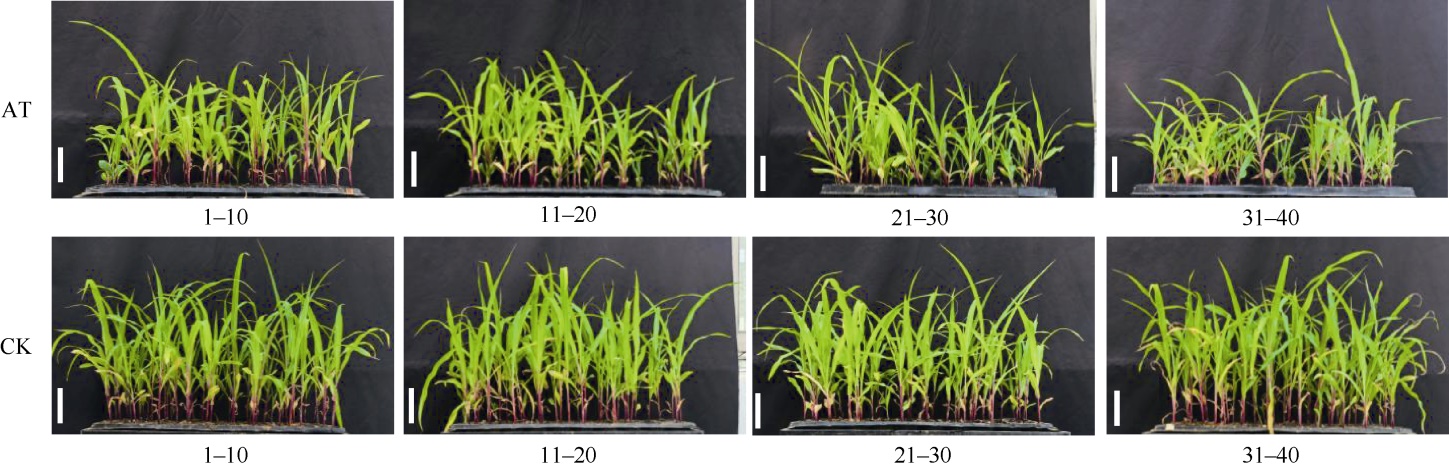
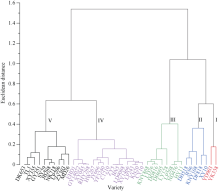
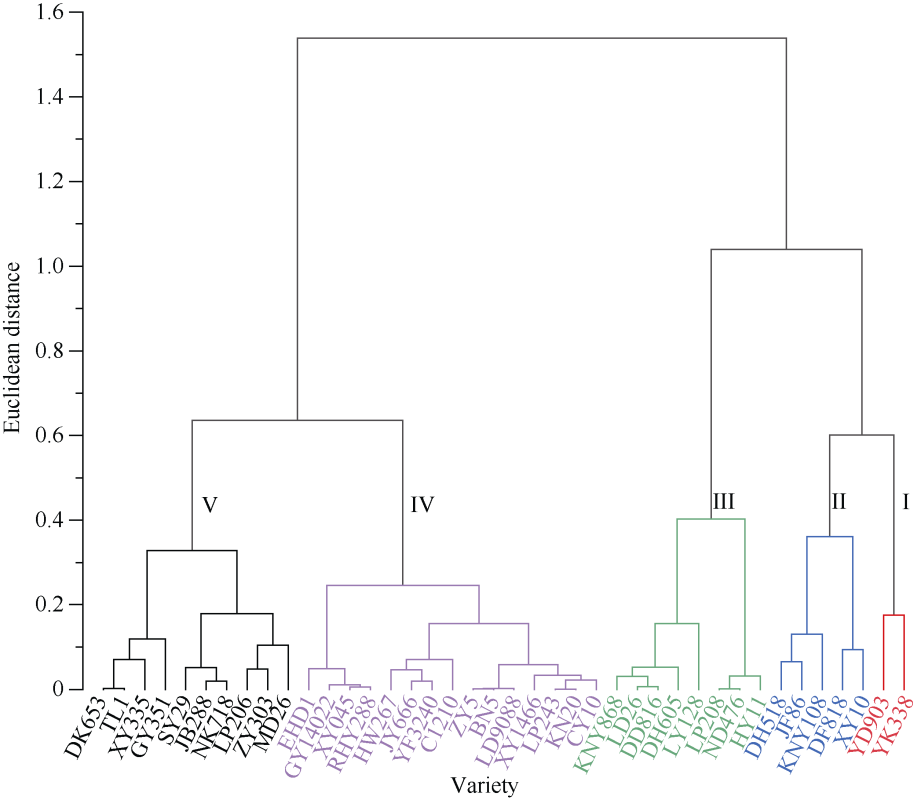
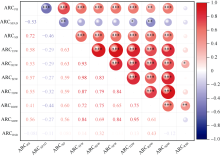
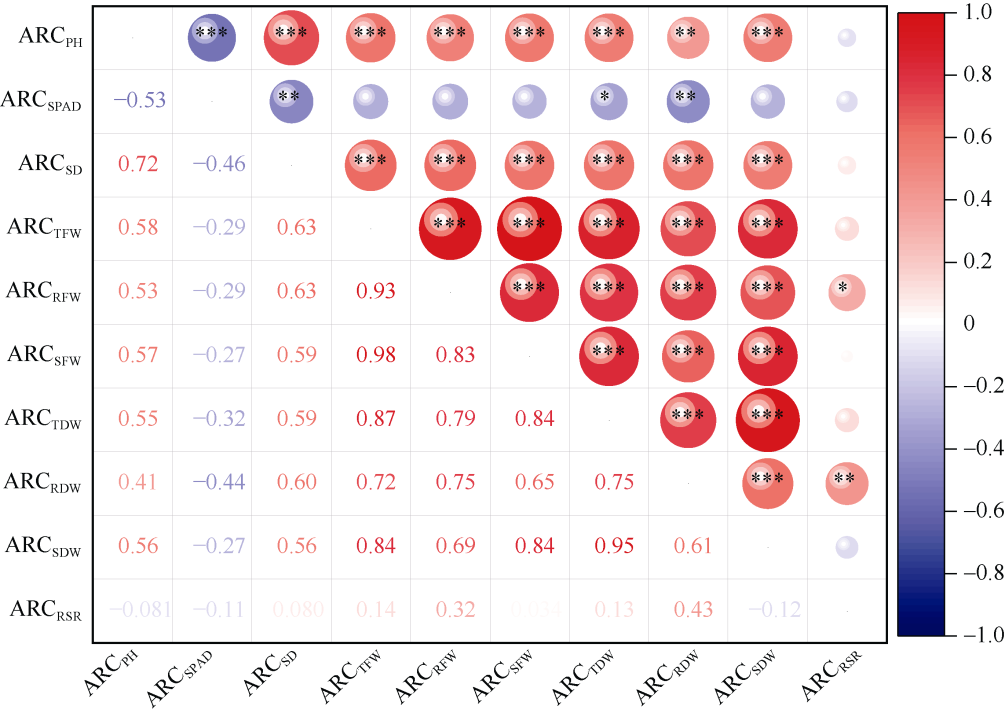
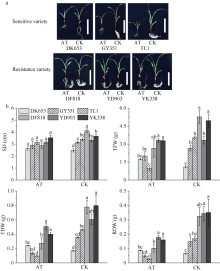
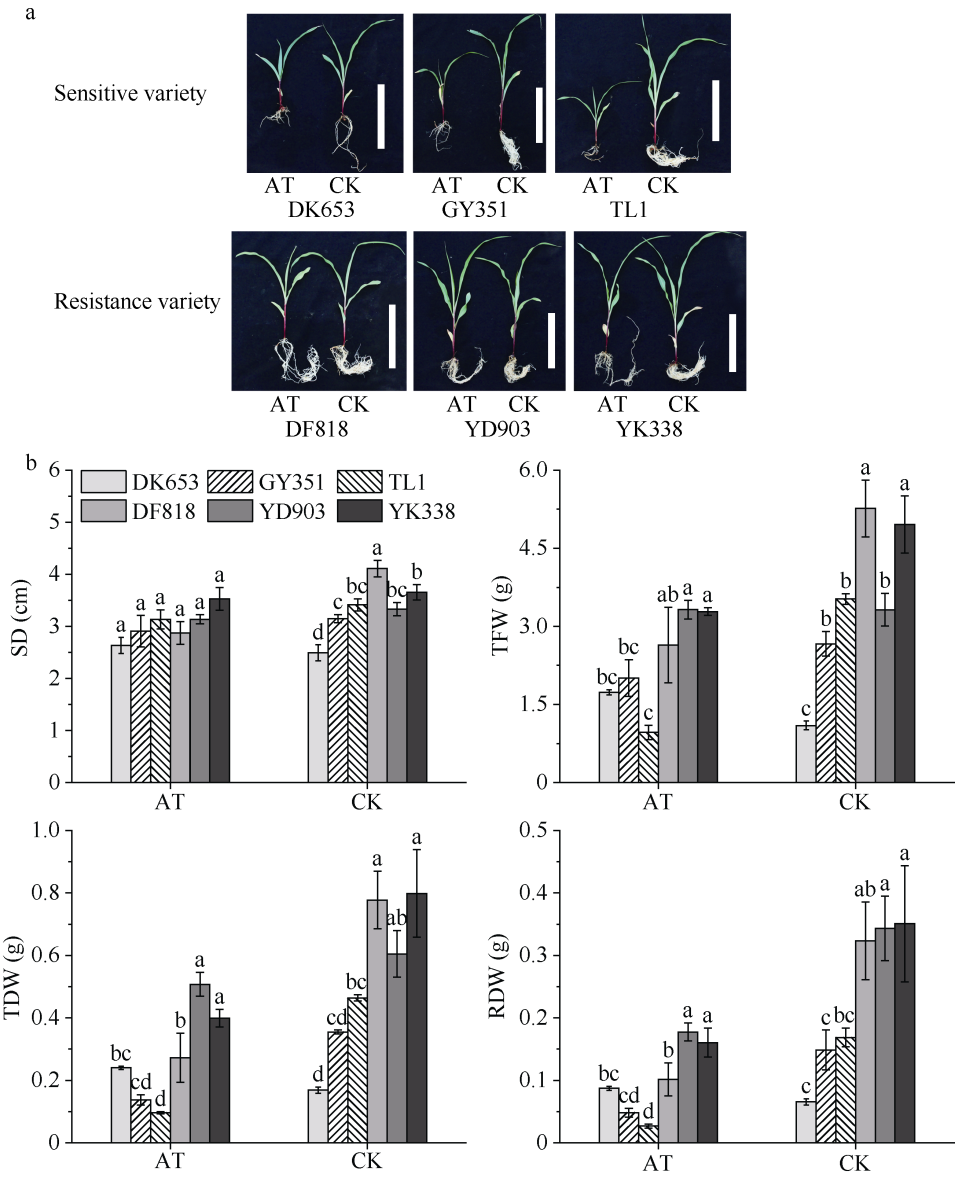
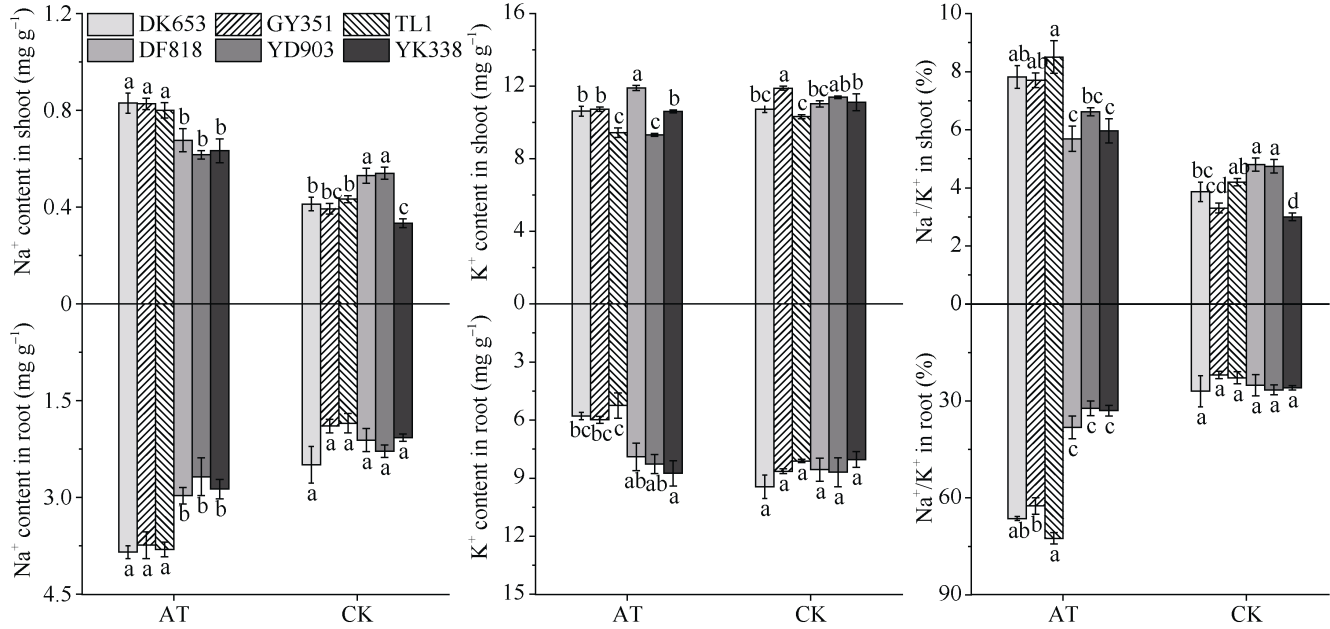
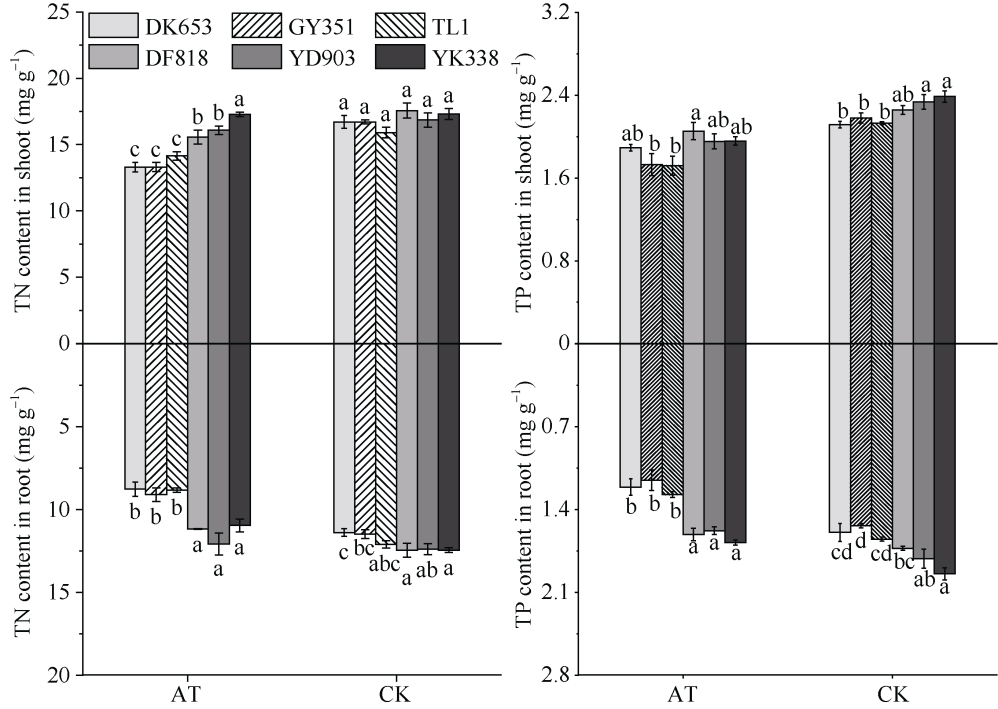
为筛选合适的耐碱玉米杂交种, 本研究通过设置碱性土壤和对照土壤2个处理, 测定40份玉米杂交种的株高、SPAD值、茎粗、总鲜重等10项指标, 系统评价了玉米杂交种苗期耐碱能力, 并通过逐步回归分析筛选用于评价玉米杂交种苗期耐碱能力的关键指标。结果表明, 测定的10项指标均显著受到碱胁迫影响并且部分指标之间存在较强的相关性。利用隶属函数法和系统聚类分析法将40份玉米杂交种分成5类, 其中YK338和YD903等属于强耐碱品种, DK653、TL1、XY335和GY351等属于碱极敏感品种。进一步通过逐步回归分析建立了玉米苗期耐碱预测模型, 筛选出总鲜重、根系干重、总干重和茎粗可作为玉米苗期耐碱鉴定核心指标(R2 = 0.99)。通过对极端品种的分析表明, 在碱胁迫条件下耐碱玉米品种长势明显优于敏感品种, 耐碱品种通过维持低钠离子(Na+)、高钾离子(K+)含量及高效氮(N)、磷(P)养分吸收等特性来提升其抗性。综上所述, 本研究建立了土培条件下玉米耐碱综合评价体系, 筛选的耐碱品种和关键指标为耐碱玉米育种及盐碱地高效利用提供了理论依据与技术支撑。
| [1] | FAO. Global Status of Salt-affected Soils:Main Report. Rome, Italy: FAO, 2024. pp 1-240. https://doi.org/10.4060/cd3044en. |
| [2] |
赵作章, 陈劲松, 彭尔瑞, 等. 土壤盐渍化及治理研究进展. 中国农村水利水电, 2023(6): 202-208.
doi: 10.12396/znsd.221319 |
| Zhao Z Z, Chen J S, Peng E R, et al. Research progress on soil salinization and management. China Rural Water Hydropower, 2023(6): 202-208 (in Chinese with English abstract). | |
| [3] | 李彬, 王志春, 孙志高, 等. 中国盐碱地资源与可持续利用研究. 干旱地区农业研究, 2005, 23(2): 154-158. |
| Li B, Wang Z C, Sun Z G, et al. Resources and sustainable resource exploitation of salinized land in China. Agric Res Arid Areas, 2005, 23(2): 154-158 (in Chinese with English abstract). | |
| [4] | 杨真, 王宝山. 中国盐渍土资源现状及改良利用对策. 山东农业科学, 2015, 47(4): 125-130. |
| Yang Z, Wang B S. Present status of saline soil resources and countermeasures for improvement and utilization in China. Shandong Agric Sci, 2015, 47(4): 125-130 (in Chinese with English abstract). | |
| [5] | 杨微. 盐碱化土壤中四种常见盐分对碱地肤的胁迫作用比较. 东北师范大学硕士学位论文, 吉林长春, 2007. |
| Yang W. Stress Comparison among Four Main Salts in Salt-alkalized Soil on Kochia Sieversiana. MS Thesis of Northeast Normal University, Changchun, Jilin, China, 2007 (in Chinese with English abstract). | |
| [6] | Yin Z P, Zhang H, Zhao Q, et al. Physiological and comparative proteomic analyses of saline-alkali NaHCO3-responses in leaves of halophyte Puccinellia tenuiflora. Plant Soil, 2019, 437: 137-158. |
| [7] | 王振华, 刘文国, 高世斌, 等. 玉米种业的昨天、今天和明天. 中国畜牧业, 2021(19): 26-32. |
| Wang Z H, Liu W G, Gao S B, et al. Past, now and future of corn seed industry. China Anim Ind, 2021(19): 26-32 (in Chinese with English abstract). | |
| [8] |
Hanks R J, Ashcroft G L, Rasmussen V P, et al. Corn production as influenced by irrigation and salinity-Utah studies. Irrig Sci, 1978, 1: 47-59.
doi: 10.1007/BF00269007 |
| [9] | 翁跃进. 作物耐盐品种及其栽培技术. 北京: 中国农业出版社, 2003, pp 32-43. |
| Weng Y J. Salt-tolerant Crop Varieties and Their Cultivation Techniques. Beijing: China Agriculture Press, 2003. pp 32-43 (in Chinese). | |
| [10] | 沈丹丹, 程文, 王志武, 等. 我国玉米耐盐种质研究现状与展望. 山东农业科学, 2018, 50(11): 163-167. |
| Shen D D, Cheng W, Wang Z W, et al. Research advances and prospects of salt tolerant maize germplasms in China. Shandong Agric Sci, 2018, 50(11): 163-167 (in Chinese with English abstract). | |
| [11] |
Abid M, Zhang Y J, Li Z, et al. Effect of salt stress on growth, physiological and biochemical characters of four kiwifruit genotypes. Sci Hortic, 2020, 271: 109473.
doi: 10.1016/j.scienta.2020.109473 |
| [12] |
Fan Y P, Lu X K, Chen X G, et al. Cotton transcriptome analysis reveals novel biological pathways that eliminate reactive oxygen species (ROS) under sodium bicarbonate (NaHCO3) alkaline stress. Genomics, 2021, 113: 1157-1169.
doi: 10.1016/j.ygeno.2021.02.022 |
| [13] |
Sagervanshi A, Geilfus C M, Kaiser H, et al. Alkali salt stress causes fast leaf apoplastic alkalinization together with shifts in ion and metabolite composition and transcription of key genes during the early adaptive response of Vicia faba L. Plant Sci, 2022, 319: 111253.
doi: 10.1016/j.plantsci.2022.111253 |
| [14] | 李倩, 陈博, 贾秉鑫, 等. 基于主成分分析和隶属函数法筛选耐盐碱大豆品种. 种子, 2025, 44(5): 196-205. |
| Li Q, Chen B, Jia B X, et al. Selection of saline-alkali tolerant Glycine max varieties based on principal component analysis and membership tunction method. Seed, 2025, 44(5): 196-205 (in Chinese with English abstract). | |
| [15] | 王佺珍, 刘倩, 高娅妮, 等. 植物对盐碱胁迫的响应机制研究进展. 生态学报, 2017, 37: 5565-5577. |
| Wang Q Z, Liu Q, Gao Y N, et al. Review on the mechanisms of the response to salinity-alkalinity stress in plants. Acta Ecol Sin, 2017, 37: 5565-5577 (in Chinese with English abstract). | |
| [16] | 路旭平, 李芳兰, 马晓娟, 等. 不同碱敏感水稻品种根系对碱胁迫的生理响应策略. 中国生态农业学报(中英文), 2021, 29: 1171-1184. |
| Lu X P, Li F L, Ma X J, et al. Physiological response strategies of roots of different alkali-tolerant rice varieties to alkali stress. Chin J Eco-Agric, 2021, 29: 1171-1184 (in Chinese with English abstract). | |
| [17] | 常国伟, 王越, 邓杰, 等. 萌芽期玉米自交系耐苏打碱的等级评价. 种子, 2018, 37(2): 78-82. |
| Chang G W, Wang Y, Deng J, et al. Evaluation the resistance of soda alkali in maize inbred lines at germination stage. Seed, 2018, 37(2): 78-82 (in Chinese with English abstract). | |
| [18] | 张会丽, 袁闯, 朱林, 等. 利用隶属函数值法对玉米成熟期耐盐性的综合评价. 西北农林科技大学学报(自然科学版), 2018, 46(2): 47-55. |
| Zhang H L, Yuan C, Zhu L, et al. Comprehensive evaluation of salt-tolerance of maize at mature period using subordinate function value analysis. J Northwest A&F Univ (Nat Sci Edn), 2018, 46(2): 47-55 (in Chinese with English abstract). | |
| [19] | 彭振, 何守朴, 孙君灵, 等. 陆地棉苗期耐盐性的高效鉴定方法. 作物学报, 2014, 40: 476-486. |
|
Peng Z, He S P, Sun J L, et al. An efficient approach to identify salt tolerance of upland cotton at seedling stage. Acta Agron Sin, 2014, 40: 476-486 (in Chinese with English abstract).
doi: 10.3724/SP.J.1006.2014.00476 |
|
| [20] | 张凤银, 陈禅友, 胡志辉, 等. 外源水杨酸对盐胁迫下菜豆种子萌发和幼苗生理特性的影响. 东北农业大学学报, 2013, 44(10): 39-43. |
| Zhang F Y, Chen C Y, Hu Z H, et al. Effect of exogenous salicylic acid on seed germination and seedling physiological characteristics of kidney bean (Phaseolus vulgaris L.) under salt stress. J Northeast Agric Univ, 2013, 44(10): 39-43 (in Chinese with English abstract). | |
| [21] | 杨晓杰, 李旭业, 王海艳, 等. 玉米自交系耐盐种质的筛选及耐盐性评价. 玉米科学, 2014, 22(4): 19-25. |
| Yang X J, Li X Y, Wang H Y, et al. Screening of maize inbred line varieties with salt tolerance and the evaluation. J Maize Sci, 2014, 22(4): 19-25 (in Chinese with English abstract). | |
| [22] | 张海艳, 赵海军. 不同品种玉米萌发期和苗期耐盐性综合评价. 玉米科学, 2016, 24(5): 61-67. |
| Zhang H Y, Zhao H J. Comprehensive evaluation of salt tolerance of different corn varieties at the germination and seedling stages. J Maize Sci, 2016, 24(5): 61-67 (in Chinese with English abstract). | |
| [23] | 邹德堂, 郭微, 孙健, 等. 水稻不同基因型耐盐相关性状主成分分析及综合评价. 东北农业大学学报, 2018, 49(8): 1-9. |
| Zou D T, Guo W, Sun J, et al. Principal component analysis and comprehensive evaluation of salt tolerance related traits in different rice (Oryza sativa L.) genotypes. J Northeast Agric Univ, 2018, 49(8): 1-9 (in Chinese with English abstract). | |
| [24] | 杨海东. 崇明县横沙岛土壤养分变化与科学施肥建议. 上海农业科技, 2016(1): 96-97. |
| Yang H D. Changes of soil nutrients and suggestions on scientific fertilization in Hengsha island, Chongming County. Shanghai Agric Sci Technol, 2016(1): 96-97 (in Chinese with English abstract). | |
| [25] | 鲍士旦. 土壤农化分析(第3版). 北京: 中国农业出版社, 2000. pp 263-271. |
| Bao S D. Soil and Agricultural Chemistry Analysis, 3rd edn. Beijing: China Agriculture Press, 2000. pp 263-271 (in Chinese). | |
| [26] | Fang Y J, Qin Y H, Xiong L Z. Determination of Na+, K+ content in rice leaf (Flame Photometric Method). Bio-protocol, 2018, e1010149. |
| [27] | Talebi R, Fayaz F, Naji A M. Effective selection criteria for assessing drought stress tolerance in durum wheat (Triticum durum Desf.). Gen Appl Plant Physiol, 2009, 35: 64-74. |
| [28] |
Chen X H, Xia Y X, Chen L Q, et al. Multivariate analysis unveils antioxidant-nutrient trade-offs in maize hybrids: a hierarchical framework for acid soil tolerance evaluation. Plant Soil, 2025, 514: 2387-2401.
doi: 10.1007/s11104-025-07525-0 |
| [29] | 陈兴华, 夏雨昕, 李家鑫, 等. 杂交玉米苗期耐铝毒的多元综合评价及指标筛选. 华中农业大学学报, 2025, 44(5): 50-59. |
| Chen X H, Xia Y X, Li J X, et al. Comprehensive multivariate evaluation and screening of indicators for aluminum toxicity tolerance in hybrid maize seedlings. J Huazhong Agric Univ, 2025, 44(5): 50-59 (in Chinese with English abstract). | |
| [30] |
Chen L F, Yu J H, Lu X, et al. Iris typhifolia responses to saline-alkali stress: germination, antioxidant activity, hormones, and photosynthetic performance. Horticulturae, 2024, 10: 588.
doi: 10.3390/horticulturae10060588 |
| [31] | 陈悦, 李赵嘉, 冯薇, 等. 不同玉米品种苗期响应盐碱胁迫的生理生化特性及耐盐碱性评价. 江苏农业科学, 2025, 53(12): 94-100. |
| Chen Y, Li Z J, Feng W, et al. Physiological and biochemical characteristics and saline-alkali tolerance evaluation of different maize cultivars in response to saline-alkali stress at seedling stage. Jiangsu Agric Sci, 2025, 53(12): 94-100 (in Chinese with English abstract). | |
| [32] | 邓杰, 孙丽芳, 王霞, 等. 89份玉米自交系萌发期耐盐碱性综合评价. 玉米科学, 2020, 28(4): 15-21. |
| Deng J, Sun L F, Wang X, et al. Comprehensive evaluation of salt tolerance and alkalinity of 89 maize inbred lines during germination. J Maize Sci, 2020, 28(4): 15-21 (in Chinese with English abstract). | |
| [33] |
孙现军, 胡正, 姜雪敏, 等. 大豆种质资源苗期耐盐性鉴定评价与筛选. 作物学报, 2024, 50: 2179-2186.
doi: 10.3724/SP.J.1006.2024.44030 |
|
Sun X J, Hu Z, Jiang X M, et al. Identification, evaluation and screening of salt-tolerant of soybean germplasm resources at seedling stage. Acta Agron Sin, 2024, 50: 2179-2186 (in Chinese with English abstract).
doi: 10.3724/SP.J.1006.2024.44030 |
|
| [34] |
张静, 高文博, 晏林, 等. 燕麦种质资源耐盐碱性鉴定评价及耐盐碱种质筛选. 作物学报, 2023, 49: 1551-1561.
doi: 10.3724/SP.J.1006.2023.21032 |
|
Zhang J, Gao W B, Yan L, et al. Identification and evaluation of salt-alkali tolerance and screening of salt-alkali tolerant germplasm of oat (Avena sativa L.). Acta Agron Sin, 2023, 49: 1551-1561 (in Chinese with English abstract).
doi: 10.3724/SP.J.1006.2023.21032 |
|
| [35] |
孙东雷, 卞能飞, 陈志德, 等. 花生萌发期耐盐性综合评价及耐盐种质筛选. 植物遗传资源学报, 2017, 18: 1079-1087.
doi: 10.13430/j.cnki.jpgr.2017.06.010 |
| Sun D L, Bian N F, Chen Z D, et al. Comprehensive evaluation of salt tolerance and screening for salt tolerant accessions of peanut (Arachis hypogaea L.) at germination stage. J Plant Genet Resour, 2017, 18: 1079-1087 (in Chinese with English abstract). | |
| [36] | 徐芬芬, 彦有娟, 韦蓉香. NaCl和Na2CO3胁迫对水稻根系生长的影响. 杂交水稻, 2020, 35(3): 76-78. |
| Xu F F, Yan Y J, Wei R X. Effects of NaCl and Na2CO3 stress on growth of rice root. Hybrid Rice, 2020, 35(3): 76-78 (in Chinese with English abstract). | |
| [37] | Tian H J, Ding S Q, Zhang D, et al. Sodium bicarbonate tolerance during seedling stages of maize (Zea mays L.) lines. Food Energy Secur, 2024, 13: e70013. |
| [38] |
Wang G Y, Ahmad S, Wang Y, et al. Multivariate analysis compares and evaluates drought and flooding tolerances of maize germplasm. Plant Physiol, 2023, 193: 339-355.
doi: 10.1093/plphys/kiad317 pmid: 37249039 |
| [39] | Zhang Z, Li Y H, Liang S, et al. Antioxidant enzymes responses of different genotypes of Leymus chinensis to saline-alkali stress and comprehensive evaluation of saline-alkali tolerance. Pak J Bot, 2022, 54: 2025-2032. |
| [40] |
齐儒春, 王静, 张晋美, 等. 宁夏引黄灌区盐碱地耐盐青贮玉米品种筛选. 中国农学通报, 2025, 41(24): 20-29.
doi: 10.11924/j.issn.1000-6850.casb2024-0687 |
|
Qi R C, Wang J, Zhang J M, et al. Selection of salt-tolerant silage maize varieties in saline-alkali land of Ningxia Yellow River irrigation area. Chin Agric Sci Bull, 2025, 41(24): 20-29 (in Chinese with English abstract).
doi: 10.11924/j.issn.1000-6850.casb2024-0687 |
|
| [41] | Capula-Rodríguez R, Valdez-Aguilar L A, Cartmill D L, et al. Supplementary calcium and potassium improve the response of tomato (Solanum lycopersicum L.) to simultaneous alkalinity, salinity and boron stress. Commun Soil Sci Plant Anal, 2016, 47: 505-511. |
| [42] |
Yan L, Gao G, Lu M, et al. Insight into the amelioration effect of Nitric acid-modified biochar on saline soil physicochemical properties and plant growth. Plants, 2024, 13: 3434.
doi: 10.3390/plants13233434 |
| [43] |
Shaheen H L, Iqbal M, Azeem M, et al. K-priming positively modulates growth and nutrient status of salt-stressed cotton (Gossypium hirsutum) seedlings. Arch Agron Soil Sci, 2016, 62: 759-768.
doi: 10.1080/03650340.2015.1095292 |
| [44] |
Kopittke P M. Interactions between Ca, Mg, Na and K: alleviation of toxicity in saline solutions. Plant Soil, 2012, 352: 353-362.
doi: 10.1007/s11104-011-1001-x |
| [45] |
Wang H, Lin X, Cao S, et al. Alkali tolerance in rice (Oryza sativa L.): growth, photosynthesis, nitrogen metabolism, and ion homeostasis. Photosynthetica, 2015, 53: 55-65.
doi: 10.1007/s11099-015-0079-4 |
| [1] | 王跃, 刘天鹏, 于筱菡, 薛亚鹏, 杨天育, 王瑞云, 刘敏轩. 基于表型性状的1547份糜子种质资源遗传多样性分析与优异种质筛选[J]. 作物学报, 2026, 52(9): 2628-2640. |
| [2] | 曾健, 王茹梦, 王旭, 崔诗瑶, 何大卫, 李江鹤, 张振华, 龚盼. 芥菜型油菜苗期耐低氮种质筛选与综合评价[J]. 作物学报, 2026, 52(7): 2057-2072. |
| [3] | 马小倩, 秦娜, 代书桃, 秦家范, 李小艳, 王淑婷, 刘忠玲, 李君霞. 175份谷子种质在2种环境下的表型变异分析[J]. 作物学报, 2026, 52(6): 1757-1773. |
| [4] | 姚术, 郭凯悦, 翟慧慧, 姚佳慧, 邓文琪, 闫玲, 黄驰, 高阳, 俞嫣然, 赵振邦, 李英慧, 王晓波, 李佳佳. 大豆苗期耐低铁综合评价及优异种质筛选[J]. 作物学报, 2026, 52(5): 1373-1387. |
| [5] | 徐建霞, 丁延庆, 曹宁, 程斌, 高旭, 李文贞, 王若若, 王磊, 张立异. 397份高粱种质资源在贵州表型多样性分析及综合评价[J]. 作物学报, 2026, 52(4): 1073-1087. |
| [6] | 谭文清, 惠荣奎, 张凡丽, 覃磊, 毛舒香, 邓力超, 郭一鸣, 曲亮, 严明理. 油菜耐渍性快速鉴定及耐渍种质筛选[J]. 作物学报, 2026, 52(4): 1035-1045. |
| [7] | 李诗晴, 王茜, 王素华, 张耀文, 王丽侠. 绿豆种质资源苗期耐盐性鉴定及相关基因发掘[J]. 作物学报, 2026, 52(2): 376-388. |
| [8] | 王雅致, 杨飚, 季香林, 石瑛, 张丽莉. 二倍体马铃薯抗旱资源鉴定及抗旱基因初步筛选[J]. 作物学报, 2026, 52(1): 72-84. |
| [9] | 胡润慧, 汪军成, 司二静, 张宏, 李兴茂, 马小乐, 孟亚雄, 王化俊, 刘青, 姚立蓉, 李葆春. 小麦苗期耐旱耐盐种质筛选及抗旱耐盐综合评价[J]. 作物学报, 2025, 51(9): 2371-2386. |
| [10] | 孟然, 李赵嘉, 冯薇, 陈悦, 刘路平, 杨春燕, 鲁雪林, 王秀萍. 大豆不同生育时期耐盐性综合评价及耐盐种质筛选[J]. 作物学报, 2025, 51(8): 1991-2008. |
| [11] | 梁红凯, 赵苏蒙, 陆琼, 周鹏, 智慧, 刁现民, 贺强. 谷子微核心种质的构建[J]. 作物学报, 2025, 51(6): 1435-1444. |
| [12] | 旺姆, 卓嘎, 扎桑, 西若曲宗, 达瓦顿珠, 郭刚刚, 张京, 卓嘎, 伦珠朗杰. 基于6个表型性状的青稞种质遗传多样性分析及综合评价[J]. 作物学报, 2025, 51(6): 1526-1537. |
| [13] | 金欣欣, 宋亚辉, 苏俏, 杨永庆, 李玉荣, 王瑾. 冀花系列高油酸花生抗旱性鉴定与综合评价[J]. 作物学报, 2025, 51(3): 797-811. |
| [14] | 王润风, 李文佳, 廖泳俊, 鲁清, 刘浩, 李海芬, 李少雄, 梁炫强, 洪彦彬, 陈小平. 花生核心种质资源荚果成熟度评鉴及早熟种质筛选[J]. 作物学报, 2025, 51(2): 395-404. |
| [15] | 李琰, 李雨晨, 于爱萍, 陈爱萍. 8份无芒雀麦种质资源的草产量与营养品质的综合评价[J]. 作物学报, 2025, 51(12): 3377-3386. |
|
||