欢迎访问作物学报,今天是
作物学报 ›› 2025, Vol. 51 ›› Issue (7): 1814-1826.doi: 10.3724/SP.J.1006.2025.41093
所属专题: 小麦:遗传育种·种质资源·分子遗传学
吴柳格( ), 陈坚, 张鑫, 邓艾兴, 宋振伟, 郑成岩(), 张卫建
WU Liu-Ge(), CHEN Jian, ZHANG Xin, DENG Ai-Xing, SONG Zhen-Wei, ZHENG Cheng-Yan(), ZHANG Wei-Jian
摘要:
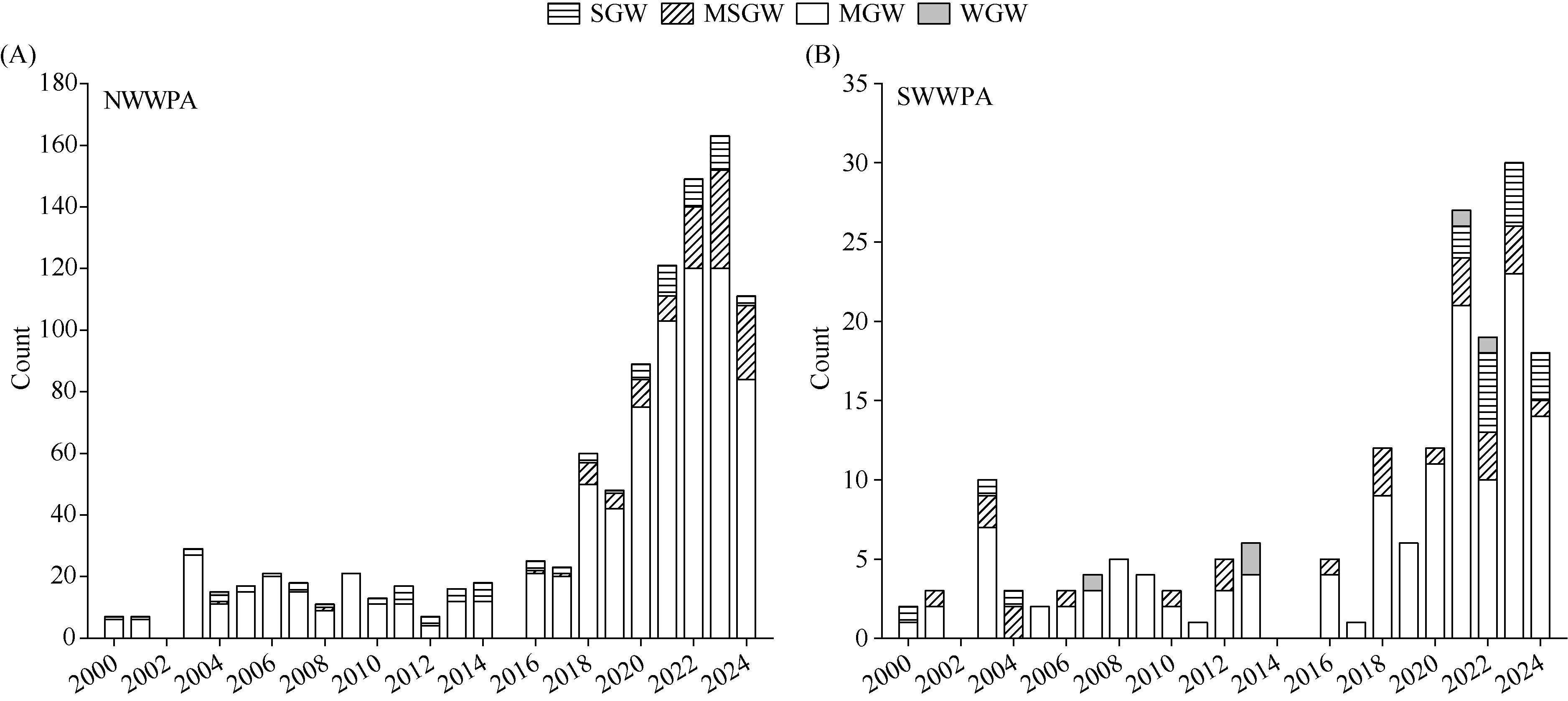
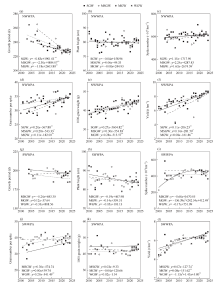
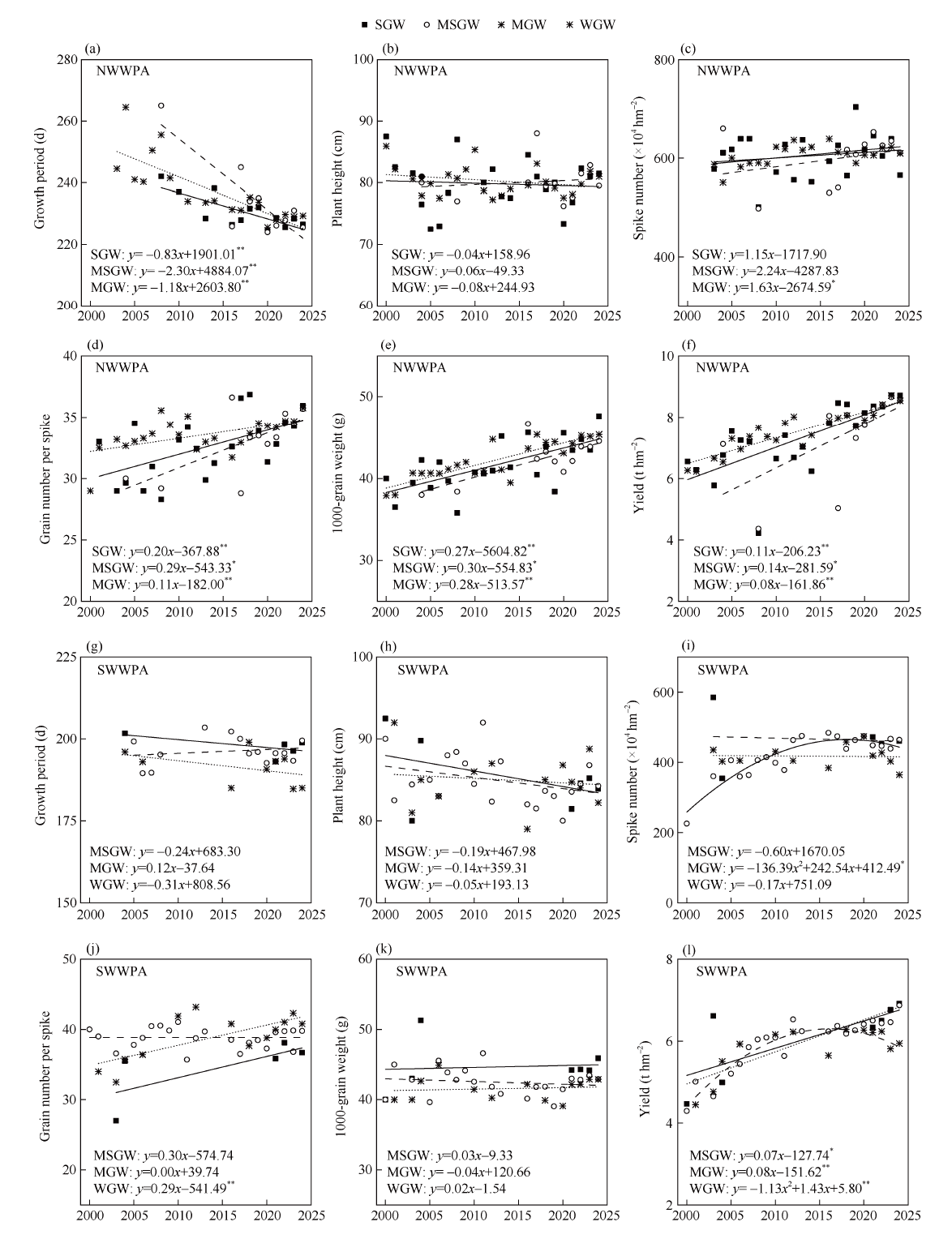
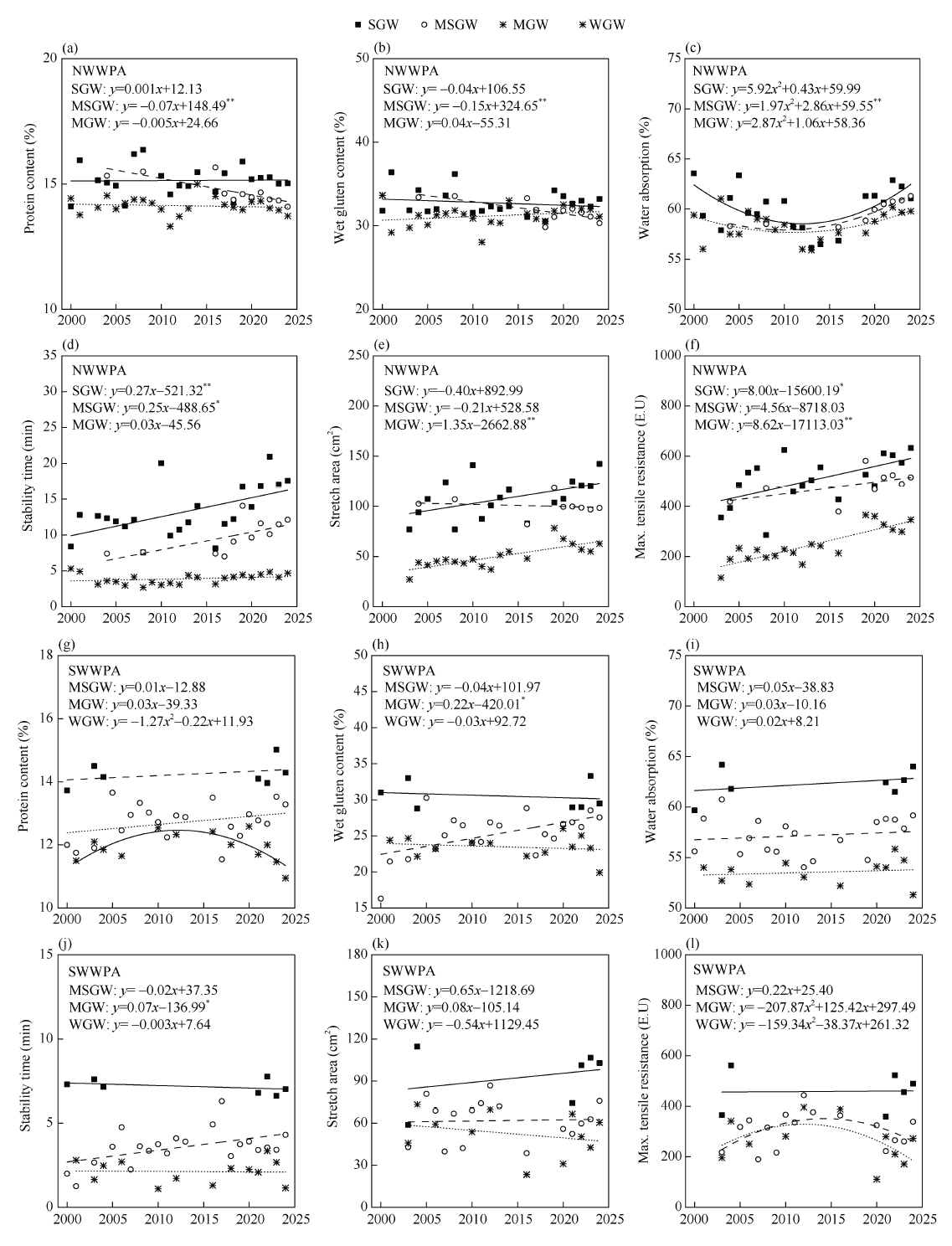
分析近二十年北方冬麦区与南方冬麦区国审冬小麦品种产量和品质变化及性状之间的相关性, 旨在明确品种更替过程中冬小麦产量和品质的变化趋势, 为未来高产优质小麦育种和栽培技术创新提供重要参考。收集并整理2000—2024年北方冬麦区与南方冬麦区1187个国审冬小麦品种数据, 将其按品质类型分为强筋、中强筋、中筋与弱筋4种类型, 并对其产量及构成因素、品质指标等进行了分析。自2017年起, 2个麦区国审冬小麦品种数量显著增加; 均以中筋品种为主。北方冬麦区的中强筋品种产量高于强筋和中筋品种, 南方冬麦区的中强筋品种产量高于弱筋品种。北方冬麦区品种的生育期显著缩短, 产量随时间显著增加, 以中强筋品种增幅最大, 为0.14 t hm-2, 中强筋品种的蛋白质和湿面筋含量年均分别减少0.07%和0.15%, 强筋和中强筋品种的稳定时间年均分别增加0.27 min和0.25 min; 南方冬麦区中强筋和中筋品种产量显著增加, 中筋品种的湿面筋含量和稳定时间年均分别增加0.22%和0.07 min。在北方冬麦区, 强筋和中强筋品种的穗粒数与产量的相关性最高。中筋品种的千粒重与产量的相关性最高。强筋和中强筋品种的蛋白质含量与湿面筋、稳定时间和拉伸面积均呈正相关。在南方冬麦区, 中强筋和中筋品种的穗数与产量呈显著正相关, 弱筋品种穗粒数与产量呈正相关。北方冬麦区冬小麦通过统筹提高产量构成三因素, 进一步提高产量和品质; 南方冬麦区中强筋和中筋小麦的穗数是提高产量的关键因素, 弱筋小麦则通过增加穗粒数并优化栽培管理以保持较低的蛋白质含量, 从而提升产量并确保加工适应性。在未来气候变化的背景下, 如何实现产量与品质的协同提升, 是我国小麦育种和优质栽培创新亟待解决的重要科技问题。
| [1] | 中华人民共和国国家统计局. 中国统计年鉴. 北京: 中国统计出版社, 2020. |
| National Bureau of Statistics of the People’s Republic of China.China Statistical Yearbook. Beijing: China Statistics Press, 2020 (in Chinese). | |
| [2] |
何中虎, 夏先春, 陈新民, 庄巧生. 中国小麦育种进展与展望. 作物学报, 2011, 37: 202-215.
doi: 10.3724/SP.J.1006.2011.00202 |
| He Z H, Xia X C, Chen X M, Zhuang Q S. Progress of wheat breeding in China and the future perspective. Acta Agron Sin, 2011, 37: 202-215 (in Chinese with English abstract). | |
| [3] |
Senapati N, Semenov M A, Halford N G, Hawkesford M J, Asseng S, Cooper M, Ewert F, van Ittersum M K, Martre P, Olesen J E, et al. Global wheat production could benefit from closing the genetic yield gap. Nat Food, 2022, 3: 532-541.
doi: 10.1038/s43016-022-00540-9 pmid: 37117937 |
| [4] | 齐琳娟, 胡学旭, 周桂英, 王爽, 李静梅, 陆伟, 吴丽娜, 陆美斌, 孙丽娟, 杨秀兰, 等. 2004-2011年中国主产省小麦蛋白质品质分析. 中国农业科学, 2012, 45: 4242-4251. |
| Qi L J, Hu X X, Zhou G Y, Wang S, Li J M, Lu W, Wu L N, Lu M B, Sun L J, Yang X L, et al. Analysis of wheat protein quality in main wheat producing areas of China from 2004 to 2011. Sci Agric Sin, 2012, 45: 4242-4251 (in Chinese with English abstract). | |
| [5] |
宋健民, 戴双, 李豪圣, 程敦公, 刘爱峰, 曹新有, 刘建军, 赵振东. 山东省近年来审定小麦品种农艺和品质性状演变分析. 中国农业科学, 2013, 46: 1114-1126.
doi: 10.3864/j.issn.0578-1752.2013.06.004 |
| Song J M, Dai S, Li H S, Cheng D G, Liu A F, Cao X Y, Liu J J, Zhao Z D. Evolution of agronomic and quality traits of wheat cultivars released in Shandong province recently. Sci Agric Sin, 2013, 46: 1114-1126 (in Chinese with English abstract). | |
| [6] | 胡学旭, 孙丽娟, 周桂英, 吴丽娜, 陆伟, 李为喜, 王爽, 杨秀兰, 宋敬可, 王步军. 2000-2015年北部、黄淮冬麦区国家区试品种的品质特征. 作物学报, 2017, 43: 501-509. |
| Hu X X, Sun L J, Zhou G Y, Wu L N, Lu W, Li W X, Wang S, Yang X L, Song J K, Wang B J. Quality variation of national tested varieties in northern winter wheat region and Yellow-Huai river valley winter wheat region from 2000 to 2015. Acta Agron Sin, 2017, 43: 501-509 (in Chinese with English abstract). | |
| [7] | 郝天佳, 曲文凯, 赵金科, 邓肖, 张霞, 李柯煜, 徐学欣, 赵长星. 1991-2018年中国国审小麦品种产量与品质相关性状的变化趋势分析. 中国粮油学报, 2023, 38(8): 84-93. |
| Hao T J, Qu W K, Zhao J K, Deng X, Zhang X, Li K Y, Xu X X, Zhao C X. Trends of yield and quality related traits of wheat varieties released in China from 1991 to 2018. J Chin Cereals Oils Assoc, 2023, 38(8): 84-93 (in Chinese with English abstract). | |
| [8] | 李式昭, 涂洋, 朱华忠, 吕季娟, 郑建敏, 万洪深, 罗江陶, 杨漫宇, 伍玲. 2009-2020年国家小麦区域试验长江上游组参试品系产量性状分析. 四川农业大学学报, 2022, 40: 19-27. |
| Li S Z, Tu Y, Zhu H Z, Lyu J J, Zheng J M, Wan H S, Luo J T, Yang M Y, Wu L. Yield traits analysis of new wheat lines (varieties) in upper reaches of Yangtze River Basin of national trial during 2009-2020. J Sichuan Agric Univ, 2022, 40: 19-27 (in Chinese with English abstract). | |
| [9] | 胡学旭, 孙丽娟, 周桂英, 吴丽娜, 陆伟, 李为喜, 王爽, 杨秀兰, 宋敬可, 王步军. 2006-2015年中国小麦质量年度变化. 中国农业科学, 2016, 49: 3063-3072. |
| Hu X X, Sun L J, Zhou G Y, Wu L N, Lu W, Li W X, Wang S, Yang X L, Song J K, Wang B J. Variations of wheat quality in China from 2006 to 2015. Sci Agric Sin, 2016, 49: 3063-3072 (in Chinese with English abstract). | |
| [10] |
魏益民, 张波, 关二旗, 张国权, 张影全, 宋哲民. 中国冬小麦品质改良研究进展. 中国农业科学, 2013, 46: 4189-4196.
doi: 10.3864/j.issn.0578-1752.2013.20.002 |
| Wei Y M, Zhang B, Guan E Q, Zhang G Q, Zhang Y Q, Song Z M. Advances in study of quality property improvement of winter wheat in China. Sci Agric Sin, 2013, 46: 4189-4196 (in Chinese with English abstract). | |
| [11] | 张华崇, 赵树琪, 闫振华, 黄晓莉, 戴宝生, 李蔚. 湖北省近20年审定小麦品种的产量、品质性状及抗病性分析. 麦类作物学报, 2021, 41: 1356-1364. |
| Zhang H C, Zhao S Q, Yan Z H, Huang X L, Dai B S, Li W. Analysis of yield, quality and disease resistance traits of wheat varieties approved in Hubei province in the last two decades. J Triticeae Crops, 2021, 41: 1356-1364 (in Chinese with English abstract). | |
| [12] | 赵广才. 中国小麦种植区划研究(一). 麦类作物学报, 2010, 30: 886-895. |
| Zhao G C. Study on Chinese wheat planting regionalization (I). J Triticeae Crops, 2010, 30: 886-895 (in Chinese with English abstract). | |
| [13] | 李爱国, 宋晓霞, 张文斐, 王改革. 2001-2020年河南省审定小麦品种育种特点及表型性状演变分析. 麦类作物学报, 2021, 41: 947-959. |
| Li A G, Song X X, Zhang W F, Wang G G. Breeding characteristics and phenotypic traits evolution of wheat varieties approved in Henan province during 2001-2020. J Triticeae Crops, 2021, 41: 947-959 (in Chinese with English abstract). | |
| [14] | Slafer G A, García G A, Serrago R A, Miralles D J. Physiological drivers of responses of grains per m2 to environmental and genetic factors in wheat. Field Crops Res, 2022, 285: 108593. |
| [15] |
Katamadze A, Vergara-Díaz O, Uberegui E, Yoldi-Achalandabaso A, Araus J L, Vicente R. Evolution of wheat architecture, physiology, and metabolism during domestication and further cultivation: Lessons for crop improvement. Crop J, 2023, 11: 1080-1096.
doi: 10.1016/j.cj.2023.06.006 |
| [16] | Zheng C Y, Zhang J, Chen J, Chen C Q, Tian Y L, Deng A X, Song Z W, Nawaz M M, van Groenigen K J, Zhang W J. Nighttime warming increases winter-sown wheat yield across major Chinese cropping regions. Field Crops Res, 2017, 214: 202-210. |
| [17] | Xiao J, Liu B, Yao Y Y, Guo Z F, Jia H Y, Kong L R, Zhang A M, Ma W J, Ni Z F, Xu S B, et al. Wheat genomic study for genetic improvement of traits in China. Sci China Life Sci, 2022, 65: 1718-1775. |
| [18] | Reynolds M, Foulkes J, Furbank R, Griffiths S, King J, Murchie E, Parry M, Slafer G. Achieving yield gains in wheat. Plant Cell Environ, 2012, 35: 1799-1823. |
| [19] | Qin X L, Zhang F X, Liu C, Yu H, Cao B G, Tian S Q, Liao Y C, Siddique K H M. Wheat yield improvements in China: Past trends and future directions. Field Crops Res, 2015, 177: 117-124. |
| [20] | Aisawi K A B, Reynolds M P, Singh R P, Foulkes M J. The physiological basis of the genetic progress in yield potential of CIMMYT spring wheat cultivars from 1966 to 2009. Crop Sci, 2015, 55: 1749-1764. |
| [21] | Zheng T C, Zhang X K, Yin G H, Wang L N, Han Y L, Chen L, Huang F, Tang J W, Xia X C, He Z H. Genetic gains in grain yield, net photosynthesis and stomatal conductance achieved in Henan province of China between 1981 and 2008. Field Crops Res, 2011, 122: 225-233. |
| [22] |
熊淑萍, 高明, 张志勇, 秦步坛, 徐赛俊, 付新露, 王小纯, 马新明. 基于GIS的河南省小麦产量及产量构成要素时空差异分析. 中国农业科学, 2022, 55: 692-706.
doi: 10.3864/j.issn.0578-1752.2022.04.006 |
|
Xiong S P, Gao M, Zhang Z Y, Qin B T, Xu S J, Fu X L, Wang X C, Ma X M. Spatial and temporal difference analysis of wheat yield and yield components in Henan province based on GIS. Sci Agric Sin, 2022, 55: 692-706 (in Chinese with English abstract).
doi: 10.3864/j.issn.0578-1752.2022.04.006 |
|
| [23] | 张俊灵, 闫金龙, 张东旭, 孙美荣, 常海霞. 北部冬麦区旱地小麦品种的演变规律. 麦类作物学报, 2017, 37: 1017-1024. |
| Zhang J L, Yan J L, Zhang D X, Sun M R, Chang H X. Evolution rule of wheat varieties in dryland of northern winter wheat zone. J Triticeae Crops, 2017, 37: 1017-1024 (in Chinese with English abstract). | |
| [24] |
黄宁, 王朝辉, 王丽, 马清霞, 张悦悦, 张欣欣, 王瑞. 我国主要麦区主栽高产品种产量差异及其与产量构成和氮磷钾吸收利用的关系. 中国农业科学, 2020, 53: 81-93.
doi: 10.3864/j.issn.0578-1752.2020.01.008 |
|
Huang N, Wang Z H, Wang L, Ma Q X, Zhang Y Y, Zhang X X, Wang R. Yield variation of winter wheat and its relationship to yield components, NPK uptake and utilization of leading and high yielding wheat cultivars in main wheat production regions of China. Sci Agric Sin, 2020, 53: 81-93 (in Chinese with English abstract).
doi: 10.3864/j.issn.0578-1752.2020.01.008 |
|
| [25] |
郑立飞, 尚一斐, 李学军, 冯浩, 魏永胜. 结构方程模型在冬小麦农艺性状与产量关系分析中的应用. 作物学报, 2017, 43: 1395-1400.
doi: 10.3724/SP.J.1006.2017.01395 |
|
Zheng L F, Shang Y F, Li X J, Feng H, Wei Y S. Structural equation model for analyzing relationship between yield and agronomic traits in winter wheat. Acta Agron Sin, 2017, 43: 1395-1400 (in Chinese with English abstract).
doi: 10.3724/SP.J.1006.2017.01395 |
|
| [26] | 胡学旭, 王步军. 北部冬麦区和黄淮冬麦区小麦区试品种品质改良现状及建议. 中国种业, 2016, 11(11): 14-16. |
| Hu X X, Wang B J. Current status and suggestions for quality improvement of wheat varieties in northern winter wheat regions and Huang-Huai winter wheat regions. China Seed Ind, 2016, 11(11): 14-16 (in Chinese with English abstract). | |
| [27] | 马小飞, 李竹梅, 王敏, 曹勇, 李晓丽, 姜兰芳, 郝建宇, 张定一, 姬虎太. 山西省近二十年审定小麦品种的农艺和品质性状变化. 麦类作物学报, 2020, 40: 938-944. |
| Ma X F, Li Z M, Wang M, Cao Y, Li X L, Jiang L F, Hao J Y, Zhang D Y, Ji H T. Variance of agronomic and quality traits of wheat cultivars released in Shanxi province in the last two decades. J Triticeae Crops, 2020, 40: 938-944 (in Chinese with English abstract). | |
| [28] |
Zhang T Y, He Y, DePauw R, Jin Z N, Garvin D, Yue X, Anderson W, Li T, Dong X, Zhang T, et al. Climate change may outpace current wheat breeding yield improvements in North America. Nat Commun, 2022, 13: 5591.
doi: 10.1038/s41467-022-33265-1 pmid: 36180462 |
| [29] | Duncan E G, O’Sullivan C A, Roper M M, Biggs J S, Peoples M B. Influence of co-application of nitrogen with phosphorus, potassium and sulphur on the apparent efficiency of nitrogen fertiliser use, grain yield and protein content of wheat: review. Field Crops Res, 2018, 226: 56-65. |
| [30] | 马雪晴, 和骅芸, 赵金媛, 方彤, 张建珍, 潘学标, 潘志华, 王靖, 胡琦. 1961-2020年中国小麦生长季干湿时空变化分析. 中国生态农业学报(中英文), 2023, 31: 608-618. |
| Ma X Q, He H Y, Zhao J Y, Fang T, Zhang J Z, Pan X B, Pan Z H, Wang J, Hu Q. Spatiotemporal variation of dry-wet climate during wheat growing seasons from 1961 to 2020 in China. Chin J Eco-Agric, 2023, 31: 608-618 (in Chinese with English abstract). | |
| [31] | 蒋进, 蒋云, 王淑荣. 四川省近年育成小麦品种农艺性状和品质性状分析. 麦类作物学报, 2019, 39: 682-691. |
| Jiang J, Jiang Y, Wang S R. Agronomic and quality traits of wheat varieties bred in Sichuan in recent years. J Triticeae Crops, 2019, 39: 682-691 (in Chinese with English abstract). | |
| [32] | 黄晓荣, 甘斌杰, 夏孝群, 赵小庆, 张力, 刘立龙, 马世杰, 李世祥, 陈阁阁. 安徽省春性小麦区试品系主要品质性状分析. 麦类作物学报, 2023, 43: 582-590. |
| Huang X R, Gan B J, Xia X Q, Zhao X Q, Zhang L, Liu L L, Ma S J, Li S X, Chen G G. Analysis of main quality traits of spring wheat lines tested in official trials in Anhui province. J Triticeae Crops, 2023, 43: 582-590 (in Chinese with English abstract). |
| [1] | 翟胜男, 曹新有, 李豪圣, 李吉虎, 李法计, 刘金栋, 夏先春, 吕莹莹, 马瑞峰, 王颖, 耿洪伟, 刘建军. 小麦Pod-A1、Pod-D1和Pod-2D位点等位变异对籽粒过氧化物酶活性的遗传效应分析[J]. 作物学报, 2026, 52(6): 1593-1603. |
| [2] | 习千辉, 徐梓瑗, 刘梦梦, 王宏艺, 郎凯琳, 井震海, 陈锋, 赵磊. 小麦籽粒铜含量的全基因组关联分析及候选基因预测[J]. 作物学报, 2026, 52(6): 1604-1617. |
| [3] | 胡川, 赵凯男, 黄修利, 吴金芝, 任开明, 王贺正, 付国占, 黄明, 李友军. 一次灌溉下耕作方式和氮肥用量对旱地小麦产量和品质的影响[J]. 作物学报, 2026, 52(6): 1830-1846. |
| [4] | 马胜乾, 王志平, 陈浩天, 窦淑贤, 张燕, 邓艾兴, 张卫建, 原向阳, 宋振伟. 秸秆还田下耕作方式与氮肥施用量对东北玉米产量及土壤团聚体的影响[J]. 作物学报, 2026, 52(6): 1802-1816. |
| [5] | 张思思, 赵向辉, 周洋, 姚云凤, 朱荣昱, 董元杰, 胡国庆, 徐通, 刘兆新. 冬闲期翻耕和绿肥还田对连作花生田土壤理化性质和产量的影响[J]. 作物学报, 2026, 52(5): 1472-1486. |
| [6] | 张宁宁, 滕雨菲, 任娜娜, 魏兴卓, 闫书豪, 樊可心, 王永宏, 陈文康, 张兴华, 朱万超, 徐淑兔, 薛吉全. 201份玉米自交系抗旱表型评价及可塑性分析[J]. 作物学报, 2026, 52(5): 1309-1325. |
| [7] | 王壮壮, 武紫君, 张永新, 张芯源, 袁丽雪, 陈如雪, 刘世举, 段剑钊, 冯伟, 王同朝, 王永华. 豫东南黏壤潮土区水氮优化协同提高冬小麦产量和氮素利用效率[J]. 作物学报, 2026, 52(5): 1501-1521. |
| [8] | 刘昕萌, 任昊, 张继波, 张吉旺, 赵斌, 任佰朝, 刘鹏, 王洪章. 茉莉酸甲酯(MeJA)缓解高温影响玉米雌穗分化的生理机制[J]. 作物学报, 2026, 52(5): 1561-1572. |
| [9] | 张鸿蓉, 王菲儿, 李盼, 仇海龙, 朱静, 赵连豪, 南运有, 何蔚, 樊志龙, 胡发龙, 柴强, 殷文. 减量20%灌水与25%有机肥替代化肥提高青贮玉米产量的光合特性[J]. 作物学报, 2026, 52(5): 1487-1500. |
| [10] | 张振, 冯连杰, 石玉, 于振文, 张永丽. 节水补灌下不同穗型小麦产量形成差异研究[J]. 作物学报, 2026, 52(5): 1522-1535. |
| [11] | 闫安, 蒋昆炜, 王蓉圆, 田林, 张璐, 王韵, 徐建龙. 水稻剑叶小维管束数基因SVN7的鉴定与克隆[J]. 作物学报, 2026, 52(5): 1364-1372. |
| [12] | 王宇诚, 张露, 刘阿康, 黄见良, 彭少兵, 袁珅. 基于产量差的作物大面积单产提升策略与展望[J]. 作物学报, 2026, 52(5): 1279-1290. |
| [13] | 赵佳雪, 周龙昊, 郭岂源, 尚伦霄, 王涵, 刘志涛, 陈曦, 张晓佩, 宋宪亮, 毛丽丽. 长期秸秆还田与深松通过改善土壤环境与棉花光合特性提高滨海盐碱地棉花产量[J]. 作物学报, 2026, 52(5): 1548-1560. |
| [14] | 杨扬, 常诗惠, 田红丽, 易红梅, 王璐, 任洁, 范亚明, 刘亚维, 王凤格, 赵久然. 不同生态区国审玉米品种的遗传多样性分析[J]. 作物学报, 2026, 52(5): 1352-1364. |
| [15] | 郭星宇, 胡丹, 林苏期, 王梦凯, 谭文峰, 黄传琴. 生物炭配施化肥提高玉米‖大豆下玉米产量和土壤生态系统多功能性[J]. 作物学报, 2026, 52(5): 1536-1547. |
|
||