欢迎访问作物学报,今天是
作物学报 ›› 2026, Vol. 52 ›› Issue (10): 2927-2938.doi: 10.3724/SP.J.1006.2026.64008
李祥栋1,2( ), 郑传奇1, 陆秀娟1, 郭超2, 魏心元1, 刘敏轩3,*()
Li Xiang-Dong1,2(), Zheng Chuan-Qi1, Lu Xiu-Juan1, Guo Chao2, Wei Xin-Yuan1, Liu Min-Xuan3,*()
摘要:
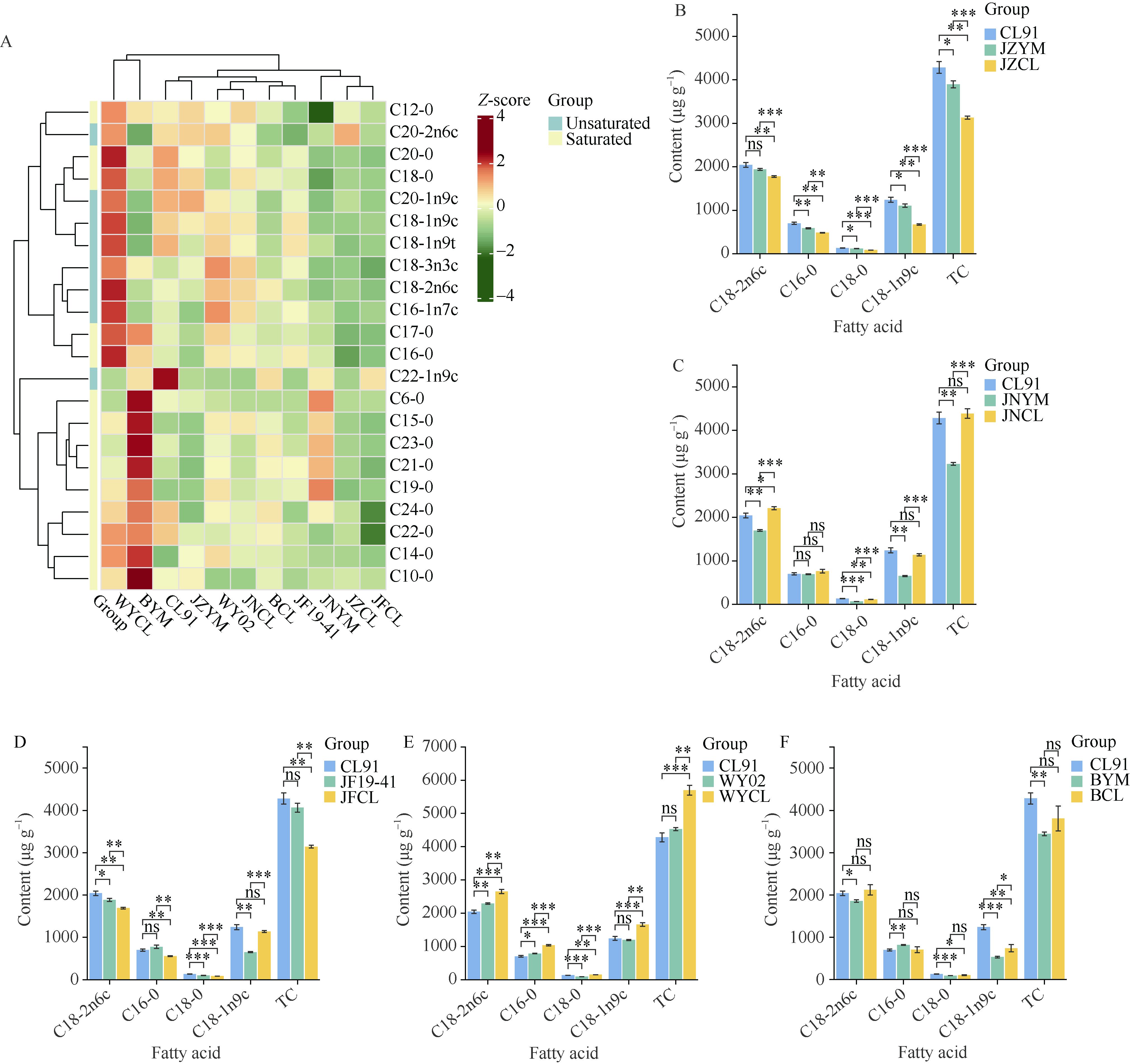
本研究以5个薏苡地方品种为母本、念珠薏苡CL91为共同父本, 配制5个杂交组合, 分析F1主要表型性状及游离脂肪酸含量的中亲优势及超高亲优势特点, 旨在为薏苡的种间渐渗改良及杂种优势利用提供依据。基于13个表型性状的聚类结果显示, JZCL、JFCL、JNCL和BCL四个F1杂种表型更倾向于母本, WYCL则更倾向于父本。8个农艺性状的中亲优势和超高亲优势范围分别为-30.6%~90.2%和-48.1%~77.3%, 整体上多表现为正向中亲优势, 少部分组合在特定性状中表现为超亲遗传的特点。5个F1总苞性状的中亲优势和超高亲优势范围分别为-5.3%~52.7%和-32.7%~9.5%, 而且总苞大小和形状介于双亲之间且多表现为正向中亲优势, 超高亲优势整体为负值。在5个杂交组合及其亲本的种仁中共检测出22种游离脂肪酸, 其中不饱和脂肪酸8种, 饱和脂肪酸14种; 亚油酸(C18-2n6c)、油酸(C18-1n9c)、棕榈酸(C16-0)和硬脂酸(C18-0)是4种含量最高的主要单体成分, 而且在5个杂种F1及其双亲中存在显著差异。杂种JNCL和WYCL的多个脂肪酸单体及总含量表现出明显的杂种优势和超亲遗传, 而JZCL、JFCL和BCL的脂肪酸含量杂种优势弱。“念珠薏苡×薏米”种间杂种在株高、着粒层等与植株形态和发育相关性状具有较为广泛的中亲优势, 且“亚热带(热带) ×温带”杂交模式在植株生长势方面的杂种优势更强, JNYM和WY02可作为高油脂改良品种的重要基础亲本材料。
| [1] | 刘旭. 作物种质资源学. 北京: 科学出版社, 2024. pp 528-533. |
| Liu X. Crop Germplasmics. Beijing: Science Press, 2024. pp 528-533 (in Chinese). | |
| [2] | 黄锁义, 李容, 潘勇, 等. 薏苡研究的新进展. 食品研究与开发, 2012, 33(11): 223-227. |
| Huang S Y, Li R, Pan Y, et al. Study new progress of Coix lachryma-jobi L. Food Res Dev, 2012, 33(11): 223-227 (in Chinese with English abstract). | |
| [3] | 张聿梅, 杨峻山, 赵杨景, 等. 薏苡化学成分及药理活性研究进展. 中国药学杂志, 2002, 37(1): 8-11. |
| Zhang Y M, Yang J S, Zhao Y J, et al. Research progress on chemical constituents and pharmaceutical activities of Coix lachryma-jobi. Chin Pharm J, 2002, 37(1): 8-11 (in Chinese). | |
| [4] | 中国科学院中国植物志编辑委员会. 中国植物志-拉丁名索引: 1959-1992. 北京: 科学出版社, 1997. p 289. |
| Chinese Flora Editorial Committee, Chinese Academy of Sciences. Flora Reipublicae Popularis Sinicae: 1959-1992. 1997. p 289 (in Chinese). | |
| [5] | 宋秀英, 赵晓明, 李明山, 等. 薏苡属种间杂种形态的观察和比较. 山西农业大学学报, 1993, 13(3): 199-202. |
| Song X Y, Zhao X M, Li M S, et al. Observation and comparison on interspecific hybrid of job’s tears genus. J Shanxi Agric Univ, 1993, 13(3): 199-202 (in Chinese with English abstract). | |
| [6] | 乔亚科, 李桂兰, 高书国, 等. 两种薏苡及其F1性状表现. 中草药, 1995, 26(2): 88-91. |
| Qiao Y K, Li G L, Gao S G, et al. Characteristic performance of F1 hybrid of jobs tears (Coix lacryma-jobi) and C. lacryma-jobi var. friamentacea and inheritance of stigma colour. Chin Tradit Herb Drugs, 1995, 26(2): 88-91 (in Chinese with English abstract). | |
| [7] | 杜维俊, 赵晓明, 李贵全. 薏苡属种间杂种F1性状遗传的研究. 山西农业大学学报, 1998(1): 22-25. |
| Du W J, Zhao X M, Li G Q. Studies on the morphogenetics of interspecific hybrid of Coix L. J Shanxi Agric Univ, 1998(1): 22-25 (in Chinese with English abstract). | |
| [8] | 乔亚科, 李桂兰, 高书国, 等. 薏苡类型间杂交F2代的性状分离. 河北农业技术师范学院学报, 1993, 7(4): 48-51. |
| Qiao Y K, Li G L, Gao S G, et al. Characters separation in F2 generation of intertype hybridization. J Hebei Norm Univ Sci Technol, 1993, 7(4): 48-51 (in Chinese with English abstract). | |
| [9] | 李贵全, 赵晓明, 宋秀英. 薏苡×川谷远缘杂交的研究. 作物学报, 1997, 23: 119-122. |
| Li G Q, Zhao X M, Song X Y. Studies of distant hybridization in C. lacryma-jobi and C. lacryma-jobi var. friamentacea. Acta Agron Sin, 1997, 23: 119-122 (in Chinese with English abstract). | |
| [10] |
段桃利, 牟锦毅, 唐祈林, 等. 玉米与摩擦禾、薏苡的杂交不亲和性. 作物学报, 2008, 34: 1656-1661.
doi: 10.3724/SP.J.1006.2008.01656 |
|
Duan T L, Mu J Y, Tang Q L, et al. Sexual incompatibility between maize and its wild relatives Tripsacum L. and Coix L. Acta Agron Sin, 2008, 34: 1656-1661 (in Chinese with English abstract).
doi: 10.3724/SP.J.1006.2008.01656 |
|
| [11] | 石明, 李祥栋, 秦礼康. 薏苡种质资源描述规范和数据标准. 北京: 中国农业出版社, 2017. |
| Shi M, Li X D, Qin L K. Descriptors and Data Standard for Job’s Tears (Coix lacryma-jobi L.). Beijing: China Agriculture Press, 2017 (in Chinese). | |
| [12] |
李祥栋, 潘虹, 陆秀娟, 等. 薏苡属种质资源的主要表型性状多样性研究. 植物遗传资源学报, 2019, 20: 229-238.
doi: 10.13430/j.cnki.jpgr.20180604003 |
| Li X D, Pan H, Lu X J, et al. Analysis of main phenotypic characteristics in Coix L. germplasm resources. J Plant Genet Resour, 2019, 20: 229-238 (in Chinese with English abstract). | |
| [13] | 李祥栋, 陆秀娟, 潘虹, 等. 薏苡属种质资源Waxy基因分型及优异资源筛选. 植物遗传资源学报, 2022, 23: 183-194. |
| Li X D, Lu X J, Pan H, et al. The Waxy gene genotyping and elite lines selection in adlay (Coix L.) germplasms. J Plant Genet Resour, 2022, 23: 183-194 (in Chinese with English abstract). | |
| [14] | 陆秀娟, 李祥栋, 石明, 等. 薏苡苗期紫叶鞘性状的遗传分析. 江苏农业科学, 2020, 48(14): 146-149. |
| Lu X J, Li X D, Shi M, et al. Inheritance of purple leaf shenth trait in job’s tears. Jiangsu Agric Sci, 2020, 48(14): 146-149 (in Chinese). | |
| [15] | 陆秀娟, 潘虹, 蒋太英, 等. 薏苡幼苗叶色性状的遗传分析. 贵州农业科学, 2020, 48(11): 1-4. |
| Lu X J, Pan H, Jiang T Y, et al. Inheritance analysis of leaf color traits in Coix seedling. Guizhou Agric Sci, 2020, 48(11): 1-4 (in Chinese with English abstract). | |
| [16] | 陆秀娟, 李祥栋, 石明, 等. 薏苡紫色柱头性状的遗传分析. 种子, 2020, 39(1): 33-35. |
| Lu X J, Li X D, Shi M, et al. Inheritance of purple stigma trait in job’s tears. Seed, 2020, 39(1): 33-35 (in Chinese with English abstract). | |
| [17] | 李祥栋, 潘虹, 陆秀娟, 等. 薏苡总苞性状的遗传分析. 南方农业学报, 2020, 51: 1896-1903. |
| Li X D, Pan H, Lu X J, et al. Inheritance of involucre traits in Coix lacroyma-jobi L. J South Agric, 2020, 51: 1896-1903 (in Chinese with English abstract). | |
| [18] | 李祥栋, 陆秀娟, 魏心元, 等. 薏苡雌性不育株FS2106的性状遗传分析. 植物遗传资源学报, 2024, 25: 1083-1091. |
| Li X D, Lu X J, Wei X Y, et al. Traits inheritance of female sterile line FS2106 in adlay (Coix L.). J Plant Genet Resour, 2024, 25: 1083-1091 (in Chinese with English abstract). | |
| [19] |
Ukita T, Tanimura A. Studies on the antitumor component in the seed of Coix lachryma jobi L. var. ma-yuen (Roman) Stapf. Isolation and antitumor activity of coixenolide. Chem Pharm Bull, 1961, 9: 43-46.
doi: 10.1248/cpb.9.43 |
| [20] | 李大鹏. 康莱特注射液抗癌作用机理研究进展. 中药新药与临床药理, 2001, 12(2): 122-124. |
| Li D P. Research progress on anticancer mechanism of Kanglaite injection. Tradit Chin Drug Res Clin Pharmacol, 2001, 12(2): 122-124 (in Chinese). | |
| [21] | 王青霞, 余佳浩, 张连富. 8种薏苡仁油的化学成分分析. 中国油脂, 2018, 43(8): 63-67. |
| Wang Q X, Yu J H, Zhang L F. Chemical compositions of eight kinds of Coix seed oils. China Oils Fats, 2018, 43(8): 63-67 (in Chinese with English abstract). | |
| [22] | 李祥栋, 章洁琼, 潘虹, 等. 18份薏苡自交系的主要氨基酸及脂肪酸组分评价. 江苏农业科学, 2021, 49(21): 159-164. |
| Li X D, Zhang J Q, Pan H, et al. Nutritional evaluation of main amino and fatty acids components in 18 adlay (Coix L.) inbred lines. Jiangsu Agric Sci, 2021, 49(21): 159-164 (in Chinese). | |
| [23] | 谈嫚嫚, 陈振林, 熊善柏, 等. 薏苡的营养特性研究. 中国粮油学报, 2017, 32(9): 43-48. |
| Tan M M, Chen Z L, Xiong S B, et al. Analysis on nutritional properties of adlay (Coix lacryma-jobi L.) seeds. J Chin Cereals Oils Assoc, 2017, 32(9): 43-48 (in Chinese with English abstract). | |
| [24] | 李祥栋, 陆秀娟, 潘虹, 等. 一种薏苡定向杂交方法. 中国专利: CN202010186828.6, 2020-06-12. |
| Li X D, Lu X J, Pan H, et al. A breeding method of directional cross-fertilization in adlay (Coix L.). Chinese Patent: CN202010186828.6, 2020-06-12 (in Chinese). | |
| [25] |
Evenson R E, Gollin D. Assessing the impact of the green revolution, 1960 to 2000. Science, 2003, 300: 758-762.
doi: 10.1126/science.1078710 pmid: 12730592 |
| [26] |
Peng J, Richards D E, Hartley N M, et al. ‘Green revolution’ genes encode mutant gibberellin response modulators. Nature, 1999, 400: 256-261.
doi: 10.1038/22307 |
| [27] |
Zhang X K, Yang S J, Zhou Y, et al. Distribution of the Rht-B1b, Rht-D1b and Rht8 reduced height genes in autumn-sown Chinese wheats detected by molecular markers. Euphytica, 2006, 152: 109-116.
doi: 10.1007/s10681-006-9184-6 |
| [28] |
刁现民, 王立伟, 智慧, 等. 谷子中矮秆资源创制、遗传解析和育种利用. 作物学报, 2024, 50: 265-279.
doi: 10.3724/SP.J.1006.2024.34131 |
|
Diao X M, Wang L W, Zhi H, et al. Development, genetic deciphering, and breeding utilization of dwarf lines in foxtail millet. Acta Agron Sin, 2024, 50: 265-279 (in Chinese with English abstract).
doi: 10.3724/SP.J.1006.2024.34131 |
|
| [29] |
Bao J L, Wang Y N, Cui K S, et al. Natural variation of ClCCT promoter promotes flowering and dwarfing in adlay (Coix lacryma-jobi L.). Crop J, 2025, 13: 942-951.
doi: 10.1016/j.cj.2025.03.003 |
| [30] | 李祥栋, 陆秀娟, 潘虹, 等. 薏苡种仁主要脂质组分分类及特征分子筛选. 中国粮油学报, 2025, 40(4): 41-48. |
| Li X D, Lu X J, Pan H, et al. Classification of principal lipid components and distinctive molecules selection in adlay seed (Coix L.). J Chin Cereals Oils Assoc, 2025, 40(4): 41-48 (in Chinese with English abstract). | |
| [31] | 周树峰, 孙福艾, 郭超, 等. 一种通过远源杂交选育多年生饲用薏苡的方法. 中国专利: CN201711096938.8, 2019-12-31. |
| Zhou S F, Sun F A, Guo C, et al. A method for breeding perennial forage adlay by far hybridization. Chinese Patent: CN201711096938.8, 2019-12-31 (in Chinese). | |
| [32] | 李祥栋, 陆秀娟, 郭超, 等. 薏苡种间杂种F1主要农艺和总苞性状的杂种优势特征. 山西农业科学, 2025, 53(5): 58-66. |
| Li X D, Lu X J, Guo C, et al. Main agronomic and involucre traits heterosis of F1 interspecific hybrids in Coix L. J Shanxi Agric Sci, 2025, 53(5): 58-66 (in Chinese with English abstract). | |
| [33] |
Xue Y J, Zhao Y K, Zhang Y L, et al. Insights into the genomic divergence of maize heterotic groups in China. J Integr Plant Biol, 2025, 67: 1467-1486.
doi: 10.1111/jipb.13884 |
| [34] | 潘光堂, 杨克诚, 李晚忱, 等. 我国西南玉米杂种优势群及其杂优模式研究与应用的回顾. 玉米科学, 2020, 28(1): 1-8. |
| Pan G T, Yang K C, Li W C, et al. A review of the research and application of heterotic groups and patterns of maize breeding in southwest China. J Maize Sci, 2020, 28(1): 1-8 (in Chinese with English abstract). |
| [1] | 郑玉珍, 齐飞艳, 孙子淇, 刘华, 秦利, 石磊, 王娟, 汪蒙蒙, 韩锁义, 徐静, 苗利娟, 黄冰艳, 董文召, 郑峥, 张新友. 花生籽仁总超长链脂肪酸和7种脂肪酸组分的QTL定位[J]. 作物学报, 2026, 52(6): 1646-1657. |
| [2] | 张颖星, 宋裕祯, 王跃, 曹越, 曹晓宁, 王瑞云. EMS诱导糜子优异性状突变体的筛选及表型分析[J]. 作物学报, 2026, 52(5): 1388-1400. |
| [3] | 李瑞, 余意雯, 王敦亮, 田婷, 孙灵湘, 陶玥玥, 孙华. 长江中下游油菜薹油兼用模式菜籽产量特征比较研究[J]. 作物学报, 2026, 52(2): 620-630. |
| [4] | 迟晓元, 刘庆, 张君, 赵旭红, 李美, 于天一, 潘丽娟, 许静, 姜骁, 殷祥贞, 马俊卿, 陈娜. 不同花生品种(系)耐盐碱性田间鉴定及各性状指标相关性研究[J]. 作物学报, 2026, 52(1): 85-98. |
| [5] | 杨锐, 陈敬东, 黄郢, 张学昆, 周登文, 刘清云, 徐劲松, 谢伶俐, 许本波. 基于北纬30°分界的长江中游油菜增产策略研究[J]. 作物学报, 2026, 52(1): 99-117. |
| [6] | 陈于婷, 丁晓雨, 许本波, 张学昆, 徐劲松, 殷艳. 气候变暖对冬油菜产量、品质及重要农艺性状的影响[J]. 作物学报, 2025, 51(2): 516-525. |
| [7] | 许静, 毕竞男, 殷祥贞, 赵健鑫, 赵旭红, 潘丽娟, 陈娜, 姜骁, 马俊卿, 殷冬梅, 迟晓元. 花生ω-3脂肪酸脱氢酶基因在拟南芥中异源表达及转录组分析[J]. 作物学报, 2025, 51(12): 3251-3265. |
| [8] | 李琰, 李雨晨, 于爱萍, 陈爱萍. 8份无芒雀麦种质资源的草产量与营养品质的综合评价[J]. 作物学报, 2025, 51(12): 3377-3386. |
| [9] | 林洋, 史晓蕾, 陈强, 刘兵强, 杨庆, 于慧娟, 闫龙, 武小霞, 杨春燕. 大豆蛋白质脂肪及脂肪酸组分相关QTL定位[J]. 作物学报, 2025, 51(11): 2899-2910. |
| [10] | 蒋昂辰, 李琰, 李雨晨, 张晶, 陈爱萍. 21份无芒雀麦种质农艺性状及种子产量的综合评价与优异种质筛选[J]. 作物学报, 2025, 51(11): 2958-2970. |
| [11] | 桂灵星, 凌溪铁, 唐兆成, 罗文臻, 朱盼珍, 仇泽宇, 张保龙. 宁麦36抗甲氧咪草烟矮秆突变体的鉴定及农艺性状分析[J]. 作物学报, 2025, 51(11): 2923-2932. |
| [12] | 姜骁, 赵健鑫, 毕竞男, 许静, 殷祥贞, 赵旭红, 潘丽娟, 陈娜, 马俊卿, 韩鹏, 杨珍, 迟晓元. 中国北方主产区主要地理和气候因子对花生农艺性状和品质的影响[J]. 作物学报, 2025, 51(10): 2805-2820. |
| [13] | 聂波涛, 刘德泉, 陈健, 崔正果, 侯云龙, 陈亮, 邱红梅, 王跃强. 北方春大豆品种农艺和品质性状分析与综合评价[J]. 作物学报, 2024, 50(9): 2248-2266. |
| [14] | 李长喜, 董占鹏, 关永虎, 刘金伟, 李航, 梅拥军. 南疆陆地棉农艺性状与皮棉产量性状的遗传贡献及决策系数分析[J]. 作物学报, 2024, 50(6): 1486-1502. |
| [15] | 刘园园, 董建科, 应静文, 梅文祥, 程刚, 郭晶晶, 焦文标, 宋波涛. 利用野生种Solanum boliviense创制马铃薯抗寒种质[J]. 作物学报, 2024, 50(6): 1384-1393. |
|
||