欢迎访问作物学报,今天是
作物学报 ›› 2021, Vol. 47 ›› Issue (2): 275-284.doi: 10.3724/SP.J.1006.2021.04105
张雪翠1( ), 孙素丽1(), 卢为国2, 李海朝2, 贾岩岩1, 段灿星1, 朱振东1,*()
ZHANG Xue-Cui1(), SUN Su-Li1(), LU Wei-Guo2, LI Hai-Chao2, JIA Yan-Yan1, DUAN Can-Xing1, ZHU Zhen-Dong1,*()
摘要:
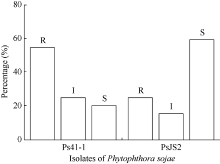
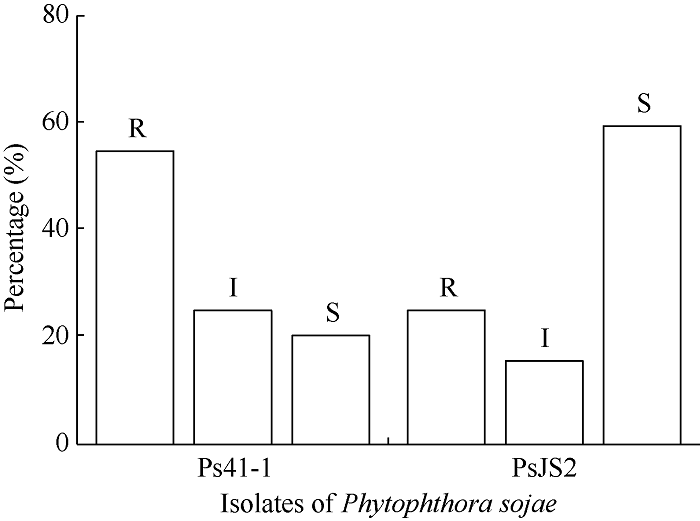
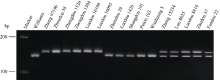
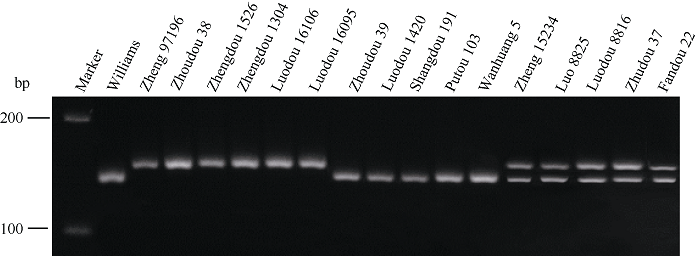
大豆疫霉根腐病作为影响大豆生产的毁灭性病害之一, 对大豆生产威胁很大。种植抗疫霉根腐病的大豆品种是控制该病害最有效的途径。河南省位于我国黄淮夏大豆产区的腹地, 具有大豆疫霉根腐病发生的潜在威胁。本研究的目的是对河南省新育成的大豆品系进行抗性鉴定和抗病基因分子标记检测, 以明确大豆新品系对大豆疫霉根腐病的抗性水平和抗病基因。采用下胚轴创伤接种法对64个河南省培育的大豆新品系进行接种, 鉴定其对2个具有不同毒力的大豆疫霉分离物PsJS2和Ps41-1的抗性。结果显示, 对分离物Ps41-1和PsJS2抗病的分别有35个和16个品系, 对Ps41-1和PsJS2为中间反应型的分别有16个和10个品系, 其中对2个分离物均抗病的有16个品系, 占鉴定品系的25%。使用抗疫霉病基因RpsZheng共分离标记WZInDel11进行新品系的基因型鉴定发现, 对2个大豆疫霉分离物均抗病的16个品系中有13个含有标记WZInDel11, 对1个或2个大豆疫霉分离物表现为中间反应型的5个大豆品系, 分子检测结果表明, 其为杂合基因型, 这些品系中的纯合抗病单株可直接选育成纯合抗病品系用于抗病育种。综合系谱分析结果推测, 有2个品系可能含抗疫霉根腐病基因RpsZheng, 2个品系可能含RpsYD29, 14个品系可能含有RpsZheng或其等位基因。表明河南省培育的大豆新品系中含有优异的大豆疫霉根腐病抗源, 该研究结果将为病害防控和抗病品种的选育提供参考。
| [1] | 查霆, 钟宣伯, 周启政, 何梦迪, 汪桂凤, 尤金华, 汪自强, 唐桂香. 我国大豆产业发展现状及振兴策略. 大豆科学, 2018,37:458-463. |
| Zha T, Zhong X B, Zhou Q Z, He M D, Wang G F, You J H, Wang Z Q, Tang G X. Development status of China’s soybean industry and strategies of revitalizing. Soybean Sci, 2018,37:458-463 (in Chinese with English abstract). | |
| [2] | Dorrance A E. Management of Phytophthora sojae of soybean: a review and future perspectives. Can J Plant Pathol, 2018,40:210-219. |
| [3] | 沈崇尧, 苏彦纯. 中国大豆疫霉病菌的发现及初步研究. 植物病理学报, 1991,21:298. |
| Shen C Y, Su Y C. Discovery and preliminary study of Phytophthora sojae in China. Acta Phytopathol Sin, 1991,21:298 (in Chinese with English abstract). | |
| [4] | Zhu Z, Wang H, Wang X, Chang R, Wu X. Distribution and virulence diversity of Phytophthora sojae in China. Agric Sci China, 2003,3:793-799. |
| [5] | Chen X R, Wang Y C. Phytophthora sojae. In: Wan F H, Jiang M X, Zhan A B, eds. Biological Invasions and Its Management in China. Germany: Springer, 2017. pp 199-223. |
| [6] | Tian M, Zhao L, Li S, Huang J, Sui Z, Wen J, Li Y. Pathotypes and metalaxyl sensitivity of Phytophthora sojae and their distribution in Heilongjiang, China 2011-2015. J Gen Plant Pathol, 2016,82:132-141. |
| [7] | Sugimoto T, Kato M, Yoshida S, Matsumoto I, Kobayashi T, Kaga A, Hajika M, Yamamoto R, Watanabe K, Aino M, Matoh T, Walker D R, Biggs A R, Ishimoto M. Pathogenic diversity of Phytophthora sojae and breeding strategies to develop Phytophthora-resistant soybeans. Breed Sci, 2012,61:511-522. |
| [8] |
Zhong C, Sun S, Li Y, Duan C, Zhu Z. Next-generation sequencing to identify candidate genes and develop diagnostic markers for a novel Phytophthora resistance gene, RpsHC18, in soybean. Theor Appl Genet, 2018,131:525-538.
pmid: 29138903 |
| [9] |
Zhong C, Sun S, Yao L, Ding J, Duan C, Zhu Z. Fine mapping and identification of a novel Phytophthora root rot resistance locus RpsZS18 on chromosome 2 in soybean. Front Plant Sci, 2018,9:44.
pmid: 29441079 |
| [10] | Zhong C, Li Y, Sun S, Duan C, Zhu Z. Genetic mapping and molecular characterization of a broad-spectrum Phytophthora sojae resistance gene in Chinese soybean. Int J Mol Sci, 2019,20:1809. |
| [11] | Schmitthenner A F. Problems and progress in control of Phytophthora root rot of soybean. Plant Dis, 1985,69:362-368. |
| [12] |
Yang B, Wang Q Q, Jing M F, Guo B D, Wu J W, Wang H N, Wang Y, Lin L, Wang Y, Ye W W, Dong S M, Wang Y C. Distinct regions of the Phytophthora essential effector Avh238 determineits function in cell death activation and plant immunity suppression. New Phytol, 2017,214:361-375.
doi: 10.1111/nph.14430 pmid: 28134441 |
| [13] |
Lee S, Mian M A R, Sneller C H, Wang H, Dorrance A E, McHale L K. Joint linkage QTL analyses for partial resistance to Phytophthora sojae in soybean using six nested inbred populations with heterogeneous conditions. Theor Appl Genet, 2014,127:429-444.
pmid: 24247235 |
| [14] | 冯艳萍. 河南省大豆生产概况及发展建议. 河南农业, 2018, (10):49-50. |
| Feng Y P. Overview of soybean production in Henan province and development suggestions. J Henan Agric, 2018, (10):49-50 (in Chinese). | |
| [15] | Lohnes D G, Nickell C D, Schmitthenner A F. Origin of soybean alleles for Phytophthora resistance in China. Crop Sci, 1996,36:1689-1692. |
| [16] | 王晓鸣, 朱振东, 王化波, 武小菲. 中国大豆疫霉根腐病和大豆种质抗病性研究. 植物病理学报, 2001,31:324-329. |
| Wang X M, Zhu Z D, Wang H B, Wu X F. Occurrence of soybean Phytophthora root rot and evaluation of germplasm resistance in China. Acta Phytopathol Sin, 2001,31:324-329 (in Chinese with English abstract). | |
| [17] | 朱振东, 霍云龙, 王晓鸣, 黄俊斌, 武小菲. 大豆疫霉根腐病抗源筛选. 植物遗传资源学报, 2006,7:24-30. |
| Zhu Z D, Huo Y L, Wang X M, Huang J B, Wu X F. Screening for resistance sources to Phytophthora root rot in soybean. J Plant Genet Resour, 2006,7:24-30 (in Chinese with English abstract). | |
| [18] |
Zhang J, Xia C, Wang X, Duan C, Sun S, Wu X, Zhu Z. Genetic characterization and fine mapping of the novel Phytophthora resistance gene in a Chinese soybean cultivar. Theor Appl Genet, 2013,126:1555-1561.
doi: 10.1007/s00122-013-2073-1 pmid: 23467992 |
| [19] | 张海鹏, 郭娜, 牛景萍, 黄婧, 彭洋, 王海棠, 赵晋铭, 邢邯. 大豆品种郑97196对疫霉根腐病的抗性遗传分析及基因定位. 大豆科学, 2016,35:373-379. |
| Zhang H P, Guo N, Niu J P, Huang J, Peng Y, Wang H T, Zhao J M, Xing H. Genetic analysis of resistance to Phytophthora sojae and mapping of resistance gene in soybean cultivar Zheng 97196. Soybean Sci, 2016,35:373-379 (in Chinese with English abstract). | |
| [20] | Zhang J, Sun S, Wang G, Duan C, Wang X, Wu X, Zhu Z. Characterization of Phytophthora resistance in soybean cultivars/lines bred in Henan province. Euphytica, 2014,196:375-384. |
| [21] | 张雪翠, 钟超, 段灿星, 孙素丽, 朱振东. 大豆品种郑97196中抗疫病基因RpsZheng精细定位. 作物学报, 2020,46:997-1005. |
| Zhang X C, Zhong C, Duan C X, Sun S L, Zhu Z D. Fine mapping of Phytophthora resistance gene RpsZheng in soybean cultivar Zheng 97196. Acta Agron Sin, 2020,46:997-1005 (in Chinese with English abstract). | |
| [22] | 叶晨晨. 河南省大豆疫霉的分离及鉴定. 安徽农业大学硕士学位论文, 安徽合肥, 2011. |
| Ye C C. Isolation and Identification of Phytophthora sojae from Henan Province MS Thesis of Anhui Agricultural University, Hefei, Anhui, China, 2011 (in Chinese with English abstract). | |
| [23] |
Dorrance A E, Berry S A, Anderson T R, Meharg C. Isolation, storage, pathotype characterization, and evaluation of resistance for Phytophthora sojae in soybean. Plant Health Prog, 2008. doi: 10.1094/PHP-2008-0118-01-DG.
pmid: 10275108 |
| [24] |
Li Y, Sun S, Zhong C, Wang X, Wu X, Zhu Z. Genetic mapping and development of co-segregating markers of RpsQ, which provides resistance to Phytophthora sojae in soybean. Theor Appl Genet, 2017,130:1223-1233.
doi: 10.1007/s00122-017-2883-7 pmid: 28258371 |
| [25] |
Zhang J, Xia C, Duan C, Sun S, Wang X, Wu X, Zhu Z. Identification and candidate gene analysis of a novel Phytophthora resistance gene Rps10 in a Chinese soybean cultivar. PLoS One, 2013,8:e69799.
doi: 10.1371/journal.pone.0069799 pmid: 23936102 |
| [26] | 钟超, 李银萍, 孙素丽, 刘章雄, 邱丽娟, 朱振东. 野生大豆资源对大豆疫病抗病性和耐病性鉴定. 植物遗传资源学报, 2015,16:684-690. |
| Zhong C, Li Y P, Sun S L, Liu Z X, Qiu L J, Zhu Z D. Identification of resistance and tolerance to Phytophthora sojae in wild soybean germplasm. J Plant Genet Resour, 2015,16:684-690 (in Chinese with English abstract). | |
| [27] |
Kyle D E, Nickell C D, Nelson R L, Pedersen W L. Response of soybean accessions from provinces in southern China to Phytophthora sojae. Plant Dis, 2007,82:555-559.
pmid: 30856987 |
| [28] | 李海朝, 马莹, 张辉, 文自翔, 李金英, 武永康, 卢为国. 优异大豆组合郑州135×泗豆2号的育种贡献. 植物遗传资源学报, 2012,13:1101-1107. |
| Li H C, Ma Y, Zhang H, Wen Z X, Li J Y, Wu Y K, Lu W G. Contribution of elite combination Zhengzhou 135 × Sidou 2 in soybean breeding. J Plant Genet Resour, 2012,13:1101-1107 (in Chinese with English abstract). | |
| [29] | 赵开兵, 沈维良, 王路路, 姜磊. 大豆新品种皖宿2156的选育及栽培技术要点. 大豆科技, 2013, (6):48-49. |
| Zhao K B, Shen W L, Wang L L, Jiang L. Breeding and cultivation techniques of new soybean cultivar Wansu 2156. Soybean Sci Technol, 2013, (6):48-49 (in Chinese). | |
| [30] | 李金花, 耿臻, 杨青春, 舒文涛, 李琼. 大豆新品种周豆23号. 中国种业, 2016, (11):52. |
| Li J H, Geng Z, Yang Q C, Shu W T, Li Q. New soybean cultivar Zhoudou 23. China Seed Ind, 2016, (11):52 (in Chinese). | |
| [31] | 张志民, 徐淑霞, 周青, 郑丽敏, 杨慧风, 王凤菊, 陈亚光. 大豆新品种安豆5156的综合性状分析. 中国种业, 2017, (11):66-67. |
| Zhang Z M, Xu S X, Zhou Q, Zheng L M, Yang H F, Wang F J, Chen Y G. Comprehensive character analysis of a new soybean cultivar Andou 5156. China Seed Ind, 2017, (11):66-67 (in Chinese). | |
| [32] | 陈晓玲, 朱振东, 杜青, 王晓鸣, 肖炎农, 武小菲. 大豆品种(系)抗疫霉根腐病基因的连锁SSR标记分析. 植物病理学报, 2008,38:75-82. |
| Chen X L, Zhu Z D, Du Q, Wang X M, Xiao Y N, Wu X F. Analysis of Phytophthora resistance loci Rps1 and Rps4 in soybean cultivars or lines using linkage SSR markers. Acta Phytopathol Sin, 2008,38:75-82 (in Chinese with English abstract). | |
| [33] | 张志民, 陈亚光, 周青, 杨慧风, 王凤菊, 郑丽敏, 郭海芳, 李明军, 徐淑霞. 安豆1498——疫霉根腐病抗性新种质. 中国油料作物学报, 2017,39:855-860. |
| Zhang Z M, Chen Y G, Zhou Q, Yang H F, Wang F J, Zheng L M, Guo H F, Li M J, Xu S X. Resistance identification of a new soybean germplasm Andou 1498 to Phytophthora root rot. Chin J Oil Crop Sci, 2017,39:855-860 (in Chinese with English abstract). | |
| [34] |
Slaminko T L, Bowen C R, Hartman G L. Multi-year evaluation of commercial soybean cultivars for resistance to Phytophthora sojae. Plant Dis, 2010,94:368-371.
pmid: 30754241 |
| [1] | 翟胜男, 曹新有, 李豪圣, 李吉虎, 李法计, 刘金栋, 夏先春, 吕莹莹, 马瑞峰, 王颖, 耿洪伟, 刘建军. 小麦Pod-A1、Pod-D1和Pod-2D位点等位变异对籽粒过氧化物酶活性的遗传效应分析[J]. 作物学报, 2026, 52(6): 1593-1603. |
| [2] | 毛嘉琦, 黄朋雨, 赵佳佳, 郑兴卫, 武棒棒, 郝宇琼, 屈非, 刘成, 马朋涛, 郑军. 山西小麦品种白粉病抗性评价及抗病基因分子检测[J]. 作物学报, 2026, 52(6): 1669-1681. |
| [3] | 彭佳泺, 李颖, 李丹丹, 杨军宁, 郭学峰, 张文姣, 俞晓雪, 周亚荣, 王振玉, 王彩香, 马雄风, 宿俊吉. 陆地棉I类LBD家族成员鉴定及GhLBD6调控开花期的功能和单倍型分析[J]. 作物学报, 2026, 52(6): 1682-1697. |
| [4] | 金昱何, 王雪菲, 徐张一娃, 缪怡宁, 蒋云杰, 伊莹, 缪德麟, 朱静仪, 钟一帆, 陈铭亨, 方芳, 刘鹏. 外源激素对低温胁迫下大豆叶片叶绿素荧光参数及抗氧化酶系统的影响[J]. 作物学报, 2026, 52(6): 1817-1829. |
| [5] | 唐宽强, 李公允, 宋美毅, 赵雪, 常春玲. 大豆株高性状全基因组关联分析及预测模型构建[J]. 作物学报, 2026, 52(6): 1743-1756. |
| [6] | 张献丰, 郭利建, 李康春, 孔斌雪, 刘玉芳, 车卓, 杨德龙. 小麦ABHD6基因家族鉴定与粒重功能标记开发[J]. 作物学报, 2026, 52(6): 1711-1727. |
| [7] | 姚术, 郭凯悦, 翟慧慧, 姚佳慧, 邓文琪, 闫玲, 黄驰, 高阳, 俞嫣然, 赵振邦, 李英慧, 王晓波, 李佳佳. 大豆苗期耐低铁综合评价及优异种质筛选[J]. 作物学报, 2026, 52(5): 1373-1387. |
| [8] | 王楚锐, 李开祥, 赵志, 肖麓, 唐国永, 赵志刚, 徐亮, 杜德志, 柳海东. 甘蓝型春油菜早花基因BnCRY2功能位点KASP标记的开发及应用[J]. 作物学报, 2026, 52(3): 708-721. |
| [9] | 张晴, 杨昱, 郭茜, 岳霈尧, 殷丛丛, 牛景萍, 赵晋忠, 杜维俊, 岳爱琴. 大豆GmARA6a的克隆及响应盐胁迫的功能分析[J]. 作物学报, 2026, 52(2): 480-493. |
| [10] | 王粤生, 葛冬冬, 程兰斐, 陈春环, 王长有, 刘新伦, 李停栋, 邓平川, 吉万全, 赵继新. 小麦-华山新麦草二体异代换系16DH25-7的分子细胞遗传学及抗病性鉴定[J]. 作物学报, 2026, 52(2): 433-445. |
| [11] | 贺红利, 张雨涵, 杨静, 程云清, 赵杨, 李星诺, 司洪亮, 张兴政, 杨向东. 大豆e1-as基因突变体的创制及生理分析[J]. 作物学报, 2025, 51(8): 2228-2239. |
| [12] | 王克晶, 李向华. 我国珍稀的大豆属多年生烟豆和短绒野大豆物种遗传资源濒危性评估分析[J]. 作物学报, 2025, 51(8): 2009-2019. |
| [13] | 孟然, 李赵嘉, 冯薇, 陈悦, 刘路平, 杨春燕, 鲁雪林, 王秀萍. 大豆不同生育时期耐盐性综合评价及耐盐种质筛选[J]. 作物学报, 2025, 51(8): 1991-2008. |
| [14] | 胡蒙, 沙丹, 张晟瑞, 谷勇哲, 张世碧, 李静, 孙君明, 邱丽娟, 李斌. 大豆分枝数QTL定位及候选基因筛选[J]. 作物学报, 2025, 51(7): 1747-1756. |
| [15] | 王琼, 邹丹霞, 陈兴运, 张威, 张红梅, 刘晓庆, 贾倩茹, 魏利斌, 崔晓艳, 陈新, 王学军, 陈华涛. 大豆开花时间和成熟期性状全基因组关联分析与候选基因预测[J]. 作物学报, 2025, 51(6): 1558-1568. |
|
||