欢迎访问作物学报,今天是
作物学报 ›› 2022, Vol. 48 ›› Issue (11): 2866-2878.doi: 10.3724/SP.J.1006.2022.14212
王建国1,2( ), 耿耘1, 杨佃卿3, 郭峰1,2, 杨莎1,2, 李新国1,2, 唐朝辉1,2, 张佳蕾1,2,*(), 万书波1,2,*()
WANG Jian-Guo1,2(), GENG Yun1, YANG Dian-Qing3, GUO Feng1,2, YANG Sha1,2, LI Xin-Guo1,2, TANG Zhao-Hui1,2, ZHANG Jia-Lei1,2,*(), WAN Shu-Bo1,2,*()
摘要:
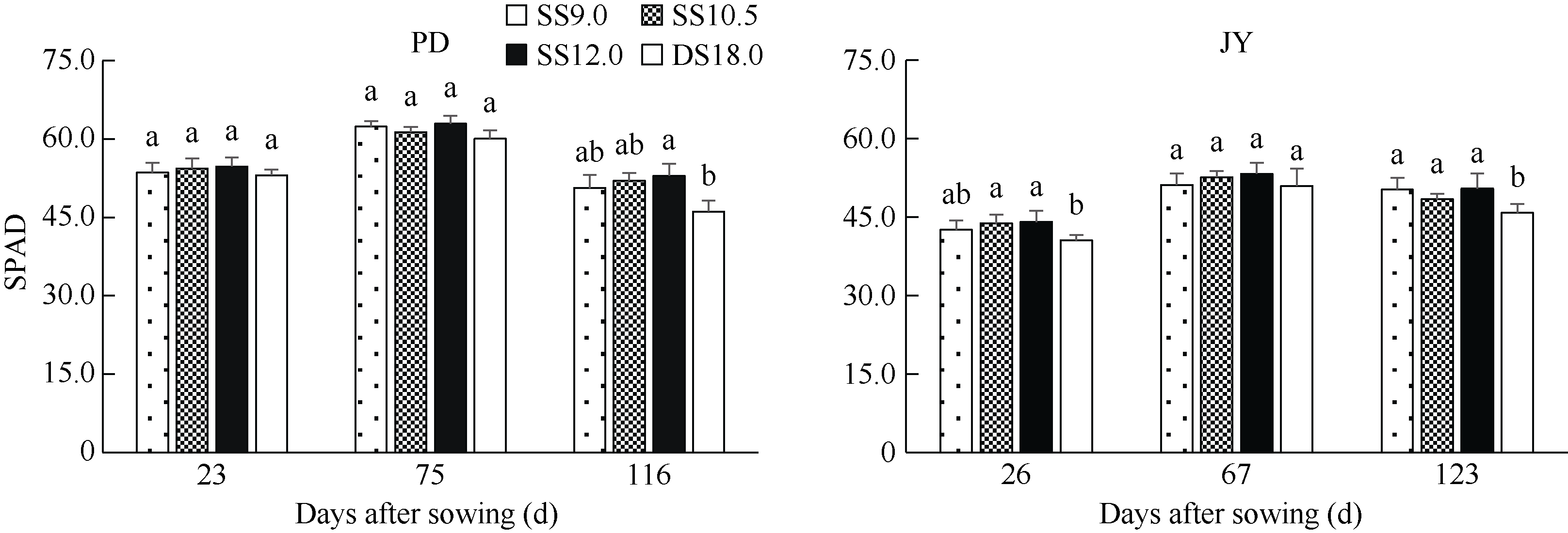
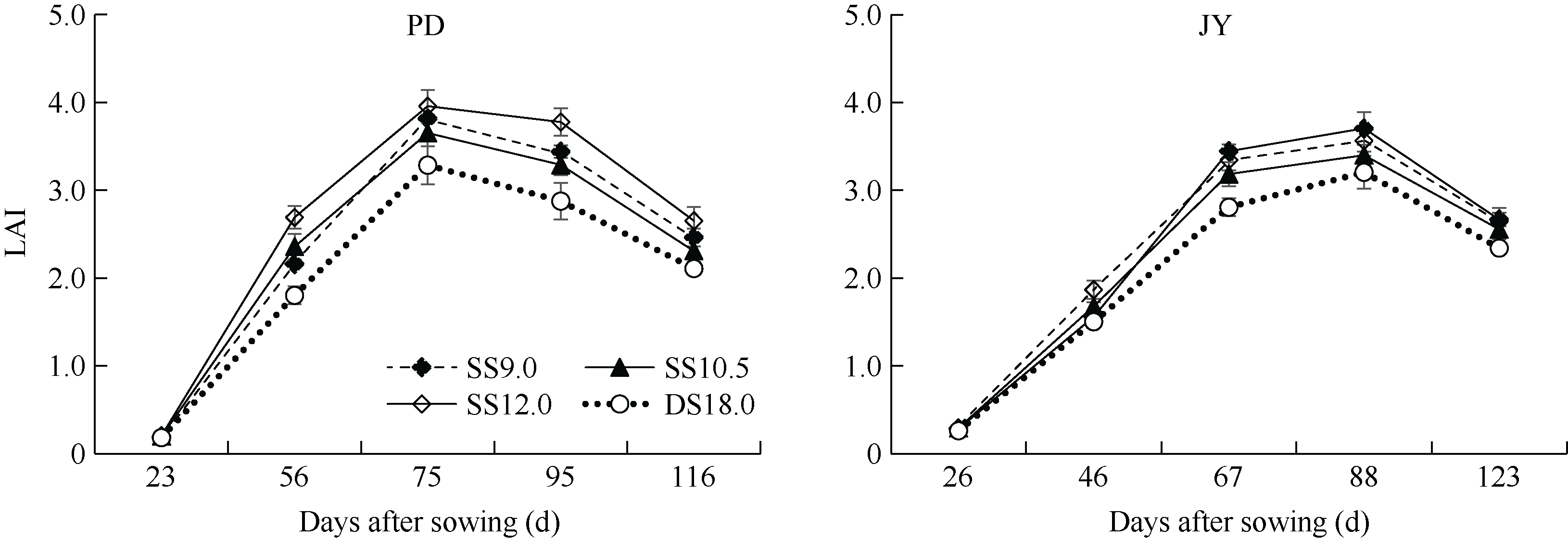
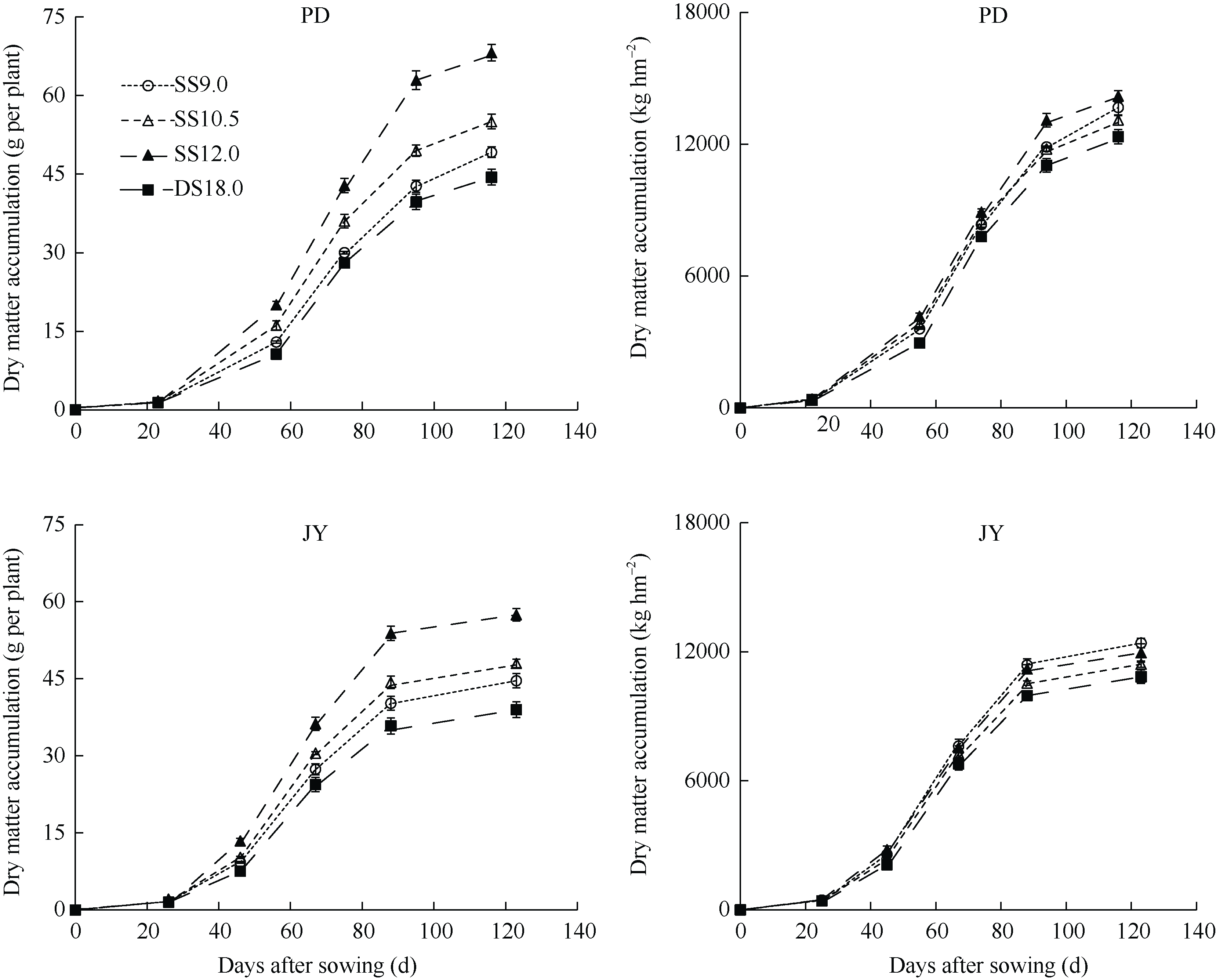
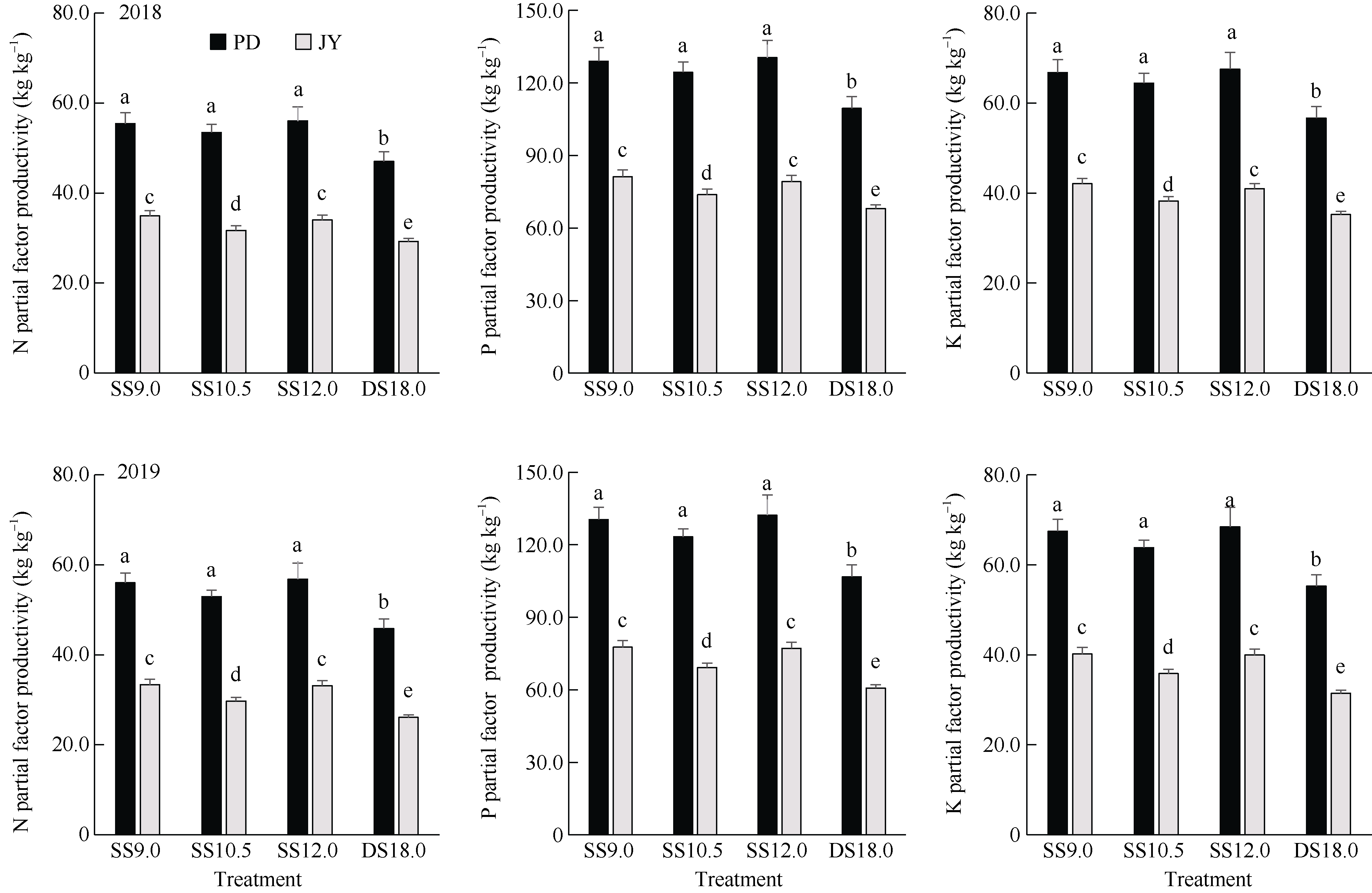
通过分析中、高产旱地花生不同单粒精播种植密度下个体和群体质量、养分吸收等方面的差异, 研究单粒精播增产机制, 以确定中、高产旱地适宜的单粒精播密度, 为花生高产高效栽培提供理论依据。2018年和2019年在山东平度(PD)选取高产旱地、济阳(JY)选取中产旱地, 开展大田试验。设3个单粒精播密度处理, 为27.8、23.8和20.8万株 hm-2, 株距分别为9.0 cm、10.5 cm和12.0 cm, 编号为SS9.0、SS10.5和SS12.0; 双粒播种株数27.8万株 hm-2, 株距18 cm, 记为DS18.0。结果表明, 与双粒播种(DS18.0)相比, 单粒精播栽培提高了叶片叶绿素含量(SPAD)、净光合速率(Pn)、叶面积指数(leaf area index, LAI), 且LAI峰值较高和持续时间长。单粒精播发挥了单株干物质生产潜力, 提高了群体干物质最大积累速率6.1%~20.7%, 实现了干物质的快速积累。对于高产旱地平度, 成熟期群体干物质积累量大小为SS12.0>SS9.0>SS10.5>DS18.0, 而中产旱地济阳为SS9.0>SS12.0>SS10.5>DS18.0; 与DS18.0相比, 单粒精播栽培群体干物质积累量提高5.4%~14.9%。单粒精播栽培促进了单株和群体对N、P、K、Ca的吸收和积累, 增加了N和P养分向荚果中分配比例, 提高了肥料利用效率。高产旱地中单粒精播栽培通过提高个体生产力, 增加单株饱果个数和百果重, 实现了群体增产13.6%~19.1% (2018年)和15.5%~23.8% (2019年), 适宜单粒精播密度为20.8万株 hm-2。中产旱地, 单粒精播促进个体健壮和形成高密度的群体优势是实现增产的关键, 增幅8.4%~19.4% (2018年)和13.9%~ 27.8% (2019年), 适宜密度为27.8万株 hm-2。综上, 高产旱地群体质量和养分吸收量均优于中产旱地。单粒精播栽培模式可充分发挥中、高产旱地花生单株生产潜力, 促进光合产物积累和养分吸收利用, 改善了中、高产旱地花生群体质量, 表现为“强源” “畅流” “壮库”, 提高了荚果产量和收获指数, 实现了花生高产高效。
| [1] | 王才斌. 实施理性栽培, 推进山东花生生产可持续发展. 花生学报, 2018, 47(1): 74-76. |
| Wang C B. Rational cultivation promotes the sustainable development of peanut production in Shandong. J Peanut Sci, 2018, 47(1): 74-76. (in Chinese with English abstract) | |
| [2] | 王在序, 盖树人. 山东花生. 上海: 上海科学技术出版社, 1999. pp 1-15. |
| Wang Z X, Ge S R. Shandong Peanut. Shanghai: Shanghai Scientific and Technolical publishers, 1999. pp 1-15. (in Chinese) | |
| [3] |
Reddy T Y, Reddy V R, Anbumozhi V. Physiological responses of peanut (Arachis hypogaea L.) to drought stress and its amelioration: a critical review. Plant Growth Regul, 2003, 41: 75-88.
doi: 10.1023/A:1027353430164 |
| [4] | 万书波, 张佳蕾. 花生单粒精播高产栽培理论与技术. 北京: 科学出版社, 2020. pp 231-251. |
| Wan S B, Zhang J L. Theory and Technology of Peanut High Yield Cultivation with Single Seed Precision Sowing. Beijing: Science Press, 2020. pp 231-251. (in Chinese) | |
| [5] | 凌启鸿. 作物群体质量. 上海: 上海科学技术出版社, 2000. pp 35-48. |
| Ling Q H. The Quality of Crop Population. Shanghai: Shanghai Scientific and Technical Publishers, 2000. pp 35-48. (in Chinese with English abstract) | |
| [6] |
Wang Y, Pang Y L, Chen K, Zhai L Y, Shen C C, Wang S, Xu J L. Genetic bases of source-, sink-, and yield-related traits revealed by genome-wide association study in Xian rice. Crop J, 2020, 8: 119-131.
doi: 10.1016/j.cj.2019.05.001 |
| [7] |
Senthold A, Belay T K, Marcelo H L, Amador C, Daniel F C. Simulating the impact of source-sink manipulations in wheat. Field Crops Res, 2017, 202: 47-56.
doi: 10.1016/j.fcr.2016.04.031 |
| [8] | 肖继兵, 刘志, 孔凡信, 辛宗绪, 吴宏生. 种植方式和密度对高粱群体结构和产量的影响. 中国农业科学, 2018, 51: 4264-4276. |
| Xiao J B, Liu Z, Kong F X, Xin Z X, Wu H S. Effects of planting pattern and density on population structure and yield of sorghum. Sci Agric Sin, 2018, 51: 4264-4276 (in Chinese with English abstract). | |
| [9] |
吕丽华, 陶洪斌, 夏来坤, 张雅杰, 赵明, 赵久然, 王璞. 不同种植密度下的夏玉米冠层结构及光合特性. 作物学报, 2008, 34: 447-455.
doi: 10.3724/SP.J.1006.2008.00447 |
|
Lyu L H, Tao H B, Xia L K, Zhang Y J, Zhao M, Zhao J R, Wang P. Canopy structure and photosynthesis traits of summer maize under different planting densities. Acta Agron Sin, 2008, 34: 447-455. (in Chinese with English abstract)
doi: 10.3724/SP.J.1006.2008.00447 |
|
| [10] | 张佳蕾, 郭峰, 苗昊翠, 李利民, 杨莎, 耿耘, 孟静静, 李新国, 万书波. 单粒精播对高产花生株间竞争缓解效应研究. 花生学报, 2018, 47(2): 52-58. |
| Zhang J L, Guo F, Miao H C, Li L M, Yang S, Geng Y, Meng J J, Li X G, Wan S B. Study on relieving inter-plant competition by single seed sowing of high yield peanut. J Peanut Sci, 2018, 47(2): 52-58. (in Chinese with English abstract) | |
| [11] | 张佳蕾, 郭峰, 杨佃卿, 孟静静, 杨莎, 王兴语, 陶寿祥, 李新国, 万书波. 单粒精播对超高产花生群体结构和产量的影响. 中国农业科学, 2015, 48: 3757-3766. |
| Zhang J L, Guo F, Yang D Q, Meng J J, Yang S, Wang X Y, Tao S X, Li X G, Wan S B. Effects of single-seed precision sowing on population structure and yield of peanuts with super-high yield cultivation. Sci Agric Sin, 2015, 48: 3757-3766. (in Chinese with English abstract) | |
| [12] |
Liang X Y, Guo F, Feng Y, Zhang J L, Yang S, Meng J J, Li X G, Wan S B. Single-seed sowing increased pod yield at a reduced seeding rate by improving root physiological state of Arachis hypogaea. J Integr Agric, 2020, 19: 1019-1032.
doi: 10.1016/S2095-3119(19)62712-7 |
| [13] |
Zhang J L, Geng Y, Guo F, Li X G, Wan S B. Research progress on the mechanism of improving peanut yield by single-seed precision sowing. J Integr Agric, 2020, 19: 1919-1927.
doi: 10.1016/S2095-3119(19)62763-2 |
| [14] | 赵长星, 邵长亮, 王月福, 宋传雪, 王铭伦. 单粒精播模式下种植密度对花生群体生态特征及产量的影响. 农学学报, 2013, 3(2):1-5. |
| Zhao C X, Shao C L, Wang Y F, Song C X, Wang M L. Effects of different planting densities on population ecological characteristics and yield of peanut under the mode of single-seed precision sowing. J Agric, 2013, 3(2): 1-5 (in Chinese with English abstract). | |
| [15] |
冯烨, 郭峰, 李宝龙, 孟静静, 李新国, 万书波. 单粒精播对花生根系生长、根冠比和产量的影响. 作物学报, 2013, 39: 2228-2237.
doi: 10.3724/SP.J.1006.2013.02228 |
|
Feng Y, Guo F, Li B L, Meng J J, Li X G, Wan S B. Effects of single-seed sowing on root growth, root-shoot ratio, and yield in peanut (Arachis hypogaca L.). Acta Agron Sin, 2013, 39: 2228-2237. (in Chinese with English abstract)
doi: 10.3724/SP.J.1006.2013.02228 |
|
| [16] | 梁晓艳, 郭峰, 张佳蕾, 孟静静, 李林, 万书波, 李新国. 单粒精播对花生冠层微环境、光合特性及产量的影响. 应用生态学报, 2015, 26: 3700-3706. |
| Liang X Y, Guo F, Zhang J L, Meng J J, Li L, Wan S B, Li X G. Effects of single-seed sowing on canopy microenvironment, photosynthetic characteristics and pod yield of peanut (Arachis hypogaca). Chin J Appl Ecol, 2015, 26: 3700-3706. (in Chinese with English abstract) | |
| [17] | 姚远, 刘兆新, 刘妍, 刘婷如, 何美娟, 李向东. 花生、玉米不同间作方式对花生生理性状以及产量的影响. 花生学报, 2017, 46(1): 1-7. |
| Yao Y, Liu Z X, Liu Y, Liu T R, He M J, Li X D. Effect of different peanut-maize intercropping patterns on peanut growth and yield. J Peanut Sci, 2017, 46(1): 1-7. (in Chinese with English abstract) | |
| [18] |
王建国, 张佳蕾, 郭峰, 唐朝辉, 杨莎, 彭振英, 孟静静, 崔利, 李新国, 万书波. 钙与氮肥互作对花生干物质和氮素积累分配及产量的影响. 作物学报, 2021, 47: 1666-1679.
doi: 10.3724/SP.J.1006.2021.04186 |
| Wang J G, Zhang J L, Guo F, Tang Z H, Yang S, Peng Z Y, Meng J J, Cui L, Li X G, Wan S B. Effects of interaction between calcium and nitrogen fertilizers on dry matter, nitrogen accumulation and distribution, and yield in peanut. Acta Agron Sin, 2021, 47: 1666-1679. (in Chinese with English abstract) | |
| [19] | 武兰芳, 欧阳竹. 不同播量与行距对小麦产量与辐射截获利用的影响. 中国生态农业学报, 2014, 22: 31-36. |
|
Wu L F, Qu-yang Z. Effects of row spacing and seeding rate on radiation use efficiency and grain yield of wheat. Chin J Eco-Agric, 2014, 22: 31-36. (in Chinese with English abstract)
doi: 10.3724/SP.J.1011.2014.30568 |
|
| [20] |
高芳, 刘兆新, 赵继浩, 汪颖, 潘小怡, 赖华江, 李向东, 杨东清. 北方主栽花生品种的源库特征及其分类. 作物学报, 2021, 47: 1712-1723.
doi: 10.3724/SP.J.1006.2021.04164 |
| Gao F, Liu Z X, Zhao J H, Wang Y, Pan X Y, Lai H J, Li X D, Yang D Q. Source-sink characteristics and classification of peanut major cultivars in North China. Acta Agron Sin, 2021, 47: 1712-1723. (in Chinese with English abstract) | |
| [21] | 张佳蕾, 张雷, 林英杰, 刘颖, 王建国, 郭峰, 唐朝辉, 李新国, 万书波. 单粒精播对花生生物学特性的影响. 中国油料作物学报, 2020, 42: 960-969. |
| Zhang J L, Zhang L, Lin Y J, Liu Y, Wang J G, Guo F, Tang Z H, Li X G, Wan S B. Effects of single seed sowing on biological characteristics of peanut. Chin J Oil Crop Sci, 2020, 42: 960-969. (in Chinese with English abstract) | |
| [22] | 刘俊华, 吴正锋, 沈浦, 于天一, 郑永美, 孙学武, 李林, 陈殿绪, 王才斌, 万书波. 氮肥与密度互作对单粒精播花生根系形态、植株性状及产量的影响. 作物学报, 2020, 46: 1605-1616. |
| Liu J H, Wu Z F, Shen P, Yu T Y, Zheng Y M, Sun X W, Li L, Chen D X, Wang C B, Wan S B. Effects of nitrogen and density interaction on root morphology, plant characteristic and pod yield under single seed planting in peanut. Acta Agron Sin, 2020, 46: 1605-1616. (in Chinese with English abstract) | |
| [23] | 赵鹏飞. 小麦/玉米轮作体系农户产量差定量及其缩减途径. 中国农业大学博士学位论文, 北京, 2016. |
| Zhao P F. Quantifying and Closing Yield Gaps for Winter Wheat and Summer Maize Rotation in Smallholder Farming System. PhD Dissertation of China Agricultural University, Beijing, China, 2016. (in Chinese with English abstract) | |
| [24] |
李娜, 姜伟, 周进, 张华, 崔中凯, 邸志峰. 山东省花生生产全程机械化现状与对策建议. 中国农机化学报, 2019, 40(10): 42-50.
doi: 10.13733/j.jcam.issn.2095-5553.2019.10.09 |
| Li N, Jiang W, Zhou J, Zhang H, Cui Z K, Di Z F. Present situation and countermeasures of peanut production mechanization in Shandong province. J Chin Agric Mechan, 2019, 40(10): 42-50. (in Chinese with English abstract) | |
| [25] |
董二伟, 王劲松, 武爱莲, 王媛, 王立革, 韩雄, 郭珺, 焦晓燕. 行距和密度对高粱籽粒灌浆、淀粉及氮磷钾累积特征的影响. 作物学报, 2021, 47: 2459-2470.
doi: 10.3724/SP.J.1006.2021.04252 |
| Dong E W, Wang J S, Wu A L, Wang Y, Wang L G, Han X, Guo J, Jiao X Y. Effects of row space and plant density on characteristics of grain filling, starch and NPK accumulation of sorghum grain of different parts of panicle. Acta Agron Sin, 2021, 47: 2459-2470. (in Chinese with English abstract) | |
| [26] | 梁晓艳, 郭峰, 张佳蕾, 李林, 孟静静, 李新国, 万书波. 不同密度单粒精播对花生养分吸收及分配的影响. 中国生态农业学报, 2016, 24: 893-901. |
| Liang X Y, Guo F, Zhang J L, Li L, Meng J J, Li X G, Wan S B. Effects of single-seed sowing at different densities on nutrient uptake and distribution in peanut. Chin J Eco-Agric, 2016, 24: 893-901. (in Chinese with English abstract) | |
| [27] | 余常兵, 孙建好, 李隆. 种间相互作用对作物生长及养分吸收的影响. 植物营养与肥料学报, 2009, 15: 1-8. |
| Yu C B, Sun J H, Li L. Effects of interspecific interactions on crop growth and nutrition accumulation. Plant Nutr Fert Sci, 2009, 15: 1-8. (in Chinese with English abstract) | |
| [28] | 董钻, 那桂秋. 大豆叶、粒关系的研究. 大豆科学, 1993, 12(1): 1-7. |
| Dong Z, Na G Q. Correlative performance between leaf and seed in soybeans. Soybean Sci, 1993, 12(1): 1-7. (in Chinese with English abstract) | |
| [29] | 潘晓华, 邓强辉. 作物收获指数的研究进展. 江西农业大学学报, 2007, 29: 1-5. |
| Pan X H, Deng Q H. Research progress of crop harvest index. Acta Agric Univ Jiangxiensis, 2007, 29: 1-5. (in Chinese with English abstract) | |
| [30] | 赵桂范, 连成才, 郑天琪, 王成, 张洪全. 种植方式对大豆植株干物质积累及养分吸收影响的研究. 大豆科学, 1995, 14: 233-240. |
| Zhao G F, Lian C C, Zheng T Q, Wang C, Zhang H Q. Effects of planting methods on dry matter accumulation and nutrient absorption of soybean plants. Soybean Sci, 1995, 14: 233-240. (in Chinese with English abstract) | |
| [31] |
Damisch W. Biomass yield and topical issue in model wheat breeding programmers. Plant Breed, 1996, 107: 11-17.
doi: 10.1111/j.1439-0523.1991.tb00523.x |
| [1] | 胡川, 赵凯男, 黄修利, 吴金芝, 任开明, 王贺正, 付国占, 黄明, 李友军. 一次灌溉下耕作方式和氮肥用量对旱地小麦产量和品质的影响[J]. 作物学报, 2026, 52(6): 1830-1846. |
| [2] | 马胜乾, 王志平, 陈浩天, 窦淑贤, 张燕, 邓艾兴, 张卫建, 原向阳, 宋振伟. 秸秆还田下耕作方式与氮肥施用量对东北玉米产量及土壤团聚体的影响[J]. 作物学报, 2026, 52(6): 1802-1816. |
| [3] | 郑玉珍, 齐飞艳, 孙子淇, 刘华, 秦利, 石磊, 王娟, 汪蒙蒙, 韩锁义, 徐静, 苗利娟, 黄冰艳, 董文召, 郑峥, 张新友. 花生籽仁总超长链脂肪酸和7种脂肪酸组分的QTL定位[J]. 作物学报, 2026, 52(6): 1646-1657. |
| [4] | 陆一楚, 李振影, 买春海, 赵晓蕊, 王利祥. 夜间复合体关键基因AhLUX1正向调控花生结瘤的功能研究[J]. 作物学报, 2026, 52(6): 1658-1668. |
| [5] | 张思思, 赵向辉, 周洋, 姚云凤, 朱荣昱, 董元杰, 胡国庆, 徐通, 刘兆新. 冬闲期翻耕和绿肥还田对连作花生田土壤理化性质和产量的影响[J]. 作物学报, 2026, 52(5): 1472-1486. |
| [6] | 张宁宁, 滕雨菲, 任娜娜, 魏兴卓, 闫书豪, 樊可心, 王永宏, 陈文康, 张兴华, 朱万超, 徐淑兔, 薛吉全. 201份玉米自交系抗旱表型评价及可塑性分析[J]. 作物学报, 2026, 52(5): 1309-1325. |
| [7] | 张鸿蓉, 王菲儿, 李盼, 仇海龙, 朱静, 赵连豪, 南运有, 何蔚, 樊志龙, 胡发龙, 柴强, 殷文. 减量20%灌水与25%有机肥替代化肥提高青贮玉米产量的光合特性[J]. 作物学报, 2026, 52(5): 1487-1500. |
| [8] | 王宇诚, 张露, 刘阿康, 黄见良, 彭少兵, 袁珅. 基于产量差的作物大面积单产提升策略与展望[J]. 作物学报, 2026, 52(5): 1279-1290. |
| [9] | 赵佳雪, 周龙昊, 郭岂源, 尚伦霄, 王涵, 刘志涛, 陈曦, 张晓佩, 宋宪亮, 毛丽丽. 长期秸秆还田与深松通过改善土壤环境与棉花光合特性提高滨海盐碱地棉花产量[J]. 作物学报, 2026, 52(5): 1548-1560. |
| [10] | 郭星宇, 胡丹, 林苏期, 王梦凯, 谭文峰, 黄传琴. 生物炭配施化肥提高玉米‖大豆下玉米产量和土壤生态系统多功能性[J]. 作物学报, 2026, 52(5): 1536-1547. |
| [11] | 张振, 冯连杰, 石玉, 于振文, 张永丽. 节水补灌下不同穗型小麦产量形成差异研究[J]. 作物学报, 2026, 52(5): 1522-1535. |
| [12] | 谷春苗, 王润风, 黄璐, 刘浩, 鲁清, 李海芬, 李少雄, 何双呈, 洪彦彬, 陈小平, 谭斌, 余倩霞. 花生WOX基因家族的全基因组分析及不定芽再生候选基因的鉴定[J]. 作物学报, 2026, 52(5): 1326-1340. |
| [13] | 闫安, 蒋昆炜, 王蓉圆, 田林, 张璐, 王韵, 徐建龙. 水稻剑叶小维管束数基因SVN7的鉴定与克隆[J]. 作物学报, 2026, 52(5): 1364-1372. |
| [14] | 刘昕萌, 任昊, 张继波, 张吉旺, 赵斌, 任佰朝, 刘鹏, 王洪章. 茉莉酸甲酯(MeJA)缓解高温影响玉米雌穗分化的生理机制[J]. 作物学报, 2026, 52(5): 1561-1572. |
| [15] | 王壮壮, 武紫君, 张永新, 张芯源, 袁丽雪, 陈如雪, 刘世举, 段剑钊, 冯伟, 王同朝, 王永华. 豫东南黏壤潮土区水氮优化协同提高冬小麦产量和氮素利用效率[J]. 作物学报, 2026, 52(5): 1501-1521. |
|
||