欢迎访问作物学报,今天是
作物学报 ›› 2023, Vol. 49 ›› Issue (4): 1111-1121.doi: 10.3724/SP.J.1006.2023.22001
唐文强1,**( ), 张文龙1,**, 朱晓乔1, 董必正1, 李勇成2, 杨楠1, 张耀2, 王云月1,*(), 韩光煜1,*()
TANG Wen-Qiang1,**(), ZHANG Wen-Long1,**, ZHU Xiao-Qiao1, DONG Bi-Zheng1, LI Yong-Cheng2, YANG Nan1, ZHANG Yao2, WANG Yun-Yue1,*(), HAN Guang-Yu1,*()
摘要:
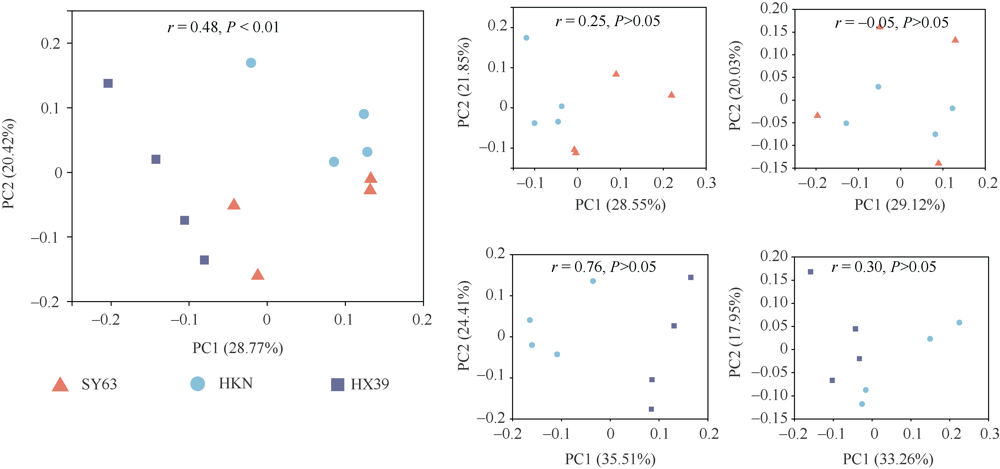
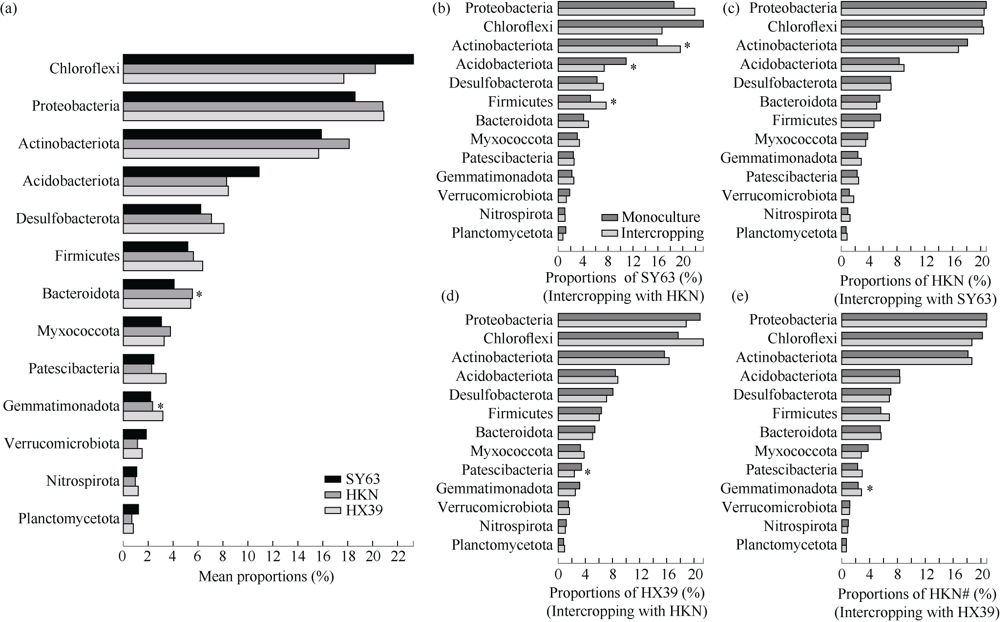
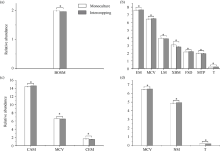
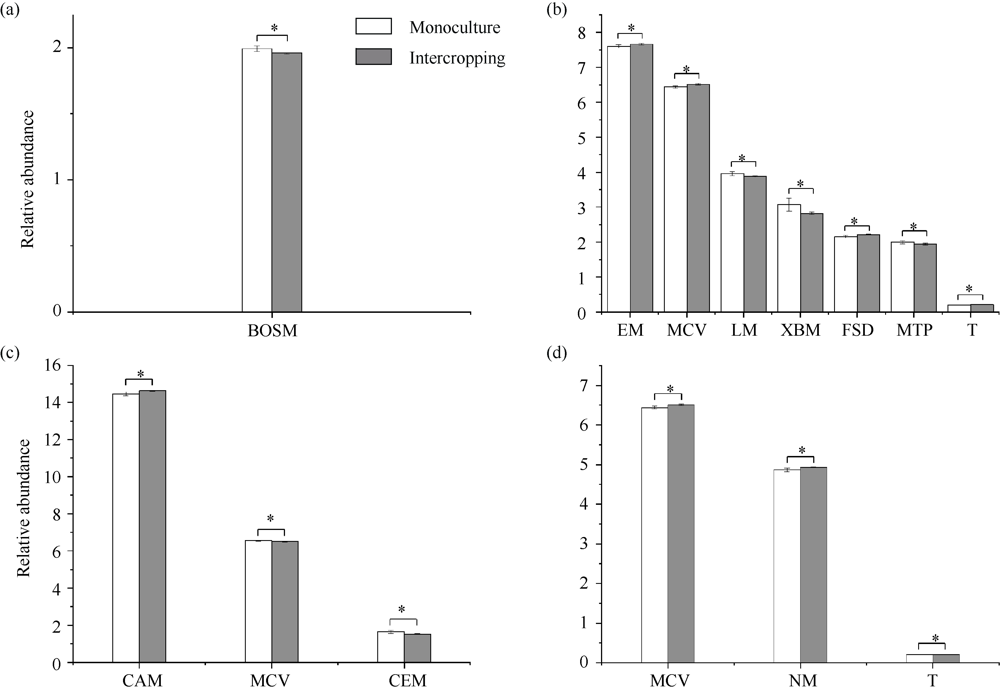
为了明确水稻多样性混合间栽对稻瘟病防治及根际细菌群落结构和功能的影响, 利用Illumina Hiseq测序技术, 对筛选的高防治效果(E=54.48%)组合(汕优63||黄壳糯)和低防治效果(E=14.12%)组合(合系39||黄壳糯)分别在间栽和净栽下进行水稻根际土壤细菌16S rRNA测序分析。结果表明, 多样性间栽系统中水稻根际共检测到土壤细菌37门116纲244目384科689属, 绿弯菌门(Chloroflexi)、变形菌门(Proteobacteria)和放线菌门(Actinobacteriota)为主要细菌优势类群, 相对丰度均在15%以上。Alpha多样性分析显示, 高防效组合在间栽条件下可显著提高水稻根际细菌群落香农指数和Chao1指数(P<0.05), 而低防效组合无差异(P>0.05)。ANOSIM及PCoA分析发现, 净栽条件下各品种根际细菌群落结构差异显著(r = 0.48, P<0.01), 间栽后高防效组合和低防效组合根际细菌群落结构无显著差异(P>0.05), 即间栽增加了组配品种间细菌群落结构的相似性。细菌优势类群组成结果表明, 与净栽相比高防效组合中汕优63根际中酸杆菌门(Acidobacteriota)相对丰度显著降低, 放线菌门(Actinobacteriota)和厚壁菌门(Firmicutes)显著上升, 黄壳糯各优势菌门无显著差异; 低防效组合中合系39根际中Patescilbacteria显著下降, 黄壳糯芽单胞菌门(Gemmatimonadota)显著上升。PICRUSt2功能预测表明, 间栽系统中主栽品种次生代谢产物的合成相对丰度显著下降, 间栽品种转录、辅酶和维生素的代谢相对丰度显著上升。综上, 高防效组合通过混合间栽, 能改善水稻根际菌群多样性、细菌群落结构及功能, 从而有效降低稻瘟病病害发生, 为利用改良土壤微生物提高植物抗病性提供应用途径和多样性间栽防治病害理论提供数据支撑。
| [1] | Redoña E D. Rice Biotechnology for Developing Countries in Asia. Science City of Muñoz: NABC, 2004. pp 201-201. |
| [2] |
Talbot N J. On the trail of a cereal killer: exploring the biology of Magnaporthe grisea. Annu Rev Microbiol, 2003, 57: 177-202.
doi: 10.1146/annurev.micro.57.030502.090957 |
| [3] |
Pennisi E. Armed and dangerous. Science, 2010, 327: 804-805.
doi: 10.1126/science.327.5967.804 pmid: 20150482 |
| [4] |
Liu W D, Liu J L, Triplett L, Leach J E, Wang G L. Novel insights into rice innate immunity against bacterial and fungal pathogens. Annu Rev Phytopathol, 2014, 52: 213-241.
doi: 10.1146/annurev-phyto-102313-045926 pmid: 24906128 |
| [5] |
Fernandez J, Orth K. Rise of a cereal killer: the biology of Magnaporthe oryzae biotrophic growth. Trends Microbiol, 2018, 26: 582-597.
doi: S0966-842X(17)30280-9 pmid: 29395728 |
| [6] |
Keesing F, Belden L K, Daszak P, Dobson A, Harvell C D, Holt R D, Hudson P, Jolles A, Jones K E, Mitchell C E, Myers S S, Bogich T, Ostfeld R S. Impacts of biodiversity on the emergence and transmission of infectious diseases. Nature, 2010, 468: 647-652.
doi: 10.1038/nature09575 |
| [7] |
Zhu Y Y, Chen H R, Fan J H, Wang Y Y, Li Y, Chen J B, Fan J X, Yang S S, Hu L P, Leung H, Mew T W, Teng P S, Wang Z H, Mundt C C. Genetic diversity and disease control in rice. Nature, 2000, 406: 718-722.
doi: 10.1038/35021046 |
| [8] |
Van Bruggen A H C, Finckh M R. Plant diseases and management approaches in organic farming systems. Annu Rev Phytopathol, 2016, 54: 25-54.
doi: 10.1146/annurev-phyto-080615-100123 pmid: 27215969 |
| [9] | 朱有勇. 遗传多样性与作物病害持续控制. 北京: 科学出版社, 2007. pp 364-385. |
| Zhu Y Y. Genetic Diversity for Corps Diseases’ Sustainable Management. Beijing: Science Press, 2007. pp 364-385. (in Chinese) | |
| [10] | 骆世明. 农业生物多样性利用的原理与技术. 北京: 化学工业出版社, 2010. pp 1-251. |
| Luo S M. Principles and Techniques of Agrobiodiversity Utilization. Beijing: Chemical Industry Press, 2010. pp 1-251 (in Chinese). | |
| [11] |
Qin J H, He H Z, Luo S M, Li H S. Effects of rice-water chestnut intercropping on rice sheath blight and rice blast diseases. Crop Prot, 2013, 43: 89-93.
doi: 10.1016/j.cropro.2012.09.009 |
| [12] |
Trivedi P, Leach J E, Tringe S G, Sa T, Singh B K. Plant-microbiome interactions: from community assembly to plant health. Nat Rev Microbiol, 2020, 18: 607-621.
doi: 10.1038/s41579-020-0412-1 |
| [13] |
Richardson A E, Simpson R J. Soil microorganisms mediating phosphorus availability update on microbial phosphorus. Plant Physiol, 2011, 156: 989-996.
doi: 10.1104/pp.111.175448 pmid: 21606316 |
| [14] |
Rodriguez P A, Rothballer M, Chowdhury S P, Nussbaumer T, Gutjahr C, Falter-Braun P. Systems biology of plant-microbiome interactions. Mol Plant, 2019, 12: 804-821.
doi: S1674-2052(19)30171-6 pmid: 31128275 |
| [15] |
Jin X, Shi Y J, Wu F Z, Pan K, Zhou X G. Intercropping of wheat changed cucumber rhizosphere bacterial community composition and inhibited cucumber Fusarium wilt disease. Sci Agric, 2020, 77: e20190005.
doi: 10.1590/1678-992x-2019-0005 |
| [16] | Shi Y J, Wang J, Jin X, Wang Z L, Pan D D, Zhuang Y, Wu F Z, Zhou X G. Effects of intercropping of wheat on composition of cucumber seedling rhizosphere fungal community. Allelopathy J, 2019, 46: 97-106. |
| [17] |
Wu H M, Lin M H, Rensing C, Qin X J, Zhang S K, Chen J, Wu L K, Zhao Y L, Lin S, Lin W X. Plant-mediated rhizospheric interactions in intraspecific intercropping alleviate the replanting disease of Radix pseudostellariae. Plant Soil, 2020, 454: 411-430.
doi: 10.1007/s11104-020-04659-1 |
| [18] |
Li Y Y, Feng J, Zheng L, Huang J B, Yang Y, Li X H. Intercropping with marigold promotes soil health and microbial structure to assist in mitigating tobacco bacterial wilt. J Plant Pathol, 2020, 102: 731-742.
doi: 10.1007/s42161-020-00490-w |
| [19] |
Zhang J Y, Liu Y X, Zhang N, Hu B, Jin T, Xu H R, Qin Y, Yan P X, Zhang X N, Guo X X, Hui J, Cao S Y, Wang X, Wang C, Wang H, Qu B Y, Fan G Y, Yuan L X, Garrido-Oter R, Chu C C, Bai Y. NRT1. 1B is associated with root microbiota composition and nitrogen use in field-grown rice. Nat Biotechnol, 2019, 37: 676-684.
doi: 10.1038/s41587-019-0104-4 |
| [20] |
Xu N, Tan G C, Wang H Y, Gai X P. Effect of biochar additions to soil on nitrogen leaching, microbial biomass and bacterial community structure. Eur J Soil Biol, 2016, 74: 1-8.
doi: 10.1016/j.ejsobi.2016.02.004 |
| [21] |
Chen S F, Zhou Y Q, Chen Y R, Gu J. fastp: an ultra-fast all-in-one FASTQ preprocessor. Bioinformatics, 2018, 34: i884-i890.
doi: 10.1093/bioinformatics/bty560 |
| [22] |
Edgar R C. UPARSE: highly accurate OTU sequences from microbial amplicon reads. Nat Methods, 2013, 10: 996-998.
doi: 10.1038/nmeth.2604 pmid: 23955772 |
| [23] | 胡汉升, 宁万光, 徐畅, 余开会, 史洪中, 刘红敏. 水稻杂糯间作栽培防治稻瘟病的效果. 江苏农业科学, 2015, 43(4): 127-128. |
| Hu H S, Ning W G, Xu C, Yu K H, Shi H Z, Liu H M. Effectiveness of intercropping hybrids rice with glutinous rice for the control of rice blast. Jiangsu Agric Sci, 2015, 43(4): 127-128. (in Chinese) | |
| [24] |
Han G Y, Lang J, Sun Y, Wang Y Y, Zhu Y Y, Lu B R. Intercropping of rice varieties increases the efficiency of blast control through reduced disease occurrence and variability. J Integr Agric, 2016, 15: 795-802.
doi: 10.1016/S2095-3119(15)61055-3 |
| [25] |
Li Z F, Wang T, He C L, Cheng K L, Zeng R S, Song Y Y. Control of Panama disease of banana by intercropping with Chinese chive (Allium tuberosum Rottler): cultivar differences. BMC Plant Biol, 2020, 20: 432.
doi: 10.1186/s12870-020-02640-9 |
| [26] | 蔡祖聪, 黄新琦. 土壤学不应忽视对作物土传病原微生物的研究. 土壤学报, 2016, 53: 305-310. |
| Cai Z C, Huang X Q. Soil-borne pathogens should not be ignored by soil science. Acta Petrol Sin, 2016, 53: 305-310. (in Chinese with English abstract) | |
| [27] | 杨俊, 王星, 付丽娜, 汪娅婷, 刘棋, 苗新利, 王凡, 魏兰芳, 姬广海. 水稻条斑病抗感品种根际微生物群落结构和功能分析. 生态科学, 2019, 38(1): 17-25. |
| Yang J, Wang X, Fu L N, Wang Y T, Liu Q, Miao X, Wang F, Wei L F, Ji G H. Study on rhizosphere microbial community and functional diversity of different resistant rice varieties to rice leaf streak disease. Ecol Sci, 2019, 38(1): 17-25. (in Chinese with English abstract) | |
| [28] | 胡蓉, 郑露, 刘浩, 黄俊斌. 秸秆还田对水稻根际微生物多样性和水稻纹枯病发生的影响. 植物保护学报, 2020, 47: 1261-1269. |
| Hu R, Zheng L, Liu H, Huang J B. Effects of straw returning on microbial diversity in rice rhizosphere and occurrence of rice sheath blight. J Plant Prot, 2020, 47: 1261-1269. (in Chinese with English abstract) | |
| [29] | 杨阳, 姚槐应. 间作下根际微生物控制土传病害的研究进展. 武汉工程大学学报, 2021, 43: 381-390. |
| Yang Y, Yao H Y. Progress in control of soil-borne diseases by rhizosphere microorganisms under intercropping. J Wuhan Inst Technol, 2021, 43: 381-390. (in Chinese with English abstract) | |
| [30] |
Zhou L J, Wang Y J, Xie Z K, Zhang Y B, Malhi S S, Guo Z H, Qiu Y, Wang L. Effects of lily/maize intercropping on rhizosphere microbial community and yield of Lilium davidii var. unicolor. J Basic Microbiol, 2018, 58: 892-901.
doi: 10.1002/jobm.201800163 |
| [31] | 郝海平, 白红彤, 夏菲, 郝渊鹏, 李慧, 崔洪霞, 谢晓明, 石雷. 茶-山苍子间作对茶园土壤微生物群落结构的影响. 中国农业科学, 2021, 54: 3959-3969. |
| Hao H P, Bai H T, Xia F, Hao Y P, Li H, Cui H X, Xie X M, Shi L. Effects of tea-Litsea cubeba intercropping on soil microbial community structure in tea plantation. Sci Agric Sin, 2021, 54: 3959-3969. (in Chinese with English abstract) | |
| [32] | 张静, 可文静, 刘娟, 王留行, 陈浩, 彭廷, 赵全志. 不同深度土壤控水对稻田土壤微生物区系及细菌群落多样性的影响. 中国生态农业学报, 2019, 27: 277-285. |
| Zhang J, Ke W J, Liu J, Wang L X, Chen H, Peng T, Zhao Q Z. Influence of water controlling depth on soil microflora and bacteria community diversity in paddy soil. Chin J Eco-Agric, 2019, 27: 277-285. (in Chinese with English abstract) | |
| [33] | 艾超, 孙静文, 王秀斌, 梁国庆, 何萍, 周卫. 植物根际沉积与土壤微生物关系研究进展. 植物营养与肥料学报, 2015, 21: 1343-1351. |
| Ai C, Sun J W, Wang X B, Liang G Q, He P, Zhou W. Advances in the study of the relationship between plant rhizodeposition and soil microorganism. Plant Nutr Fert Sci, 2015, 21: 1343-1351. (in Chinese with English abstract) | |
| [34] |
Pankratov T A, Ivanova A O, Dedysh S N, Liesack W. Bacterial populations and environmental factors controlling cellulose degradation in an acidic Sphagnum peat. Environ Microbiol, 2011, 13: 1800-1814.
doi: 10.1111/j.1462-2920.2011.02491.x pmid: 21564458 |
| [35] |
Lu S, Gischkat S, Reiche M, Akob D M, Hallberg K B, Küsel K. Ecophysiology of Fe-cycling bacteria in acidic sediments. Appl Environ Microbiol, 2010, 76: 8174-8183.
doi: 10.1128/AEM.01931-10 |
| [36] |
Coates J D, Ellis D J, Gaw C V, Lovley D R. Geothrix fermentans gen. nov., sp. nov., a novel Fe(III)-reducing bacterium from a hydrocarbon-contaminated aquifer. Int J Syst Evol Microbiol, 1999, 49: 1615-1622.
doi: 10.1099/00207713-49-4-1615 |
| [37] |
Kanokratana P, Uengwetwanit T, Rattanachomsri U, Bunterngsook B, Nimchua T, Tangphatsornruang S, Plengvidhya V, Champreda V, Eurwilaichitr L. Insights into the phylogeny and metabolic potential of a primary tropical peat swamp forest microbial community by metagenomic analysis. Microb Ecol, 2011, 61: 518-528.
doi: 10.1007/s00248-010-9766-7 pmid: 21057783 |
| [38] |
Gu Y, Ding Y, Ren C, Sun Z, Rodionov D A, Zhang W W, Yang S, Yang C, Jiang W H. Reconstruction of xylose utilization pathway and regulons in Firmicutes. BMC Genomics, 2010, 11: 255.
doi: 10.1186/1471-2164-11-255 pmid: 20406496 |
| [39] | 徐佳迎, 周金蓉, 吴杰, 王珏, 程粟裕, 赵鸽, 蒋静艳. 磺胺二甲嘧啶对稻田土壤微生物的中长期效应. 农业环境科学学报, 2020, 39: 1757-1766. |
| Xu J Y, Zhou J R, Wu J, Wang J, Cheng S Y, Zhao G, Jiang J Y. Medium- and long-term effects of the veterinary antibiotic sulfadiazine on soil microorganisms in a rice field. J Agro-Environ Sci, 2020, 39: 1757-1766. (in Chinese with English abstract) | |
| [40] | 王珂, 杨玉爱, 袁可能. 维生素(B6, C, PP)对小麦生理特性及生长的影响. 科技通报, 1995, 11: 301-305. |
| Wang K, Yang Y A, Yuan K N. Effects of three vitamins on the growth and physiological properties in wheat. Bull Sci Technol, 1995, 11: 301-305. (in Chinese with English abstract) |
| [1] | 胡赵, 钱润, 谢丰璞, 应素平. 水稻SPX基因家族鉴定及响应磷处理的表达分析[J]. 作物学报, 2026, 52(6): 1902-1912. |
| [2] | 邹仪妹, 徐敏, 汪海洋, 姚辉, 王加峰, 刘浩, 任代胜. 两系不育系水稻幼苗根系响应盐胁迫的转录因子调控网络鉴定[J]. 作物学报, 2026, 52(6): 1728-1742. |
| [3] | 闫安, 蒋昆炜, 王蓉圆, 田林, 张璐, 王韵, 徐建龙. 水稻剑叶小维管束数基因SVN7的鉴定与克隆[J]. 作物学报, 2026, 52(5): 1364-1372. |
| [4] | 陈伟, 卫万娟, 赵其兵, 常东伟, 余凌波, 翟鹏飞, 冯志明, 陈宗祥, 任仰涛, 杨鹏, 刘海浪, 李珍富, 杨永乐, 金彦刚, 左示敏. 利用CRISPR/Cas9编辑Hd6基因创制优质早熟水稻新种质[J]. 作物学报, 2026, 52(4): 1046-1056. |
| [5] | 石少阶, 刘凯, 陈姿夷, 王卉颖, 李三和, 周雷, 游艾青. 水稻矮化多分蘖基因DMT1的克隆与功能分析[J]. 作物学报, 2026, 52(4): 1022-1034. |
| [6] | 覃奕琰, 付瑶, 苏畅, 李娜, 徐静茹, 程笑然, 张琪, 赵明辉. OsST41调控水稻苗期耐盐性的功能分析[J]. 作物学报, 2026, 52(3): 802-812. |
| [7] | 叶凡, 李帅, 李思宇, 陈云, 窦超银, 刘立军. 不同节水灌溉方式对东北稻区水稻产量和群体质量的影响[J]. 作物学报, 2026, 52(3): 895-907. |
| [8] | 王婵, 吴莹莹, 李文奇, 李霞, 王芳权, 周彤, 杨杰. 基于HRM技术开发水稻抗条纹叶枯病基因STV11功能标记[J]. 作物学报, 2025, 51(9): 2547-2556. |
| [9] | 陈惠莹, 何嘉欣, 朱斌, 黄士轩, 周星佑, 伍君权, 杨美艳. 水稻黄单胞菌噬菌体vB_XaS_HDB2的全基因组分析和生物学特性研究[J]. 作物学报, 2025, 51(8): 2087-2099. |
| [10] | 杨海洋, 吴林宣, 李博纹, 石翰峰, 袁禧龙, 刘金朝, 蔡海荣, 陈诗怡, 郭涛, 王慧. 基于QTL定位发现的OsWRI3调控水稻种子的落粒性[J]. 作物学报, 2025, 51(7): 1712-1724. |
| [11] | 雷松翰, 范骏扬, 车艳奕, 代永东, 郑雨萌, 田维江, 桑贤春, 王晓雯. 水稻内卷叶突变体acl3的鉴定及调控基因的功能分析[J]. 作物学报, 2025, 51(6): 1467-1479. |
| [12] | 李福媛, 杨奕, 马继琼, 许明辉, 林良斌, 孙一丁. 水稻OsPUB4基因克隆、激素诱导表达分析与互作蛋白筛选[J]. 作物学报, 2025, 51(6): 1690-1700. |
| [13] | 王梦宁, 谢可冉, 高逖, 王飞, 任孝俭, 熊栋梁, 黄见良, 彭少兵, 崔克辉. 水稻幼穗分化期至抽穗期高温对籽粒形态和充实的影响及其与粒重的关系[J]. 作物学报, 2025, 51(5): 1347-1362. |
| [14] | 盛倩男, 方娅婷, 赵剑, 杜思垚, 胡行珍, 余秋华, 朱俊, 任涛, 鲁剑巍. 不同养分管理措施对稻田和旱地油菜产量的影响及其对冻害的响应[J]. 作物学报, 2025, 51(5): 1286-1298. |
| [15] | 翁文安, 邢志鹏, 胡群, 魏海燕, 廖萍, 朱海滨, 瞿济伟, 李秀丽, 刘桂云, 高辉, 张洪程. 无人化旱直播水稻产量形成特征及其能量与经济效益研究[J]. 作物学报, 2025, 51(5): 1363-1377. |
|
||