欢迎访问作物学报,今天是
作物学报 ›› 2024, Vol. 50 ›› Issue (4): 1030-1042.doi: 10.3724/SP.J.1006.2024.33030
所属专题: 玉米:耕作栽培·生理生化
邹佳琪1( ), 王仲林1,2, 谭先明1, 陈燎原1, 杨文钰1, 杨峰1,*()
ZOU Jia-Qi1(), WANG Zhong-Lin1,2, TAN Xian-Ming1, CHEN Liao-Yuan1, YANG Wen-Yu1, YANG Feng1,*()
摘要:
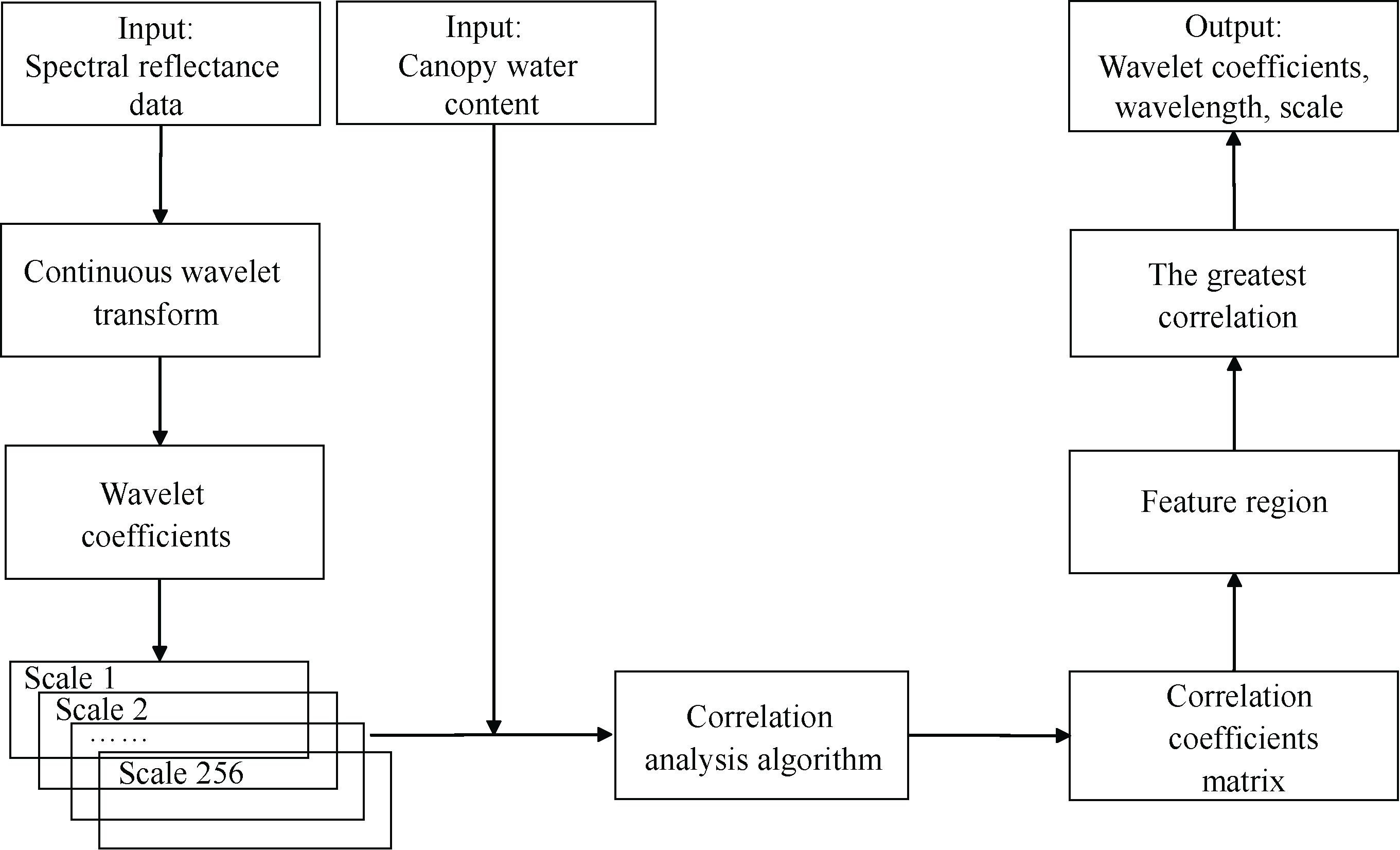
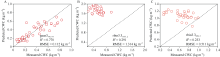
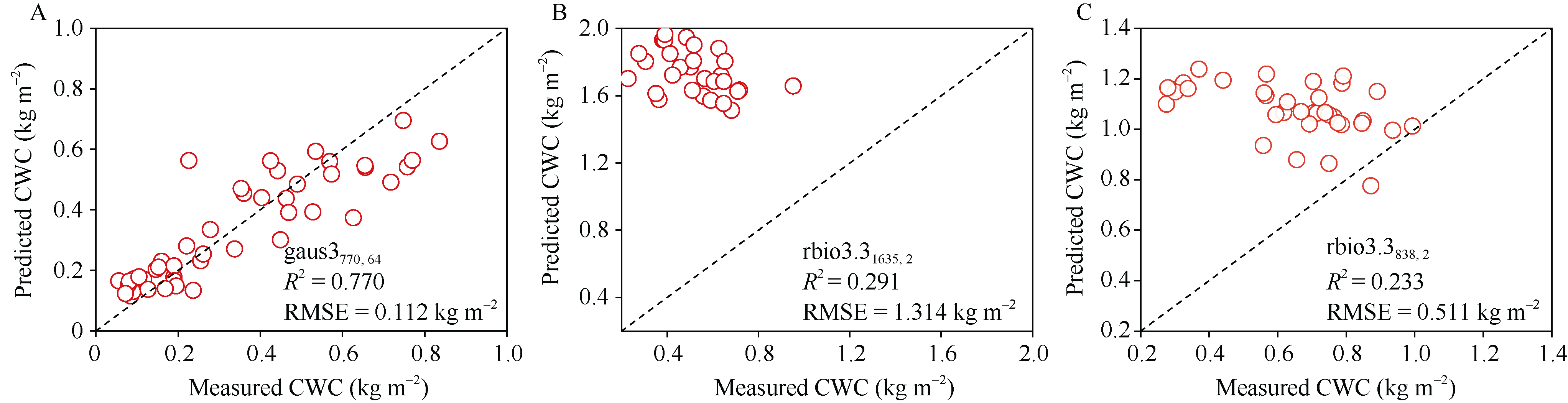
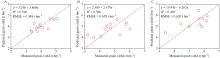
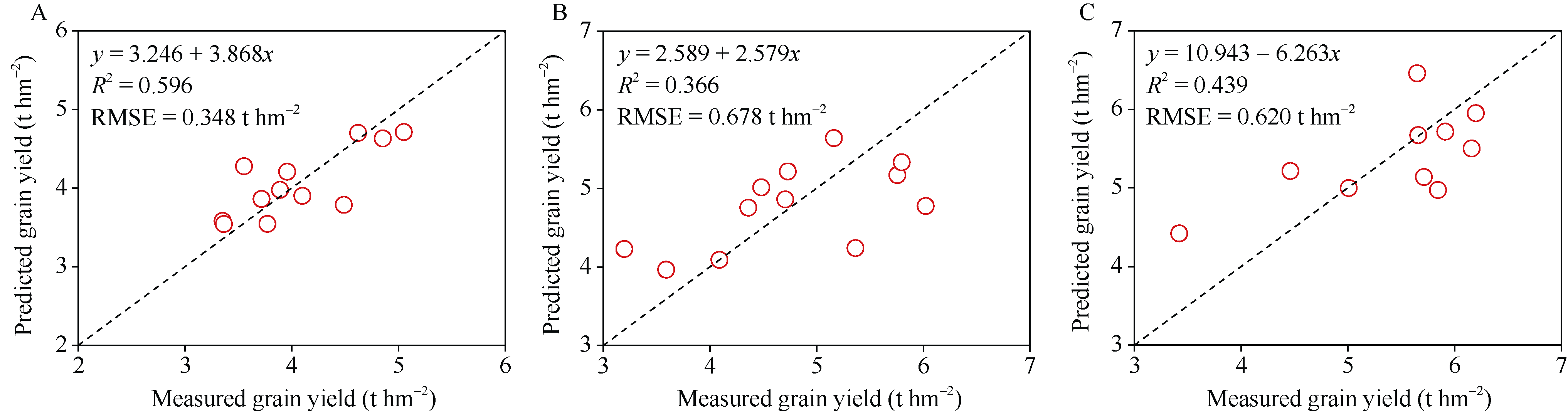
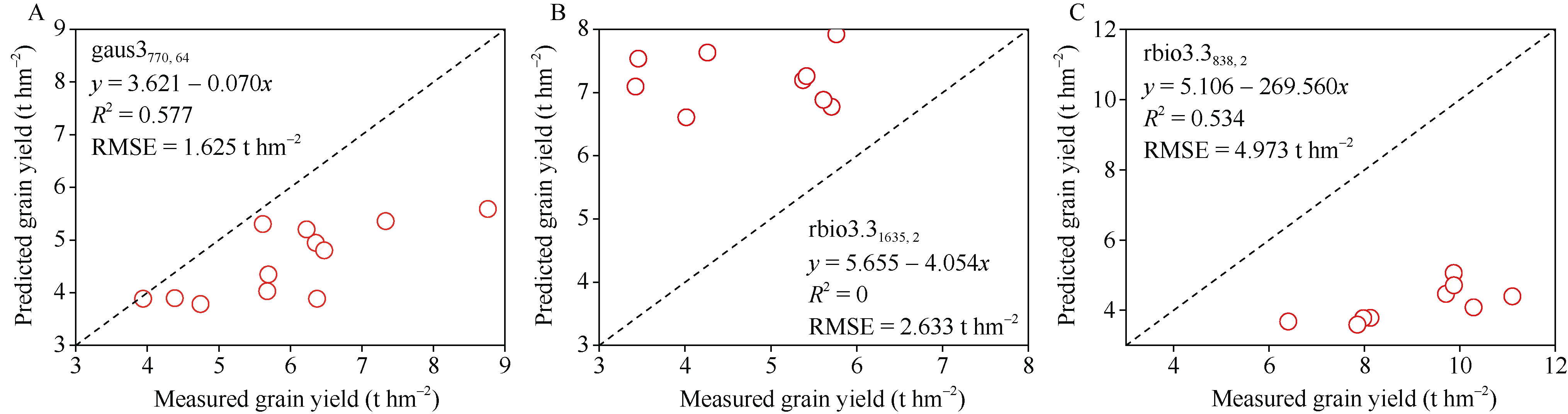
利用高光谱遥感技术监测作物水分状况和籽粒产量, 对于调控作物生长、优化水分管理和改善产量形成具有重要意义。本研究玉米品种选用正红505, 于2018—2019年在四川雅安和仁寿的试验田设置4个水分处理(正常水分、轻度、中度和重度干旱), 分析玉米在拔节期(V6)、抽雄期(VT)和灌浆期(R2)的冠层含水量(canopy water content, CWC)与籽粒产量的定量关系, 利用植被指数和连续小波变换对光谱反射率数据进行处理, 采用线性回归方法构建CWC定量反演模型, 进一步探索以CWC为桥梁建立的玉米籽粒产量的预测模型效果。结果表明, (1) 利用小波特征构建的CWC估测模型的预测效果高于植被指数, V6、VT和R2期分别以小波特征gaus3770,64、rbio3.31635,2和rbio3.3838,2构建的线性回归模型检验精度较高, R2分别为0.770、0.291和0.233。(2) CWC与玉米籽粒产量间建立的线性回归模型均达极显著水平(P<0.01), V6、VT和R2期的R2分别为0.596、0.366和0.439。(3) 基于光谱反射率构建的产量预测模型以V6期小波特征gaus3770,64的验证效果最好(R2 = 0.577, RMSE = 1.625 t hm-2), 可作为预测玉米籽粒产量的最佳时期。因此, 本研究提出的“光谱反射率—冠层含水量—产量”建模方法能够实现对玉米籽粒产量的精确估测, 为未来大面积监测玉米生产力提供了理论依据。
| [1] | 王延仓, 张萧誉, 金永涛, 顾晓鹤, 冯华, 王闯. 基于连续小波变换定量反演冬小麦叶片含水量研究. 麦类作物学报, 2020, 40: 503-509. |
| Wang Y C, Zhang X Y, Jin Y T, Gu X H, Feng H, Wang C. Quantitative retrieval of water content in winter wheat leaves based on continuous wavelet transform. J Triticeae Crops, 2020, 40: 503-509. (in Chinese with English abstract) | |
| [2] |
Ren B, Zhang J, Li X, Fan X, Dong S, Liu P, Zhao B. Effects of waterlogging on the yield and growth of summer maize under field conditions. Can J Plant Sci, 2014, 94: 23-31.
doi: 10.4141/cjps2013-175 |
| [3] |
Zhou H, Zhou G, Song X, He Q. Dynamic characteristics of canopy and vegetation water content during an entire maize growing season in relation to spectral-based indices. Remote Sens, 2022, 14: 584.
doi: 10.3390/rs14030584 |
| [4] | 任传友, 姜卓群, 苏小琁, 米前川, 王婧, 李玥, 高西宁. 水分胁迫/复水对谷子光合特性及产量影响. 应用气象学报, 2021, 32: 456-467. |
| Ren C Y, Jiang Z Q, Su X X, Mi Q C, Wang J, Li Y, Gao X N. Effect of water stress/rewatering on photosynthetic characteristics and yield of cereals. J Appl Meteorol Sci, 2021, 32: 456-467. (in Chinese with English abstract) | |
| [5] | 马雅丽, 郭建平, 栾青, 刘文平, 李蕊. 持续性水分胁迫对冬小麦光合特性及产量的影响. 气象, 2022, 48: 1303-1311. |
| Ma Y L, Guo J P, Luan Q, Liu W P, Li R. Effects of persistent water stress on photosynthetic characteristics and yield of winter wheat. Meteorol Month, 2022, 48: 1303-1311. (in Chinese with English abstract) | |
| [6] | 唐源, 王小平, 鲁聪聪, 赵传燕. 基于PROSAIL模型与光谱指数的紫花苜蓿冠层含水量估算. 兰州大学学报(自然科学版), 2023, 59: 55-62. |
| Tang Y, Wang X P, Lu C C, Zhao C Y. Estimating the canopy water content of alfalfa based on the PROSAIL model and spectral index. J Lanzhou Univ (Nat Sci Edn), 2023, 59: 55-62. (in Chinese with English abstract) | |
| [7] |
Zhang F, Zhou G. Estimation of vegetation water content using hyperspectral vegetation indices: a comparison of crop water indicators in response to water stress treatments for summer maize. BMC Ecol, 2019, 19: 18.
doi: 10.1186/s12898-019-0233-0 pmid: 31035986 |
| [8] | 江海英, 柴琳娜, 贾坤, 刘进, 杨世琪, 郑杰. 联合PROSAIL模型和植被水分指数的低矮植被含水量估算. 遥感学报, 2021, 25: 1025-1036. |
| Jiang H Y, Chai L N, Jia K, Liu J, Yang S Q, Zheng J. Estimation of water content for short vegetation based on PROSAIL model and vegetation water indices. Nation Remote Sens Bull, 2021, 25: 1025-1036. (in Chinese with English abstract) | |
| [9] |
Wang Z L, Chen J X, Fan Y F, Cheng Y J, Wu X L, Zhang J W, Wang B B, Wang X C, Yong T W, Liu W G, Liu J, Du J B, Yang W Y, Yang F. Evaluating photosynthetic pigment contents of maize using UVE-PLS based on continuous wavelet transform. Comput Electron Agric, 2020, 169: 105160.
doi: 10.1016/j.compag.2019.105160 |
| [10] |
Cheng T, Rivard B, Sánchez-Azofeifa A G, Féret J B, Jacquemoud S, Ustin S L. Predicting leaf gravimetric water content from foliar reflectance across a range of plant species using continuous wavelet analysis. J Plant Physiol, 2012, 169: 1134-1142.
doi: 10.1016/j.jplph.2012.04.006 |
| [11] |
Cheng T, Riaño D, Ustin S L. Detecting diurnal and seasonal variation in canopy water content of nut tree orchards from airborne imaging spectroscopy data using continuous wavelet analysis. Remote Sens Environ, 2014, 143: 39-53.
doi: 10.1016/j.rse.2013.11.018 |
| [12] | Liu H J, Li M Z, Zhang J Y, Gao D H, Sun H, Yang L W. Estimation of chlorophyll content in maize canopy using wavelet denoising and SVR method. Int J Agric Biol Eng, 2018, 11: 132-137. |
| [13] | Liu Y, Sun Q, Feng H K, Yang F Q. Estimation of above-ground biomass of potato based on wavelet analysis. Spectrosc Spectral Anal, 2021, 41: 1205-1212. |
| [14] | Liu M, Liu X, Ding W, Wu L. Monitoring stress levels on rice with heavy metal pollution from hyperspectral reflectance data using wavelet-fractal analysis. Int J Appl Earth Obs Geoinf, 2010, 13: 246-255. |
| [15] |
Chen J X, Li F, Wang R, Fan Y F, Ali Raza M, Liu Q L, Wang Z L, Cheng Y J, Wu X L, Yang F, Yang W Y. Estimation of nitrogen and carbon content from soybean leaf reflectance spectra using wavelet analysis under shade stress. Comput Electron Agric, 2019, 156: 482-489.
doi: 10.1016/j.compag.2018.12.003 |
| [16] |
Tao H L, Feng H K, Xu L J, Miao M K, Yang G J, Yang X D, Fan L L. Estimation of the yield and plant height of winter wheat using UAV-based hyperspectral images. Sensors, 2020, 20: 1231.
doi: 10.3390/s20041231 |
| [17] |
Yue J B, Feng H K, Yang G J, Li Z H. A comparison of regression techniques for estimation of above-ground winter wheat biomass using near-surface spectroscopy. Remote Sens, 2018, 10: 66.
doi: 10.3390/rs10010066 |
| [18] |
Zhang F, Zhou G S. Estimation of canopy water content by means of hyperspectral indices based on drought stress gradient experiments of maize in the North Plain China. Remote Sens, 2015, 7: 15203-15223.
doi: 10.3390/rs71115203 |
| [19] | Atzberger C, Darvishzadeh R, Immitzer M, Martin S, Andrew S, Guerric I M. Comparative analysis of different retrieval methods for mapping grassland leaf area index using airborne imaging spectroscopy. Int J Appl Earth Obs Geoinf, 2015, 43: 19-31. |
| [20] | 陶惠林, 徐良骥, 冯海宽, 杨贵军, 杨小冬, 牛亚超. 基于无人机高光谱遥感数据的冬小麦产量估算. 农业机械学报, 2020, 51(7): 146-155. |
| Tao H L, Xu L J, Feng H K, Yang G J, Yang X D, Niu Y C. Winter wheat yield estimation based on UAV hyperspectral remote sensing data. Trans CSAM, 2020, 51(7): 146-155. (in Chinese with English abstract) | |
| [21] | 韩文霆, 彭星硕, 张立元, 牛亚晓. 基于多时相无人机遥感植被指数的夏玉米产量估算. 农业机械学报, 2020, 51(1): 148-155. |
| Han W T, Peng X S, Zhang L Y, Niu Y X. Summer maize yield estimation based on vegetation index derived from multi- temporal UAV remote sensing. Trans CSAM, 2020, 51(1): 148-155. (in Chinese with English abstract) | |
| [22] |
Jiang Y, Wei H, Hou S, Yin X, Wei S, Jiang D. Estimation of maize yield and protein content under different density and N rate conditions based on UAV multi-spectral images. Agronomy, 2023, 13: 421.
doi: 10.3390/agronomy13020421 |
| [23] |
Li Z H, Jin X L, Zhao C J, Wang J H, Xu X G, Yang G J, Li C J, Shen J X. Estimating wheat yield and quality by coupling the DSSAT-CERES model and proximal remote sensing. Eur J Agron, 2015, 71: 53-62.
doi: 10.1016/j.eja.2015.08.006 |
| [24] | Zhang C, Liu J G, Shang J L, Cai H J. Capability of crop water content for revealing variability of winter wheat grain yield and soil moisture under limited irrigation. Sci Total Environ, 2018, 631-632: 677-687. |
| [25] | Clevers J G P W, Kooistra L, Schaepman M E. Estimating canopy water content using hyperspectral remote sensing data. Int J Appl Earth Obs Geoinf, 2010, 12: 119-125. |
| [26] |
Blackburn G A, Ferwerda J G. Retrieval of chlorophyll concentration from leaf reflectance spectra using wavelet analysis. Remote Sens Environ, 2008, 112: 1614-1632.
doi: 10.1016/j.rse.2007.08.005 |
| [27] |
Nourani V, Baghanam A H, Adamowski J, Gebremichael M. Using self-organizing maps and wavelet transforms for space-time pre-processing of satellite precipitation and runoff data in neural network based rainfall-runoff modeling. J Hydrol, 2013, 476: 228-243.
doi: 10.1016/j.jhydrol.2012.10.054 |
| [28] |
Rivard B, Feng J, Gallie A, Sanchez-Azofeifa A. Continuous wavelets for the improved use of spectral libraries and hyperspectral data. Remote Sens Environ, 2008, 112: 2850-2862.
doi: 10.1016/j.rse.2008.01.016 |
| [29] |
Penuelas J, Filella I, Biel C S, Serrano L, Save R. The reflectance at the 950-970 nm region as an indicator of plant water status. Int J Remote Sens, 1993, 14: 1887-1905.
doi: 10.1080/01431169308954010 |
| [30] |
Ceccato P, Gobron N, Flasse S, Pinty B, Tarantola S. Designing a spectral index to estimate vegetation water content from remote sensing data: Part 1: Theoretical approach. Remote Sens Environ, 2002, 82: 188-197.
doi: 10.1016/S0034-4257(02)00037-8 |
| [31] |
Ceccato P, Flasse S, Grégoire J M. Designing a spectral index to estimate vegetation water content from remote sensing data: part 2. Validation and applications. Remote Sens Environ, 2002, 82: 198-207.
doi: 10.1016/S0034-4257(02)00036-6 |
| [32] | Pearson R L, Miller L D. Remote mapping of standing crop biomass for estimation of the productivity of the shortgrass prairie. In: Proceeding of the 8th International Symposium on Remote Sensing of the Environment, Michigan, Ann Arbor, Michigan USA, 1972. pp 1355-1397. |
| [33] |
Jordan C F. Derivation of leaf-area index from quality of light on the forest floor. Ecology, 1969, 50: 663-666.
doi: 10.2307/1936256 |
| [34] | Rouse J W, Haas R H, Schell J A, Deering D W. Monitoring vegetation systems in the great plains with erts. NASA Sp Publ, 1974, 351: 309-313. |
| [35] |
Mutanga O, Skidmore A K. Red edge shift and biochemical content in grass canopies. ISPRS J Photogr Remote Sens, 2007, 62: 34-42.
doi: 10.1016/j.isprsjprs.2007.02.001 |
| [36] | Oki K, Yasuoka Y. Estimation of chlorophyll-a concentration in rich chlorophyll water area from near-infrared and red Spectral signature. J Remote Sens Soc Jpn, 2009, 16: 315-323. |
| [37] |
Cheng T, Rivard B, Sánchez-Azofeifa A. Spectroscopic determination of leaf water content using continuous wavelet analysis. Remote Sens Environ, 2010, 115: 659-670.
doi: 10.1016/j.rse.2010.11.001 |
| [38] | 林波, 杨玉静. 利用连续统去除方法遥感反演冠层水分含量的比较研究. 气象研究与应用, 2012, 33: 181-184. |
| Lin B, Yang Y J. A comparative study of remote sensing inversion of canopy moisture content using the continuum removal method. J Meteorol Res Appl, 2012, 33: 181-184. (in Chinese with English abstract) | |
| [39] |
Sims D A, Gamon J A. Estimation of vegetation water content and photosynthetic tissue area from spectral reflectance: a comparison of indices based on liquid water and chlorophyll absorption features. Remote Sens Environ, 2003, 84: 526-537.
doi: 10.1016/S0034-4257(02)00151-7 |
| [40] | 苏涛, 王鹏新, 刘翔舸, 杨博. 基于熵值组合预测和多时相遥感的春玉米估产. 农业机械学报, 2011, 42(1): 186-192. |
| Su T, Wang P X, Liu X G, Yang B. Spring maize yield estimation based on combination of forecasting of entropy method and multi-temporal remotely sensed data. Trans CSAM, 2011, 42(1): 186-192. (in Chinese with English abstract) | |
| [41] |
任丽雯, 刘明春, 王兴涛, 丁文魁, 王润元. 拔节和抽雄期水分胁迫对春玉米生长和产量的影响. 中国农学通报, 2019, 35(1): 17-22.
doi: 10.11924/j.issn.1000-6850.casb17100010 |
|
Ren L W, Liu M C, Wang X T, Ding W K, Wang R Y. Water stress at jointing and tasseling stage: effect on growth and yield of spring maize. Chin Agric Sci Bull, 2019, 35(1): 17-22. (in Chinese with English abstract)
doi: 10.11924/j.issn.1000-6850.casb17100010 |
|
| [42] | 白向历, 孙世贤, 杨国航, 刘明, 张振平, 齐华. 不同生育时期水分胁迫对玉米产量及生长发育的影响. 玉米科学, 2009, 17(2): 60-63. |
| Bai X L, Sun S X, Yang G H, Liu M, Zhang Z P, Qi H. Effect of water stress on maize yield during different growing stages. J Maize Sci, 2009, 17(2): 60-63. (in Chinese with English abstract) | |
| [43] | 李叶蓓, 陶洪斌, 王若男, 张萍, 吴春江, 雷鸣, 张巽, 王璞. 干旱对玉米穗发育及产量的影响. 中国生态农业学报, 2015, 23: 383-391. |
| Li Y B, Tao H B, Wang R N, Zhang P, Wu C J, Lei M, Zhang X, Wang P. Effect of drought on ear development and yield of maize. Chin J Eco-Agric, 2015, 23: 383-391. (in Chinese with English abstract) | |
| [44] | 郭松, 常庆瑞, 郑智康, 蒋丹垚, 高一帆, 宋子怡, 姜时雨. 基于无人机高光谱影像的玉米叶绿素含量估测. 江苏农业学报, 2022, 38: 976-984. |
| Guo S, Chang Q R, Zheng Z K, Jiang D Y, Gao Y F, Song Z Y, Jiang S Y. Estimation of maize chlorophyll content based on unmanned aerial vehicle (UAV) hyperspectral images. Jiangsu J Agric Sci, 2022, 38: 976-984. (in Chinese with English abstract) | |
| [45] | Mirzaie M, Darvishzadeh R, Shakiba A, Matkan A A, Atzberger C, Skidmore A. Comparative analysis of different uni-and multi-variate methods for estimation of vegetation water content using hyper-spectral measurements. Int J Appl Earth Obs Geoinf, 2014, 26: 1-11. |
| [46] |
Jiang Y, Wei H J, Hou S X, Yin X B, Wei S S, Jiang D. Estimation of maize yield and protein content under different density and N rate conditions based on UAV multi-spectral images. Agronomy, 2023, 13: 421.
doi: 10.3390/agronomy13020421 |
| [47] |
祝榛, 李天胜, 崔静, 陈建华, 史晓艳, 姜孟豪, 王海江. 基于高光谱成像估测冬小麦不同生育时期水分状况. 新疆农业科学, 2022, 59: 521-532.
doi: 10.6048/j.issn.1001-4330.2022.03.001 |
|
Zhu Z, Li T S, Cui J, Chen J H, Shi X Y, Jiang M H, Wang H J. Study on estimation of water status of winter wheat in different growth stages based on hyperspectral imaging. Xinjiang Agric Sci, 2022, 59: 521-532. (in Chinese with English abstract)
doi: 10.6048/j.issn.1001-4330.2022.03.001 |
|
| [48] |
Zhang Y, Yang Y Z, Zhang Q W, Duan R Q, Liu J Q, Qin Y C, Wang X Z. Toward multi-stage phenotyping of soybean with multimodal UAV sensor data: a comparison of machine learning approaches for leaf area index estimation. Remote Sens, 2022, 15: 7.
doi: 10.3390/rs15010007 |
| [1] | 刘恩波, 陈静, 李红星, 于宁宁, 任佰朝, 赵斌, 刘鹏, 张吉旺. 遮阴改变源-库平衡和调节碳水化合物代谢进而抑制夏玉米幼穗发育[J]. 作物学报, 2026, 52(6): 1891-1901. |
| [2] | 梁进宇, 尹嘉德, 王红丽, 张国平, 侯慧芝, 董博, 马明生. 基于无人机高光谱和机器学习的旱地饲用玉米叶片氮含量估测[J]. 作物学报, 2026, 52(6): 1788-1801. |
| [3] | 孙淑凤, 许振南, 黄嘉鑫, 翁建峰, 李新海. 玉米MAPK家族全基因组鉴定及其对拟轮枝镰孢菌感染的响应[J]. 作物学报, 2026, 52(5): 1291-1308. |
| [4] | 张宁宁, 滕雨菲, 任娜娜, 魏兴卓, 闫书豪, 樊可心, 王永宏, 陈文康, 张兴华, 朱万超, 徐淑兔, 薛吉全. 201份玉米自交系抗旱表型评价及可塑性分析[J]. 作物学报, 2026, 52(5): 1309-1325. |
| [5] | 杨扬, 常诗惠, 田红丽, 易红梅, 王璐, 任洁, 范亚明, 刘亚维, 王凤格, 赵久然. 不同生态区国审玉米品种的遗传多样性分析[J]. 作物学报, 2026, 52(5): 1352-1364. |
| [6] | 张鸿蓉, 王菲儿, 李盼, 仇海龙, 朱静, 赵连豪, 南运有, 何蔚, 樊志龙, 胡发龙, 柴强, 殷文. 减量20%灌水与25%有机肥替代化肥提高青贮玉米产量的光合特性[J]. 作物学报, 2026, 52(5): 1487-1500. |
| [7] | 杨欣雨, 崔文涛, 迪力尼格尔·阿力木, 汪凯翔, 吴鹏昊, 任姣姣. 玉米穗上叶片数全基因组关联分析和全基因组选择[J]. 作物学报, 2026, 52(5): 1573-1590. |
| [8] | 韩亚鑫, 何冠华, 张小琼, 张登峰, 李永祥, 刘旭洋, 王天宇, 黎裕, 邹华文, 李春辉. 基于RNA-Seq和BSA-Seq联合分析挖掘玉米侧根密度基因资源[J]. 作物学报, 2026, 52(5): 1341-1352. |
| [9] | 张振, 冯连杰, 石玉, 于振文, 张永丽. 节水补灌下不同穗型小麦产量形成差异研究[J]. 作物学报, 2026, 52(5): 1522-1535. |
| [10] | 蔡宏玮, 于爱忠, 姜科强, 王鹏飞, 王玉珑, 霍建喆, 庞小能, 尹波, 尚永盼. 干旱灌区有机肥替代部分化肥促进甜玉米产量提升的关键机制[J]. 作物学报, 2026, 52(4): 1166-1180. |
| [11] | 田红丽, 杨扬, 范亚明, 易红梅, 郭丹丹, 王凤格, 赵久然. 适于玉米品种鉴定的一套三等位变异SNP新型标记组合[J]. 作物学报, 2026, 52(4): 993-1005. |
| [12] | 杨亚莉, 徐明睿, 马越飞, 海艺蕊, 刘凯栋, 刘万茂, 孙颖. 玉米根尖及整根响应缺铁的转录组比较研究[J]. 作物学报, 2026, 52(4): 1006-1021. |
| [13] | 张超, 郭欢, 李忠玲, 岳淑宁, 赵娜. 基于BSA-seq技术定位玉米籽粒花青素关联基因[J]. 作物学报, 2026, 52(3): 780-789. |
| [14] | 郭向阳, 涂亮, 王栋, 刘鹏飞, 王安贵, 易强, 任洪, 李刚, 祝云芳, 吴迅, 蒋喻林, 田丰, 陈泽辉. 热带Suwan种质在我国玉米种质改良中的创新与利用[J]. 作物学报, 2026, 52(3): 655-664. |
| [15] | 马亮, 马璐, 张舒钰, 章慧敏, 王仁明, 宋旭东, 张振良, 冒宇翔, 陆虎华, 陈国清, 郝德荣, 周广飞. 玉米苞叶数目转录组分析及候选基因鉴定[J]. 作物学报, 2026, 52(3): 790-801. |
|
||