欢迎访问作物学报,今天是
作物学报 ›› 2025, Vol. 51 ›› Issue (9): 2318-2329.doi: 10.3724/SP.J.1006.2025.53011
所属专题: 玉米:遗传育种·种质资源·分子遗传学
高源**( ), 王宇琦**(), 姜佳宁, 赵健雄, 王雪贺缘, 王浩宇, 张芮嘉, 徐晶宇, 贺琳*()
GAO Yuan**(), WANG Yu-Qi**(), JIANG Jia-Ning, ZHAO Jian-Xiong, WANG Xue-He-Yuan, WANG Hao-Yu, ZHANG Rui-Jia, XU Jing-Yu, HE Lin*()
摘要:
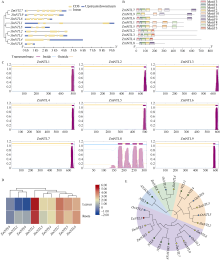
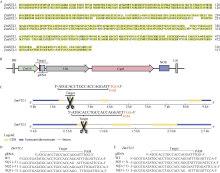
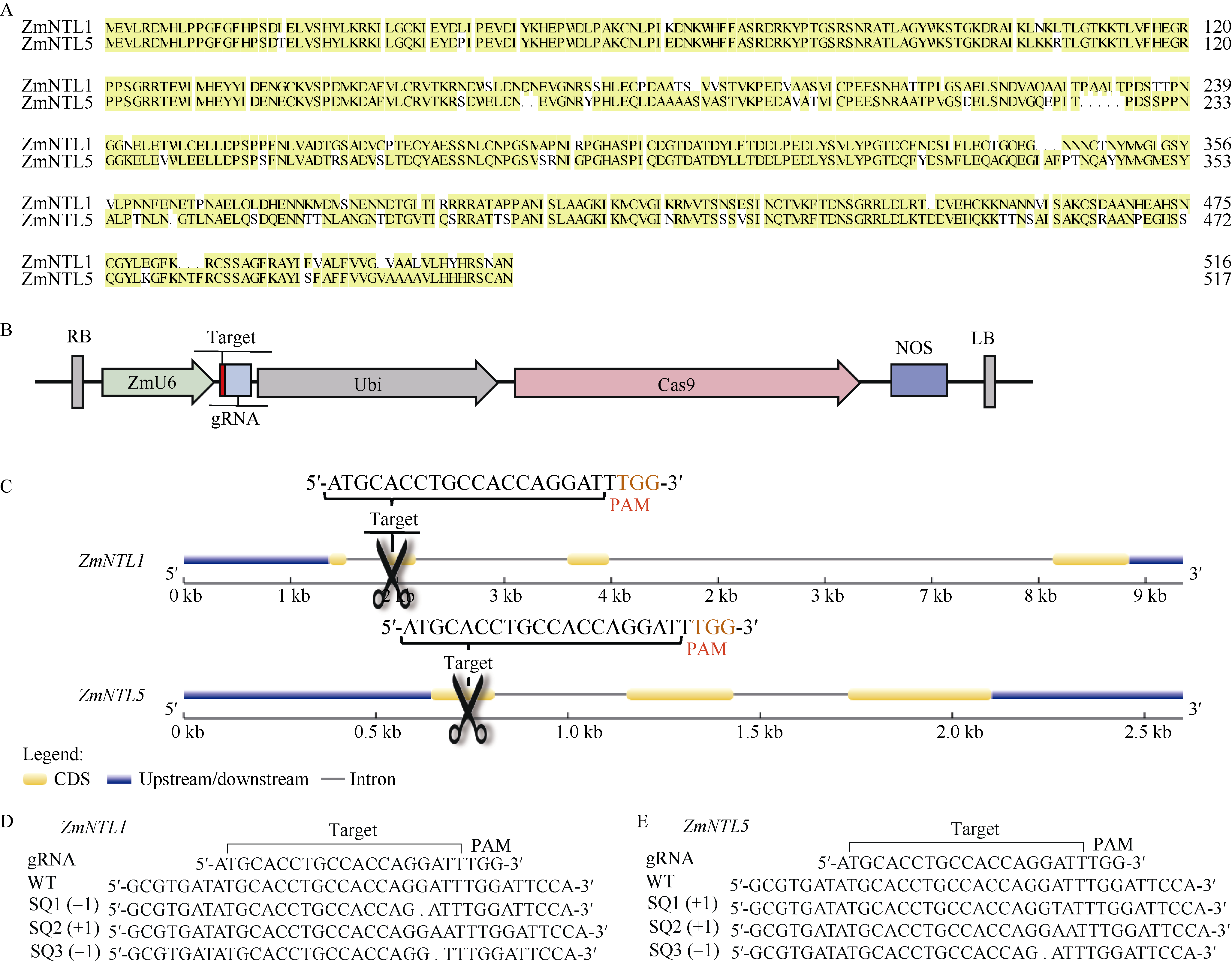
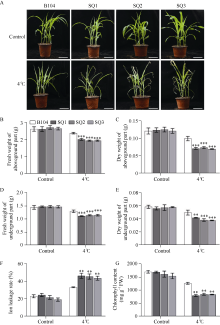
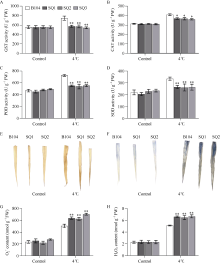
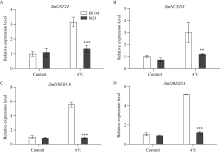
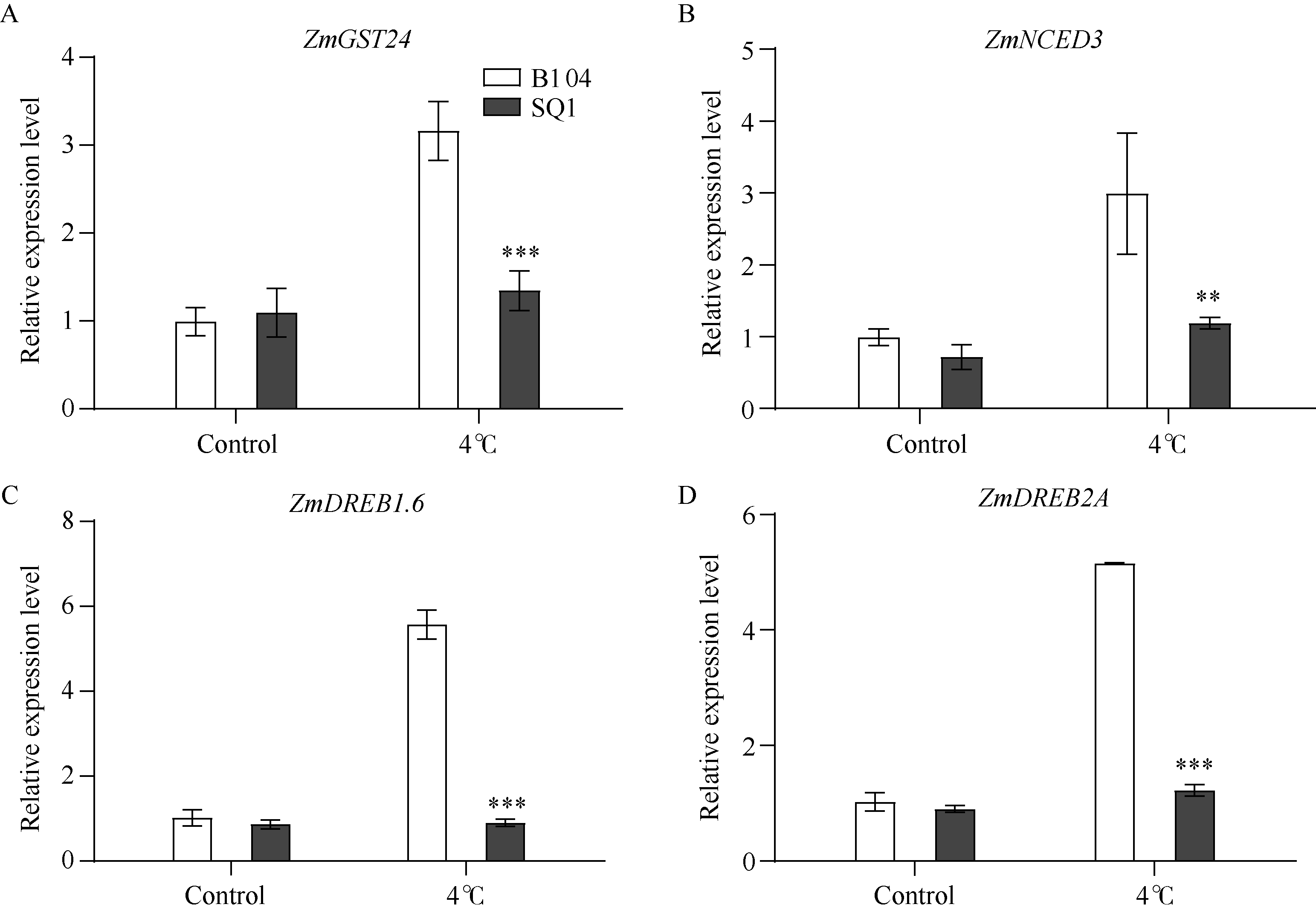
低温是限制东北地区玉米产量的主要逆境之一。膜NAC转录因子在植物抵御逆境过程中发挥着重要作用, 探究其功能将为玉米耐低温育种提供一定的理论依据。本研究通过生物信息技术分析了9条玉米NTL基因的分子特性, 利用已发表的玉米低温RNA-seq数据, 发现6个成员在根和叶中同时受到低温诱导显著上调表达。选取蛋白同源性达到80.04%的ZmNTL1与ZmNTL5基因, 采用基因敲除技术构建了该2条基因的双敲材料zmntl1zmntl5。在低温胁迫条件下, zmntl1zmntl5株系的叶片离子渗透率显著高于B104株系; 而其地上部干重和鲜重、地下部干重和鲜重以及叶绿素含量均显著低于B104株系; zmntl1zmntl5株系的O2-和H2O2含量显著高于B104对照株系, 而GST、SOD、POD和CAT活性均显著低于B104株系。此外, 低温胁迫下ZmGST24、ZmNCED3、ZmDREB1.6和ZmDREB2A基因在zmntl1zmntl5株系中的表达量较B104株系显著降低。综上所述, ZmNTL1与ZmNTL5的缺失降低了植物对低温的耐受性, 表明二者是玉米低温耐受性的正调控因子。本研究为耐冷玉米品种改良和新品种培育提供了重要的理论基础和宝贵的遗传资源。
| [1] |
Shikha K, Madhumal Thayil V, Shahi J P, Zaidi P H, Seetharam K, Nair S K, Singh R, Tosh G, Singamsetti A, Singh S, et al. Genomic-regions associated with cold stress tolerance in Asia-adapted tropical maize germplasm. Sci Rep, 2023, 13: 6297.
doi: 10.1038/s41598-023-33250-8 pmid: 37072497 |
| [2] |
Ding Y L, Yang S H. Surviving and thriving: how plants perceive and respond to temperature stress. Dev Cell, 2022, 57: 947-958.
doi: 10.1016/j.devcel.2022.03.010 pmid: 35417676 |
| [3] | Yang Z R, Cao Y B, Shi Y T, Qin F, Jiang C F, Yang S H. Genetic and molecular exploration of maize environmental stress resilience: toward sustainable agriculture. Mol Plant, 2023, 16: 1496-1517. |
| [4] |
Ding Y L, Shi Y T, Yang S H. Molecular regulation of plant responses to environmental temperatures. Mol Plant, 2020, 13: 544-564.
doi: S1674-2052(20)30034-4 pmid: 32068158 |
| [5] | Li Z Y, Fu D Y, Wang X, Zeng R, Zhang X, Tian J G, Zhang S S, Yang X H, Tian F, Lai J S, et al. The transcription factor bZIP68 negatively regulates cold tolerance in maize. Plant Cell, 2022, 34: 2833-2851. |
| [6] |
Jiang H F, Shi Y T, Liu J Y, Li Z, Fu D Y, Wu S F, Li M Z, Yang Z J, Shi Y L, Lai J S, et al. Natural polymorphism of ZmICE1 contributes to amino acid metabolism that impacts cold tolerance in maize. Nat Plants, 2022, 8: 1176-1190.
doi: 10.1038/s41477-022-01254-3 pmid: 36241735 |
| [7] |
Seo P J. Recent advances in plant membrane-bound transcription factor research: emphasis on intracellular movement. J Integr Plant Biol, 2014, 56: 334-342.
doi: 10.1111/jipb.12139 |
| [8] | Yang Z T, Wang M J, Sun L, Lu S J, Bi D L, Sun L, Song Z T, Zhang S S, Zhou S F, Liu J X. The membrane-associated transcription factor NAC089 controls ER-stress-induced programmed cell death in plants. PLoS Genet, 2014, 10: e1004243. |
| [9] | De Backer J, Van Breusegem F, De Clercq I. Proteolytic activation of plant membrane-bound transcription factors. Front Plant Sci, 2022, 13: 927746. |
| [10] | Li S, Wang N, Ji D D, Xue Z Y, Yu Y C, Jiang Y P, Liu J L, Liu Z H, Xiang F N. Evolutionary and functional analysis of membrane-bound NAC transcription factor genes in soybean. Plant Physiol, 2016, 172: 1804-1820. |
| [11] | Kim S G, Lee A K, Yoon H K, Park C M. A membrane-bound NAC transcription factor NTL8 regulates gibberellic acid-mediated salt signaling in Arabidopsis seed germination. Plant J, 2008, 55: 77-88. |
| [12] | Sakuraba Y, Kim Y S, Han S H, Lee B D, Paek N C. The Arabidopsis transcription factor NAC016 promotes drought stress responses by repressing AREB1 transcription through a trifurcate feed-forward regulatory loop involving NAP. Plant Cell, 2015, 27: 1771-1787. |
| [13] | Sun H M, Xie Y Z, Yang W B, Lyu Q, Chen L P, Li J T, Meng Y, Li L Q, Li X J. Membrane-bound transcription factor TaNTL1 positively regulates drought stress tolerance in transgenic Arabidopsis. Plant Physiol Biochem, 2022, 182: 182-193. |
| [14] | Wu Z, Li T, Xiang J, Teng R D, Zhang D H, Teng N J. A lily membrane-associated NAC transcription factor LlNAC014 is involved in thermotolerance via activation of the DREB2-HSFA3 module. J Exp Bot, 2023, 74: 945-963. |
| [15] |
Wang D X, Yu Y C, Liu Z H, Li S, Wang Z L, Xiang F N. Membrane-bound NAC transcription factors in maize and their contribution to the oxidative stress response. Plant Sci, 2016, 250: 30-39.
doi: S0168-9452(16)30098-X pmid: 27457981 |
| [16] | Qian Y X, Xi Y, Xia L X, Qiu Z L, Liu L, Ma H. Membrane-bound transcription factor ZmNAC074 positively regulates abiotic stress tolerance in transgenic Arabidopsis. Int J Mol Sci, 2023, 24: 16157. |
| [17] | Xi Y, Ling Q Q, Zhou Y, Liu X, Qian Y X. ZmNAC074, a maize stress-responsive NAC transcription factor, confers heat stress tolerance in transgenic Arabidopsis. Front Plant Sci, 2022, 13: 986628. |
| [18] |
Gu Y N, He L, Zhao C J, Wang F, Yan B W, Gao Y Q, Li Z T, Yang K J, Xu J Y. Biochemical and transcriptional regulation of membrane lipid metabolism in maize leaves under low temperature. Front Plant Sci, 2017, 8: 2053.
doi: 10.3389/fpls.2017.02053 pmid: 29250095 |
| [19] | Zhao X C, Wei Y L, Zhang J J, Yang L, Liu X Y, Zhang H Y, Shao W J, He L, Li Z T, Zhang Y F, et al. Membrane lipids' metabolism and transcriptional regulation in maize roots under cold stress. Front Plant Sci, 2021, 12: 639132. |
| [20] | Liu X H, Lyu Y S, Yang W P, Yang Z T, Lu S J, Liu J X. A membrane-associated NAC transcription factor OsNTL3 is involved in thermotolerance in rice. Plant Biotechnol J, 2020, 18: 1317-1329. |
| [21] | Zhao Y S, Antoniou-Kourounioti R L, Calder G, Dean C, Howard M. Temperature-dependent growth contributes to long-term cold sensing. Nature, 2020, 583: 825-829. |
| [22] | Seo P J, Kim M J, Park J Y, Kim S Y, Jeon J, Lee Y H, Kim J, Park C M. Cold activation of a plasma membrane-tethered NAC transcription factor induces a pathogen resistance response in Arabidopsis. Plant J, 2010, 61: 661-671. |
| [23] | Yang Z T, Fan S X, Wang J J, An Y, Guo Z Q, Li K, Liu J X. The plasma membrane-associated transcription factor NAC091 regulates unfolded protein response in Arabidopsis thaliana. Plant Sci, 2023, 334: 111777. |
| [24] |
Shi Y T, Ding Y L, Yang S H. Molecular regulation of CBF signaling in cold acclimation. Trends Plant Sci, 2018, 23: 623-637.
doi: S1360-1385(18)30086-4 pmid: 29735429 |
| [25] | Nguyen H T, Leipner J, Stamp P, Guerra-Peraza O. Low temperature stress in maize (Zea mays L.) induces genes involved in photosynthesis and signal transduction as studied by suppression subtractive hybridization. Plant Physiol Biochem, 2009, 47: 116-122. |
| [26] |
Liu L, Tang C, Zhang Y, Sha X, Tian S, Luo Z, Wei G, Zhu L, Li Y, Fu J, et al. The SnRK2.2-ZmHsf28-JAZ14/17 module regulates drought tolerance in maize. New Phytol, 2025, 245: 1985-2003.
doi: 10.1111/nph.20355 pmid: 39686522 |
| [27] | Song X P, Cao B Y, Xu Z P, Liang L, Xiao J C, Tang W, Xie M H, Wang D, Zhu L, Huang Z, et al. Molecular regulation by H2S of antioxidant and glucose metabolism in cold-sensitive Capsicum. BMC Plant Biol, 2024, 24: 931. |
| [1] | 刘恩波, 陈静, 李红星, 于宁宁, 任佰朝, 赵斌, 刘鹏, 张吉旺. 遮阴改变源-库平衡和调节碳水化合物代谢进而抑制夏玉米幼穗发育[J]. 作物学报, 2026, 52(6): 1891-1901. |
| [2] | 梁进宇, 尹嘉德, 王红丽, 张国平, 侯慧芝, 董博, 马明生. 基于无人机高光谱和机器学习的旱地饲用玉米叶片氮含量估测[J]. 作物学报, 2026, 52(6): 1788-1801. |
| [3] | 金昱何, 王雪菲, 徐张一娃, 缪怡宁, 蒋云杰, 伊莹, 缪德麟, 朱静仪, 钟一帆, 陈铭亨, 方芳, 刘鹏. 外源激素对低温胁迫下大豆叶片叶绿素荧光参数及抗氧化酶系统的影响[J]. 作物学报, 2026, 52(6): 1817-1829. |
| [4] | 孙淑凤, 许振南, 黄嘉鑫, 翁建峰, 李新海. 玉米MAPK家族全基因组鉴定及其对拟轮枝镰孢菌感染的响应[J]. 作物学报, 2026, 52(5): 1291-1308. |
| [5] | 张宁宁, 滕雨菲, 任娜娜, 魏兴卓, 闫书豪, 樊可心, 王永宏, 陈文康, 张兴华, 朱万超, 徐淑兔, 薛吉全. 201份玉米自交系抗旱表型评价及可塑性分析[J]. 作物学报, 2026, 52(5): 1309-1325. |
| [6] | 徐苗苗, 邸太妹, 王洁, 吴叶蝶, 刘恩贝, 王玉春, 王新超, 王璐. 外源槲皮素增强茶树抗寒性的分子机制[J]. 作物学报, 2026, 52(5): 1418-1429. |
| [7] | 杨扬, 常诗惠, 田红丽, 易红梅, 王璐, 任洁, 范亚明, 刘亚维, 王凤格, 赵久然. 不同生态区国审玉米品种的遗传多样性分析[J]. 作物学报, 2026, 52(5): 1352-1364. |
| [8] | 张鸿蓉, 王菲儿, 李盼, 仇海龙, 朱静, 赵连豪, 南运有, 何蔚, 樊志龙, 胡发龙, 柴强, 殷文. 减量20%灌水与25%有机肥替代化肥提高青贮玉米产量的光合特性[J]. 作物学报, 2026, 52(5): 1487-1500. |
| [9] | 杨欣雨, 崔文涛, 迪力尼格尔·阿力木, 汪凯翔, 吴鹏昊, 任姣姣. 玉米穗上叶片数全基因组关联分析和全基因组选择[J]. 作物学报, 2026, 52(5): 1573-1590. |
| [10] | 韩亚鑫, 何冠华, 张小琼, 张登峰, 李永祥, 刘旭洋, 王天宇, 黎裕, 邹华文, 李春辉. 基于RNA-Seq和BSA-Seq联合分析挖掘玉米侧根密度基因资源[J]. 作物学报, 2026, 52(5): 1341-1352. |
| [11] | 陈伟, 卫万娟, 赵其兵, 常东伟, 余凌波, 翟鹏飞, 冯志明, 陈宗祥, 任仰涛, 杨鹏, 刘海浪, 李珍富, 杨永乐, 金彦刚, 左示敏. 利用CRISPR/Cas9编辑Hd6基因创制优质早熟水稻新种质[J]. 作物学报, 2026, 52(4): 1046-1056. |
| [12] | 蔡宏玮, 于爱忠, 姜科强, 王鹏飞, 王玉珑, 霍建喆, 庞小能, 尹波, 尚永盼. 干旱灌区有机肥替代部分化肥促进甜玉米产量提升的关键机制[J]. 作物学报, 2026, 52(4): 1166-1180. |
| [13] | 田红丽, 杨扬, 范亚明, 易红梅, 郭丹丹, 王凤格, 赵久然. 适于玉米品种鉴定的一套三等位变异SNP新型标记组合[J]. 作物学报, 2026, 52(4): 993-1005. |
| [14] | 杨亚莉, 徐明睿, 马越飞, 海艺蕊, 刘凯栋, 刘万茂, 孙颖. 玉米根尖及整根响应缺铁的转录组比较研究[J]. 作物学报, 2026, 52(4): 1006-1021. |
| [15] | 张超, 郭欢, 李忠玲, 岳淑宁, 赵娜. 基于BSA-seq技术定位玉米籽粒花青素关联基因[J]. 作物学报, 2026, 52(3): 780-789. |
|
||