欢迎访问作物学报,今天是
作物学报 ›› 2025, Vol. 51 ›› Issue (2): 516-525.doi: 10.3724/SP.J.1006.2025.44074
陈于婷1( ), 丁晓雨2, 许本波1, 张学昆1, 徐劲松1,*(), 殷艳1,*()
CHEN Yu-Ting1(), DING Xiao-Yu2, XU Ben-Bo1, ZHANG Xue-Kun1, XU Jin-Song1,*(), YIN Yan1,*()
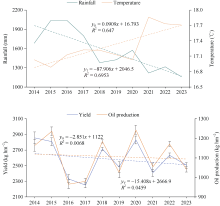
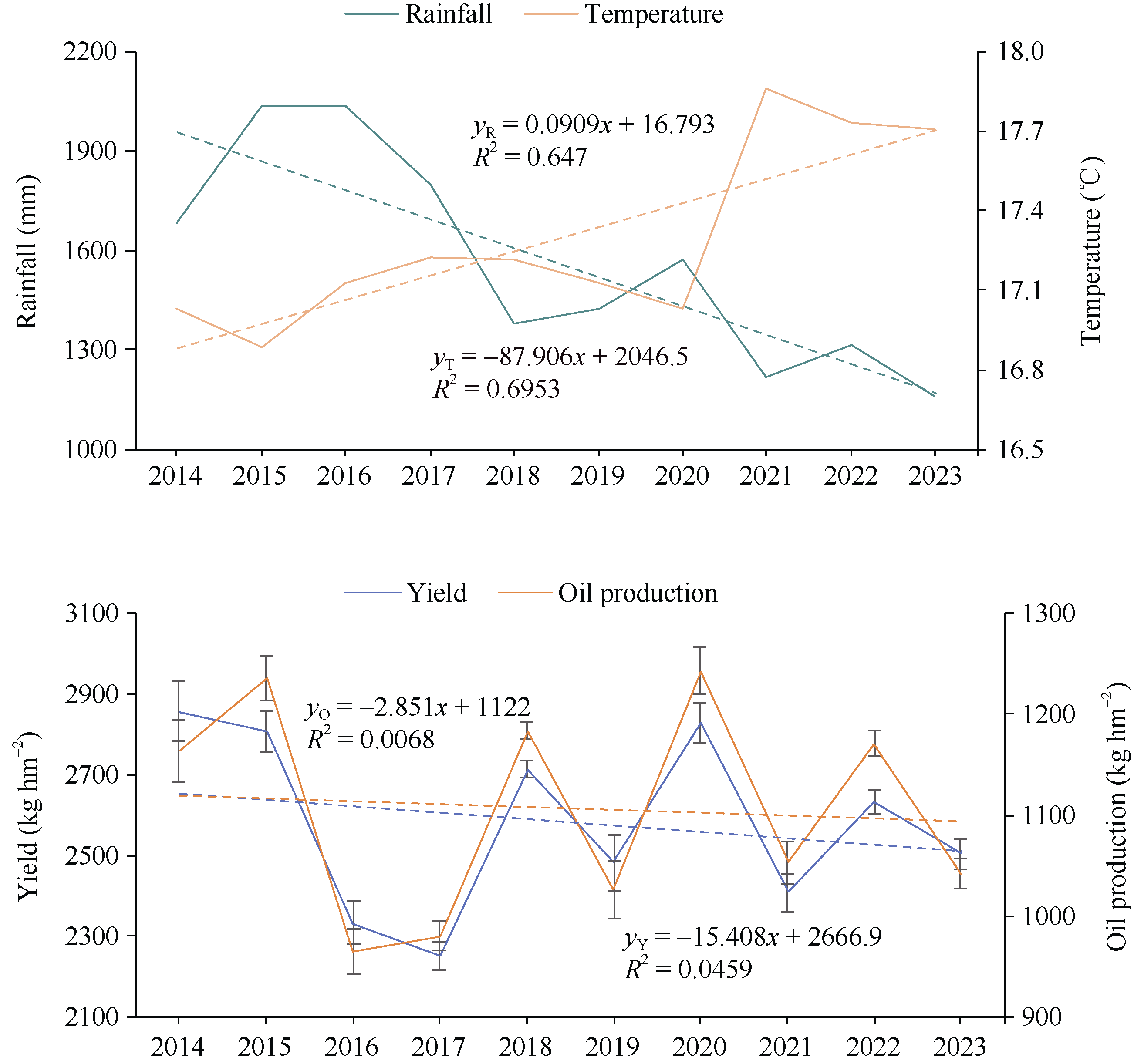
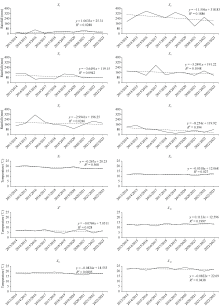
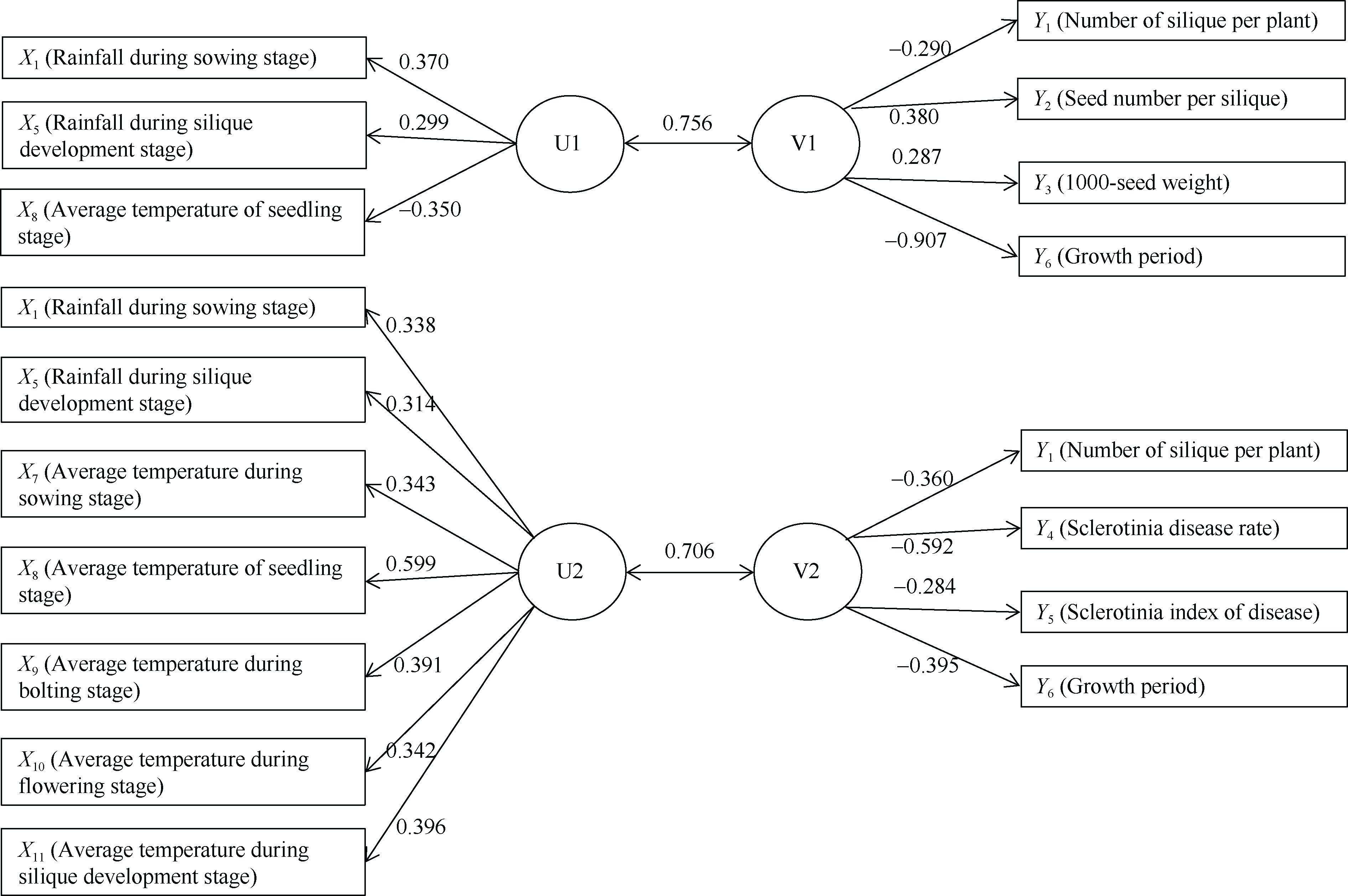
摘要: 长江中游流域是我国最重要的油菜主产区, 为探明气候变暖下降雨和气温时空变化对我国油菜生产的影响规律, 本研究利用油菜主栽品种华油杂12 (国家油菜区试长江中游组对照品种), 在长江中游6个主产区开展10年定点试验, 同时记录试验点的气象数据, 并在此基础上分析了重要生育时期降雨量、气温等气象变化与产量等性状的关系。结果表明, 近10年来, 长江流域降雨时空分布发生明显变化, 全年平均降雨量显著减少。其中播种期降雨增加且波动较大, 苗期、花期和成熟期降雨减少趋势明显, 角果期降雨较稳定。近10年来长江流域气温发生明显变化, 6个油菜主产区的全年平均气温显著上升, 播种期和冬季苗期气温下降约2℃, 抽薹期和成熟期气温年度间波动剧烈, 花期气温上升2℃以上。多元回归分析发现, 播种期、花期和角果期降雨量与产量呈显著负相关, 10年间油菜出现3次显著减产, 分别减产9.6%、12.8%、6.7%。典型相关分析发现, 播种期降雨量和苗期平均气温与单株角果数呈显著负相关, 与每角粒数、千粒重呈显著正相关; 播种期和角果期降雨量, 及播种期、苗期、抽薹期、花期和角果期平均气温与菌核病发病率呈显著正相关。针对降雨和气温时空变化趋势, 建议生产上提高品种耐渍性和耐迟播能力, 改善农田排灌能力, 强化菌核病等次生灾害防控, 最大程度降低渍涝影响, 保障油菜高产稳产。
| [1] |
王汉中. 以新需求为导向的油菜产业发展战略. 中国油料作物学报, 2018, 40: 613-617.
doi: 10.7505/j.issn.1007-9084.2018.05.001 |
| Wang H Z. New-demand oriented oilseed rape industry developing strategy. Chin J Oil Crop Sci, 2018, 40: 613-617 (in Chinese with English abstract). | |
| [2] | 王瑞元. 2022年我国粮油产销和进出口情况. 中国油脂, 2023, 48(6): 1-7. |
| Wang R Y. Production, marketing, import and export of grain and oil in China in 2022. China Oils Fats, 2023, 48(6): 1-7 (in Chinese). | |
| [3] | 殷艳, 尹亮, 张学昆, 郭静利, 王积军. 我国油菜产业高质量发展现状和对策. 中国农业科技导报, 2021, 23(8): 1-7. |
| Yin Y, Yin L, Zhang X K, Guo J L, Wang J J. Status and countermeasure of the high-quality development of rapeseed industry in China. J Agric Sci Technol, 2021, 23(8): 1-7 (in Chinese with English abstract). | |
| [4] | 王汉中. 入世后的中国油菜产业. 中国油料作物学报, 2002, 24(2): 82-86. |
| Wang H Z. Rapeseed of China after its entrance into WTO. Chin J Oil Crop Sci, 2002, 24(2): 82-86 (in Chinese with English abstract). | |
| [5] | Deng Z F, Wu X S, Villarini G, Wang Z L, Zeng Z Y, Lai C G. Stronger exacerbation of extreme rainfall at the hourly than daily scale by urbanization in a warming climate. J Hydrol, 2024, 633: 131025. |
| [6] | Du J, Yu X J, Zhou L, Li X D, Ao T Q. Less concentrated precipitation and more extreme events over the Three River Headwaters region of the Tibetan Plateau in a warming climate. Atmos Res, 2024, 303: 107311. |
| [7] |
舒章康, 李文鑫, 张建云, 金君良, 薛晴, 王银堂, 王国庆. 中国极端降水和高温历史变化及未来趋势. 中国工程科学, 2022, 24(5): 116-125.
doi: 10.15302/J-SSCAE-2022.05.014 |
| Shu Z K, Li W X, Zhang J Y, Jin J L, Xue Q, Wang Y T, Wang G Q. Historical changes and future trends of extreme precipitation and high temperature in China. Strateg Study CAE, 2022, 24(5): 116-125 (in Chinese with English abstract). | |
| [8] |
Sasidharan R, Bailey-Serres J, Ashikari M, Atwell B J, Colmer T D, Fagerstedt K, Fukao T, Geigenberger P, Hebelstrup K H, Hill R D, Holdsworth M J, Ismail A M, Licausi F, Mustroph A, Nakazono M, Pedersen O, Perata P, Sauter M, Shih M C, Sorrell B K, Striker G G, van Dongen J T, Whelan J, Xiao S, Visser E J W, Voesenek L A C J. Community recommendations on terminology and procedures used in flooding and low oxygen stress research. New Phytol, 2017, 214: 1403-1407.
doi: 10.1111/nph.14519 pmid: 28277605 |
| [9] | 赵国良, 高强, 姚小英, 温宏昌, 强玉柱, 王娟. 气候变暖对天水市作物生长的影响: 以冬油菜为例. 干旱地区农业研究, 2012, 30(6): 261-266. |
| Zhao G L, Gao Q, Yao X Y, Wen H C, Qiang Y Z, Wang J. Impact of climate warming on crop in Tianshui City: an example based on winter rape. Agric Res Arid Areas, 2012, 30(6): 261-266 (in Chinese with English abstract). | |
| [10] | 蒲金涌, 姚小英, 邓振镛, 姚玉璧, 王位泰, 张谋草. 气候变暖对甘肃冬油菜(Brassica compestris L.)种植的影响. 作物学报, 2006, 32: 1397-1401. |
| Pu J Y, Yao X Y, Deng Z Y, Yao Y B, Wang W T, Zhang M C. Impact of climate warming on winter rape planting in Gansu Province. Acta Agron Sin, 2006, 32: 1397-1401 (in Chinese with English abstract). | |
| [11] | 韩沁哲, 罗伯良, 周伟, 黄晚华, 陆魁东. 湖南省油菜生长期连阴雨气象灾害发生强度的时空特征. 湖南农业科学, 2012, (19): 93-96. |
| Han Q Z, Luo B L, Zhou W, Huang W H, Lu K D. Analysis of spatial-temporal features of occurring intensity of continuous rain in growth period of rape in Hunan province. Hunan Agric Sci, 2012, (19): 93-96 (in Chinese with English abstract). | |
| [12] | 程伦国, 刘德福, 郭显平, 吴立仁. 油菜受渍抑制天数指标试验研究. 中国农村水利水电, 2009, (7): 4-8. |
| Cheng L G, Liu D F, Guo X P, Wu L R. Experimental research on stress day index of rape suffering from continuous subsurface waterlogging. China Rural Water Hydropower, 2009, (7): 4-8 (in Chinese with English abstract). | |
| [13] | 汤畅, 吴小飞, 毛江玉, 张冠舜. 2014年夏季长江流域降水季节内振荡的环流分析. 高原山地气象研究, 2021, 41(2): 10-22. |
| Tang C, Wu X F, Mao J Y, Zhang G S. Circulation analysis of intraseasonal oscillation of precipitation in the Yangtze River valley in the summer of 2014. Plateau Mount Meteorol Res, 2021, 41(2): 10-22 (in Chinese with English abstract). | |
| [14] | 中国人民共和国农业农村部. NY/T 415-2000低芥酸低硫苷油菜籽. 北京: 中国农业出版社, 2000. |
| Ministry of Agriculture and Rural Affairs, the People’s Republic of China. NY/T 415-2000 Low Eruic Acid Low Glucosinolate rapeseed. Beijing: China Agriculture Press, 2000 (in Chinese). | |
| [15] | 中华人民共和国农业农村部. 油菜品种菌核病抗性鉴定技术规程. 北京: 中国农业出版社, 2017. pp 3-7. |
| Ministry of Agriculture and Rural Affairs, the People’s Republic of China. Code of practice for identification of resistance to Sclerotinia sclerotiorum in oilseed rape. Beijing: China Agriculture Press, 2017. pp 3-7 (in Chinese). | |
| [16] | 戴清明, 吕爱钦, 何维君, 谢年保, 陈欣, 张志远, 匡朝凌, 瞿科. 洞庭湖区油菜主要气象灾害发生规律与减灾避灾对策. 作物研究, 2006, 20(1): 60-63. |
| Dai Q M, Lyu A Q, He W J, Xie N B, Chen X, Zhang Z Y, Kuang Z L, Qu K. The rule of principle weather disaster for rape planting in Dongting Lake region and the countermeasures to relief and avoid the disaster. Crop Res, 2006, 20(1): 60-63 (in Chinese). | |
| [17] | 唐海明, 帅细强, 肖小平, 殷玉梁, 黄桂林, 杨光立, 汤文光. 2010年湖南省农业气象灾害分析及减灾对策. 中国农学通报, 2012, 28(12): 284-290. |
| Tang H M, Shuai X Q, Xiao X P, Yin Y L, Huang G L, Yang G L, Tang W G. Analysis and countermeasures on the agro- meteorological disasters of Hunan province in 2010. Chin Agric Sci Bull, 2012, 28(12): 284-290 (in Chinese with English abstract). | |
| [18] | Liu W W, Chen Y Y, Sun W W, Huang R, Huang J F. Mapping waterlogging damage to winter wheat yield using downscaling- merging satellite daily precipitation in the middle and lower reaches of the Yangtze River. Remote Sens, 2023, 15: 2573. |
| [19] | 吴贤云, 丁一汇, 王琪, 叶成志. 近40年长江中游地区旱涝特点分析. 应用气象学报, 2006, 17: 19-28. |
| Wu X Y, Ding Y H, Wang Q, Ye C Z. Characteristics of the recent 40-year flood/drought over the middle reaches of the Yangtze. J Appl Meteorol Sci, 2006, 17: 19-28 (in Chinese with English abstract). | |
| [20] | 陈鹏运. 湖南油菜生产主要气象灾害与应对措施. 农业科技通讯, 2021, (10): 216-220. |
| Chen P Y. Main meteorological disasters in rape production in Hunan province and countermeasures. Bull Agric Sci Technol, 2021, (10): 216-220 (in Chinese with English abstract). | |
| [21] |
何泽威, 丁晓雨, 徐劲松, 叶鹏, 贺继奎, 程勇, 许本波, 张学昆. 播种期降水偏多对油菜重要农艺性状和产量的影响. 中国油料作物学报, 2024, 46: 92-101.
doi: 10.19802/j.issn.1007-9084.2022248 |
| He Z W, Ding X Y, Xu J S, Ye P, He J K, Cheng Y, Xu B B, Zhang X K.Effect of autumn continuously rainy weather which cause waterlogging in rapeseed (Brassica napus L.) traits and yield. Chin J Oil Crop Sci, 2024, 46: 92-101 (in Chinese with English abstract). | |
| [22] | 刘秋霞, 任涛, 韩上, 李小坤, 丛日环, 武际, 鲁剑巍. 苗期渍水对直播冬油菜产量和农学利用率的影响及油菜在不同氮肥施用下的响应. 中国油料作物学报, 2020, 42: 594-602. |
| Liu Q X, Ren T, Han S, Li X K, Cong R H, Wu J, Lu J W. Effects of waterlogging at seedling stage on yield and agronomy efficency of direct-sown winter rapeseed and its response to nitrogen application. Chin J Oil Crop Sci, 2020, 42: 594-602 (in Chinese with English abstract). | |
| [23] | 刘波, 魏全全, 鲁剑巍, 李小坤, 丛日环, 吴礼树, 徐维明, 杨运清, 任涛. 苗期渍水和氮肥用量对直播冬油菜产量及氮肥利用率的影响. 植物营养与肥料学报, 2017, 23: 144-153. |
| Liu B, Wei Q Q, Lu J W, Li X K, Cong R H, Wu L S, Xu W M, Yang Y Q, Ren T. Effects of waterlogging at the seedling stage and nitrogen application on seed yields and nitrogen use efficiency of direct-sown winter rapeseed (Brassica napus L.). J Plant Nutr Fert, 2017, 23: 144-153 (in Chinese with English abstract). | |
| [24] | Li L L, Zhang L, Tang J W, Xing H C, Zhao L, Jie H D, Jie Y C. Waterlogging increases greenhouse gas release and decreases yield in winter rapeseed (Brassica napus L.) seedlings. Sci Rep, 2023, 13: 18673. |
| [25] | 高华东, 晏军, 苏荣瑞, 刘凯文, 周守华. 渍水对油菜抽薹期叶片光合参数及产量的影响. 湖北农业科学, 2018, 57(10): 39-44. |
| Gao H D, Yan J, Su R R, Liu K W, Zhou S H. Effects of waterlogging on leaf photosynthetic parameters and yields of oilseed rape at the bolting stage. Hubei Agric Sci, 2018, 57(10): 39-44 (in Chinese with English abstract). | |
| [26] | 杨奕涵, 马玉申, 揭红东, 赵龙, 揭雨成. 不同生育期渍水对油菜农艺性状和产量的影响. 安徽农业科学, 2022, 50(16): 20-22. |
| Yang Y H, Ma Y S, Jie H D, Zhao L, Jie Y C. Effects of waterlogging at different growth stages on agronomic characters and yield of rapeseed. J Anhui Agric Sci, 2022, 50(16): 20-22 (in Chinese with English abstract). | |
| [27] |
丛日环, 张智, 鲁剑巍. 长江流域不同种植区气候因子对冬油菜产量的影响. 中国油料作物学报, 2019, 41: 894-903.
doi: 10.19802/j.issn.1007-9084.2019046 |
|
Cong R H, Zhang Z, Lu J W. Climate impacts on yield of winter oilseed rape in different growth regions of the Yangtze River Basin. Chin J Oil Crop Sci, 2019, 41: 894-903 (in Chinese with English abstract).
doi: 10.19802/j.issn.1007-9084.2019046 |
|
| [28] |
宋楚崴, 曹宏鑫, 张文宇, 张伟欣, 陈魏涛, 冯春焕, 葛思俊. 施肥和花期渍水胁迫对油菜产量及其形成影响的模型研究. 中国农业科学, 2018, 51: 662-674.
doi: 10.3864/j.issn.0578-1752.2018.04.006 |
|
Song C W, Cao H X, Zhang W Y, Zhang W X, Chen W T, Feng C H, Ge S J. Modeling the effects of post-anthesis waterlogging stress under different fertilizer levels on rapeseed yield and its formation. Sci Agric Sin, 2018, 51: 662-674 (in Chinese with English abstract).
doi: 10.3864/j.issn.0578-1752.2018.04.006 |
|
| [29] | Sophie H, Saadia Z. Global risks report 2023. Geneva, Switzerland:The World Economic Forum, 2023 [2024-03-17]. https://www.weforum.org/reports. |
| [30] | 蔡琳, 陶丽, 赵久伟, 张梦. 全球变暖、 AMO、IPO对全球陆地降水变化的相对贡献. 大气科学学报, 2022, 45: 755-767. |
| Cai L, Tao L, Zhao J W, Zhang M. Relative contributions of global warming, AMO and IPO to the changes of land precipitation. Trans Atmos Sci, 2022, 45: 755-767 (in Chinese with English abstract). | |
| [31] |
Namazkar S, Stockmarr A, Frenck G, Egsgaard H, Terkelsen T, Mikkelsen T, Ingvordsen C H, Jørgensen R B. Concurrent elevation of CO2, O3 and temperature severely affects oil quality and quantity in rapeseed. J Exp Bot, 2016, 67: 4117-4125.
doi: 10.1093/jxb/erw180 pmid: 27222513 |
| [32] | Tian Z, Ji Y H, Sun L X, Xu X L, Fan D L, Zhong H L, Liang Z R, Gunther F. Changes in production potentials of rapeseed in the Yangtze River Basin of China under climate change: a multi-model ensemble approach. J Geogr Sci, 2018, 28: 1700-1714. |
| [33] | 张学昆, 陈洁, 王汉中, 李加纳, 邹崇顺. 甘蓝型油菜耐湿性的遗传差异鉴定. 中国油料作物学报, 2007, 29: 204-208. |
| Zhang X K, Chen J, Wang H Z, Li J N, Zou C S. Genetic difference of waterlogging tolarance in rapeseed (Brassica napus L.). Chin J Oil Crop Sci, 2007, 29: 204-208 (in Chinese with English abstract). | |
| [34] | 杨海云, 艾雪莹, Batool Maria, 刘芳, 蒯婕, 王晶, 汪波, 周广生. 油菜响应水分胁迫的生理机制及栽培调控措施研究进展. 华中农业大学学报, 2021, 40(2): 6-16. |
| Yang H Y, Ai X Y, Maria B, Liu F, Kuai J, Wang J, Wang B, Zhou G S. Progress on physiological mechanisms of response to water stress and measures of cultivation controlling in rapeseed. J Huazhong Agric Univ, 2021, 40(2): 6-16 (in Chinese with English abstract). | |
| [35] | Wang Z Y, Han Y L, Luo S, Rong X M, Song H X, Jiang N, Li C W, Yang L. Calcium peroxide alleviates the waterlogging stress of rapeseed by improving root growth status in a rice-rape rotation field. Front Plant Sci, 2022, 13: 1048227. |
| [36] | Hussain M A, Naeem A, Pitann B, Mühling K H. High sulfur (S) supplementation imparts waterlogging tolerance to oilseed rape (Brassica napus L.) through upregulating S metabolism and antioxidant pathways. J Plant Growth Regul, 2023, 42: 7591-7605. |
| [1] | 胡川, 赵凯男, 黄修利, 吴金芝, 任开明, 王贺正, 付国占, 黄明, 李友军. 一次灌溉下耕作方式和氮肥用量对旱地小麦产量和品质的影响[J]. 作物学报, 2026, 52(6): 1830-1846. |
| [2] | 马胜乾, 王志平, 陈浩天, 窦淑贤, 张燕, 邓艾兴, 张卫建, 原向阳, 宋振伟. 秸秆还田下耕作方式与氮肥施用量对东北玉米产量及土壤团聚体的影响[J]. 作物学报, 2026, 52(6): 1802-1816. |
| [3] | 张思思, 赵向辉, 周洋, 姚云凤, 朱荣昱, 董元杰, 胡国庆, 徐通, 刘兆新. 冬闲期翻耕和绿肥还田对连作花生田土壤理化性质和产量的影响[J]. 作物学报, 2026, 52(5): 1472-1486. |
| [4] | 任依涵, 赵曼利, 代晶, 李银水, 顾炽明, 杨璐, 杜雪竹, 胡文诗, 秦璐. 油菜叶片功能氮动态变化对光合速率及光合氮利用效率的影响[J]. 作物学报, 2026, 52(5): 1459-1471. |
| [5] | 张宁宁, 滕雨菲, 任娜娜, 魏兴卓, 闫书豪, 樊可心, 王永宏, 陈文康, 张兴华, 朱万超, 徐淑兔, 薛吉全. 201份玉米自交系抗旱表型评价及可塑性分析[J]. 作物学报, 2026, 52(5): 1309-1325. |
| [6] | 张颖星, 宋裕祯, 王跃, 曹越, 曹晓宁, 王瑞云. EMS诱导糜子优异性状突变体的筛选及表型分析[J]. 作物学报, 2026, 52(5): 1388-1400. |
| [7] | 张振, 冯连杰, 石玉, 于振文, 张永丽. 节水补灌下不同穗型小麦产量形成差异研究[J]. 作物学报, 2026, 52(5): 1522-1535. |
| [8] | 闫安, 蒋昆炜, 王蓉圆, 田林, 张璐, 王韵, 徐建龙. 水稻剑叶小维管束数基因SVN7的鉴定与克隆[J]. 作物学报, 2026, 52(5): 1364-1372. |
| [9] | 刘昕萌, 任昊, 张继波, 张吉旺, 赵斌, 任佰朝, 刘鹏, 王洪章. 茉莉酸甲酯(MeJA)缓解高温影响玉米雌穗分化的生理机制[J]. 作物学报, 2026, 52(5): 1561-1572. |
| [10] | 王壮壮, 武紫君, 张永新, 张芯源, 袁丽雪, 陈如雪, 刘世举, 段剑钊, 冯伟, 王同朝, 王永华. 豫东南黏壤潮土区水氮优化协同提高冬小麦产量和氮素利用效率[J]. 作物学报, 2026, 52(5): 1501-1521. |
| [11] | 张鸿蓉, 王菲儿, 李盼, 仇海龙, 朱静, 赵连豪, 南运有, 何蔚, 樊志龙, 胡发龙, 柴强, 殷文. 减量20%灌水与25%有机肥替代化肥提高青贮玉米产量的光合特性[J]. 作物学报, 2026, 52(5): 1487-1500. |
| [12] | 王宇诚, 张露, 刘阿康, 黄见良, 彭少兵, 袁珅. 基于产量差的作物大面积单产提升策略与展望[J]. 作物学报, 2026, 52(5): 1279-1290. |
| [13] | 赵佳雪, 周龙昊, 郭岂源, 尚伦霄, 王涵, 刘志涛, 陈曦, 张晓佩, 宋宪亮, 毛丽丽. 长期秸秆还田与深松通过改善土壤环境与棉花光合特性提高滨海盐碱地棉花产量[J]. 作物学报, 2026, 52(5): 1548-1560. |
| [14] | 郭星宇, 胡丹, 林苏期, 王梦凯, 谭文峰, 黄传琴. 生物炭配施化肥提高玉米‖大豆下玉米产量和土壤生态系统多功能性[J]. 作物学报, 2026, 52(5): 1536-1547. |
| [15] | 蔡宏玮, 于爱忠, 姜科强, 王鹏飞, 王玉珑, 霍建喆, 庞小能, 尹波, 尚永盼. 干旱灌区有机肥替代部分化肥促进甜玉米产量提升的关键机制[J]. 作物学报, 2026, 52(4): 1166-1180. |
|
||