欢迎访问作物学报,今天是
作物学报 ›› 2020, Vol. 46 ›› Issue (10): 1526-1538.doi: 10.3724/SP.J.1006.2020.94197
肖燕( ), 姚珺玥(), 刘冬, 宋海星, 张振华*()
XIAO Yan(), YAO Jun-Yue(), LIU Dong, SONG Hai-Xing, ZHANG Zhen-Hua*()
摘要:
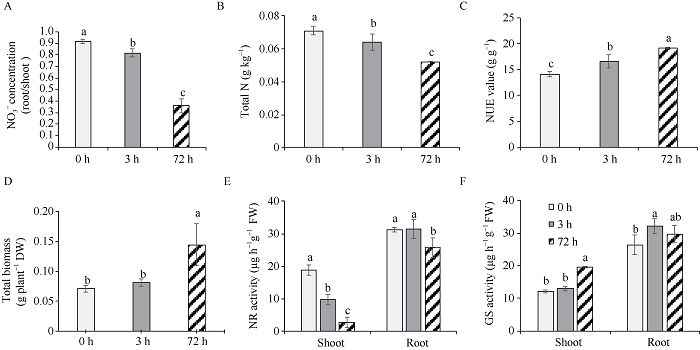
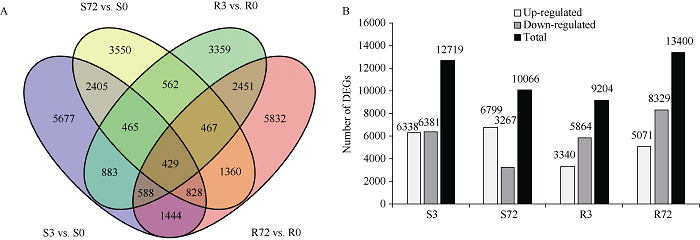
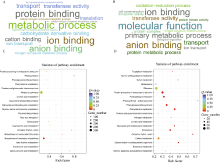
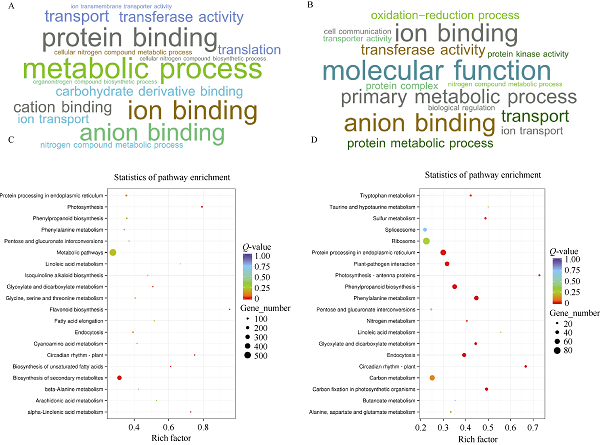
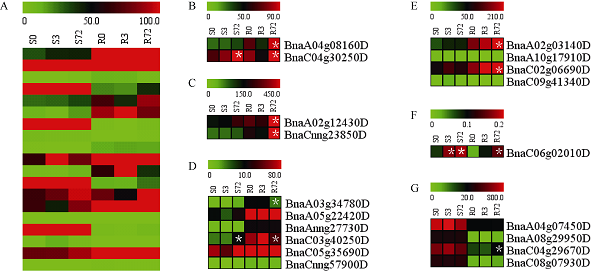
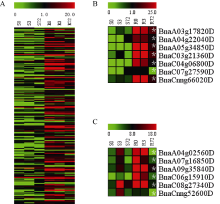
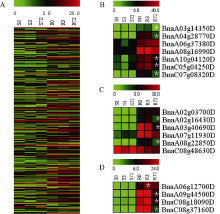
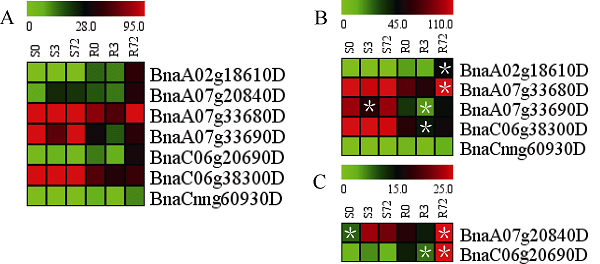
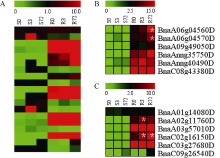
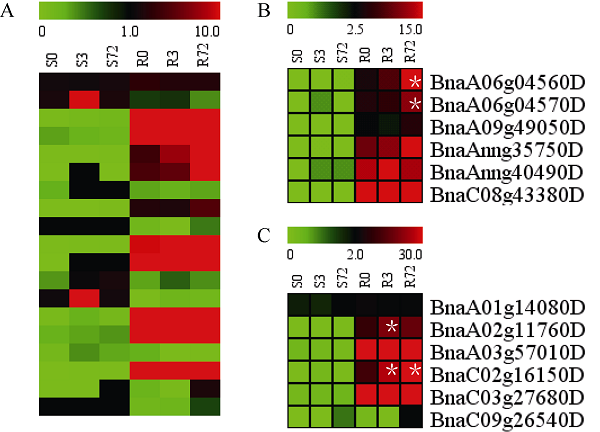
随着人们对作物产量的需求不断提高, 氮肥被过量施用, 而作物的氮素利用率(NUE)却在不断降低。本研究从低氮胁迫下油菜的生理变化入手, 结合高通量的数字基因表达谱测序技术, 分析了油菜在低氮0、3、72 h下的转录组差异响应, 鉴定了氮的吸收﹑转运﹑分配和转录因子等方面的差异表达基因。结果表明, 甘蓝型油菜在低氮处理后, 氮优先分配到地上部, 硝酸还原酶(NR)活性显著降低, 而谷氨酞胺合成酶(GS)活性升高, 油菜植株总氮浓度降低, NUE升高。基因基因本位论(GO)功能与京都基因和基因组百科全书(KEGG)代谢通路分析表明, 地上部差异表达基因主要是参与代谢过程、蛋白结合、离子结合、阴离子结合等, 根中差异表达基因主要是参与分子功能、初级代谢过程、离子结合、阴离子结合等。基因表达谱分析表明, 低氮胁迫72 h后, 根中BnaGLNs家族基因表达大部分升高; 根中BnaWRKY33s和BnaWRKY70s的基因表达量降低; BnaMYB4s、BnaMYB44s和BnaMYB51s亚家族中的大部分基因的表达量降低; BnaNIAs家族中的大部分基因表达上调; 在BnaNRT2.1s和BnaNRT3.1s亚家族中, 根中BnaA6NRT2.1 (BnaA06g04560D)、BnaA6NRT2.1 (BnaA06g04570D)、BnaA2NRT3.1 (BnaA02g11760D)、BnaC2NRT3.1 (BnaC02g16150D)的表达上调。同时, 地上部和根发生外显子跳跃(SE), 外显子选择性跳跃(MXE)类型的可变剪接积极加强对低氮的适应。总而言之, 在低氮处理下, 甘蓝型油菜可以通过调控BnaNRTs、BnaGLNs、BnaNIAs家族基因提高NUE, 以及调控BnaMYBs、BnaWRKYs家族和可变剪接积极适应低氮胁迫。
| [1] |
Konishi M, Yanagisawa S. Emergence of a new step towards understanding the molecular mechanisms underlying nitrate- regulated gene expression. J Exp Bot, 2014,65:5589-5600.
doi: 10.1093/jxb/eru267 |
| [2] |
Hermans C, Hammond J P, White P J, Verbruggen N. How do plants respond to nutrient shortage by biomass allocation? Trends Plant Sci, 2006,11:610-617.
doi: 10.1016/j.tplants.2006.10.007 pmid: 17092760 |
| [3] |
冯洋, 陈海飞, 胡孝明, 周卫, 徐芳森, 蔡红梅. 我国南方主推水稻品种氮效率筛选及评价. 植物营养与肥料学报, 2014,20:1051-1062.
doi: 10.11674/zwyf.2014.0501 |
| Feng Y, Chen H F, Hu X M, Zhou W, Xu F S, Cai H M. Nitrogen efficiency screening of rice cultivars popularized in South China. J Plant Nutr Fert, 2014,20:1051-1062 (in Chinese with English abstract). | |
| [4] |
Grant C A, Bailey L D. Fertility management in canola production. Can J Plant Sci, 1993,73:651-670.
doi: 10.4141/cjps93-087 |
| [5] |
Rathke G W, Christen O, Diepenbrock W. Effects of nitrogen source and rate on productivity and quality of winter oilseed rape (Brassica napus L.) grown in different crop rotations. Field Crops Res, 2005,94:103-113.
doi: 10.1016/j.fcr.2004.11.010 |
| [6] | 荣楠, 韩永亮, 荣湘民, 宋海星, 彭建伟, 谢桂先, 张玉平, 张振华. 油菜NO3的吸收, 分配及氮利用效率对低氮胁迫的响应. 植物营养与肥料学报, 2017,23:1104-1111. |
| Rong N, Han Y L, Rong X M, Song H X, Peng J W, Xie G X, Zhang Y P, Zhang Z H. Response of NO3 uptake and distribution and nitrogen use efficiency in oilseed rape to limited nitrogen stress. J Plant Nutr Fert, 2017,23:1104-1111 (in Chinese with English abstract). | |
| [7] |
Clément G, Moison M, Soulay F, Reisdorf Cren M, Masclaux Daubresse C. Metabolomics of laminae and midvein during leaf senescence and source-sink metabolite management in Brassica napus L. leaves. J Exp Bot, 2017,69:891-903.
doi: 10.1093/jxb/erx253 pmid: 28992054 |
| [8] |
Wang X, Wang H, Wang J, Sun R, Wu J, Liu S, Bai Y, Mun J H, Bancroft I, Cheng F. The genome of the mesopolyploid crop species Brassica rapa. Nat Genet, 2011,43:1035.
doi: 10.1038/ng.919 pmid: 21873998 |
| [9] |
Bayer P E, Hurgobin B, Golicz A, Chan C K, Yuan Y, Lee H T, Renton M, Meng J, Li R, Long Y, Zou J, Bancroft I, Chalhoub B, King G J, Batley J, Edwards D. Assembly and comparison of two closely related Brassica napus genomes. Plant Biotechnol J, 2017,10:1-9.
doi: 10.1111/pbi.2011.10.issue-1 |
| [10] |
Han Y L, Liu Q, Gu J D, Gong J M, Guan C Y, Lepo J E, Rong X M, Song H X, Zhang Z H. V-ATPase and V-PPase at the tonoplast affect NO3-content in Brassica napus by controlling distribution of NO3-between the cytoplasm and vacuole. J Plant Growth Regul, 2015,34:22-34.
doi: 10.1007/s00344-014-9439-8 |
| [11] | 薛飞洋. 谷子苗期低氮胁迫转录组测序及蛋白磷酸酶2C(PP2C)基因家族的特性分析. 西北农林科技大学硕士学位论文, 陕西杨陵, 2013. |
| Xue F Y. Transcriptome of Seeding Foxtall Millet Response to Low Nitrogen Stress and Characteristics Analysis of Protein Phosphatease 2C (PP2C) Gene Family in Foxtall Millet. MS Thesis of Northwest A&F University, Yangling, Shaanxi, China, 2013 (in Chinese with English abstract). | |
| [12] |
Chen W, Provart N J, Glazebrook J, Katagiri F, Chang H S, Eulgem T, Budworth P R. Expression profile matrix of Arabidopsis transcription factor genes suggests their putative functions in response to environmental stresses. Plant Cell, 2002,14:559-574.
doi: 10.1105/tpc.010410 pmid: 11910004 |
| [13] |
Tran L S P, Nakashima K, Sakuma Y, Simpson S D, Fujita Y, Maruyama K, Yamaguchi Shinozaki K. Isolation and functional analysis of Arabidopsis stress-inducible NAC transcription factors that bind to a drought-responsive cis-element in the early responsive to dehydration stress 1 promoter. Plant Cell, 2004,16:2481-2498.
doi: 10.1105/tpc.104.022699 pmid: 15319476 |
| [14] |
Singh K B, Foley R C, Oñate Sánchez L. Transcription factors in plant defense and stress responses. Curr Opin Plant Biol, 2002,5:430-436.
doi: 10.1016/s1369-5266(02)00289-3 pmid: 12183182 |
| [15] | Zhao M H, Zhang W Z, Xu Z J, Wang J Y, Zhang L, Chen W F. Altered expression of transcription factor genes in rice flag leaf under low nitrogen stress. Rice Sci, 2012,19:100-107. |
| [16] |
Shamloo Dashtpagerdi R, Razi H, Ebrahimie E, Niazi A. Molecular characterization of Brassica napus stress related transcription factors, BnMYB44 and BnVIP1, selected based on comparative analysis of Arabidopsis thaliana and Eutrema salsugineum transcriptomes. Mol Biol Rep, 2018,45:1111-1124.
doi: 10.1007/s11033-018-4262-0 pmid: 30039430 |
| [17] | Hoagland D R, Arnon D I. The water-culture method for growing plants without soil. Circ Calif Agric Exp Stn, 1950,347:1-39. |
| [18] |
Hua Y P, Zhang D D, Zhou T, He M L, Ding G D, Shi L, Xu F S. Transcriptomics assisted quantitative trait locus fine mapping for the rapid identification of a nodulin 26-like intrinsic protein gene regulating boron efficiency in allotetraploid rapeseed. Plant Cell Environ, 2016,39:1601-1618.
doi: 10.1111/pce.12731 pmid: 26934080 |
| [19] |
Ehlting B, Dluzniewska P, Dietrich H, Selle A, Teuber M, Hänsch R, Gessler A. Interaction of nitrogen nutrition and salinity in Grey poplar (Populus tremula × alba). Plant Cell Environ, 2007,30:796-811.
doi: 10.1111/j.1365-3040.2007.01668.x pmid: 17547652 |
| [20] | Wang L, Zhou Q, Ding L, Sun Y. Effect of cadmium toxicity on nitrogen metabolism in leaves of Solanum nigrum L. as a newly found cadmium hyperaccumulator. J Hazard Mater, 2008,154:818-825. |
| [21] |
Patterson K, Cakmak T, Cooper A, Lager I, Rasmusson A G, Escobar M A. Distinct signalling pathways and transcriptome response signatures differentiate ammonium- and nitrate-supplied plants. Plant Cell Environ, 2010,33:1486-1501.
doi: 10.1111/j.1365-3040.2010.02158.x pmid: 20444219 |
| [22] |
Wang R C, Xing X J, Wang Y, Tran A, Crawford N M. A genetic screen for nitrate regulatory mutants captures the nitrate transporter gene NRT1.1. Plant Physiol, 2009,151:472-478.
doi: 10.1104/pp.109.140434 pmid: 19633234 |
| [23] |
Li H, Li M, Luo J, Cao X, Qu L, Gai Y, Polle A, Peng C, Luo Z B. N-fertilization has different effects on the growth, carbon and nitrogen physiology, and wood properties of slow- and fast-growing Populus species. J Exp Bot, 2012,63:6173-6185.
doi: 10.1093/jxb/ers271 |
| [24] |
Jain A K, Murty M N, Flynn P J. Data clustering: a review. ACM Comput Surv, 1999,31:264-323.
doi: 10.1145/331499.331504 |
| [25] |
Saldanha A J. Java Treeview-extensible visualization of microarray data. Bioinformatics, 2004,20:3246-3248.
doi: 10.1093/bioinformatics/bth349 pmid: 15180930 |
| [26] | Ye J, Fang L, Zheng H K, Zhang Y, Chen J, Zhang Z J, Wang J, Li S T, Li R Q, Bolund L, Wang J. WEGO: a web tool for plotting GO annotations. Nucleic Acids Res, 2006,34:D293-D297. |
| [27] |
Kanehisa M, Araki M, Goto S, Hattori M, Hirakawa M, Itoh M, Katayama T, Kawashima S, Okuda S, Tokimatsu T, Yamanishi Y. KEGG for linking genomes to life and the environment. Nucleic Acid Res, 2008,36:D480-D484.
doi: 10.1093/nar/gkm882 pmid: 18077471 |
| [28] |
Tarazona S, García Alcalde F, Dopazo J, Ferrer A, Conesa A. Differential expression in RNA-seq: a matter of depth. Genome Res, 2011,21:2213-2223.
doi: 10.1101/gr.124321.111 |
| [29] |
Eisen M B, Spellman P T, Brown P O, Botstein D. Cluster analysis and display of genome-wide expression patterns. Proc Natl Acad Sci USA, 1998,95:14863-14868.
doi: 10.1073/pnas.95.25.14863 pmid: 9843981 |
| [30] |
Ding L, Wang K J, Jiang G M, Biswas D K, Xu H, Li L F, Li Y H. Effects of nitrogen deficiency on photosynthetic traits of maize hybrids released in different years. Ann Bot, 2005,96:925-930.
doi: 10.1093/aob/mci244 pmid: 16103036 |
| [31] |
Tobin A K, Yamaya T. Cellular compartmentation of ammonium assimilation in rice and barley. J Exp Bot, 2001,52:591-604.
pmid: 11373307 |
| [32] |
Jiang Y, Duan Y, Yin J, Ye S, Zhu J, Zhan F, Luo K. Genome-wide identification and characterization of the populus WRKY transcription factor family and analysis of their expression in response to biotic and abiotic stresses. J Exp Bot, 2014,65:6629-6644.
doi: 10.1093/jxb/eru381 |
| [33] |
He Y J, Mao S S, Gao Y L, Zhu L Y, Wu D M, Cui Y X, Li J N, Qian W. Genome-wide identification and expression analysis of WRKY transcription factors under multiple stresses in Brassica napus. PLoS One, 2016,11:e0157558.
doi: 10.1371/journal.pone.0157558 pmid: 27322342 |
| [34] |
Cheng C L, Dewdney J, Nam H G, Den Boer B G, Goodman H M. A new locus (NIA 1) in Arabidopsis thaliana encoding nitrate reductase. EMBO J, 1988,7:3309-3314.
pmid: 2905260 |
| [35] |
Wang Y Y, Hsu P K, Tsay Y F. Uptake, allocation and signaling of nitrate. Trends Plant Sci, 2012,17:458-467.
doi: 10.1016/j.tplants.2012.04.006 pmid: 22658680 |
| [36] |
Feng H, Yan M, Fan X, Li B, Shen Q, Miller A J, Xu G. Spatial expression and regulation of rice high-affinity nitrate transporters by nitrogen and carbon status. J Exp Bot, 2011,62:2319-2332.
doi: 10.1093/jxb/erq403 |
| [37] |
Lopez A J. Alternative splicing of pre-mRNA: developmental consequences and mechanisms of regulation. Annu Rev Genet, 1998,32:279-305.
doi: 10.1146/annurev.genet.32.1.279 pmid: 9928482 |
| [38] |
Good A G, Shrawat A K, Muench D G. Can less yield more is reducing nutrient input into the environment compatible with maintaining crop production? Trends Plant Sci, 2004,9:597-605.
doi: 10.1016/j.tplants.2004.10.008 pmid: 15564127 |
| [39] |
Filleur S, Daniel Vedele F. Expression analysis of a high-affinity nitrate transporter isolated from Arabidopsis thaliana by differential display. Planta, 1999,207:461-469.
doi: 10.1007/s004250050505 pmid: 9951738 |
| [40] |
Birkenbihl R P, Diezel C, Somssich I E. Arabidopsis WRKY33 is a key transcriptional regulator of hormonal and metabolic responses towards Botrytis cinerea infection. Plant Physiol, 2012,159:266-285.
doi: 10.1104/pp.111.192641 |
| [41] |
Li J, Brader G, Kariola T, Tapio P E. WRKY70 modulates the selection of signaling pathways in plant defense. Plant J, 2006,46:477-491.
doi: 10.1111/j.1365-313X.2006.02712.x pmid: 16623907 |
| [42] |
Stracke R, Werber M, Weisshaar B. The R2R3-MYB gene family in Arabidopsis thaliana. Curr Opin Plant Biol, 2001,4:447-456.
doi: 10.1016/s1369-5266(00)00199-0 pmid: 11597504 |
| [43] |
Dubos C, Stracke R, Grotewold E, Weisshaar B, Martin C, Lepiniec L. MYB transcription factors in Arabidopsis. Trends Plant Sci, 2010,15:573-581.
doi: 10.1016/j.tplants.2010.06.005 pmid: 20674465 |
| [44] | 王玉明, 曹廷, 冯瑜, 柴友荣. 甘蓝型油菜myb4基因RNA干扰载体构建. 作物杂志, 2010, (2):23-27. |
| Wang Y M, Cao T, Feng Y, Chai Y R. Construction of RNAi vector of Brassica napusMYB4gene. Crops, 2010, (2):23-27 (in Chinese with English abstract). | |
| [45] |
Jung C, Seo J S, Han S W, Koo Y J, Kim C H, Song S I, Nahm B H, Choi Y D, Cheong J J. Overexpression of AtMYB44 enhances stomatal closure to confer abiotic stress tolerance in transgenic Arabidopsis. Plant Physiol, 2008,146:623-635.
doi: 10.1104/pp.107.110981 pmid: 18162593 |
| [46] |
Shim J S, Jung C, Lee S, Min K, Lee Y W, Choi Y, Choi Y D. AtMYB44 regulates WRKY70 expression and modulates antagonistic interaction between salicylic acid and jasmonic acid signaling. Plant J, 2013,73:483-495.
doi: 10.1111/tpj.12051 |
| [47] |
Celenza J L, Quiel J A, Smolen G A, Merrikh H, Silvestro A R, Normanly J, Bender J. The Arabidopsis ATR1 MYB transcription factor controls indolic glucosinolate homeostasis. Plant Physiol, 2005,137:253-262.
doi: 10.1104/pp.104.054395 pmid: 15579661 |
| [48] |
Gigolashvili T, Yatusevich R, Berger B, Müller C, Flügge U I. The R2R3-MYB transcription factor HAG1/MYB28 is a regulator of methionine-derived glucosinolate biosynthesis in Arabidopsis thaliana. Plant J, 2007,51:247-261.
doi: 10.1111/j.1365-313X.2007.03133.x pmid: 17521412 |
| [49] |
Malitsky S, Blum E, Less H, Venger I, Elbaz M, Morin S, Eshed Y, Aharoni A. The transcript and metabolite networks affected by the two clades of Arabidopsis glucosinolate biosynthesis regulators. Plant Physiol, 2008,148:2021-2049.
doi: 10.1104/pp.108.124784 pmid: 18829985 |
| [50] |
Frerigmann H, Gigolashvili T. MYB34, MYB51, and MYB122 distinctly regulate indolic glucosinolate biosynthesis in Arabidopsis thaliana. Mol Plant, 2014,7:814-828.
doi: 10.1093/mp/ssu004 |
| [51] |
Kirik V, Kölle K, Miséra S, Bäumlein H. Two novel MYB homologues with changed expression in late embryogenesis-defective Arabidopsis mutants. Plant Mol Biol, 1998,37:819-827.
doi: 10.1023/a:1006011002499 pmid: 9678577 |
| [52] |
Sun Q, Lin L, Liu D, Wu D, Fang Y, Wu J, Wang Y. CRISPR/Cas9-mediated multiplex genome editing of the BnWRKY11 and BnWRKY70 genes in Brassica napus L. Int J Mol Sci, 2018,19:2716.
doi: 10.3390/ijms19092716 |
| [53] |
Boue S, Letunic I, Bork P. Alternative splicing and evolution. Bioessays, 2003,25:1031-1034.
doi: 10.1002/bies.10371 pmid: 14579243 |
| [54] |
Staiger D, Brown J W S. Alternative splicing at the intersection of biological timing, development, and stress responses. Plant Cell, 2013,25:3640-3656.
doi: 10.1105/tpc.113.113803 |
| [55] |
Filichkin S, Priest H D, Megraw M, Mockler T C. Alternative splicing in plants: directing traffic at the crossroads of adaptation and environmental stress. Curr Opin Plant Biol, 2015,24:125-135.
doi: 10.1016/j.pbi.2015.02.008 pmid: 25835141 |
| [1] | 马毅娜, 吴晓明玉, 李藕琪, 王圆, 陈丽, 张盈川, 赵伦, 文静, 傅廷栋, 沈金雄. Bna-miR1040-EIF3A模块调控油菜开花时间的功能研究[J]. 作物学报, 2026, 52(2): 349-362. |
| [2] | 王彬, 蒙姜宇, 邱浩良, 贺亚军, 钱伟. 甘蓝型油菜BnaDUF579基因家族的鉴定与表达模式分析[J]. 作物学报, 2025, 51(8): 2100-2110. |
| [3] | 夏琦, 郭滢, 王坤美, 王思忆, 巨建业, 彭雅雯, 刘忠松, 夏石头. 甘蓝型油菜种子和种皮中水杨酸含量与原花色素积累的关系研究[J]. 作物学报, 2025, 51(5): 1189-1197. |
| [4] | 王晓琳, 刘忠松, 康雷, 杨柳. 甘蓝型油菜角果长度和每角粒数基因定位以及角果皮转录组动态分析[J]. 作物学报, 2025, 51(4): 888-899. |
| [5] | 张琴, 戴成, 马朝芝. 生长素响应报告基因转化甘蓝型油菜及各组织GUS动态信号分析[J]. 作物学报, 2025, 51(3): 667-675. |
| [6] | 孙程明, 周晓婴, 陈锋, 张维, 王晓东, 彭琦, 郭月, 高建芹, 胡茂龙, 付三雄, 张洁夫. 长链非编码RNA (lncRNA)在甘蓝型油菜分枝角度调控中的功能分析与预测[J]. 作物学报, 2025, 51(3): 559-567. |
| [7] | 黄绒, 周渠晨, 陈楚铭, 罗倩, 易东, 杜常欢, 黄祥宇, 盛锋, 杜雪竹. 过表达BnNRT2.3-like对油菜氮素吸收利用及产量的影响[J]. 作物学报, 2025, 51(12): 3184-3197. |
| [8] | 巨建业, 杨柳, 陈浩, 康雷, 夏石头, 刘忠松. 单细胞核转录组分析揭示油菜种皮分化过程和种子颜色差异原因[J]. 作物学报, 2025, 51(11): 2860-2874. |
| [9] | 张雯, 李玉, 王创, 石磊, 丁广大. 甘蓝型油菜磷转运蛋白BnaPT48的功能研究[J]. 作物学报, 2025, 51(11): 2983-2995. |
| [10] | 胡志康, 舒雨, 王会, 杨莹莹, 廖俊宇, 刘佳, 成洪涛, 郭晨, 张园园, 刘胜毅, 胡琼, 梅德圣, 李超. 甘蓝型油菜苗期耐碱性种质综合鉴定与评价[J]. 作物学报, 2025, 51(10): 2681-2692. |
| [11] | 王晨, 贺丹, 姚敏, 邱萍, 何昕, 熊兴华, 康雷, 刘忠松, 钱论文. 基于转录组分析鉴定甘蓝型油菜开花候选基因以及BnaCOR27功能验证[J]. 作物学报, 2025, 51(10): 2693-2704. |
| [12] | 徐林珊, 郜耿东, 王宇, 王家星, 杨吉招, 武亚瑞, 张宵寒, 常影, 李真, 谢雄泽, 龚德平, 王晶, 葛贤宏. 甘蓝型油菜漆酶基因家族成员表达模式及与茎秆抗折力的关联分析[J]. 作物学报, 2025, 51(1): 134-148. |
| [13] | 李嘉欣, 黄莹, 吴潞梅, 赵伦, 易斌, 马朝芝, 涂金星, 沈金雄, 傅廷栋, 文静. 甘蓝型油菜BnaSLY1基因进化分析及功能研究[J]. 作物学报, 2025, 51(1): 44-57. |
| [14] | 钟元, 朱天宇, 戴成, 马朝芝. 耐亚磷酸盐除草剂转基因油菜的创建和抗性评价[J]. 作物学报, 2024, 50(5): 1158-1171. |
| [15] | 曹松, 姚敏, 任睿, 贾元, 向星汝, 李文, 何昕, 刘忠松, 官春云, 钱论文, 熊兴华. 转录组结合区域关联分析挖掘油菜含油量积累的候选基因[J]. 作物学报, 2024, 50(5): 1136-1146. |
|
||