欢迎访问作物学报,今天是
作物学报 ›› 2021, Vol. 47 ›› Issue (5): 789-798.doi: 10.3724/SP.J.1006.2021.04169
• 作物遗传育种·种质资源·分子遗传学 • 下一篇
李杰华1,3( ), 端群1,3(), 史明涛1,3(), 吴潞梅1,3, 柳寒2, 林拥军1, 吴高兵3, 范楚川1,3,*(), 周永明1,3,*()
LI Jie-Hua1,3(), DUAN Qun1,3(), SHI Ming-Tao1,3(), WU Lu-Mei1,3, LIU Han2, LIN Yong-Jun1, WU Gao-Bing3, FAN Chu-Chuan1,3,*(), ZHOU Yong-Ming1,3,*()
摘要:
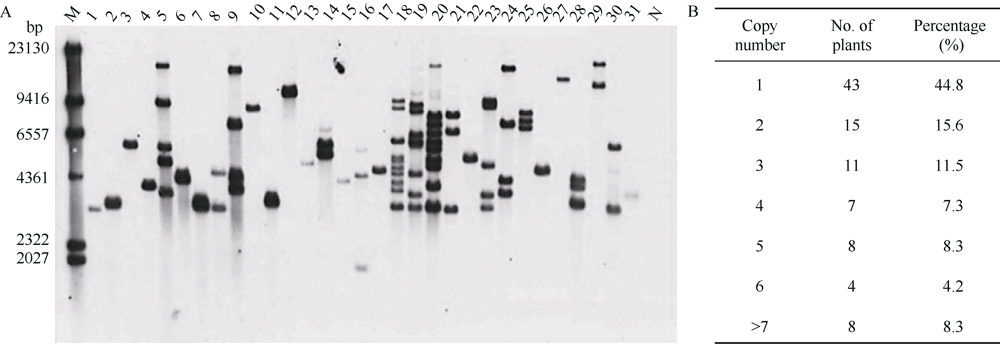
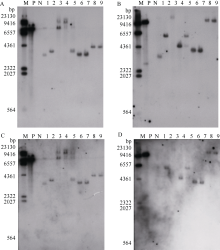
草甘膦是世界上应用最广泛的广谱性除草剂, 目前我国还没有自主知识产权的抗草甘膦油菜品种。本研究利用农杆菌介导的油菜下胚轴遗传转化方法, 将新型抗草甘膦基因I. variabilis EPSPS转入甘蓝型油菜品系J9707中, 获得了126株阳性转化株, 阳性率为97.0%。这些转化单株中的T-DNA插入以单拷贝为主(占44.8%)。通过反向PCR确定了EPS-2、EPS-6和EPS-7等油菜转化体中T-DNA插入位置, 并设计转化体特异性引物对它们的T0~T3代材料进行检测, 证明了它们的T-DNA在基因组水平上整合的稳定性。RNA和蛋白水平的表达分析证实, I. variabilis EPSPS转基因及其蛋白产物在各转化株系不同世代能够稳定表达。苗期进行不同剂量的除草剂喷施处理发现, EPS-1、EPS-2、EPS-5、EPS-6和EPS-7等株系可耐受4倍田间推荐使用剂量的草甘膦。本研究所创建的新型抗草甘膦油菜种质资源将为我国抗除草剂油菜品种培育奠定了重要基础。
| [1] | 王汉中. 我国油菜产业发展的历史回顾与展望. 中国油料作物学报, 2010,32:300-302. |
| Wang H Z. Historical review and prospect of rapeseed industry development in China. Chin J Oil Crop Sci, 2010,32:300-302 (in Chinese with English abstract). | |
| [2] | 官春云. 优质油菜生理生态和现代栽培技术. 北京: 中国农业出版社, 2013. pp 192-219. |
| Guan C Y. Physiological Ecology and Modern Cultivation Techniques of High-Quality Rapeseed. Beijing: China Agriculture Press, 2013. pp 192-219(in Chinese). | |
| [3] | Dill G M. Glyphosate-resistant crops: history, status and future. Pest Manage Sci, 2010,61:219-224. |
| [4] | 赵平. 2015年全球农药市场概况及发展趋势. 农药, 2017,56(2):79-85. |
| Zhao P. Overview and development trend of global pesticide market in 2015. Pesticide, 2017,56(2):79-85 (in Chinese with English abstract). | |
| [5] | Li H T, Li J J, Zhao B, Wang J, Yi L C, Liu C, Wu J S, King G J, Liu K D. Generation and characterization of tribenuron-methyl herbicide-resistant rapeseed ( Brasscia napus) for hybrid seed production using chemically induced male sterility. Theor Appl Genet, 2015,128:107-118. |
| [6] | 魏松红, 纪明山, 张希科, 孙桂玲. 应用诱变法筛选抗草甘膦水稻植株. 农药, 2006,45(11):43-44. |
| Wei S H, Ji M S, Zhang X K, Sun G L. Selection of glyphosate-resistant rice with mutation. Pesticide, 2006,45(11):43-44 (in Chinese with English abstract). | |
| [7] | 张俐俐, 谷维, 雷勃钧, 吕晓波, 李铁. 应用化学诱变法筛选抗草甘膦大豆突变株系. 大豆科学, 2009,28:938-940. |
| Zhang L L, Gu W, Lei B J, Lyu X B, Li T. Glyphosate resistant mutant strain of soybean filtered by chemomorphosis. Soybean Sci, 2009,28:938-940 (in Chinese with English abstract). | |
| [8] | Padgette S R, Kolacz K H, Delannay X, Re D B, LaVallee B J, Tinius C N, Rhodes W K, Otero Y I, Barry G F, Eichholtz D A. Development, identification, and characterization of a glyphosate-tolerant soybean line. Crop Sci, 1995,35:1451-1461. |
| [9] | Kahrizi D, Salmanian A H, Afshari A, Moieni A, Mousavi A. Simultaneous substitution of Gly96 to Ala and Ala183 to Thr in 5-enolpyruvylshikimate-3-phosphate synthase gene of E. coli (k12) and transformation of rapeseed (Brassica napus L.) in order to make tolerance to glyphosate. Plant Cell Rep, 2007,26:95-104. |
| [10] | Main C L, Jones M A, Murdock E C. Weed response and tolerance of enhanced glyphosate-resistant cotton to glyphosate. J Cotton Sci, 2007,11:104-109. |
| [11] | Green J M, Hale T, Pagano M A, Andreassi J L, Gutteridge S A. Response of 98140 corn with gat4621 and hra transgenes to glyphosate and ALS-inhibiting herbicides. Weed Sci, 2009,57:142-148. |
| [12] | Comai L, Facciotti D, Hiatt W R, Thompson G, Rose R E, Stalker D M. Expression in plants of a mount aroA gene from Salmonella typhimurium confers tolerance to glyphosate. Nature, 1985,317:741-744. |
| [13] | Barry G, Kishore G, Padgette S, Taylor M, Kolacz K, Weldon M, Re D, Fincher K, Hallas L. Inhibitors of amino acid biosynthesis: strategies for imparting glyphosate tolerance to crop plants. Curr Top Plant Physiol, 1992,7:139-145. |
| [14] | 陈家华, 潘良文, 沈禹飞, 胡永强, 陶军. 转基因抗草甘膦油菜籽中草甘膦氧化还原酶基因的检测方法研究. 中国油料作物学报, 2001,23:63-67. |
| Chen J H, Pan L W, Shen Y F, Hu Y Q, Tao J. Detection of glyphosate oxidoreductase gene in transgenic rapeseed resistant to glyphosate. Chin J Oil Crop Sci, 2001,23:63-67 (in Chinese with English abstract). | |
| [15] | Yang X, Li L, Jiang X Q, Wang W, Cai X X, Su J, Wang F, Lu B R. Genetically engineered rice endogenous 5-enolpyruvoylshikimate-3-phosphate synthase (EPSPS) transgene alters phenology and fitness of crop-wild hybrid offspring. Sci Rep, 2017,7:6834. |
| [16] | Li J, Meng X B, Zong Y, Chen K L, Zhang H W, Liu J X, Li J Y, Gao C X. Gene replacements and insertions in rice by intron targeting using CRISPR-Cas9. Nat Plants, 2016,2:139. |
| [17] | Aaron W H, Raj D C, Tomas C, Andrew M M, Anupama V, Adam B, Colby G S, Rebecca B, Daniel F V, Nigel J T. Allele exchange at the EPSPS locus confers glyphosate tolerance in cassava. Plant Biotechnol J, 2018,16:1275-1282. |
| [18] | Cui Y, Huang S Q, Liu Z D, Yi S Y, Zhou F, Chen H, Lin Y J. Development of novel glyphosate-tolerant japonica rice lines: a step toward commercial release. Front Plant Sci, 2016,7:1218. |
| [19] | 刘子铎, 易沭远, 林拥军, 张利莉, 吴高兵. 一种分离的5-烯醇丙酮莽草酸-3-磷酸合酶基因. CN103834674, 2016-2-23. |
| Liu Z Y, Yi M Y, Lin Y J, Zhang L L, Wu G B. A isolated 5- enolpyruvyl-shikimate-3-phosphate synthase gene. CN103834674, 2016-2-23 (in Chinese). | |
| [20] | Yi S Y, Wu G B, Lin Y J, Hu N, Liu Z D. Characterization of a new type of glyphosate-tolerant 5-enolpyruvyl shikimate-3- phosphate synthase from Isoptericola variabilis. J Mol Catal B Enzym, 2015,111:1-8. |
| [21] | Zhou Y, Wang H, Gilmer S, Whitwill S, Keller W, Fowke L C. Control of petal and pollen development by the plant cyclin- dependent kinase inhibitor ICK1 in transgenic Brassica plants. Planta, 2002,215:248-257. |
| [22] | 李杰华. 抗广谱性除草剂转基因油菜创制及抗性评价. 华中农业大学硕士学位论文, 湖北武汉, 2018. |
| Li J H. Development and Evaluation of Transgenic Rapeseed with Broad Spectrum Herbicide Resistant Gene. MS Thesis of Huazhong Agricultural University, Wuhan, Hubei, China, 2018 (in Chinese with English abstract). | |
| [23] | Fan C C, Wu Y D, Yang Q Y, Yang Y, Meng Q W, Zhang K Q, Li J G, Wang J F, Zhou Y M. A novel single-nucleotide mutation in a CLAVATA3 gene homologue controls a multilocular silique trait in Brassica rapa L. Mol Plant, 2014,7:1788-1792. |
| [24] | Dong Y F, Jin X, Tang Q L, Zhang X, Yang J T, Liu X J, Cai J F, Zhang X B, Wang X J, Wang Z X. Development and event-specific detection of transgenic glyphosate-resistant rice expressing the G2-EPSPS gene. Front Plant Sci, 2017,8:885. |
| [1] | 马毅娜, 吴晓明玉, 李藕琪, 王圆, 陈丽, 张盈川, 赵伦, 文静, 傅廷栋, 沈金雄. Bna-miR1040-EIF3A模块调控油菜开花时间的功能研究[J]. 作物学报, 2026, 52(2): 349-362. |
| [2] | 许忆葳, 张莹莹, 李瑞, 燕永亮, 刘允军, 孔照胜, 郑军, 王逸茹. 戈壁异常球菌csp2基因提高玉米的抗旱性[J]. 作物学报, 2025, 51(8): 1981-1990. |
| [3] | 王彬, 蒙姜宇, 邱浩良, 贺亚军, 钱伟. 甘蓝型油菜BnaDUF579基因家族的鉴定与表达模式分析[J]. 作物学报, 2025, 51(8): 2100-2110. |
| [4] | 夏琦, 郭滢, 王坤美, 王思忆, 巨建业, 彭雅雯, 刘忠松, 夏石头. 甘蓝型油菜种子和种皮中水杨酸含量与原花色素积累的关系研究[J]. 作物学报, 2025, 51(5): 1189-1197. |
| [5] | 王晓琳, 刘忠松, 康雷, 杨柳. 甘蓝型油菜角果长度和每角粒数基因定位以及角果皮转录组动态分析[J]. 作物学报, 2025, 51(4): 888-899. |
| [6] | 张琴, 戴成, 马朝芝. 生长素响应报告基因转化甘蓝型油菜及各组织GUS动态信号分析[J]. 作物学报, 2025, 51(3): 667-675. |
| [7] | 孙程明, 周晓婴, 陈锋, 张维, 王晓东, 彭琦, 郭月, 高建芹, 胡茂龙, 付三雄, 张洁夫. 长链非编码RNA (lncRNA)在甘蓝型油菜分枝角度调控中的功能分析与预测[J]. 作物学报, 2025, 51(3): 559-567. |
| [8] | 黄绒, 周渠晨, 陈楚铭, 罗倩, 易东, 杜常欢, 黄祥宇, 盛锋, 杜雪竹. 过表达BnNRT2.3-like对油菜氮素吸收利用及产量的影响[J]. 作物学报, 2025, 51(12): 3184-3197. |
| [9] | 巨建业, 杨柳, 陈浩, 康雷, 夏石头, 刘忠松. 单细胞核转录组分析揭示油菜种皮分化过程和种子颜色差异原因[J]. 作物学报, 2025, 51(11): 2860-2874. |
| [10] | 张雯, 李玉, 王创, 石磊, 丁广大. 甘蓝型油菜磷转运蛋白BnaPT48的功能研究[J]. 作物学报, 2025, 51(11): 2983-2995. |
| [11] | 胡志康, 舒雨, 王会, 杨莹莹, 廖俊宇, 刘佳, 成洪涛, 郭晨, 张园园, 刘胜毅, 胡琼, 梅德圣, 李超. 甘蓝型油菜苗期耐碱性种质综合鉴定与评价[J]. 作物学报, 2025, 51(10): 2681-2692. |
| [12] | 李威, 朱玉鹏, 孙宾成, 温有祥, 吴宗声, 徐一帆, 宋雯雯, 徐彩龙, 吴存祥. 转基因大豆结合免耕平作实现东北地区大豆生产轻简化[J]. 作物学报, 2025, 51(10): 2738-2749. |
| [13] | 王晨, 贺丹, 姚敏, 邱萍, 何昕, 熊兴华, 康雷, 刘忠松, 钱论文. 基于转录组分析鉴定甘蓝型油菜开花候选基因以及BnaCOR27功能验证[J]. 作物学报, 2025, 51(10): 2693-2704. |
| [14] | 徐林珊, 郜耿东, 王宇, 王家星, 杨吉招, 武亚瑞, 张宵寒, 常影, 李真, 谢雄泽, 龚德平, 王晶, 葛贤宏. 甘蓝型油菜漆酶基因家族成员表达模式及与茎秆抗折力的关联分析[J]. 作物学报, 2025, 51(1): 134-148. |
| [15] | 李嘉欣, 黄莹, 吴潞梅, 赵伦, 易斌, 马朝芝, 涂金星, 沈金雄, 傅廷栋, 文静. 甘蓝型油菜BnaSLY1基因进化分析及功能研究[J]. 作物学报, 2025, 51(1): 44-57. |
|
||