欢迎访问作物学报,今天是
作物学报 ›› 2022, Vol. 48 ›› Issue (10): 2533-2545.doi: 10.3724/SP.J.1006.2022.14183
贾小霞1,2( ), 齐恩芳1,2, 马胜1,2, 黄伟1,2, 郑永伟1,2, 白永杰1,2, 文国宏1,2,*()
JIA Xiao-Xia1,2(), QI En-Fang1,2, MA Sheng1,2, HUANG Wei1,2, ZHENG Yong-Wei1,2, BAI Yong-Jie1,2, WEN Guo-Hong1,2,*()
摘要:
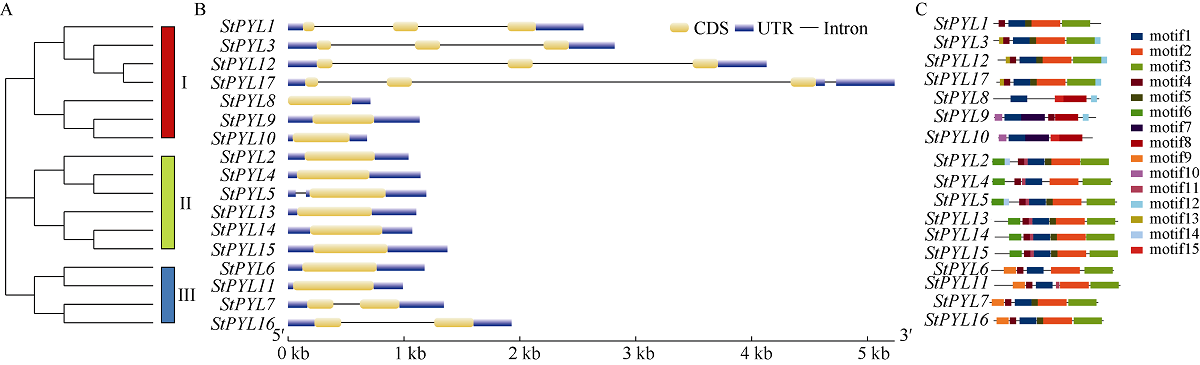
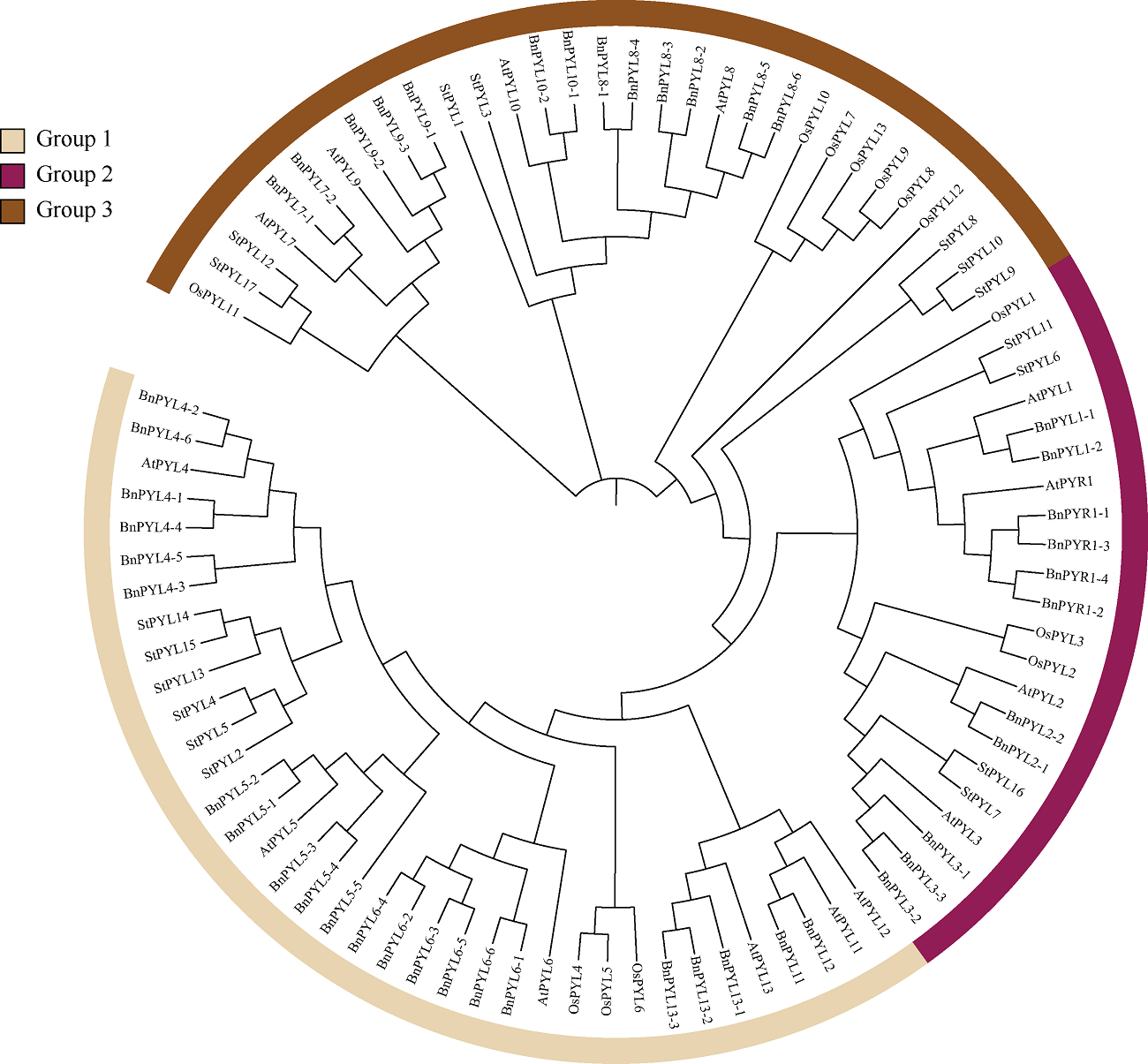
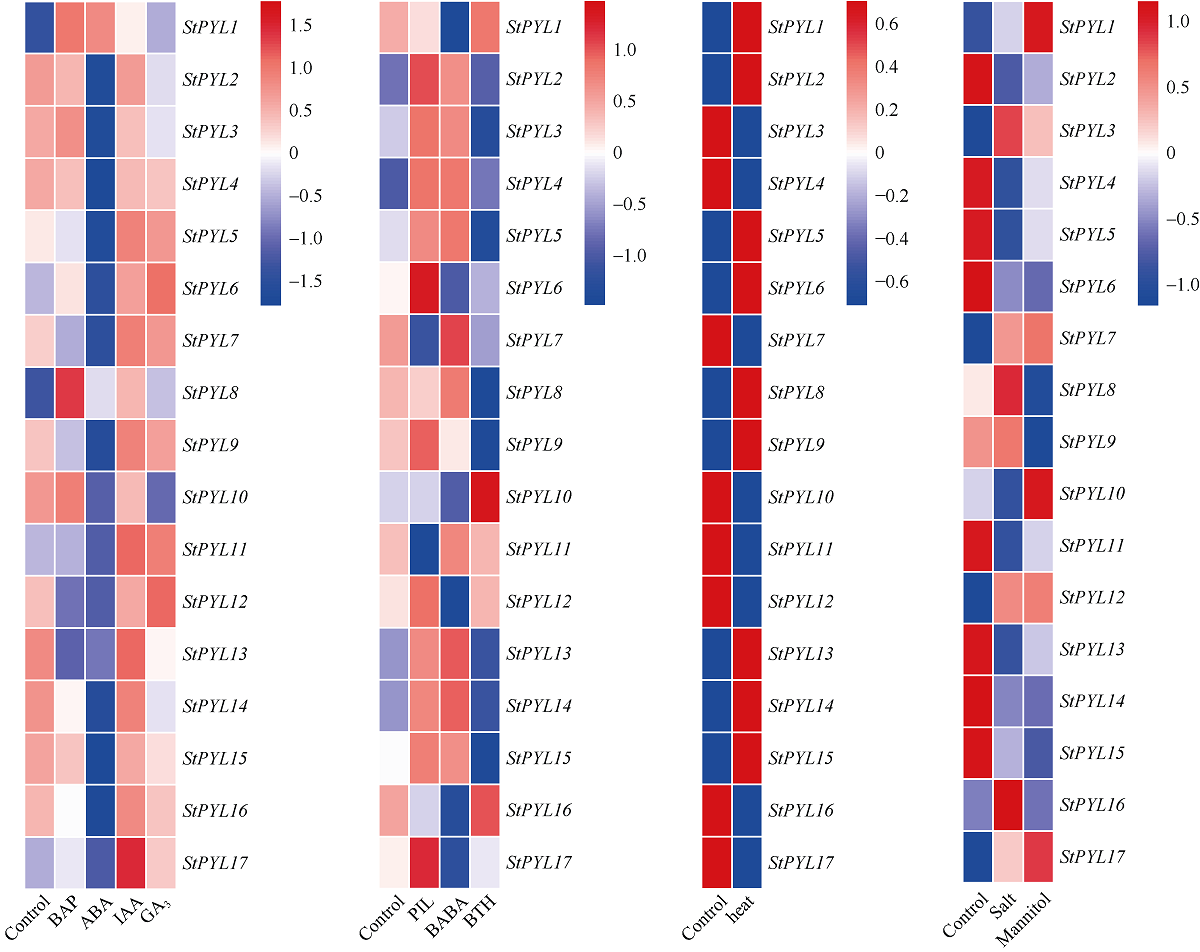
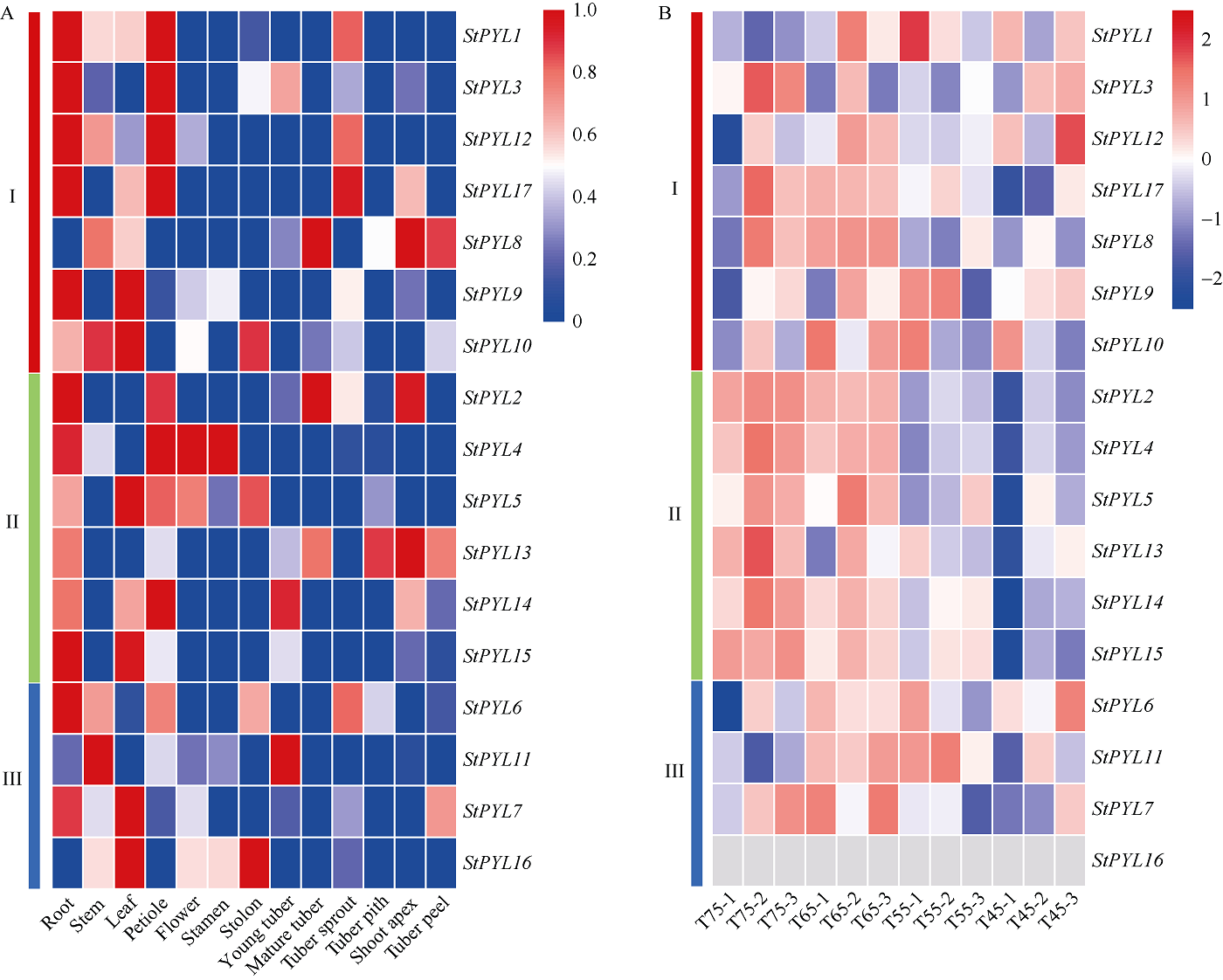
作为关键信号分子, 脱落酸(ABA)通过其核心信号通路PYLs-PP2Cs-SnRK2s广泛调控植物的生长发育和逆境响应过程, PYLs蛋白作为ABA信号传导的核心组件, 在ABA信号传导中发挥着不可替代的作用。为探究PYLs (PYR/PYL/RCARs) 基因在马铃薯中的进化以及表达模式, 本研究从马铃薯全基因组‘DM-v 6.1’共鉴定到17个StPYLs基因, 并对其分布、蛋白理化性质、系统进化、基因结构特征以及基因表达模式进行了分析。结果表明, 17个StPYLs基因不均匀分布在8条染色体上, 其氨基酸大小在163~231 aa之间, 等电点在4.5~8.6之间, 相对分子量在18.71~25.29 kD之间。根据基因结构和蛋白的系统发育特征, StPYL家族成员共分为3个亚组, motif 1存在于本家族所有基因中, 说明它在StPYLs的进化过程中较为保守。基因表达模式分析表明, StPYL家族成员具有明显的组织表达特异性, 且除StPYL1在外源激素(BAP、ABA和IAA)和非生物胁迫(高温、盐和干旱)下均上调表达外, 其余基因存在功能分化, 不同胁迫下的表达模式各异。本研究结果为进一步阐明StPYLs基因在马铃薯中的功能奠定了理论基础。
| [1] | 禄兴丽, 段雅欣, 李闪闪, 岳衡, 吴佳瑞, 刘继虎, 康建宏. 覆膜对半干旱地区马铃薯生长生理性状及作物产量的影响. 植物生理学报, 2021, 57: 1582-1594. |
| Lu X L, Duan Y X, Li S S, Yue H, Wu J R, Liu J H, Kang J H. Effect of film mulching on potato physiological characters and production in semi-arid area. Plant Physiol J, 2021, 57: 1582-1594. (in Chinese with English abstract) | |
| [2] | 秦军红, 张婷婷, 孟丽丽, 徐建飞, 蒙美莲, 金黎平. 引进马铃薯种质资源抗旱性评价. 植物遗传资源学报, 2019, 20: 574-582. |
| Qin J H, Zhang T T, Meng L L, Xu J F, Meng M L, Jin L P. Evaluation of drought tolerance in exotic potato germplasm. J Plant Genet Resour, 2019, 20: 574-582. (in Chinese with English abstract) | |
| [3] |
Yamaguchi T, Blumwald E. Developing salt-tolerant crop plants: challenges and opportunities. Trends Plant Sci, 2018, 10: 615-620.
doi: 10.1016/j.tplants.2005.10.002 |
| [4] | 邵宏波, 梁宗锁, 邵明安. 小麦抗旱生理生化和分子生物学研究进展与趋势. 草业学报, 2006, 15(3): 5-17. |
| Shao H B, Liang Z S, Shao M A. Progress and trends in the study of anti-drought physiology and biochemistry, and molecular biology of Triticum aestivum. Acta Pratac Sin, 2006, 15(3): 5-17. (in Chinese with English abstract) | |
| [5] |
Neil S, Barros R, Bright J, Desikan R, Hancock J, Harrison J, Morris P, Ribeiro D, Wilson L. Nitric oxide, stomatal closure, and abiotic stress. J Exp Bot, 2008, 59: 165-176.
doi: 10.1093/jxb/erm293 |
| [6] | Sirichandra C, Davanture M, Turk B E, Zivy M, Valot B, Leung J, Merlot S. The Arabidopsis ABA-activated kinase OST1 phosphorylates the bZIP transcription factor ABF3 and creates a 14-3-3 binding site involved in its turnover. PLoS One, 2010, 5: e13935. |
| [7] |
Hubbard K E, Nishimura N, Hitomi K, Getzoff E D, Schroeder J I. Early abscisic acid signal transduction mechanisms: newly discovered components and newly emerging questions. Gene Dev, 2010, 24: 1695-1708.
doi: 10.1101/gad.1953910 |
| [8] |
Umezawa T, Sugiyama N, Mizoguchi M, Hayashi S, Myouga F, Yamaguchi-Shinozaki K, Ishihama Y, Hirayama T, Shinozaki K R, Ecker J. Type 2C protein phosphatases directly regulate abscisic acid-activated proteinkinases in Arabidopsis. Proc Natl Acad Sci USA, 2009, 106: 17588-17593.
doi: 10.1073/pnas.0907095106 |
| [9] |
Zhu J K. Abiotic stress signaling and responses in plants. Cell, 2016, 167: 313-324.
doi: 10.1016/j.cell.2016.08.029 |
| [10] |
Pizzio G A, Rodriguez L, Antoni R, Gonzalez-Guzman M, Yunta C, Merilo E, Kollist H, Albert A, Rodriguez P L. The PYL4 A194T mutant uncovers a key role of PYR1-LIKE4/PROTEIN PHOSPHATASE 2CA interaction for abscisic acid signaling and plant drought resistance. Plant Physiol, 2013, 163: 441-455.
doi: 10.1104/pp.113.224162 |
| [11] |
Kim H, Lee K, Wang H, Bhatnagar N, Kim D Y, Yoon I S, Byun M O, Kim S T, Jung K H, Kim B G. Over-expression of PYL5 in rice enhances drought tolerance, inhibits growth, and modulates gene expression. J Exp Bot, 2014, 65: 453-464.
doi: 10.1093/jxb/ert397 |
| [12] | 徐冰瑶. 苹果MdPYL9基因在干旱胁迫下的功能研究. 西北农林科技大学硕士学位论文, 陕西杨凌, 2019. |
| Xu B Y. Functional Study of MdPYL9Gene under Drought Stress in Malus. MS Thesis of Northwest A&F University, Yangling, Shaanxi, China, 2019. (in Chinese with English abstract) | |
| [13] | 赵仕荣, 杨江伟, 唐勋, 张宁, 文义凯, 周香艳, 司怀军. 马铃薯脱落酸受体StPYR1基因生物信息学分析及过表达载体构建. 分子植物育种, 2018, 16: 309-7314. |
| Zhao S R, Yang J W, Tang X, Zhang N, Wen Y K, Zhou X Y, Si H J. Bioinformatics analysis and over expression vector construction of abscisic acid receptor StPYR1 gene in potato. Mol Plant Breed, 2018, 16: 7309-7314. (in Chinese with English abstract) | |
| [14] | 徐玉伟, 印敬明, 白潇, 史珂, 杨清. 马铃薯StPYL1和StPYL8基因的分子克隆与表达分析. 江苏农业学报, 2015, 31(1): 23-31. |
| Xu Y W, Yin J M, Bai X, Shi K, Yang Q. Molecular cloning and expression analysis of potato StPYL1 and StPYL8 genes. Jiangsu J Agric Sci, 2015, 31(1): 23-31 (in Chinese with English abstract). | |
| [15] |
Bjellqvist B, Hughes G J, Pasquali C, Paquet N, Ravier F, Sanchez J C, Frutiger S, Hochstrasser D. The focusing positions of polypeptides in immobilized pH gradients can be predicted from their amino acid sequences. Electrophoresis, 1993, 14: 1023-1031.
pmid: 8125050 |
| [16] | Gasteiger E, Hoogland C, Gattiker A, Duvaud S, Wilkins M R, Appel R D, Bairoch A. Protein identification and analysis tools on the ExPASy server. Proteomics Protocol Handbook, 2005, 53: 571-607. |
| [17] | 郭安源, 朱其慧, 陈新, 罗静初. GSDS: 基因结构显示系统. 遗传, 2007, 29: 1023-1026. |
| Guo A Y, Zhu Q H, Chen X, Luo J C. GSDS: a gene structure display server. Hereditas (Beijing), 2007, 29: 1023-1026. (in Chinese with English abstract) | |
| [18] | Bailey T L, Mikael B, Buske F A, Martin F, Grant C E, Luca C, Ren J, Li W W, Noble W S. MEME Suite: tools for motif discovery and searching. Nucleic Acids Res, 2009, 37: 202-208. |
| [19] |
Sudhir K, Glen S, Koichiro T. MEGA7: molecular evolutionary genetics analysis version 7.0 for bigger datasets. Mol Biol Evol, 2016, 33: 1870-1874.
doi: 10.1093/molbev/msw054 pmid: 27004904 |
| [20] | Chow C N, Lee T Y, Hung Y C, Li G Z, Tseng K C, Liu Y H, Kuo P L, Zheng H Q, Chang W C. PlantPAN3.0: a new and updated resource for reconstructing transcriptional regulatory networks from ChIP-seq experiments in plants. Nucleic Acids Res, 2018, 47: D1155-D1163. |
| [21] | Zhao Y, Xing L, Wang X, Hou Y J, Gao J, Wang P, Duan C G, Zhu X, Zhu J K. The ABA receptor PYL8 promotes lateral root growth by enhancing MYB77-dependent transcription of auxin-responsive genes. Sci Signal, 2014, 7: ra53. |
| [22] |
Dittrich M, Mueller H M, Bauer H, Peirats-Llobet M, Rodriguez P L, Geilfus C M, Carpentier S C, Al Rasheid K A S, Kollist H, Merilo E. The role of Arabidopsis ABA receptors from the PYR/PYL/RCAR family in stomatal acclimation and closure signal integration. Nat Plants, 2019, 5: 1002-1011.
doi: 10.1038/s41477-019-0490-0 pmid: 31451795 |
| [23] | Kumar R, Vinjamuri V, Santosh V, Shashank K, Yadav K. Overexpression of ABA receptor PYL10 gene confers drought and cold tolerance to Indica rice. Front Plant Sci, 2019, 10: 1488. |
| [24] | Kumar V V S, Yadav S K, Verma R K, Shrivastava S, Ghimire O, Pushkar S, Rao M V, Kumar T S, Chinnusamy V. The abscisic acid receptor OsPYL6 confers drought tolerance to indica rice through dehydration avoidance and tolerance mechanisms. J Exp Bot, 2021, 4: 1411-1431. |
| [25] | Di F, Jian H, Wang T, Chen X, Ding Y, Du H, Lu K, Li J, Liu L. Genome-wide analysis of the PYL gene family and identification of PYL genes that respond to abiotic stress in Brassica napus. Genes, 2018, 9: 156. |
| [26] |
Yun C, Li F, Wei N, Liu Z H, Shan H, Li X B. Overexpression of cotton PYL genes in Arabidopsis enhances the transgenic plant tolerance to drought stress. Plant Physiol Biochem, 2017, 115: 229-238.
doi: 10.1016/j.plaphy.2017.03.023 |
| [27] |
Ma Y, Szostkiewicz I, Korte A, Moes D, Yi Y, Cristmann A, Grill E. Regulators of PP2C phosphatase activity function as abscisic acid sensors. Science, 2009, 324: 1064-1068.
doi: 10.1126/science.1172408 |
| [28] | Tian X, Wang Z Y, Li X F, Lv T X, Liu H Z, Wang L Z, Niu H B, Bu Q Y. Characterization and functional analysis of pyrabactin resistance-like abscisic acid receptor family in rice. Rice, 2015, 8: 28. |
| [29] | 王帅磊, 李子琪, 陈辉龙, 吴蒙, 葛伟娜. 谷子PYR/PYL/ RCAR基因家族进化及表达分析. 分子植物育种, 2020, 18: 5544-5554. |
| Wang S L, Li Z Q, Chen H L, Wu M, Ge W N. Evolution and expression analysis of the PYR/PYL/RCAR gene family in Setaria italica. Mol Plant Breed, 2020, 18: 5544-5554. (in Chinese with English abstract) | |
| [30] |
Boneh U, Biton I, Zheng C, Schwartz A, Ben-Ari G. Characterization of potential ABA receptors in Vitis vinifera. Plant Cell Rep, 2012, 31: 311-321.
doi: 10.1007/s00299-011-1166-z pmid: 22016084 |
| [31] | 靳容, 蒋薇, 刘明, 赵鹏, 张强强, 李铁鑫, 王丹凤, 范文静, 张爱君, 唐忠厚. 甘薯Dof基因家族挖掘及表达分析. 作物学报, 2021, 48: 608-623. |
| Jin R, Jiang W, Liu M, Zhao P, Zhang Q Q, Li T X, Wang D F, Fan W J, Zhang A J, Tang Z H. Genome-wide characterization and expression analysis of Dof family genes in sweetpotato. Acta Agron Sin, 2021, 48: 608-623. (in Chinese with English abstract) | |
| [32] |
Bai G, Xie H, Yao H. Genome-wide identification and characterization of ABA receptor PYL/RCAR gene family reveals evolution and roles in drought stress in Nicotiana tabacum. BMC Genomics, 2019, 20: 575-583.
doi: 10.1186/s12864-019-5839-2 pmid: 31296158 |
| [33] |
Ma J Q, Jian H J, Yang B, Lu K, Zhang A X, Liu P, Li J N. Genome-wide analysis and expression profiling of the GRF gene family in oilseed rape (Brassica napus L.). Gene, 2017, 620: 36-45.
doi: 10.1016/j.gene.2017.03.030 |
| [34] | 赵夏云, 鲜登宇, 宋明, 汤青林. MIKC型MADS-box蛋白对开花调控作用研究进展. 生物技术通报, 2014, (7): 8-15. |
| Zhao X Y, Xian D Y, Song M, Tang Q L. Research progress of MIKC-type MADS-box protein regulation on flowering. Biotechnol Bull, 2014, (7): 8-15. (in Chinese with English abstract) | |
| [35] |
Wei P C, Tan F, Gao X Q, Zhang X Q, Wang G Q, Xu H, Li L J, Chen J, Wang X C. Overexpression of AtDOF4.7, an Arabidopsis DOF family transcription factor, induces floral organ abscission deficiency in Arabidopsis. Plant Physiol, 2010, 153: 1031-1045.
doi: 10.1104/pp.110.153247 |
| [36] |
Qin H, Wang J, Chen X B, Wang F F, Peng P, Zhou Y, Miao Y C, Zhang Y Q, Gao Y D, Qi Y D, Zhou J H, Huang R F. Rice OsDOF15 contributes to ethylene-inhibited primary root elongation under salt stress. New Phytol, 2019, 223: 798-813.
doi: 10.1111/nph.15824 pmid: 30924949 |
| [37] |
Gonzales L R, Shi L, Bergonzi S B, Oortwijn M, Franco-Zorrilla J M, Solano-Tavira R, Visser R G F, Abelenda J A, Bachem C W B. Potato CYCLING DOF FACTOR 1 and its lncRNA counterpart StFLORE link tuber development and drought response. Plant J, 2021, 105: 855-869.
doi: 10.1111/tpj.15093 |
| [38] |
Noman A, Liu Z Q, Yang S, Shen L, Hussain A, Ashraf M F, Khan M I, He S. Expression and functional evaluation of CaZNF830 during pepper response to Ralstonia solanacearum or high temperature and humidity. Microb Pathog, 2018, 118: 336-346.
doi: 10.1016/j.micpath.2018.03.044 |
| [39] | 张爱冬. 拟南芥C2H2型锌指蛋白ZFP5同源基因ZFP3、ZFP1和ZFP7的克隆及功能验证. 浙江大学博士学位论文, 浙江杭州, 2016. |
| Zhang A D. Cloning and Functional Analysis of C2H2 Zinc Finger Protein ZFP5 Homologous Gene ZFP3, ZFP1 and ZFP7 in Arabidopsis thaliana. PhD Dissertation of Zhejiang University, Hangzhou, Zhejiang, China, 2016 (in Chinese with English abstract). | |
| [40] | 钟婵娟, 彭伟业, 王冰, 刘世名, 戴良英, 李魏. 植物逆境响应相关的C2H2型锌指蛋白研究进展. 植物生理学报, 2020, 56: 2356-2366. |
| Zhong C J, Peng W Y, Wang B, Liu S, Dai L Y, Li W. Advances of plant C2H2 zinc finger proteins in response to stresses. Plant Physiol J, 2020, 56: 2356-2366 (in Chinese with English abstract). | |
| [41] |
Ramya M, Kwon O K, An H R, Park P M, Baek Y S, Park P H. Floral scent: regulation and role of MYB transcription factors. Phytochem Lett, 2017, 19: 114-120.
doi: 10.1016/j.phytol.2016.12.015 |
| [42] | Lau S E, Schwarzacher T, Othman R Y, Harikrishna J A. dsRNA silencing of an R2R3-MYB transcription factor affects flower cell shape in a Dendrobium hybrid. BMC Plant Biol, 2015, 15: 194. |
| [43] | 王鸿雪, 刘天宇, 庄维兵, 王忠, 朱林, 渠慎春, 翟恒华. 花青素苷在植物逆境响应中的功能研究进展. 农业生物技术学报, 2020, 28(1): 174-183. |
| Wang H X, Liu T Y, Zhuang W B, Wang Z, Zhu L, Qu S C, Zhai H H. Research advances in the function of anthocyanin in plant stress response. J Agric Biotechnol, 2020, 28(1): 174-183. (in Chinese with English abstract) | |
| [44] | Shang X G, Yu Y J, Zhu L J, Liu H Q, Chai Q C, Guo W Z. A cotton NAC transcription factor GhirNAC2 plays positive roles in drought tolerance via regulating ABA biosynthesis. Plant Sci, 2020, 296: 110498. |
| [45] | 代春艳, 张笑晗, 王晓丽, 弓琼, 苏醒, 成耀华, 张明政, 于澄宇. 芥菜bZIP基因家族的鉴定和表达分析. 分子植物育种, 2021, https://kns.cnki.net/kcms/detail/46.1068.S.20210701.1838.006.html. |
| Dai C Y, Zhang X H, Wang X L, Gong Q, Su X, Cheng Y H, Zhang M Z, Yu C Y. Identification and expression analysis of bZIP gene family in Brassica juncea. Mol Plant Breed, 2021, https://kns.cnki.net/kcms/detail/46.1068.S.20210701.1838.006.html. (in Chinese with English abstract) |
| [1] | 陈国欢, 张锐, 李艳迪, 赵佳琪, 任湧涛, 张天赐, 郭华春, 李俊, 杨芳. 外源硒叶面喷施对浅紫色马铃薯块茎花青素合成的影响[J]. 作物学报, 2026, 52(6): 1876-1890. |
| [2] | 王文辕, 燕雪嘉, 刘玉霖, 孙晓彤, 李亚楠, 唐鑫华, 石瑛. 耐弱光马铃薯品种筛选及转录因子编码基因StPIF3的克隆与功能分析[J]. 作物学报, 2026, 52(6): 1631-1645. |
| [3] | 田立涛, 丁宁, 王树林, 齐恩芳, 张荣, 王蕊蕊, 马利雯, 李建武, 杨江伟. 马铃薯Argonaute基因家族鉴定及晚疫病诱导表达分析[J]. 作物学报, 2026, 52(4): 1116-1126. |
| [4] | 张宇, 刘芳, 蔡诚诚, 杨小华, 吉阿么石扎, 杨元军, 王西瑶. 溴乙烷与赤霉素协同处理破除马铃薯块茎休眠的机理初探[J]. 作物学报, 2026, 52(3): 825-838. |
| [5] | 汪玲, 胡好, 宋家凤, 程洁蓝, 陈颖, 郑婷婷, 吕钊彦, 朱晓彪, 侯华兰. 马铃薯UDP-糖基转移酶基因StUGT52的克隆及功能验证[J]. 作物学报, 2026, 52(3): 665-676. |
| [6] | 徐强, 谢奎忠, 胡新元, 岳云, 董博, 罗爱花. 连作对马铃薯根际土壤线虫群落结构与功能的影响[J]. 作物学报, 2026, 52(2): 527-538. |
| [7] | 杨飚, 杜帅康, 张继旺, 石瑛, 张丽莉. 马铃薯III类POD基因家族的全基因组鉴定及其表达谱分析[J]. 作物学报, 2026, 52(2): 405-420. |
| [8] | 詹戈锐, 余文, 李锋, 武明珠, 徐馨, 罗朝鹏, 巫升鑫, 杨军, 张智强, 王中. 烟草NtWRKY6基因响应ABA表达及其调控多酚合成的功能研究[J]. 作物学报, 2026, 52(2): 446-458. |
| [9] | 王雅致, 杨飚, 季香林, 石瑛, 张丽莉. 二倍体马铃薯抗旱资源鉴定及抗旱基因初步筛选[J]. 作物学报, 2026, 52(1): 72-84. |
| [10] | 姬炫彤, 卞春松, 金黎平, 李森, 秦军红, 李广存. 不同耐旱型马铃薯根际微生物对干旱的响应[J]. 作物学报, 2026, 52(1): 165-177. |
| [11] | 田甲春, 葛霞, 李守强, 李梅, 田世龙, 张亚倩, 程建新, 李玉梅. 低O2高CO2贮藏环境延缓马铃薯块茎衰老的作用机制[J]. 作物学报, 2026, 52(1): 262-278. |
| [12] | 卓峰琦, 唐振三, 雷雨俊, 程李香, 赵甜甜, 吕汰, 杨晨, 张峰. 基于烹饪方式及回生温度筛选低升糖马铃薯品种(系)[J]. 作物学报, 2025, 51(9): 2538-2546. |
| [13] | 朱锦程, 杨秋华, 程李香, 李文丽, 石明明, 李惠霞, 张峰. 马铃薯抗南方根结线虫种质资源筛选及相关生理反应分析[J]. 作物学报, 2025, 51(9): 2307-2317. |
| [14] | 尹丽娜, 张锐, 陈国欢, 白磊, 李俊, 郭华春, 杨芳. 不同马铃薯品种块茎创伤愈合能力的比较[J]. 作物学报, 2025, 51(9): 2399-2411. |
| [15] | 贾小霞, 齐恩芳, 文国宏, 马胜, 黄伟, 吕和平, 李建武, 曲亚英, 丁宁. 中早熟马铃薯‘陇薯20号’高效再生体系建立及抗草铵膦种质创制[J]. 作物学报, 2025, 51(9): 2285-2294. |
|
||