欢迎访问作物学报,今天是
作物学报 ›› 2024, Vol. 50 ›› Issue (8): 1961-1970.doi: 10.3724/SP.J.1006.2024.33050
曹晓晴( ), 祁显涛, 刘昌林, 谢传晓()
CAO Xiao-Qing(), QI Xian-Tao, LIU Chang-Lin, XIE Chuan-Xiao()
摘要:
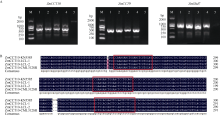
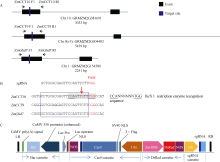
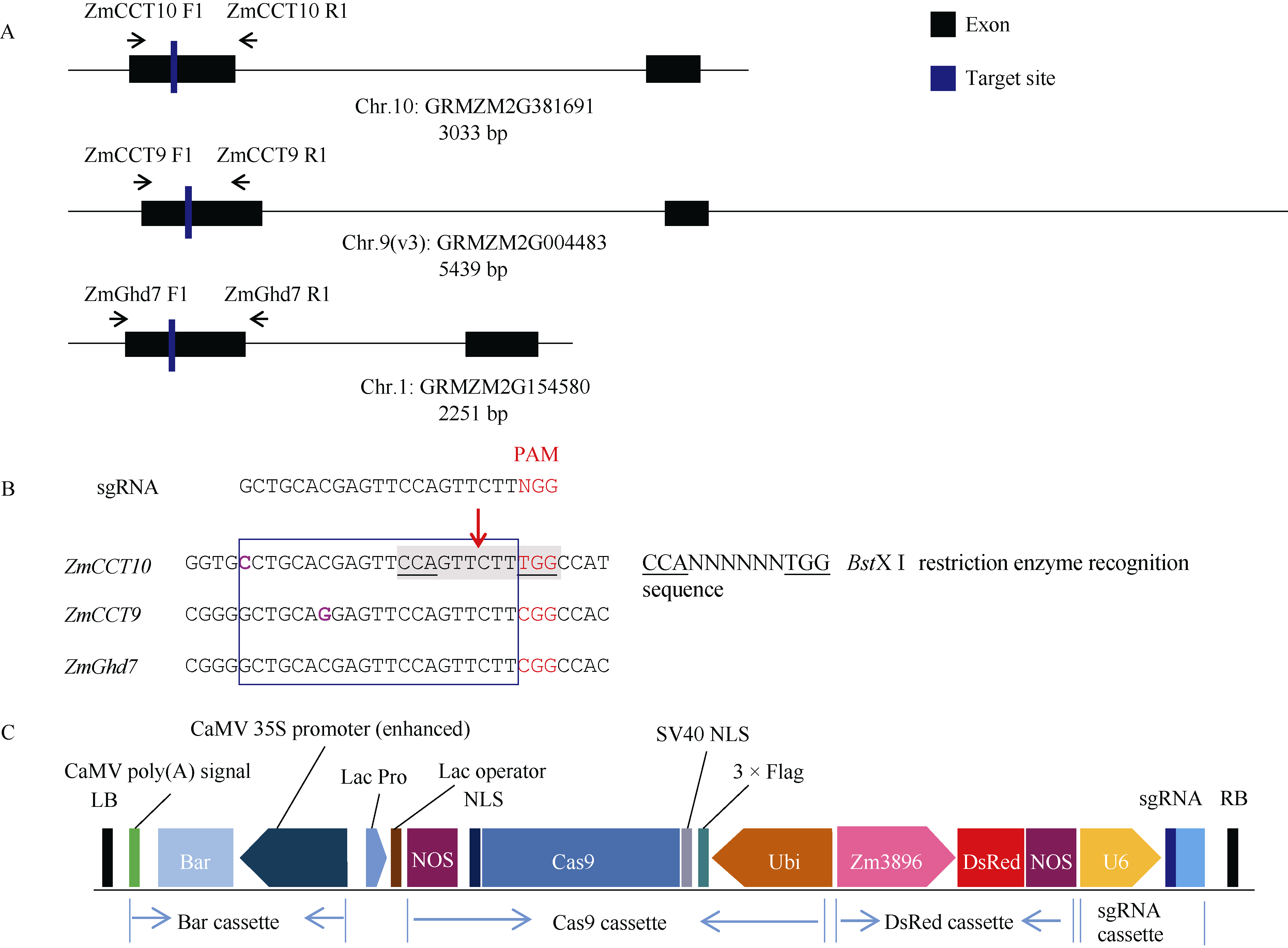
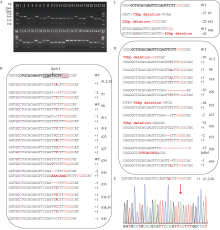
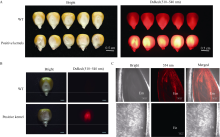
CCT家族基因影响植物开花, 在玉米中, ZmCCT10、ZmCCT9基因是光周期敏感基因, ZmGhd7基因是与开花期相关的基因。利用CRISPR/Cas9技术靶向编辑ZmCCT10、ZmCCT9、ZmGhd7基因为研究基因的功能和快速改良玉米的开花期提供了可能。本研究以玉米ZmCCT10、ZmCCT9、ZmGhd7基因为编辑对象, 以KN5585为稳定转化受体、以CML312SR、LCL-1、LCL-2为预改良的晚熟材料受体, 首先通过Sanger测序验证了3个基因靶标区域在4份玉米材料中的保守性, 其次根据sgRNA设计原则选择了1个sgRNA复合编辑3个基因, 并利用同源重组方法构建了将由胚特异性启动子Zm3896驱动的DsRed表达盒和由ZmU6-2启动子驱动的sgRNA表达盒串联的CRISPR/Cas9基因编辑敲除载体CCT-CPD, 然后采用酶切法和Sanger测序法分析T0代KN5585中3个基因的突变率和突变类型, 验证了该系统的基因编辑效果, 最后通过对稳定遗传转化植株所结籽粒在籽粒水平、组织水平进行DsRed荧光标记表型鉴定, 验证了该系统中DsRed荧光筛选标记的有效性。在此基础上, 通过杂交育种法以晚熟材料为母本、以T1代KN5585阳性株为父本获得F1并经过DsRed荧光筛选获得含有有效编辑转基因元件的晚熟材料。本研究构建的编辑ZmCCT10/ZmCCT9/ZmGhd7基因的串联DsRed荧光表达盒的CRISPR/Cas9系统为创制单基因突变体, 双基因突变体, 三基因突变体奠定了基础, 该系统中DsRed荧光筛选标记的应用可以快速筛选区分有无转基因成分的玉米籽粒, 成本低, 鉴定效率高, 具有大规模籽粒筛选的潜力, 本研究为鉴定ZmCCT10、ZmCCT9、ZmGhd7三个基因的功能和创制玉米光周期钝感材料奠定了材料基础和高效的技术基础。
| [1] | 徐雷, 贾飞飞, 王利琳. 拟南芥开花诱导途径分子机制研究进展. 西北植物学报, 2011, 31: 1057-1065. |
| Xu L, Jia F F, Wang L L. Progresses on molecular mechanisms of flowering transition in Arabidopsis. Acta Bot Boreali-Occident Sin, 2011, 31: 1057-1065 (in Chinese with English abstract). | |
| [2] | Hung H Y, Shannon L M, Tian F, Bradbury P J, Chen C, Garcia S A F, McMullen M D, Ware D, Buckler E S, Doebley J F, Holland J B. ZmCCT and the genetic basis of day-length adaptation underlying the post domestication spread of maize. Proc Natl Acad Sci USA, 2012, 109: 1913-1921. |
| [3] | Jin M L, Liu X G, Jia W, Liu H J, Li W Q, Peng Y, Du Y F, Wang Y B, Yin Y J, Zhang X H, Liu Q, Deng M, Li N, Cui X Y, Hao D Y, Yan J B. ZmCOL3, a CCT gene represses flowering in maize by interfering with the circadian clock and activating expression of ZmCCT. J Integr Plant Biol, 2018, 60: 465-480. |
| [4] | Xue W Y, Xing Y Z, Weng X Y, Zhao Y, Tang W J, Wang L, Zhou H J, Yu S B, Xu C G, Li X H, Zhang Q F. Natural variation in Ghd7 is an important regulator of heading date and yield potential in rice. Nat Genet, 2008, 40: 761-767. |
| [5] | Meng X, Muszynski M G, Danilevskaya O N. The FT-like ZCN8 gene functions as a floral activator and is involved in photoperiod sensitivity in maize. Plant Cell, 2011, 23: 942-960. |
| [6] |
Yang Q, Li Z, Li W Q, Ku L X, Wang C, Ye J R, Li K, Yang N, Li Y P, Zhong T, Li J S, Chen Y H, Yan J B, Yang X H, Xu M L. CACTA-like transposable element in ZmCCT attenuated photoperiod sensitivity and accelerated the post domestication spread of maize. Proc Natl Acad Sci USA, 2013, 110: 16969-16974.
doi: 10.1073/pnas.1310949110 pmid: 24089449 |
| [7] | Huang C, Sun H Y, Xu D Y, Chen Q Y, Liang Y M, Wang X F, Xu G H, Tian J G, Wang C L, Li D, Wu L S, Yang X H, Jin W W, Doebley J F, Tian F. ZmCCT9 enhances maize adaptation to higher latitudes. Proc Natl Acad Sci USA, 2018, 115: 334-341. |
| [8] | Jamann T M, Sood S, Wisser R J, Holland J B. High-throughput resequencing of maize landraces at genomic regions associated with flowering time. PLoS One, 2017, 12: e0168910. |
| [9] |
郭栋, 杜媚, 周宝元, 高卓晗, 曹哲统, 赵明. 玉米CCT基因家族的鉴定与生物信息学分析. 植物遗传资源学报, 2019, 20: 1001-1010.
doi: 10.13430/j.cnki.jpgr.20181107001 |
| Guo D, Du M, Zhou B Y, Gao Z H, Cao Z T, Zhao M. Identification and bioinformatic analysis of maize CCT gene family. J Plant Genet Resour, 2019, 20: 1001-1010 <br (in Chinese with English abstract). | |
| [10] |
Zhang H, Zhang J S, Wei P L, Zhang B T, Gou F, Feng Z Y, Mao Y F, Yang L, Zhang H, Xu N F, Zhu J K. The CRISPR/Cas9 system produces specific and homozygous targeted gene editing in rice in one generation. Plant Biotechnol J, 2014, 12: 797-807.
doi: 10.1111/pbi.12200 pmid: 24854982 |
| [11] | Zeng D C, Liu T L, Ma X L, Wang B, Zheng Z Y, Zhang Y L, Xie X R, Yang B W, Zhao Z, Zhu Q L, Liu Y G. Quantitative regulation of Waxy expression by CRISPR/Cas9-based promoter and 5'UTR-intron editing improves grain quality in rice. Plant Biotechnol J, 2020, 18: 2385. |
| [12] |
Wang Y P, Cheng X, Shan Q W, Zhang Y, Liu J X, Gao C X, Qiu J L. Simultaneous editing of three homoeoalleles in hexaploid bread wheat confers heritable resistance to powdery mildew. Nat Biotechnol, 2014, 32: 947-953.
doi: 10.1038/nbt.2969 pmid: 25038773 |
| [13] | Zhang S J, Zhang R Z, Gao J, Gu T T, Song G Q, Li W, Li D D, Li Y L, Li Y G. Highly efficient and heritable targeted mutagenesis in wheat via the Agrobacterium tumefaciens-mediated CRISPR/Cas9 system. Int J Mol Sci, 2019, 20: 4257. |
| [14] |
Jacobs T B, LaFayette P R, Schmitz R J, Parrott W A. Targeted genome modifications in soybean with CRISPR/Cas9. BMC Biotechnol, 2015, 15: 16.
doi: 10.1186/s12896-015-0131-2 pmid: 25879861 |
| [15] |
Wang L W, Sun S, Wu T T, Liu L P, Sun X G, Cai Y P, Li J C, Jia H C, Yuan S, Chen L, Jiang B J, Wu C X, Hou W S, Han T F. Natural variation and CRISPR/Cas9-mediated mutation in GmPRR37 affect photoperiodic flowering and contribute to regional adaptation of soybean. Plant Biotechnol J, 2020, 18: 1869-1881.
doi: 10.1111/pbi.13346 pmid: 31981443 |
| [16] | Li C X, Liu C L, Qi X T, Wu Y C, Fei X H, Mao L, Cheng B J, Li X H, Xie C X. RNA-guided Cas9 as an in vivo desired-target mutator in maize. Plant Biotechnol J, 2017, 15: 1566-1576. |
| [17] |
Dong L, Qi X T, Zhu J J, Liu C L, Zhang X, Cheng B J, Mao L, Xie C X. Supersweet and waxy: meeting the diverse demands for specialty maize by genome editing. Plant Biotechnol J, 2019, 17: 1853.
doi: 10.1111/pbi.13144 pmid: 31050154 |
| [18] | Yifhar T, Pekker I, Peled D, Friedlander D, Pistunov A, Sabban M, Wachsman G, Alvarez J P, Amsellem Z, Eshed Y. Failure of the tomato trans-acting short interfering RNA program to regulate AUXIN RESPONSE FACTOR3 and ARF4 underlies the wiry leaf syndrome. Plant Cell, 2012, 24: 3575-3589. |
| [19] |
Ma X L, Zhang Q Y, Zhu Q L, Liu W, Chen Y, Qiu R, Wang B, Yang Z F, Li H Y, Lin Y R, Xie Y Y, Shen R X, Chen S F, Wang Z, Chen Y L, Guo J X, Chen L T, Zhao X C, Dong Z C, Liu Y G. A robust CRISPR/Cas9 system for convenient, high-efficiency multiplex genome editing in monocot and dicot plants. Mol Plant, 2015, 8: 1274-1284.
doi: 10.1016/j.molp.2015.04.007 pmid: 25917172 |
| [20] |
Hsu P D, Lander E S, Zhang F. Development and applications of CRISPR-Cas9 for genome engineering. Cell, 2014, 157: 1262-1278.
doi: S0092-8674(14)00604-7 pmid: 24906146 |
| [21] | Zhang H, Zhang J S, Lang Z B, Botella J R, Zhu J K. Genome editing-principles and applications for functional genomics research and crop improvement. Crit Rev Plant Sci, 2017, 36: 291-309. |
| [22] | Soyk S, Müller N A, Park S J, Schmalenbach I, Jiang K, Hayama R, Zhang L, Eck J V, Jiménez-Gómez J M, Lippman Z B. Variation in the flowering gene SELF PRUNING 5G promotes day- neutrality and early yield in tomato. Nat Genet, 2017, 49: 162-168. |
| [23] | Cai Y P, Chen L, Liu X J, Guo C, Sun S, Wu C X, Jiang B J, Han T F, Hou W S. CRISPR/Cas9-mediated targeted mutagenesis of GmFT2a delays flowering time in soybean. Plant Biotechnol J, 2018, 16: 176-185. |
| [24] |
Liu X Q, Tian J, Zhou X J, Chen R M, Wang L, Zhang C Y, Zhao J, FanY L. Identification and characterization of promoters specifically and strongly expressed in maize embryos. Plant Biotechnol J, 2014, 12: 1286-1296.
doi: 10.1111/pbi.12227 pmid: 25052028 |
| [25] |
Kalla R, Shimamoto K, Potter R, Nielsen P S, Linnestad C, Olsen O A. The promoter of the barley aleurone-specific gene encoding a putative 7 kDa lipid transfer protein confers aleurone cell-specific expression in transgenic rice. Plant J, 1994, 6: 849-860.
pmid: 7849757 |
| [26] |
Dong L, Li L N, Liu C L, Liu C X, Geng S F, Li X H, Huang C L, Mao L, Chen S J, Xie C X. Genome editing and double- fluorescence proteins enable robust maternal haploid induction and identification in maize. Mol Plant, 2018, 11: 1214-1217.
doi: S1674-2052(18)30218-1 pmid: 30010025 |
| [27] | 李荣华, 夏岩石, 刘顺枝, 孙莉丽, 郭培国, 缪绅裕, 陈健辉. 改进的CTAB提取植物DNA方法. 实验室研究与探索, 2009, 28(9): 14-16. |
| Li R H, Xia Y S, Liu S Z, Sun L L, Guo P G, Miao S Y, Chen J H. CTAB-improved method of DNA extraction in plant. Res Explor Lab, 2009, 28(9): 14-16 (in Chinese with English abstract). | |
| [28] | 马兴亮, 刘耀光. 植物CRISPR/Cas9基因组编辑系统与突变分析. 遗传, 2015, 38: 118-125. |
| Ma X L, Liu Y G. CRISPR/Cas9-based genome editing systems and the analysis of targeted genome mutations in plants. Hereditas (Beijing), 2015, 38: 118-125 (in Chinese with English abstract). |
| [1] | 刘恩波, 陈静, 李红星, 于宁宁, 任佰朝, 赵斌, 刘鹏, 张吉旺. 遮阴改变源-库平衡和调节碳水化合物代谢进而抑制夏玉米幼穗发育[J]. 作物学报, 2026, 52(6): 1891-1901. |
| [2] | 梁进宇, 尹嘉德, 王红丽, 张国平, 侯慧芝, 董博, 马明生. 基于无人机高光谱和机器学习的旱地饲用玉米叶片氮含量估测[J]. 作物学报, 2026, 52(6): 1788-1801. |
| [3] | 孙淑凤, 许振南, 黄嘉鑫, 翁建峰, 李新海. 玉米MAPK家族全基因组鉴定及其对拟轮枝镰孢菌感染的响应[J]. 作物学报, 2026, 52(5): 1291-1308. |
| [4] | 张宁宁, 滕雨菲, 任娜娜, 魏兴卓, 闫书豪, 樊可心, 王永宏, 陈文康, 张兴华, 朱万超, 徐淑兔, 薛吉全. 201份玉米自交系抗旱表型评价及可塑性分析[J]. 作物学报, 2026, 52(5): 1309-1325. |
| [5] | 张鸿蓉, 王菲儿, 李盼, 仇海龙, 朱静, 赵连豪, 南运有, 何蔚, 樊志龙, 胡发龙, 柴强, 殷文. 减量20%灌水与25%有机肥替代化肥提高青贮玉米产量的光合特性[J]. 作物学报, 2026, 52(5): 1487-1500. |
| [6] | 杨欣雨, 崔文涛, 迪力尼格尔·阿力木, 汪凯翔, 吴鹏昊, 任姣姣. 玉米穗上叶片数全基因组关联分析和全基因组选择[J]. 作物学报, 2026, 52(5): 1573-1590. |
| [7] | 韩亚鑫, 何冠华, 张小琼, 张登峰, 李永祥, 刘旭洋, 王天宇, 黎裕, 邹华文, 李春辉. 基于RNA-Seq和BSA-Seq联合分析挖掘玉米侧根密度基因资源[J]. 作物学报, 2026, 52(5): 1341-1352. |
| [8] | 杨扬, 常诗惠, 田红丽, 易红梅, 王璐, 任洁, 范亚明, 刘亚维, 王凤格, 赵久然. 不同生态区国审玉米品种的遗传多样性分析[J]. 作物学报, 2026, 52(5): 1352-1364. |
| [9] | 蔡宏玮, 于爱忠, 姜科强, 王鹏飞, 王玉珑, 霍建喆, 庞小能, 尹波, 尚永盼. 干旱灌区有机肥替代部分化肥促进甜玉米产量提升的关键机制[J]. 作物学报, 2026, 52(4): 1166-1180. |
| [10] | 田红丽, 杨扬, 范亚明, 易红梅, 郭丹丹, 王凤格, 赵久然. 适于玉米品种鉴定的一套三等位变异SNP新型标记组合[J]. 作物学报, 2026, 52(4): 993-1005. |
| [11] | 杨亚莉, 徐明睿, 马越飞, 海艺蕊, 刘凯栋, 刘万茂, 孙颖. 玉米根尖及整根响应缺铁的转录组比较研究[J]. 作物学报, 2026, 52(4): 1006-1021. |
| [12] | 马亮, 马璐, 张舒钰, 章慧敏, 王仁明, 宋旭东, 张振良, 冒宇翔, 陆虎华, 陈国清, 郝德荣, 周广飞. 玉米苞叶数目转录组分析及候选基因鉴定[J]. 作物学报, 2026, 52(3): 790-801. |
| [13] | 孟成, 王哲. 玉米ZmPFK基因家族全基因组鉴定及响应胁迫表达分析[J]. 作物学报, 2026, 52(3): 764-779. |
| [14] | 李新浩, 邢梦柯, 周梓惠, 李思烨, 任昊, 王洪章, 赖华江. 外源褪黑素通过协调光反应与暗反应增强玉米苗期的耐热性[J]. 作物学报, 2026, 52(3): 839-856. |
| [15] | 张超, 郭欢, 李忠玲, 岳淑宁, 赵娜. 基于BSA-seq技术定位玉米籽粒花青素关联基因[J]. 作物学报, 2026, 52(3): 780-789. |
|
||