欢迎访问作物学报,今天是
作物学报 ›› 2022, Vol. 48 ›› Issue (10): 2663-2670.doi: 10.3724/SP.J.1006.2022.11084
李英浩( ), 王琦(), 赵宝平(), 柳妍娣, 米俊珍, 武俊英, 刘景辉
LI Ying-Hao(), WANG Qi(), ZHAO Bao-Ping(), LIU Yan-Di, MI Jun-Zhen, WU Jun-Ying, LIU Jing-Hui
摘要:
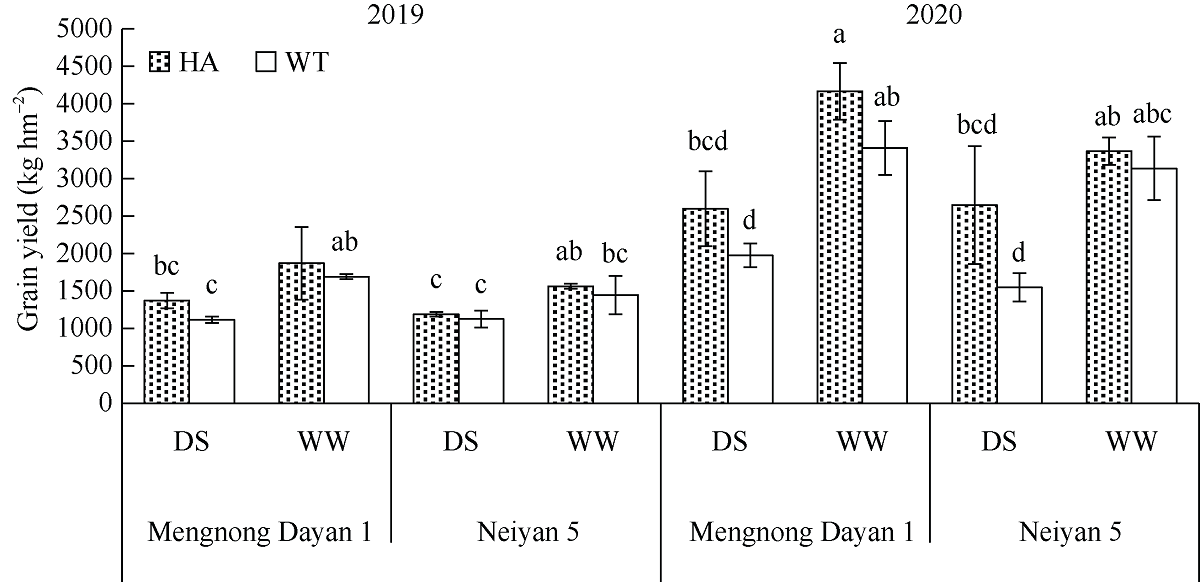
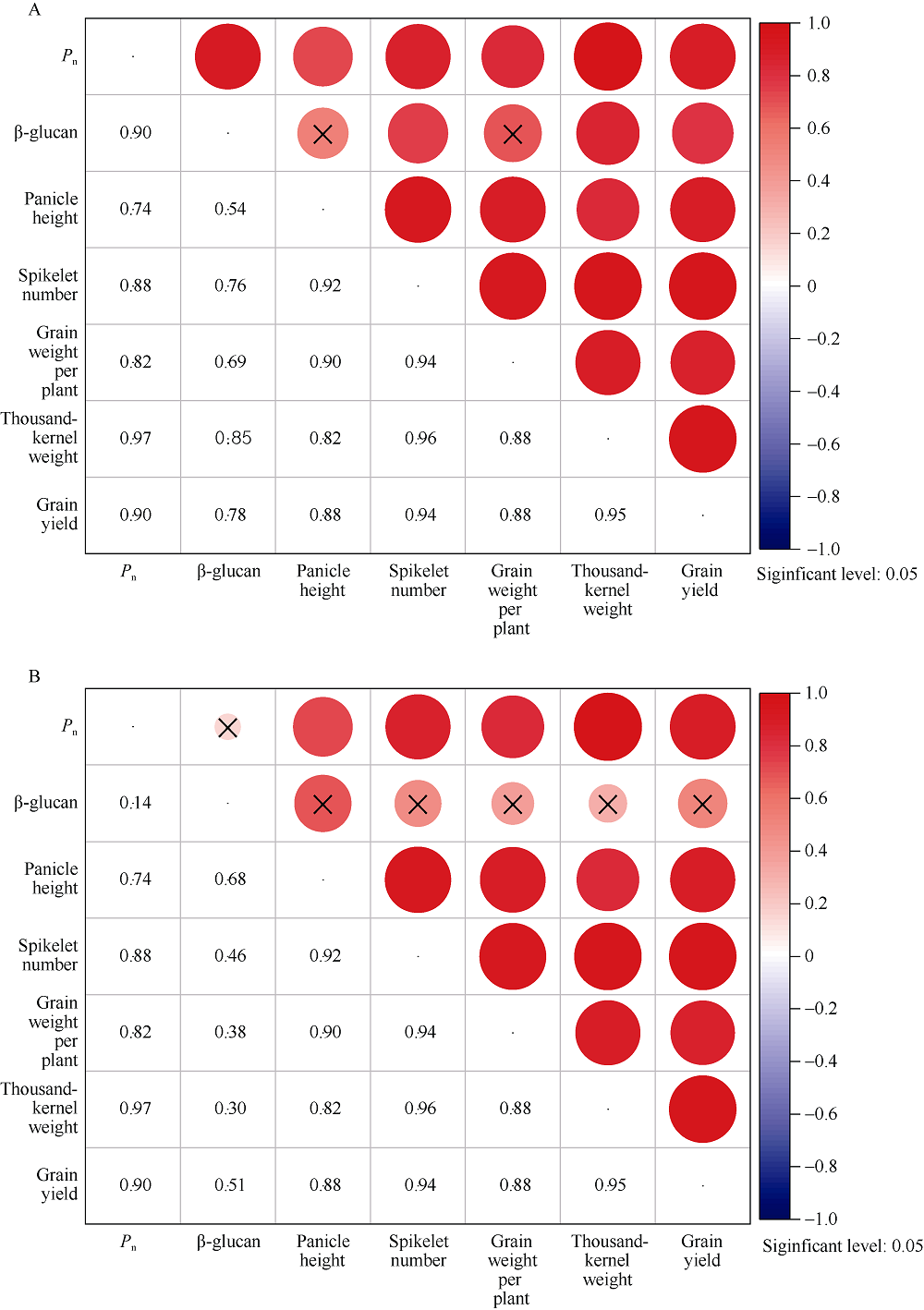
为明确水分和腐植酸协同作用对燕麦的增产提质效应, 本试验以蒙农大燕1号和内燕5号燕麦品种为研究对象, 分别设置旱作和有限灌溉2个水分处理, 分析喷施腐植酸对燕麦叶片光合特性、籽粒产量和β-葡聚糖含量的影响。结果表明: 孕穗和开花期喷施腐植酸后可以显著提高燕麦叶片的光合特性, 与灌水条件下相比, 蒙农大燕1号叶片的光合速率在旱作条件下的提高幅度更大, 提高了31.78%~123.72%, 而内燕5号在旱作和灌水条件下增幅基本一致; 在旱作条件下喷施腐植酸后两品种籽粒产量和β-葡聚糖含量均显著提高, 尤其以内燕5号的提高幅度更大, 分别提高了5.60%~74.68%和11.24%~19.56%; 与旱作处理相比, 在灌水条件下喷施HA, 两品种籽粒β-葡聚糖含量提高幅度更大, 分别提高了11.30%~33.29%和7.76%~43.81%。通过各指标之间的相关性分析, 蒙农大燕1号品种叶片的光合速率与籽粒β-葡聚糖含量、穗长、单穗小穗数、单穗粒重、千粒重及籽粒产量呈显著正相关关系, 籽粒产量与穗长、单穗小穗数、单穗粒重、千粒重呈显著正相关关系, 籽粒β-葡聚糖与单穗小穗数、千粒重和籽粒产量呈显著正相关关系(P<0.05), 而内燕5号品种籽粒β-葡聚糖含量与各产量构成因子正相关, 但未达到显著水平。综上说明, 水分和腐植酸协同作用可有效改善燕麦叶片的光合性能, 并且协同提高籽粒产量和β-葡聚糖含量。
| [1] | 任长忠, 崔林, 何峰, 欧阳韶晖, 胡新中, 李再贵, 陕方. 我国燕麦荞麦产业技术体系建设与发展. 吉林农业大学学报, 2018, 40: 524-532. |
| Ren C Z, Cui L, He F, Ou-Yang S H, Hu X Z, Li Z G, Shan F. Construction and development of China oat and buckwheat industrial technology system. J Jilin Agric Univ, 2018, 40: 524-532. (in Chinese with English abstract) | |
| [2] | Wood P J. Cereal beta-glucans in diet and health. J Cereal Sci, 2007, 45: 230-238. |
| [3] |
Nazare J-A, Normand S, Triantafyllou A O, Desage M, Laville M. Modulation of the postprandial phase by β-glucan in overweight subjects: effects on glucose and insulin kinetics. Mol Nutr Food Res, 2009, 53: 361-369.
doi: 10.1002/mnfr.200800023 |
| [4] |
Marshall A, Cowan S, Edwards S, Griffiths I, Howarth C, Langdon T, White E. Crops that feed the world 9. Oats-a cereal crop for human and livestock feed with industrial applications. Food Secur, 2013, 5: 13-33.
doi: 10.1007/s12571-012-0232-x |
| [5] |
Bodner G, Nakhforoosh A, Kaul H P. Management of crop water under drought: a review. Agron Sustain Dev, 2015, 35: 401-442.
doi: 10.1007/s13593-015-0283-4 |
| [6] | Kadam N N, Xiao G, Melgar R J. Chapter 3: agronomic and physiological responses to high temperature, drought, and elevated CO2 interactions in cereals. Adv Agron, 2014, 127: 111-156. |
| [7] | 任长忠, 胡跃高. 中国燕麦学. 北京: 中国农业出版社, 2013. |
| Ren C Z, Hu Y G. Chinese Oatology. Beijing: China Agriculture Press, 2013 (in Chinese) | |
| [8] | Liu D Q, Wan F, Guo R, Li F M, Cao H H, Sun G J. GIS-based modeling of potential yield distributions for different oat varieties in China. Math Comput Mod, 2011, 54: 869. |
| [9] | 苏日娜. 中国燕麦产业发展研究. 内蒙古农业大学博士学位论文, 内蒙古呼和浩特, 2013. |
| Su R N. Research on the Development of China’s Oat Industry. PhD Dissertation of Inner Mongolia Agricultural University, Hohhot, Inner Mongolia, China, 2013. (in Chinese with English abstract) | |
| [10] |
Humphreys D G, Mather D E. Heritability of β-glucan, groat- percentage, and crown rust resistance in two oat crosses. Euphytica, 1996, 91: 359-364.
doi: 10.1007/BF00033098 |
| [11] |
Doehlert D C, McMullen M S, Hammond J J. Genotypic and environmental effects on grain yield and quality of oat grown in North Dakota. Crop Sci, 2001, 41: 1066-1072.
doi: 10.2135/cropsci2001.4141066x |
| [12] |
Brunner B R, Freed R D. Oat grain β-glucan content as affected by nitrogen level, location and year. Crop Sci, 1994, 34: 473-476.
doi: 10.2135/cropsci1994.0011183X003400020031x |
| [13] |
Peterson D M, Wesenberg D M, Burrup D E. β-glucan content and its relationship to agronomic characteristics in elite oat germplasm. Crop Sci, 1995, 35: 965-970.
doi: 10.2135/cropsci1995.0011183X003500040005x |
| [14] | Guler M. Nitrogen and irrigation effects on grain beta-glucan content of oats (Avena sativa L.). Austr J Crop Sci, 2011, 5: 239-244. |
| [15] |
Chernyshova A A, White P J, Scott M P. Selection for nutritional function and agronomic performance in oat. Crop Sci, 2007, 47: 2330-2339.
doi: 10.2135/cropsci2006.12.0759 |
| [16] | Cervantes-Martinez C T, Frey K J, White P J. Correlated responses to selection for greater β-glucan content in two oat populations. Crop Sci, 2002, 42: 730-738. |
| [17] | 程亮, 张保林, 王杰, 史亚龙, 陈可可. 腐植酸肥料的研究进展. 中国土壤与肥料, 2011, (5): 1-6. |
| Cheng L, Zhang B L, Wang J, Shi Y L, Chen K K. Research progress of humic acid fertilizers. Soils Fert China, 2011, (5): 1-6. (in Chinese with English abstract) | |
| [18] |
Lotfi R, Kalaji H M, Valizadeh G R, Khalilvand Behrozyar E, Hemati A, Gharavi-Kochebagh P, Ghassemi A. Effects of humic acid on photosynthetic efficiency of rapeseed plants growing under different watering conditions. Photosynthetica, 2018, 56: 962-970.
doi: 10.1007/s11099-017-0745-9 |
| [19] | 刘伟, 刘景辉, 萨如拉. 腐植酸水溶肥料对燕麦叶片保护酶活性和渗透物质的影响. 灌溉排水学报, 2014, 33(1): 107-109. |
| Liu W, Liu J H, Sarula. Effects of humic acid water-soluble fertilizers on protective enzyme activities and osmotic substances in oat leaves. J Irrig Drain, 2014, 33(1): 107-109. (in Chinese with English abstract) | |
| [20] |
Robredo A, Pérez-lópez U, Lacuesta M, Mena-Petite A, Munoz- Rueda A. Influence of water stress on photosynthetic characteristics in barley plants under ambient and elevated CO2 concentrations. Biol Plant, 2010, 54: 285-292.
doi: 10.1007/s10535-010-0050-y |
| [21] |
Liu B H, Liang J, Tang G M, Wang X F, Liu F C, Zhao D C. Drought stress affects on growth, water use efficiency, gas exchange and chlorophyll fluorescence of Juglans rootstocks. Sci Hortic, 2019, 250: 230-235.
doi: 10.1016/j.scienta.2019.02.056 |
| [22] | Janani P, Kumar N, Jegadeeswari V. Dynamics of gas exchange and chlorophyll fluorescence parameters of cocoa genotypes in response to water deficit. J Pharm Phytochem, 2019, 8: 415-419. |
| [23] |
Farooq M, Wahid A, Kobayashi N. Plant drought stress: effects, mechanisms and management. Agron Sustain Dev, 2009, 29: 185-212.
doi: 10.1051/agro:2008021 |
| [24] | 邓万和, 王强, 吕耀昌, 周素梅. 品种和环境效应对燕麦β-葡聚糖含量的影响. 中国粮油学报, 2005, 20(2): 30-32. |
| Deng W H, Wang Q, Lyu Y C, Zhou S M. Effects of variety and environmental effects on the content of oat β-glucan. J Chin Cereals Oils Assoc, 2005, 20(2): 30-32. (in Chinese with English abstract) | |
| [25] | 王冰, 朱莉, 李茂玮, 詹晓北. 适应性驯化生产低分子质量β-葡聚糖及其抗氧化活性研究. 食品与发酵工业, 2021, 47(17): 27-33. |
| Wang B, Zhu L, Li M W, Zhan X B. Adaptive domestication to produce low molecular weight β-glucan and its antioxidant activity. Food Ferment Ind Sin, 2021, 47(17): 27-33. (in Chinese with English abstract) | |
| [26] | 张俊峰, 段娜, 刘兵兵, 刘龙龙, 赵文千. 灌浆期干旱胁迫对燕麦籽粒β-葡聚糖含量的影响. 山西农业科学, 2020, 48: 884-888. |
| Zhang J F, Duan N, Liu B B, Liu L L, Zhao W Q. Effects of drought stress during grain filling period on β-glucan content in oat grains. Shanxi Agric Sci, 2020, 48: 884-888. (in Chinese with English abstract) | |
| [27] |
Zhang X, Huang G, Bian X, Zhao Q G. Effects of nitrogen fertilization and root interaction on the agronomic traits of intercropped maize, and the quantity of microorganisms and activity of enzymes in the rhizosphere. Plant Soil, 2013, 368: 407-417.
doi: 10.1007/s11104-012-1528-5 |
| [28] | 韩文元. 水分与腐植酸对燕麦抗旱性、产量形成和品质的影响. 内蒙古农业大学博士学位论文, 内蒙古呼和浩特, 2016. |
| Han W Y. Effects of Moisture and Humic Acid on Drought Resistance, Yield Formation and Quality of Oats. PhD Dissertation of Inner Mongolia Agricultural University, Hohhot, Inner Mongolia, China, 2016. (in Chinese with English abstract) | |
| [29] | 孙雯. 水分和腐植酸对燕麦光合、糖代谢及产量和β-葡聚糖形成的影响. 内蒙古农业大学博士学位论文, 内蒙古呼和浩特, 2018. |
| Sun W. Effects of Water and Humic Acid on Oat Photosynthesis, Sugar Metabolism, Yield and β-glucan Formation. PhD Dissertation of Inner Mongolia Agricultural University, Hohhot, Inner Mongolia, China, 2018. (in Chinese with English abstract) | |
| [30] |
Dong C C, Yong I J, Nam J H, Chung G C, Ji H C, Su J K, Hong S Y. Early drought effect on canopy development and tuber growth of potato cultivars with different maturities. Field Crops Res, 2018, 215: 156-162.
doi: 10.1016/j.fcr.2017.10.008 |
| [31] | Moghadam H R T, Khamene M K, Zahedi H. Effect of humic acid foliar application on growth and quantity of corn in irrigation withholding at different growth stages. Maydica, 2014, 59: 125-129. |
| [32] | Hartz T K, Bottoms T G. Humic substances generally ineffective in improving vegetable crop nutrient uptake or productivity. Hortic Sci, 2010, 45: 906-910. |
| [33] | Ahmad W, Shah Z, Khan F, Ali S, Malik W. Maize yield and soil properties as influenced by integrated use of organic, inorganic and bio-fertilizers in a low fertility soil. Soil Environ, 2013, 32: 121-129. |
| [34] | 李英浩, 刘景辉, 朱珊珊. 干旱胁迫下腐植酸对燕麦叶片光合性能的调控效应. 麦类作物学报, 2019, 39: 1385-1391. |
| Li Y H, Liu J H, Zhu S S. Regulation effects of humic acid on photosynthetic performance of oat leaves under drought stress. J Triticeae Crops, 2019, 39: 1385-1391. (in Chinese with English abstract) |
| [1] | 胡川, 赵凯男, 黄修利, 吴金芝, 任开明, 王贺正, 付国占, 黄明, 李友军. 一次灌溉下耕作方式和氮肥用量对旱地小麦产量和品质的影响[J]. 作物学报, 2026, 52(6): 1830-1846. |
| [2] | 马胜乾, 王志平, 陈浩天, 窦淑贤, 张燕, 邓艾兴, 张卫建, 原向阳, 宋振伟. 秸秆还田下耕作方式与氮肥施用量对东北玉米产量及土壤团聚体的影响[J]. 作物学报, 2026, 52(6): 1802-1816. |
| [3] | 张思思, 赵向辉, 周洋, 姚云凤, 朱荣昱, 董元杰, 胡国庆, 徐通, 刘兆新. 冬闲期翻耕和绿肥还田对连作花生田土壤理化性质和产量的影响[J]. 作物学报, 2026, 52(5): 1472-1486. |
| [4] | 张宁宁, 滕雨菲, 任娜娜, 魏兴卓, 闫书豪, 樊可心, 王永宏, 陈文康, 张兴华, 朱万超, 徐淑兔, 薛吉全. 201份玉米自交系抗旱表型评价及可塑性分析[J]. 作物学报, 2026, 52(5): 1309-1325. |
| [5] | 张振, 冯连杰, 石玉, 于振文, 张永丽. 节水补灌下不同穗型小麦产量形成差异研究[J]. 作物学报, 2026, 52(5): 1522-1535. |
| [6] | 闫安, 蒋昆炜, 王蓉圆, 田林, 张璐, 王韵, 徐建龙. 水稻剑叶小维管束数基因SVN7的鉴定与克隆[J]. 作物学报, 2026, 52(5): 1364-1372. |
| [7] | 刘昕萌, 任昊, 张继波, 张吉旺, 赵斌, 任佰朝, 刘鹏, 王洪章. 茉莉酸甲酯(MeJA)缓解高温影响玉米雌穗分化的生理机制[J]. 作物学报, 2026, 52(5): 1561-1572. |
| [8] | 王壮壮, 武紫君, 张永新, 张芯源, 袁丽雪, 陈如雪, 刘世举, 段剑钊, 冯伟, 王同朝, 王永华. 豫东南黏壤潮土区水氮优化协同提高冬小麦产量和氮素利用效率[J]. 作物学报, 2026, 52(5): 1501-1521. |
| [9] | 张鸿蓉, 王菲儿, 李盼, 仇海龙, 朱静, 赵连豪, 南运有, 何蔚, 樊志龙, 胡发龙, 柴强, 殷文. 减量20%灌水与25%有机肥替代化肥提高青贮玉米产量的光合特性[J]. 作物学报, 2026, 52(5): 1487-1500. |
| [10] | 王宇诚, 张露, 刘阿康, 黄见良, 彭少兵, 袁珅. 基于产量差的作物大面积单产提升策略与展望[J]. 作物学报, 2026, 52(5): 1279-1290. |
| [11] | 赵佳雪, 周龙昊, 郭岂源, 尚伦霄, 王涵, 刘志涛, 陈曦, 张晓佩, 宋宪亮, 毛丽丽. 长期秸秆还田与深松通过改善土壤环境与棉花光合特性提高滨海盐碱地棉花产量[J]. 作物学报, 2026, 52(5): 1548-1560. |
| [12] | 郭星宇, 胡丹, 林苏期, 王梦凯, 谭文峰, 黄传琴. 生物炭配施化肥提高玉米‖大豆下玉米产量和土壤生态系统多功能性[J]. 作物学报, 2026, 52(5): 1536-1547. |
| [13] | 蔡宏玮, 于爱忠, 姜科强, 王鹏飞, 王玉珑, 霍建喆, 庞小能, 尹波, 尚永盼. 干旱灌区有机肥替代部分化肥促进甜玉米产量提升的关键机制[J]. 作物学报, 2026, 52(4): 1166-1180. |
| [14] | 崔雪梅, 柳妍娣, 刘景辉, 米俊珍, 武俊英, 赵宝平. 不同基因型燕麦强弱势粒生理特性与产量关系研究[J]. 作物学报, 2026, 52(4): 1220-1235. |
| [15] | 杨锐, 陈敬东, 黄郢, 张学昆, 周登文, 刘清云, 徐劲松, 谢伶俐, 许本波. 长江下游冬油菜区应对气候变化的育种和栽培策略研究[J]. 作物学报, 2026, 52(4): 1153-1165. |
|
||