欢迎访问作物学报,今天是
作物学报 ›› 2022, Vol. 48 ›› Issue (5): 1273-1278.doi: 10.3724/SP.J.1006.2022.14070
王海波1,2( ), 应静文1, 何礼1,3, 叶文宣1, 涂卫1, 蔡兴奎1, 宋波涛1,*(), 柳俊1
WANG Hai-Bo1,2(), YING Jing-Wen1, HE Li1,3, YE Wen-Xuan1, TU Wei1, CAI Xing-Kui1, SONG Bo-Tao1,*(), LIU Jun1
摘要:
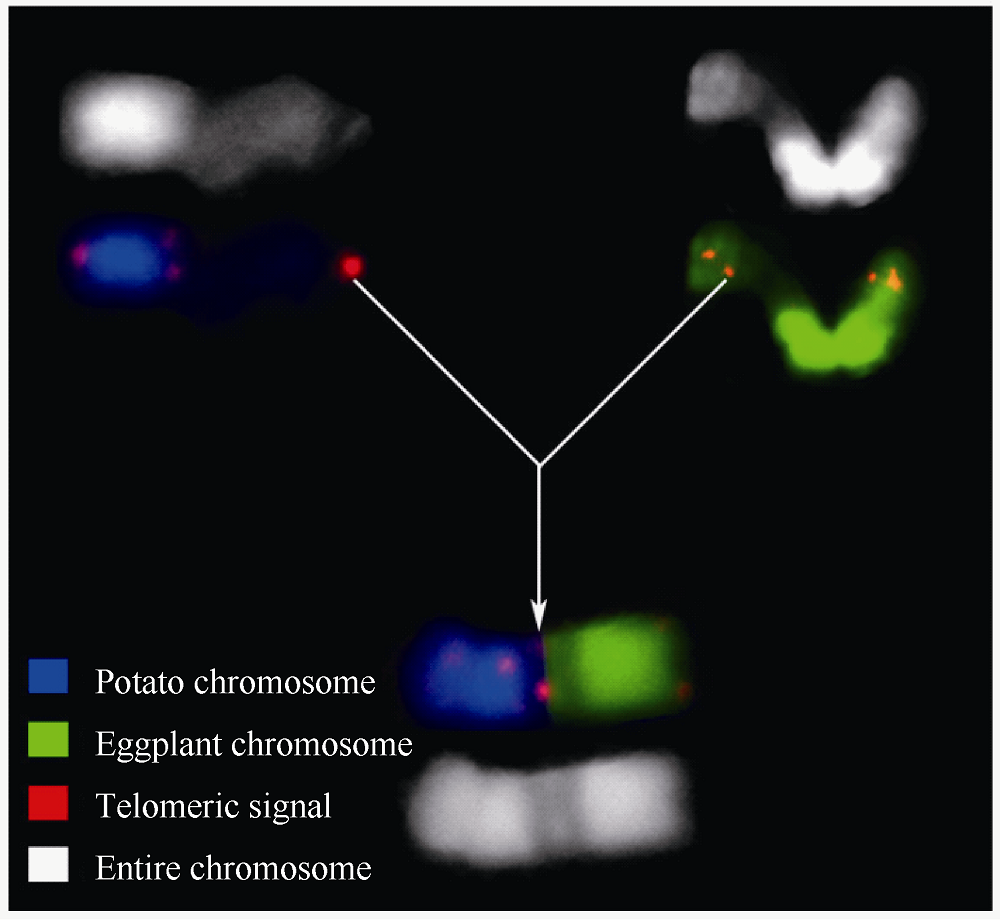
植物体细胞杂交是植物种质资源创制的重要方法。体细胞杂种在原生质体再生的过程中染色体会产生非常多的遗传变异。研究体细胞杂种的染色体行为为马铃薯体细胞杂种的创制和利用提供理论基础。本研究采用rDNA和端粒重复序列作为探针进行原位杂交(fluorescence in situ hybridization), 并结合基因组原位杂交(genomic in situ hybridization), 对马铃薯和茄子体细胞杂种染色体组成和变异进行了分析。原位杂交结果表明, 体细胞杂种中存在马铃薯和茄子融合的染色体和双着丝粒染色体, 并发现部分融合染色体是由马铃薯和茄子2号染色体末端对末端融合得到的。重排的双着丝粒染色体的着丝粒一个来源于马铃薯, 一个来源于茄子。此外, 体细胞杂种中来源于茄子的5S rDNA在体细胞杂种再生及稳定的过程中全部丢失。研究结果表明马铃薯与茄子在进行体细胞杂交的过程中, 染色体是不稳定的, 容易造成融合后代出现双着丝粒和染色体重排等现象。体细胞杂种的染色体会通过染色体重排、双着丝粒、rDNA均一化等多种形式使其染色体趋于稳定。
| [1] |
Xiang F N, Xia G M, Chen H M. Effect of UV dosage on somatic hybridization between common wheat (Triticum aestivum L.) and Avena sativa L. Plant Sci, 2003, 164:697-707.
doi: 10.1016/S0168-9452(03)00021-9 |
| [2] | 王晶, 向凤宁, 夏光敏, 陈惠民. 利用不对称体细胞杂交向小麦转移高冰草染色体小片段. 中国科学, 2004, 34:113-120. |
| Wang J, Xiang F N, Xia G M, Chen H M. Using asymmetric somatic hybridization to transfer small chromosome fragments from tall wheatgrass to wheat. Sci China, 2004, 34:113-120 (in Chinese). | |
| [3] |
Greplová M, Polzerová H, Vlastníková H. Electrofusion of protoplasts from Solanum tuberosum, S. bulbocastanum and S. pinnatisectum. Acta Physiol Plant, 2008, 30:787-796.
doi: 10.1007/s11738-008-0183-1 |
| [4] |
Tarwacka J, Polkowska-Kowalczyk L, Kolano B, Kolano B, Śliwka J, Wielgat B. Interspecific somatic hybrids Solanum villosum (+) S. tuberosum, resistant to Phytophthora infestans. J Plant Physiol, 2013, 170:1541-1548.
doi: 10.1016/j.jplph.2013.06.013 |
| [5] |
Fock I, Collonnier C, Purwito A, Luisetti J, Souvannavong V, Vedel F, Servaes A, Ambroise A, Kodja H, Ducreux G, Sihachakr D. Resistance to bacterial wilt in somatic hybrids between Solanum tuberosum and Solanum phureja. Plant Sci, 2000, 160:165-176.
pmid: 11164589 |
| [6] |
Yu Y, Ye W X, He L, Cai X K, Liu T, Liu J. Introgression of bacterial wilt resistance from eggplant to potato via protoplast fusion and genome components of the hybrids. Plant Cell Rep, 2013, 32:1687-1701.
doi: 10.1007/s00299-013-1480-8 |
| [7] |
Austin S, Baer M A, Helgeson J P. Transfer of resistance to potato leaf roll virus from Solanum brevidens into Solanum tuberosum by somatic fusion. Plant Sci, 1985, 39:75-81.
doi: 10.1016/0168-9452(85)90195-5 |
| [8] |
Thieme R, Rakosy-Tican E, Gavrilenko T, Antonova O, Schubert J, Nachtigall M, Heimbach U, Thieme T. Novel somatic hybrids (Solanum tuberosum L.+ Solanum tarnii) and their fertile BC1 progenies express extreme resistance to potato virus Y and late blight. Theor Appl Genet, 2008, 116:691-700.
doi: 10.1007/s00122-007-0702-2 |
| [9] |
Bastia T, Carotenuto N, Basile B, Zoina A, Cardi T. Induction of novel organelle DNA variation and transfer of resistance to frost and Verticillium wilt in Solanum tuberosum through somatic hybridization with 1EBN S. commersonii. Euphytica, 2000, 116:1-10.
doi: 10.1023/A:1003943704037 |
| [10] |
Bidani A, Nouri-Ellouz O, Lakhoua L, Sihachakr D, Cheniclet C, Mahjoub A, Drira N, Gargouri-Bouzid R. Interspecific potato somatic hybrids between Solanum berthaultii and Solanum tuberosum L. showed recombinant plastome and improved tolerance to salinity. Plant Cell Tissue Organ Cult, 2007, 91:179-189.
doi: 10.1007/s11240-007-9284-6 |
| [11] |
Raina S, Rani V. GISH technology in plant genome research. Methods Cell Sci, 2001, 23:83-104.
doi: 10.1023/A:1013197705523 |
| [12] |
Zluvova J, Lengerova M, Markova M, Hobza R, Nicolas M, Vyskot B, Charlesworth D, Negrutiu I, Janousek B. The inter-specific hybrid Silene latifolia × S. viscosa reveals early events of sex chromosome evolution. Evol Dev, 2005, 7:327-336.
pmid: 15982369 |
| [13] | 何礼. 茄属种及其种间体细胞杂种的染色体特征分析. 华中农业大学博士学位论文, 湖北武汉, 2013. |
| He L. Optimization of Potato Fluorescence in Situ Hybridization and Chromosome Characteristics of Solanum Genomes and the Inter-specific Somatic Hybrids. PhD Dissertation of Huazhong Agricultural University, Wuhan, Hubei, China, 2013 (in Chinese with English abstract). | |
| [14] |
Wang H B, Cheng Z N, Wang B S, Dong J K, Ye W X, Yu Y, Liu T, Cai X K, Song B T, Liu J. Combining genome composition and differential gene expression analyses reveals that SmPGH1 contributes to bacterial wilt resistance in somatic hybrids. Plant Cell Rep, 2020, 39:1235-1248.
doi: 10.1007/s00299-020-02563-7 |
| [15] |
Dong F, Song J, Naess S K, Helgeson J P, Gebhardt C, Jiang J. Development and applications of a set of chromosome-specific cytogenetic DNA markers in potato. Theor AppI Genet, 2000, 101:1001-1007.
doi: 10.1007/s001220051573 |
| [16] |
He L, Liu J, Torres G A, Zhang H Q, Jiang J M, Xie C H. Interstitial telomeric repeats are enriched in the centromeres of chromosomes in Solanum species. Chromosome Res, 2012, 21:5-13.
doi: 10.1007/s10577-012-9332-x |
| [17] |
Lou Q, Iovene M, Spooner D M, Buell C R, Jiang J. Evolution of chromosome 6 of Solanum species revealed by comparative fluorescence in situ hybridization mapping. Chromosoma, 2010, 119:435-442.
doi: 10.1007/s00412-010-0269-6 |
| [18] |
Pendinen G, Gavrilenko T, Jiang J, Spooner D M. Allopolyploid speciation of the Mexican tetraploid potato species Solanum stoloniferum and S. hjertingii revealed by genomic in situ hybridization. Genome, 2008, 51:714-720.
doi: 10.1139/G08-052 pmid: 18772949 |
| [19] |
Wu F, Tanksley S D. Chromosomal evolution in the plant family Solanaceae. BMC Genomics, 2010, 11:182.
doi: 10.1186/1471-2164-11-182 |
| [20] |
Malinska H, Tate J, Matyasek R, Leitch A, Soltis D, Soltis P, Kovarik A. Similar patterns of rDNA evolution in synthetic and recently formed natural populations of Tragopogon(Asteraceae) allotetraploids. BMC Evol Biol, 2010, 10:291.
doi: 10.1186/1471-2148-10-291 pmid: 20858289 |
| [21] |
Mlinarec J, Satovic Z, Malenica N, Ivancic-Bace I, Besendorfer V. Evolution of the tetraploid Anemone multifida (2n = 32) and hexaploid A. baldensis (2n = 48) (Ranunculaceae) was accompanied by rDNA loci loss and intergenomic translocation: evidence for their common genome origin. Ann Bot, 2012, 110:703-712.
doi: 10.1093/aob/mcs128 |
| [22] |
Pontes O, Neves N, Silva M, Lewis M S, Madlung A, Comai L, Viegas W, Pikaard C S. Chromosomal locus rearrangements are a rapid response to formation of the allotetraploid Arabidopsis suecica genome. Proc Natl Acad Sci USA, 2004, 101:18240-18245.
doi: 10.1073/pnas.0407258102 |
| [23] |
Metcalfe C J, Bulazel K V, Ferreri G C, Schroeder-Reiter E, Wanner G, Rens W, Obergfell C, Eldridge M D, O'Neill R J. Genomic instability within centromeres of interspecific marsupial hybrids. Genetics, 2007, 177:2507-2517.
doi: 10.1534/genetics.107.082313 pmid: 18073443 |
| [24] |
Sato H, Masuda F, Takayama Y, Takahashi K, Saitoh S. Epigenetic inactivation and subsequent heterochromatinization of a centromere stabilize dicentric chromosomes. Curr Biol, 2012, 22:658-667.
doi: 10.1016/j.cub.2012.02.062 |
| [1] | 陈国欢, 张锐, 李艳迪, 赵佳琪, 任湧涛, 张天赐, 郭华春, 李俊, 杨芳. 外源硒叶面喷施对浅紫色马铃薯块茎花青素合成的影响[J]. 作物学报, 2026, 52(6): 1876-1890. |
| [2] | 王文辕, 燕雪嘉, 刘玉霖, 孙晓彤, 李亚楠, 唐鑫华, 石瑛. 耐弱光马铃薯品种筛选及转录因子编码基因StPIF3的克隆与功能分析[J]. 作物学报, 2026, 52(6): 1631-1645. |
| [3] | 田立涛, 丁宁, 王树林, 齐恩芳, 张荣, 王蕊蕊, 马利雯, 李建武, 杨江伟. 马铃薯Argonaute基因家族鉴定及晚疫病诱导表达分析[J]. 作物学报, 2026, 52(4): 1116-1126. |
| [4] | 张宇, 刘芳, 蔡诚诚, 杨小华, 吉阿么石扎, 杨元军, 王西瑶. 溴乙烷与赤霉素协同处理破除马铃薯块茎休眠的机理初探[J]. 作物学报, 2026, 52(3): 825-838. |
| [5] | 汪玲, 胡好, 宋家凤, 程洁蓝, 陈颖, 郑婷婷, 吕钊彦, 朱晓彪, 侯华兰. 马铃薯UDP-糖基转移酶基因StUGT52的克隆及功能验证[J]. 作物学报, 2026, 52(3): 665-676. |
| [6] | 徐强, 谢奎忠, 胡新元, 岳云, 董博, 罗爱花. 连作对马铃薯根际土壤线虫群落结构与功能的影响[J]. 作物学报, 2026, 52(2): 527-538. |
| [7] | 杨飚, 杜帅康, 张继旺, 石瑛, 张丽莉. 马铃薯III类POD基因家族的全基因组鉴定及其表达谱分析[J]. 作物学报, 2026, 52(2): 405-420. |
| [8] | 姬炫彤, 卞春松, 金黎平, 李森, 秦军红, 李广存. 不同耐旱型马铃薯根际微生物对干旱的响应[J]. 作物学报, 2026, 52(1): 165-177. |
| [9] | 田甲春, 葛霞, 李守强, 李梅, 田世龙, 张亚倩, 程建新, 李玉梅. 低O2高CO2贮藏环境延缓马铃薯块茎衰老的作用机制[J]. 作物学报, 2026, 52(1): 262-278. |
| [10] | 王雅致, 杨飚, 季香林, 石瑛, 张丽莉. 二倍体马铃薯抗旱资源鉴定及抗旱基因初步筛选[J]. 作物学报, 2026, 52(1): 72-84. |
| [11] | 卓峰琦, 唐振三, 雷雨俊, 程李香, 赵甜甜, 吕汰, 杨晨, 张峰. 基于烹饪方式及回生温度筛选低升糖马铃薯品种(系)[J]. 作物学报, 2025, 51(9): 2538-2546. |
| [12] | 朱锦程, 杨秋华, 程李香, 李文丽, 石明明, 李惠霞, 张峰. 马铃薯抗南方根结线虫种质资源筛选及相关生理反应分析[J]. 作物学报, 2025, 51(9): 2307-2317. |
| [13] | 尹丽娜, 张锐, 陈国欢, 白磊, 李俊, 郭华春, 杨芳. 不同马铃薯品种块茎创伤愈合能力的比较[J]. 作物学报, 2025, 51(9): 2399-2411. |
| [14] | 贾小霞, 齐恩芳, 文国宏, 马胜, 黄伟, 吕和平, 李建武, 曲亚英, 丁宁. 中早熟马铃薯‘陇薯20号’高效再生体系建立及抗草铵膦种质创制[J]. 作物学报, 2025, 51(9): 2285-2294. |
| [15] | 李秋云, 李世贵, 范军亮, 刘昊天, 赵晓斌, 吕硕, 王艳浩, 岳云, 张宁, 司怀军. 离子锌和纳米锌对马铃薯生理特性、产量及品质的影响[J]. 作物学报, 2025, 51(7): 1838-1849. |
|
||