欢迎访问作物学报,今天是
作物学报 ›› 2025, Vol. 51 ›› Issue (12): 3184-3197.doi: 10.3724/SP.J.1006.2025.55032
黄绒, 周渠晨, 陈楚铭, 罗倩, 易东, 杜常欢, 黄祥宇, 盛锋( ), 杜雪竹()
HUANG Rong, ZHOU Qu-Chen, CHEN Chu-Ming, LUO Qian, YI Dong, DU Chang-Huan, HUANG Xiang-Yu, SHENG Feng(), DU Xue-Zhu()
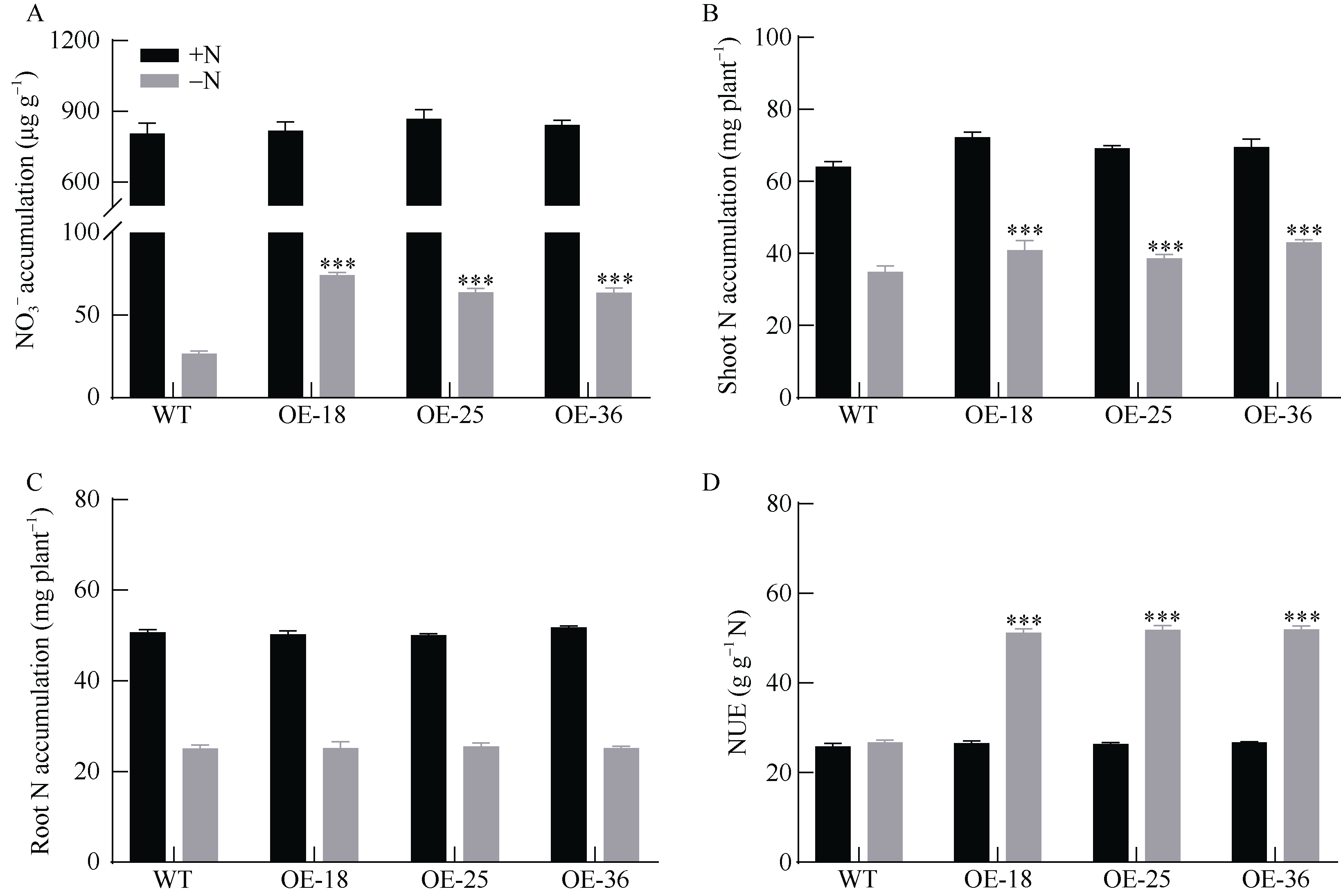
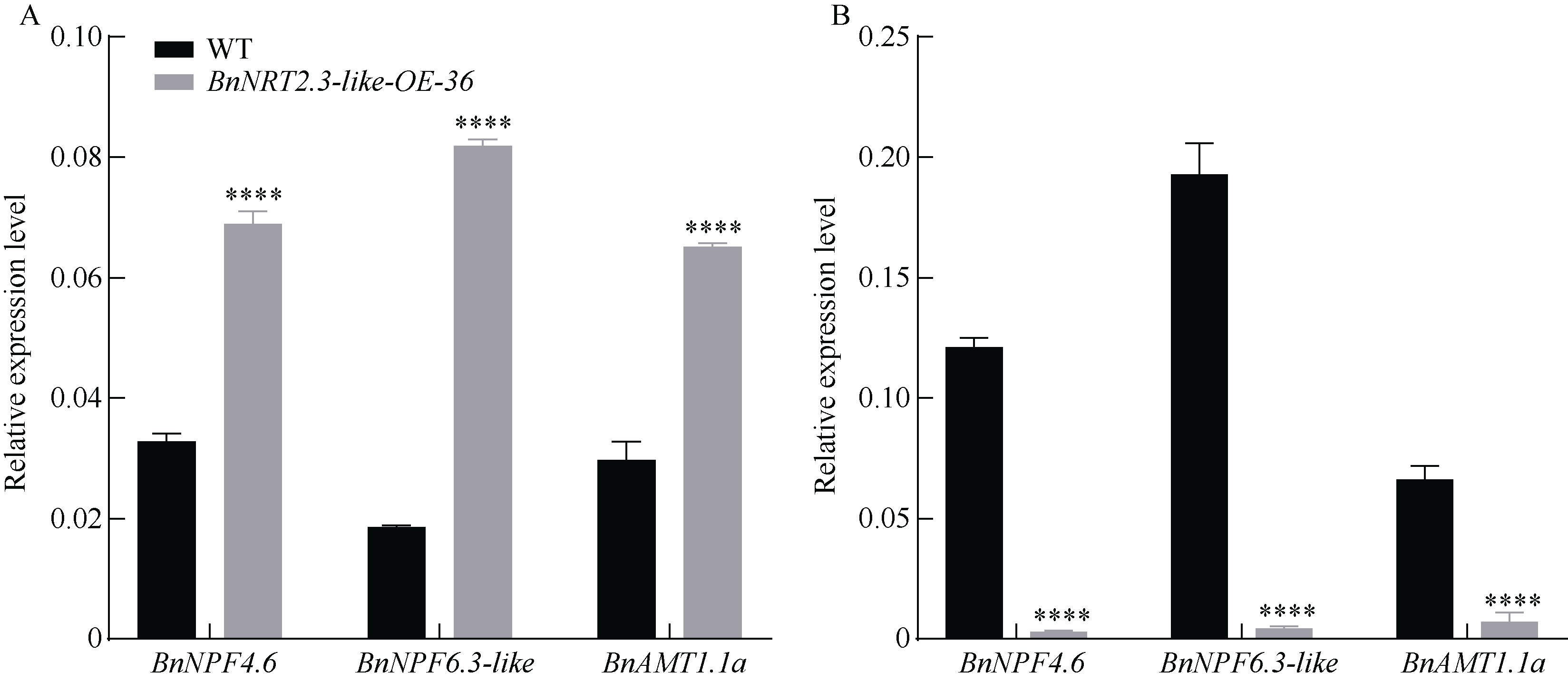
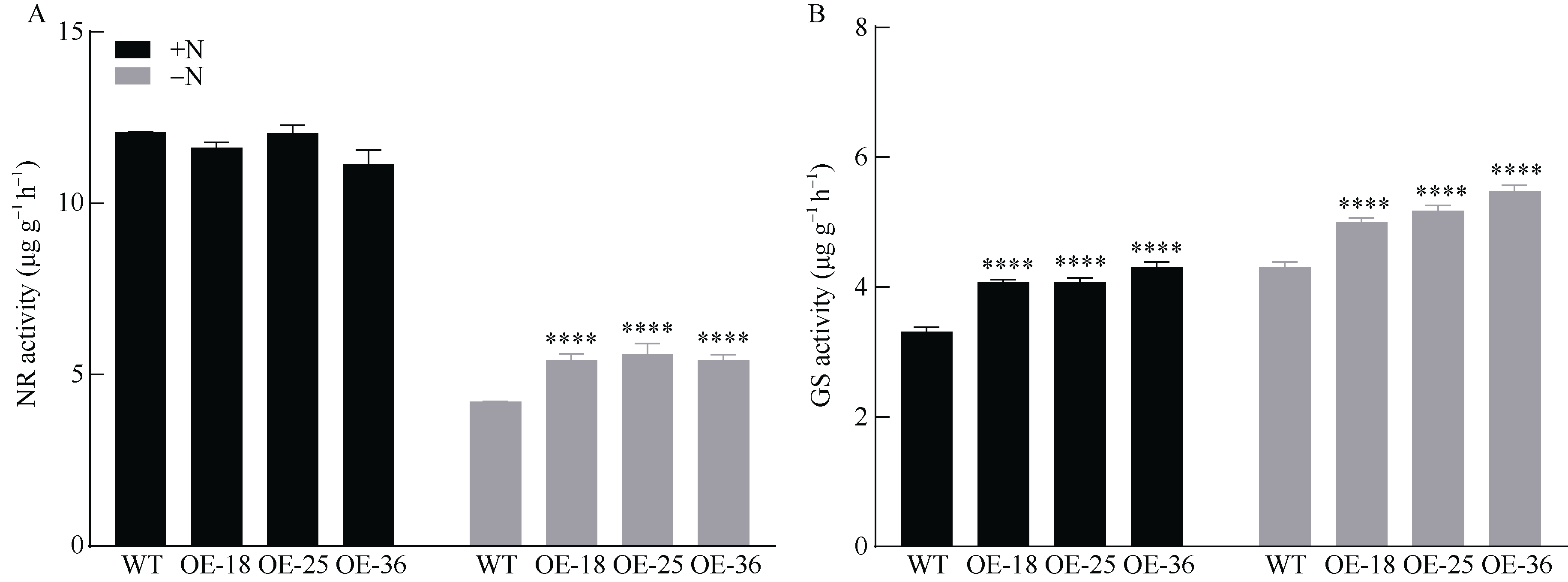
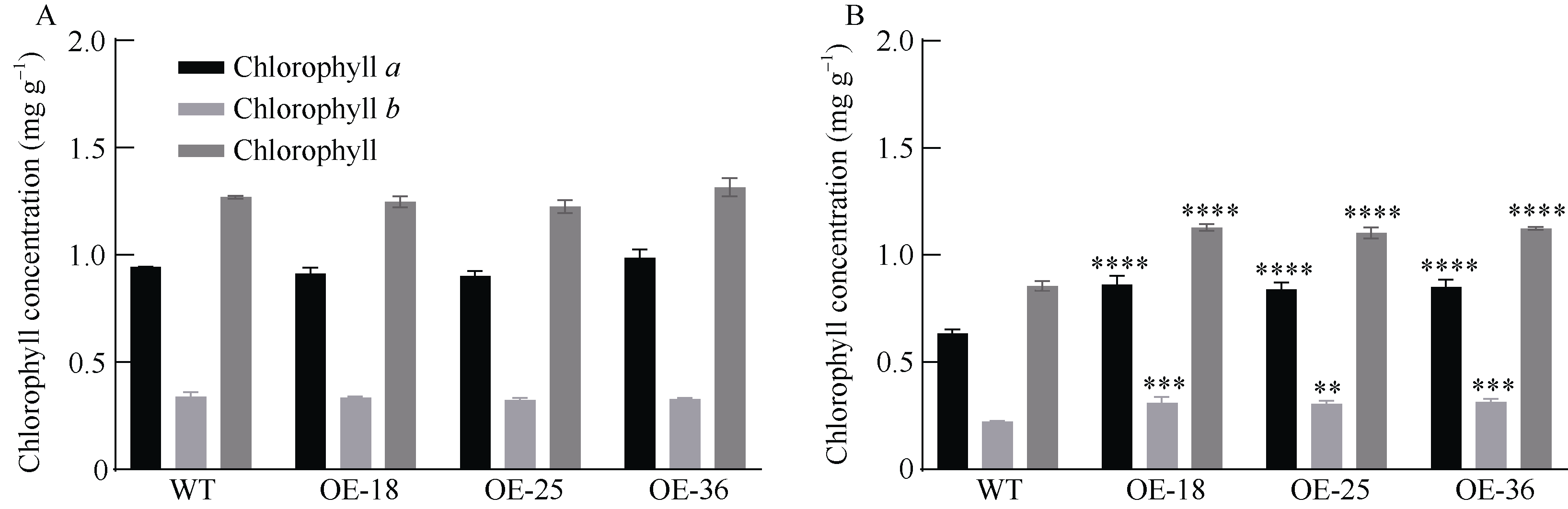
摘要: 硝酸盐转运蛋白2 (NRT2)是一种高亲和硝酸盐转运蛋白, 在植物硝酸盐的吸收和转运过程中发挥重要作用。本研究利用实时荧光定量PCR (qRT-PCR)鉴定到响应低氮胁迫的关键基因BnNRT2.3-like, 对其进行生物信息学分析, 构建BnNRT2.3-like过表达载体, 获得转基因植株, 通过盆栽试验对油菜成熟期的重要农艺性状进行观察和分析, 并在油菜苗期测定其氮素积累量、氮素利用效率、叶绿素含量、氮素利用相关基因表达量以及硝酸还原酶(NR)和谷氨酰胺合成酶(GS)活性。结果表明, BnNRT2.3-like蛋白分子量为61.87 kD, 等电点为9.08, 具有MFS超家族和NNP家族基因的典型特征。与野生型相比, BnNRT2.3-like过表达植株的株高、千粒重和单株籽粒产量分别提高9.1%、20.0%和62.1%, 有效分枝高度、主轴有效长度、主轴有效角果数、全株有效角果数、每角果长度、平均每角果粒数均显著提高。在低氮处理下, 过表达油菜与野生型相比主根长平均增加1.22 cm, 植株鲜重增加0.633 g, 地上部和根部干重分别增加55.0%和13.6%, 单株总干重增加42.1%; 地上部氮积累量较野生型增加17.0%。此外, 在低氮胁迫下, 过表达植株苗期的氮素积累量、氮素利用效率、硝酸还原酶和谷氨酰胺合成酶活性以及叶绿素含量与野生型相比均显著提高, 氮素利用相关基因BnNPF4.6、BnNPF6.3-like和BnAMT1.1a在叶片中表达水平上升而在根中显著降低。因此, 过表达BnNRT2.3-like可以增强油菜对低氮胁迫的耐受性, 提高油菜产量性状, 为提高油菜氮素利用效率提供了种质资源及理论依据。
| [1] |
Du E C, Guo W Z, Zhao N, Chen F, Fan Q W, Zhang W, Huang S W, Zhou G S, Fu T D, Wei J T. Effects of diets with various levels of forage rape (Brassica napus) on growth performance, carcass traits, meat quality and rumen microbiota of Hu lambs. J Sci Food Agric, 2022, 102: 1281-1291.
doi: 10.1002/jsfa.v102.3 |
| [2] |
Wang X D, Ma H, Guan C Y, Guan M. Germplasm screening of green manure rapeseed through the effects of short-term decomposition on soil nutrients and microorganisms. Agriculture, 2021, 11: 1219.
doi: 10.3390/agriculture11121219 |
| [3] | 甘国渝, 邹家龙, 陈曦, 朱海, 金慧芳, 李继福. 中国油菜生产格局与施肥研究现状. 湖北农业科学, 2022, 61(1): 5-11. |
| Gan G Y, Zou J L, Chen X, Zhu H, Jin H F, Li J F. Research status of rape production pattern and fertilization in China. Hubei Agric Sci, 2022, 61(1): 5-11 (in Chinese with English abstract). | |
| [4] | 张婧妤, 许本波, 郑家喜. 我国食用植物油消费变化分析及改革对策. 中国油脂, 2022, 47(3): 5-10. |
| Zhang J Y, Xu B B, Zheng J X. Analysis on consumption changes and reform countermeasures of edible vegetable oil in China. China Oils Fats, 2022, 47(3): 5-10 (in Chinese with English abstract). | |
| [5] |
de Bang T C, Husted S, Laursen K H, Persson D P, Schjoerring J K. The molecular-physiological functions of mineral macronutrients and their consequences for deficiency symptoms in plants. New Phytol, 2021, 229: 2446-2469.
doi: 10.1111/nph.17074 pmid: 33175410 |
| [6] |
刘陈, 王昆昆, 廖世鹏, 杨佳群, 丛日环, 任涛, 李小坤, 鲁剑巍. 氮肥用量对玉米-油菜和水稻-油菜轮作模式下油菜产量及氮素吸收利用的影响. 作物学报, 2024, 50: 2067-2077.
doi: 10.3724/SP.J.1006.2024.34181 |
|
Liu C, Wang K K, Liao S P, Yang J Q, Cong R H, Ren T, Li X K, Lu J W. Effects of nitrogen fertilizer application levels on yield and nitrogen absorption and utilization of oilseed rape under maize-oilseed rape and rice-oilseed rape rotation fields. Acta Agron Sin, 2024, 50: 2067-2077 (in Chinese with English abstract).
doi: 10.3724/SP.J.1006.2024.34181 |
|
| [7] | 郭子琪, 王慧, 韩上, 李敏, 雷之萌, 张军, 程文龙, 卜容燕, 武际, 朱林. 氮肥用量对直播油菜产量及氮素吸收利用的影响. 中国土壤与肥料, 2020, (5): 40-44. |
| Guo Z Q, Wang H, Han S, Li M, Lei Z M, Zhang J, Cheng W L, Bu R Y, Wu J, Zhu L. Effect of nitrogen application rate on yield and nitrogen uptake and utilization of direct seeding rape. Soil Fert Sci China, 2020, (5): 40-44 (in Chinese with English abstract). | |
| [8] |
Zhan N, Xu K, Ji G X, Yan G X, Chen B Y, Wu X M, Cai G Q. Research progress in high-efficiency utilization of nitrogen in rapeseed. Int J Mol Sci, 2023, 24: 7752.
doi: 10.3390/ijms24097752 |
| [9] | Hao P F, Lin B G, Ren Y, Hu H, Xue B W, Huang L, Hua S J. Auxin-regulated timing of transition from vegetative to reproductive growth in rapeseed (Brassica napus L.) under different nitrogen application rates. Front Plant Sci, 2022, 13: 927662. |
| [10] |
Yahbi M, Nabloussi A, Maataoui A, El Alami N, Boutagayout A, Daoui K. Effects of nitrogen rates on yield, yield components, and other related attributes of different rapeseed (Brassica napus L.) varieties. Ocl, 2022, 29: 8.
doi: 10.1051/ocl/2022001 |
| [11] | Hao P F, Ren Y, Lin B G, Yi K G, Huang L, Li X, Jiang L X, Hua S J. Transcriptomic analysis of the reduction in seed oil content through increased nitrogen application rate in rapeseed (Brassica napus L.). Int J Mol Sci, 2023, 24: 16220. |
| [12] |
Zhang J L, Li J, Geng G T, Hu W S, Ren T, Cong R H, Li X K, Lu J W. Combined application of nitrogen and potassium reduces seed yield loss of oilseed rape caused by Sclerotinia stem rot disease. Agron J, 2020, 112: 5143-5157.
doi: 10.1002/agj2.v112.6 |
| [13] |
Hu Y, Zhang F F, Hassan Javed H, Peng X, Chen H L, Tang W Q, Lai Y, Wu Y C. Controlled-release nitrogen mixed with common nitrogen fertilizer can maintain high yield of rapeseed and improve nitrogen utilization efficiency. Plants, 2023, 12: 4105.
doi: 10.3390/plants12244105 |
| [14] | Dunn P J, Gilbertson L M. A mechanistic model for determining factors that influence inorganic nitrogen fate in corn cultivation. Environ Sci Proc Impacts, 2025, 27: 549-562. |
| [15] | Tang J Q, Qian H Y, Zhu X C, Liu Z S, Kuzyakov Y, Zou J W, Wang J Y, Xu Q, Li G H, Liu Z H, et al. Soil pH determines nitrogen effects on methane emissions from rice paddies. Glob Change Biol, 2024, 30: e17577. |
| [16] | Romero F, Hilfiker S, Edlinger A, Held A, Hartman K, Labouyrie M, van der Heijden M G A. Soil microbial biodiversity promotes crop productivity and agro-ecosystem functioning in experimental microcosms. Sci Total Environ, 2023, 885: 163683. |
| [17] | Pereira E G, Ribeiro de Lima B, Alves Medeiros L R, Ribeiro S A, Bucher C A, Santos L A, Fernandes M S, Vieira Rossetto C A. Nutripriming with ammonium nitrate improves emergence and root architecture and promotes an increase in nitrogen content in upland rice seedlings. Biocatal Agric Biotechnol, 2022, 42: 102331. |
| [18] |
Xiao C B, Fang Y, Wang S M, He K. The alleviation of ammonium toxicity in plants. J Integr Plant Biol, 2023, 65: 1362-1368.
doi: 10.1111/jipb.13467 |
| [19] | Xu N, Cheng L, Kong Y, Chen G L, Zhao L F, Liu F. Functional analyses of the NRT2 family of nitrate transporters in Arabidopsis. Front Plant Sci, 2024, 15: 1351998. |
| [20] | 黄赳.NRTs基因的克隆及其功能研究. 中国农业科学院硕士学位论文, 北京, 2021. |
| Huang J. Cloning and Functional Study of NRTs Gene. MS Thesis of Chinese Academy of Agricultural Sciences, Beijing, China, 2021 (in Chinese with English abstract). | |
| [21] |
Kou Y C, Su B D, Yang S Y, Gong W, Zhang X, Shan X Y. Phosphorylation of Arabidopsis NRT1.1 regulates plant stomatal aperture and drought resistance in low nitrate condition. BMC Plant Biol, 2025, 25: 95.
doi: 10.1186/s12870-024-06008-1 |
| [22] |
Chaput V, Li J F, Séré D, Tillard P, Fizames C, Moyano T, Zuo K J, Martin A, Gutiérrez R A, Gojon A, et al. Characterization of the signalling pathways involved in the repression of root nitrate uptake by nitrate in Arabidopsis thaliana. J Exp Bot, 2023, 74: 4244-4258.
doi: 10.1093/jxb/erad149 |
| [23] |
Ueda Y, Yanagisawa S. Transcription factor module NLP-NIGT1 fine-tunes NITRATE TRANSPORTER2.1 expression. Plant Physiol, 2023, 193: 2865-2879.
doi: 10.1093/plphys/kiad458 |
| [24] |
De Pessemier J, Moturu T R, Nacry P, Ebert R, De Gernier H, Tillard P, Swarup K, Wells D M, Haseloff J, Murray S C, et al. Root system size and root hair length are key Phenes for nitrate acquisition and biomass production across natural variation in Arabidopsis. J Exp Bot, 2022, 73: 3569-3583.
doi: 10.1093/jxb/erac118 pmid: 35304891 |
| [25] | Puccio G, Ingraffia R, Giambalvo D, Frenda A S, Harkess A, Sunseri F, Mercati F. Exploring the genetic landscape of nitrogen uptake in durum wheat: genome-wide characterization and expression profiling of NPF and NRT2 gene families. Front Plant Sci, 2023, 14: 1302337. |
| [26] |
Huang W, Ma D N, Xia L, Zhang E, Wang P, Wang M L, Guo F, Wang Y, Ni D J, Zhao H.Overexpression of CsATG3a improves tolerance to nitrogen deficiency and increases nitrogen use efficiency in Arabidopsis. Plant Physiol Biochem, 2023, 196: 328-338.
doi: 10.1016/j.plaphy.2023.01.057 |
| [27] |
Zhuo M N, Sakuraba Y, Yanagisawa S. Dof1.7 and NIGT1 transcription factors mediate multilayered transcriptional regulation for different expression patterns of NITRATE TRANSPORTER2 genes under nitrogen deficiency stress. New Phytol, 2024, 242: 2132-2147.
doi: 10.1111/nph.v242.5 |
| [28] | Akhtar K, Ain N U, Vara Prasad P V, Naz M, Aslam M M, Djalovic I, Riaz M, Ahmad S, Varshney R K, He B, et al. Physiological, molecular, and environmental insights into plant nitrogen uptake, and metabolism under abiotic stresses. Plant Genome, 2024, 17: e20461. |
| [29] |
Tong J F, Walk T C, Han P P, Chen L Y, Shen X J, Li Y S, Gu C M, Xie L H, Hu X J, Liao X, et al. Genome-wide identification and analysis of high-affinity nitrate transporter 2 (NRT2) family genes in rapeseed (Brassica napus L.) and their responses to various stresses. BMC Plant Biol, 2020, 20: 464.
doi: 10.1186/s12870-020-02648-1 |
| [30] |
李嘉欣, 黄莹莹, 吴潞梅, 赵伦, 易斌, 马朝芝, 涂金星, 沈金雄, 傅廷栋, 文静. 甘蓝型油菜BnaSLY1基因进化分析及功能研究. 作物学报, 2025, 51: 44-57.
doi: 10.3724/SP.J.1006.2025.44079 |
| Li J X, Huang Y Y, Wu L M, Zhao L, Yi B, Ma C Z, Tu J X, Shen J X, Fu T D, Wen J. Phylogenetic and functional analysis of the BnaSLY1 genes in Brassica napus L. Acta Agron Sin, 2025, 51: 44-57 (in Chinese with English abstract). | |
| [31] | 伍晓明, 陈碧云, 陆光远. 油菜种质资源描述规范和数据标准. 北京: 中国农业出版社, 2007. |
| Wu X M, Chen B Y, Lu G Y. Descriptors and Data Standard for Rapeseed (Brassica spp.) . Beijing: China Agriculture Press, 2007 (in Chinese). | |
| [32] | 李合生. 植物生理生化实验原理和技术. 北京: 高等教育出版社, 2000. |
| Li H S. Principles and Techniques of Plant Physiological Biochemical Experiment. Beijing: Higher Education Press, 2000 (in Chinese). | |
| [33] |
Qi J F, Yu L, Ding J L, Ji C C, Wang S L, Wang C, Cai H M, Ding G D, Shi L, Xu F S, et al. Transcription factor OsSNAC1 positively regulates nitrate transporter gene expression in rice. Plant Physiol, 2023, 192: 2923-2942.
doi: 10.1093/plphys/kiad290 |
| [34] |
Fan X R, Tang Z, Tan Y W, Zhang Y, Luo B B, Yang M, Lian X M, Shen Q R, Miller A J, Xu G H. Overexpression of a pH-sensitive nitrate transporter in rice increases crop yields. Proc Natl Acad Sci USA, 2016, 113: 7118-7123.
doi: 10.1073/pnas.1525184113 pmid: 27274069 |
| [35] |
Chen J G, Liu X Q, Liu S H, Fan X R, Zhao L M, Song M Q, Fan X R, Xu G H. Co-overexpression of OsNAR2.1 and OsNRT2.3a increased agronomic nitrogen use efficiency in transgenic rice plants. Front Plant Sci, 2020, 11: 1245.
doi: 10.3389/fpls.2020.01245 |
| [36] |
Xie Y Y, Nan Y Y, Atif A, Shi D R, Tian H, Hui J, Zhang Y F, Jones A M, Gao Y J. Enhancing seed yield and nitrogen use efficiency of Brassica napus L. under low nitrogen by overexpression of G-proteins from Arabidopsis thaliana. J Exp Bot, 2025, 76: 3954-3971.
doi: 10.1093/jxb/eraf130 |
| [37] |
王娟, 陈皓宁, 石大川, 于天一, 闫彩霞, 孙全喜, 苑翠玲, 赵小波, 牟艺菲, 王奇, 等. 花生高亲和硝酸盐转运蛋白基因AhNRT2.7a响应低氮胁迫的功能研究. 中国农业科学, 2022, 55: 4356-4372.
doi: 10.3864/j.issn.0578-1752.2022.22.003 |
| Wang J, Chen H N, Shi D C, Yu T Y, Yan C X, Sun Q X, Yuan C L, Zhao X B, Mou Y F, Wang Q, et al. Functional analysis of AhNRT2.7a in response to low-nitrogen in peanut. Sci Agric Sin, 2022, 55: 4356-4372 (in Chinese with English abstract). | |
| [38] |
Ju Y W, Jia Y Y, Cheng B S, Wang D, Gu D L, Jing W J, Zhang H, Chen X H, Li G. NRT1.1B mediates rice plant growth and soil microbial diversity under different nitrogen conditions. AMB Express, 2024, 14: 39.
doi: 10.1186/s13568-024-01683-7 pmid: 38647736 |
| [1] | 付江鹏, 柳发财, 闫宝琴, 王永栋, 李利利, 魏玮, 周英霞. 控释肥替代普通尿素对旱作高粱干物质积累分配、产量和品质的影响[J]. 作物学报, 2025, 51(9): 2501-2513. |
| [2] | 杨姝, 白伟, 蔡倩, 杜桂娟. 玉米‖紫花苜蓿间作群体光分布特征及对植物性状和产量的影响[J]. 作物学报, 2025, 51(9): 2514-2526. |
| [3] | 张海燕, 解备涛, 董顺旭, 张立明, 段文学. 滴灌条件下不同水溶肥种类和配比对鲜食甘薯产量和品质的影响[J]. 作物学报, 2025, 51(9): 2485-2500. |
| [4] | 郭保卫, 王旺, 王开, 王岩, 曾鑫, 景秀, 王晶, 倪新华, 许轲, 张洪程. 长江中下游两类型糯稻高产群体动态特征及超高产形成规律[J]. 作物学报, 2025, 51(9): 2433-2453. |
| [5] | 杨婷婷, 陈娟, ABDUL Rehman, 李婧, 闫素辉, 汪建来, 李文阳. 花后弱光对软质小麦干物质积累转运、籽粒产量和淀粉品质的影响[J]. 作物学报, 2025, 51(8): 2204-2219. |
| [6] | 尤根基, 谢昊, 梁毓文, 李龙, 王玉茹, 蒋晨炀, 郭剑, 李广浩, 陆大雷. 氮肥减施措施对江淮春玉米产量和氮素吸收利用的影响[J]. 作物学报, 2025, 51(8): 2152-2163. |
| [7] | 李宜谦, 徐守振, 刘萍, 马麒, 谢斌, 陈红. 基于40K SNP芯片的陆地棉产量构成因素全基因组关联分析及单铃重位点挖掘[J]. 作物学报, 2025, 51(8): 2128-2138. |
| [8] | 王彬, 蒙姜宇, 邱浩良, 贺亚军, 钱伟. 甘蓝型油菜BnaDUF579基因家族的鉴定与表达模式分析[J]. 作物学报, 2025, 51(8): 2100-2110. |
| [9] | 樊友众, 王先领, 王宗铠, 王春云, 王天尧, 谢捷, 蒯婕, 汪波, 王晶, 徐正华, 赵杰, 周广生. 秸秆还田耦合氮肥运筹对稻茬油菜光合性能及产量的影响[J]. 作物学报, 2025, 51(8): 2139-2151. |
| [10] | 武斌, 曹永刚, 胡发龙, 殷文, 樊志龙, 范虹, 柴强. 免耕轮作对减氮小麦产量下降的补偿效果[J]. 作物学报, 2025, 51(7): 1959-1968. |
| [11] | 吴柳格, 陈坚, 张鑫, 邓艾兴, 宋振伟, 郑成岩, 张卫建. 近二十年国审冬小麦品种的产量与品质性状变化趋势研究[J]. 作物学报, 2025, 51(7): 1814-1826. |
| [12] | 李秋云, 李世贵, 范军亮, 刘昊天, 赵晓斌, 吕硕, 王艳浩, 岳云, 张宁, 司怀军. 离子锌和纳米锌对马铃薯生理特性、产量及品质的影响[J]. 作物学报, 2025, 51(7): 1838-1849. |
| [13] | 赵佳雯, 李子洪, 欧星雨, 王伊朗, 丁小飞, 梁乐瑶, 丁文金, 张海鹏, 马尚宇, 樊永惠, 黄正来, 张文静. 氮肥与钾肥运筹对弱筋小麦籽粒产量、品质的影响[J]. 作物学报, 2025, 51(7): 1914-1933. |
| [14] | 李炳霖, 叶晓磊, 肖红, 肖国滨, 吕伟生, 刘君权, 任涛, 陆志峰, 鲁剑巍. 镁肥用量对油菜产量和镁吸收量及因冻害减产程度的影响[J]. 作物学报, 2025, 51(7): 1850-1860. |
| [15] | 霍建喆, 于爱忠, 王玉珑, 王鹏飞, 尹波, 刘亚龙, 张冬玲, 姜科强, 庞小能, 王凤. 有机肥替代化肥对绿洲灌区甜玉米产量、品质及氮素利用的影响[J]. 作物学报, 2025, 51(7): 1887-1900. |
|
||